The Complete Guide to Data Center Technician Staffing
The data center industry is experiencing a sharp growth, mainly because of the explosion of Artificial Intelligence (AI) on the scene.
This rapid growth has driven demand for highly skilled professionals, particularly data center technicians, who manage core infrastructure, including power and cooling systems, structured cabling, and security, with precision.
According to the US Census Bureau, data center jobs grew by more than 60%, from about 306,000 to over 500,000, between 2016 and 2023. And projections suggest tens of thousands more will be added by 2033 as digital transformation accelerates.
At the same time, there’s a staffing shortage. In a 2023 Uptime Institute survey, 58% of companies reported difficulty filling data center vacancies.
Data center technicians are key to smooth operations, so hiring and retaining them should be a top priority for any facility that aims to honor its service level agreements (SLAs).
In this data center technician staffing guide, we’ll cover everything you need to know to find the right talent and do it with speed.
Want to hire the best data technicians? Work with the Top Data Center Staffing Firms.
What Does a Data Center Technician Do? What Are Their Responsibilities?
A data center technician installs, maintains, and troubleshoots the physical hardware (servers, storage, and networking infrastructure) and, sometimes, software within a data center.
Their job is to make sure the critical infrastructure runs efficiently, securely, and without downtime. They might handle tasks from rack & stack to complex repairs and environmental monitoring
They’re essentially the on-site staff deployed to track systems, maintain documentation, and respond in emergencies.
Core Responsibilities of a Data Center Technician
At a high level, data center technicians are accountable for ensuring that all physical and logical systems within the facility operate as expected.
Their specific duties include:
- Install, maintain, and troubleshoot hardware: They rack, stack, label, and connect servers, network switches, and storage devices in accordance with structured cabling standards and operational procedures for cloud services, AI infrastructure, or customer workloads.
- Monitor performance and infrastructure health: Using DCIM (Data Center Infrastructure Management) tools and physical walkthroughs, technicians monitor server performance, environmental conditions, and electrical systems to prevent failures and maintain SLAs.
- Manage the physical environment: Technicians check and flag issues with power and cooling systems, including UPS units, liquid-cooling components, HVAC, ventilation, and emergency generator systems, to maintain optimal conditions and prevent thermal events.
- Respond to incidents and tickets: In a ticket-based operations model, technicians troubleshoot and resolve hardware, networking, or environmental alerts. They escalate complex problems while documenting changes and resolution steps.
- Support security and compliance: They help enforce physical access control, data center security procedures, fire detection systems, and audit requirements to protect sensitive equipment and customer data.
- Documentation and audits: They maintain detailed logs of maintenance, changes, and cable labels, as well as inventory, for compliance and easy handovers.
Data Center Technician Tiers
In mature data center operations, technicians are organized into different data center roles and tiers based on their experience and the complexity of their responsibilities.
This tiered approach ensures work is matched to skill level and that escalations follow a logical progression.
| Tier | Typical Titles | Primary Responsibilities | Experience Level | Where They Add the Most Value |
|---|---|---|---|---|
| Entry-level (Level 1 / Smart Hands) | Data Center Technician I, Smart Hands Technician | Rack and stack servers, basic structured cabling, asset tagging, visual inspections, basic monitoring, assisting senior technicians | 0–2 years or trade school/internship background | Routine tasks, remote hands support, ticket volume relief, 24/7 coverage foundation |
| Mid-level (Level 2 / Operations Technician) | Data Center Operations Technician, Data Center Technician II | Independent troubleshooting, break/fix, hardware replacements, cabling remediation, environmental checks, mentoring Level 1 staff | 2–5 years of hands-on experience | Day-to-day operations, shift ownership, and reduced escalation load |
| Senior / Lead Technician | Senior Data Center Technician, Lead Technician | Incident leadership, advanced troubleshooting, procedure improvement, onboarding and training, vendor coordination, project support | 5+ years in mission-critical environments | Uptime protection, outage mitigation, operational consistency |
| Specialized Roles | Network Technician, Power Technician, Cooling/HVAC Technician, Security Technician | Domain-specific work (network switches, power systems, cooling/HVAC, access control, compliance) | Varies by specialty (senior-level for hyperscale) | High-density environments, hyperscale, AI workloads, compliance-heavy facilities |
Why Data Center Technician Staffing Is a Strategic Issue
Data centers are growing rapidly, with nearly 3,000 already under construction or planned. Generative AI has been a big catalyst behind this surge, as big tech, SaaS providers, and startups prepare for AI workloads across the board.
As mentioned, there’s a talent shortage among skilled data center staff, including technicians. Finding the right individual is a strategic move by the companies that own and operate these data centers.
Here’s why:
1. Uptime Guarantees
The ability to meet uptime promises is core to the business model of every data center, whether you’re operating hyperscale facilities, colocation providers, or enterprise digital infrastructure.
From what we’ve observed, Even brief outages can cause cascading failures across network infrastructure, servers, and storage systems. These incidents don’t just disrupt operations—they create serious financial and reputational damage.
The average cost of an hour of downtime sits at $300K, with complex incidents escalating far beyond that.
And there can be a variety of causes behind outages.
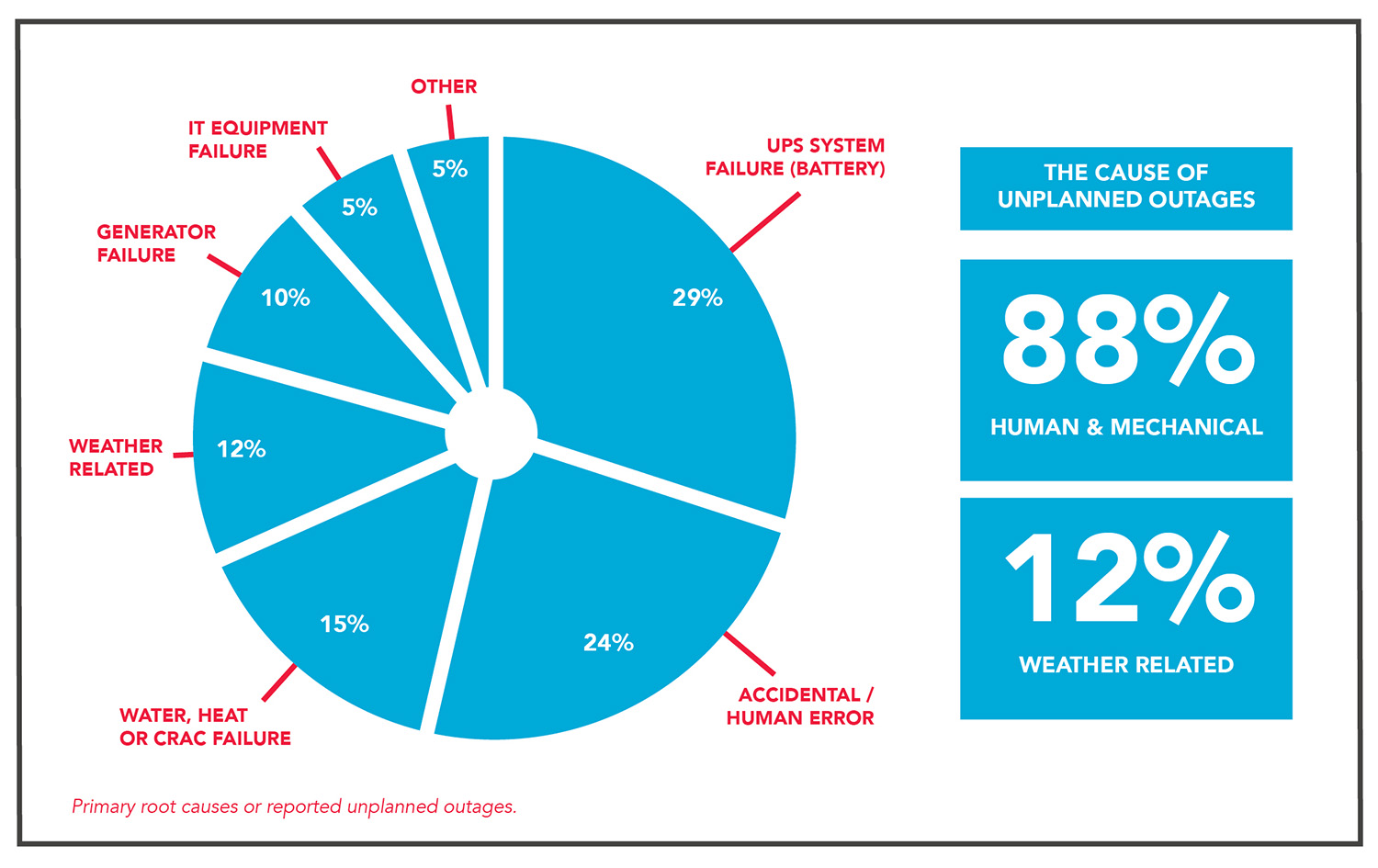
In our day-to-day work, we’ve seen that understaffed technician teams lead to:
- Slower response times to environmental or hardware alerts
- Backlogs in preventive and corrective maintenance
- Missed warning signs in electrical systems, backup generators, and fire detection infrastructure
- Higher likelihood of human error during high-pressure incidents
When technician coverage is thin, even best-in-class monitoring tools and DCIM platforms can’t compensate for delayed or overstretched human response.
That’s why we consistently recommend treating data center technician staffing as a risk-management function instead of just a hiring activity.
2. Security and Compliance
Data centers require solid digital and physical security. And there are all sorts of regulations they must comply with to ensure data security, especially when facilities handle private or sensitive data.
From what we’ve seen working with data center operations teams, technicians, who are typically on-site personnel, are a critical component of data center security. They help implement access control, surveillance, and compliance protocols.
Inadequate staffing increases personnel workload, which correlates with a higher likelihood of procedural missteps, deferred maintenance, and human error.
If you don’t have enough technicians to respond to security incidents in time, you risk downtime and the financial and reputational damage that comes with it.
3. Complexities of Running Data Centers
Today’s data centers are more complex than ever before. They operate 24/7 with dense racks, structured cabling, liquid cooling/HVAC systems, and advanced automation. The boom in edge computing, distributed cloud services, and generative AI applications has only compounded these complexities.
We’ve noticed that this shift has fundamentally changed what’s expected of data center technicians. Technicians are expected to master mixed domains such as mechanical systems, electrical switchgear, and environmental controls. This, in turn, makes recruitment even more challenging for data centers.
Companies need to find technicians with the right mix of skills, practical training, and willing need to expand their knowledge.
The complexity of managing core infrastructure means that data center staffing is not a plug-and-play function. It requires strategic investment in talent acquisition, training programs, and workforce planning aligned with the expansion in demand for cloud, AI, and edge computing.
Types of Data Centers (And How Facility Types Affect Staffing Needs)
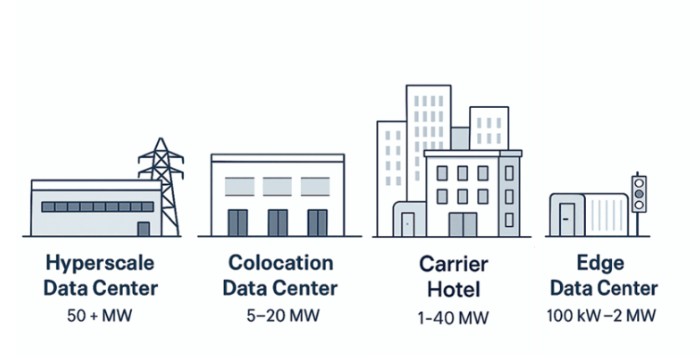
Not all data centers are built or staffed in the same way. Facility type can influence technician skill mix, staffing ratios, shift models, and reliance on contractors versus full-time skilled talent.
One thing we’ve consistently observed is that staffing challenges change significantly depending on the type of facility being operated. As digital infrastructure expands to support cloud computing, AI, and edge computing, data center operations are becoming more diverse.
Because of this, a staffing approach that works well for one facility type can fall short in another.
Different data center environments demand different technician profiles, response capabilities, and coverage strategies.
Below, we’ll break down the most common types of data centers and outline how each typically shapes technician staffing needs.
1. Hyperscale Data Centers
Hyperscale facilities, operated by major cloud service providers, are designed for massive scale, automation, and extreme power density. These sites support cloud services, GPU instances, and AI data center workloads that demand advanced power and cooling management, including more novice liquid cooling and high-capacity electrical supply.
Hyperscale staffing emphasizes specialization, separate roles for network infrastructure, electrical systems, mechanical systems, and automation tooling like DCIM and building control systems.
Operators rely heavily on standardized training programs and internal certifications (for example, AWS certifications) to ensure consistent execution across global sites. We’ve observed that this structured approach helps reduce operational risk at scale.
Pro Tip: Hyperscalers can benefit from a consistent data center talent pipeline in collaboration with an expert data center staffing agency that maintains a ready-to-go roster of potential technicians and engineering hires.
2. Colocation Providers
Colocation providers operate multi-tenant facilities where customer experience, security, and SLA adherence are incredibly important. It’s a fast-growing sector within the data center industry, comprising nearly 40% of all facilities in North America in 2024.
Unlike hyperscale, technicians in these facilities may interact with customers. From what we’ve seen, this typically includes supporting remote hands requests, structured cabling, hardware installations, and cross-connect work.
Because of this, staffing models favor technicians who combine strong technical competence with customer service skills (soft skills). Also, security procedures, access management, and documentation discipline are more rigorous in shared environments.
3. Enterprise Data Centers
Enterprise data centers support internal business systems rather than external customers. Many of these facilities are older environments that have been retrofitted to support modern cloud and digital transformation initiatives.
Staffing is typically lean, with technicians wearing multiple hats across servers, storage systems, and network support. And depending on the size, one or a few technicians may be responsible for the entire facility (so the dependability is even higher). As a result, cross-training is critical, particularly with the limited overnight or on-call coverage.
Because internal teams are usually small, these environments benefit from hybrid staffing models that supplement in-house teams with contract specialists during upgrades or migrations.
4. Carrier Hotels
Carrier hotels are high-density interconnection hubs that house telecom providers, cloud on-ramps, and network exchanges. In environments like these, staffing is usually heavily skewed toward network expertise and cabling precision.
One pattern that consistently stands out is how unforgiving these facilities can be. Technicians are expected to handle data center cabling, fiber management, and change control under tight maintenance windows where even minor errors can trigger widespread service disruption.
5. Edge Computing Data Centers
Edge computing facilities are smaller, geographically distributed, and designed for low-latency workloads supporting 5G, IoT, and real-time analytics.
And we’ve noticed that they’re popping everywhere to support expansion and provide better services to clients by processing workloads nearer to the data source. This shift is driving major investment, with global edge computing spending projected to reach $380 billion by 2028.
For these facilities, enterprises rely on regional technicians, on-call rotations, and remote monitoring tools. Of course, technicians have to be highly autonomous and capable of handling hardware, power, cooling, and security issues without immediate escalation.
For edge environments, strategic talent acquisition focuses on versatility and geographic coverage rather than headcount.
Key Skills and Certifications to Look for in a Data Center Technician
A data center technician's role is highly technical, but technical ability alone isn’t enough. Over time, we’ve seen that the technicians who perform best also bring strong problem-solving habits, clear communication, and the ability to stay calm under pressure. For role-specific options, see our list of data center executive search firms.
Certifications can also be a meaningful differentiator, particularly when hiring at scale or screening for baseline competency across facilities. That said, what matters most is how well a candidate can apply their knowledge in real-world environments.
When evaluating candidates, these are the key technical skills, soft skills, and certifications we recommend prioritizing:
Data Center Technician Technical Skills
To keep pace with evolving infrastructure, technicians need a broad set of technical skills. These form the backbone of reliable operations and help ensure uptime, mitigate risk, and support growth.
- Server, storage, and network fundamentals: Technicians must be fluent with hardware skills like racking servers, configuring network switches, handling storage systems, and troubleshooting hardware failures. They should have an understanding of network basics (TCP/IP, VLANs, routing, cabling standards).
- Power, cooling, and physical infrastructure: Modern facilities run on complex power and cooling systems, and technicians need practical experience with UPS, electrical switchgear, HVAC, and environmental monitoring. This requires actual facility experience, as there are no formal certifications. For fresh entrants, hands-on training can suffice.
- Ticketing systems and DCIM tools: Data center technicians work daily with digital tools, like ticketing systems, DCIM platforms, and building automation systems, to monitor performance, track issues, and document maintenance. Proficiency here isn’t always certified but can be validated through on-the-job learning and assessment during interviews.
Data Center Technician Soft Skills
Technical chops are invaluable, but when uptime, documentation accuracy, and cross-shift communication matter, you also need a candidate with the right soft skills.
- Documentation discipline: Clear, accurate logs of changes and issue resolutions help ensure continuity across shifts. Candidates should have meticulous documentation habits, which reduce human error and simplify compliance.
- Incident communication: Technicians regularly communicate with teams, from junior technicians to systems engineers. Effective reporting during incidents and handovers minimizes miscommunication and accelerates resolution.
- Shift handover accuracy: Data centers operate 24/7 and require proper handover of shifts with formal standard operating procedures. This discipline correlates strongly with reduced outages and smoother daily operations.
Common Data Center Technician Certifications
Certifications serve as objective markers of training and expertise. Although not always mandatory, they give you confidence that candidates have been tested against recognized standards.
Entry and vendor-neutral certifications
- CompTIA A+: Basic IT hardware, troubleshooting, and foundational skills.
- CompTIA Network+: Networking fundamentals across IT environments.
- CompTIA Server+: Server management and maintenance for physical and virtual environments.
Data center–specific programs
- Certified Data Centre Technician Professional (CDCTP®): Focuses on mission-critical operations, including power, cooling, and policies that support uptime.
- Certified Data Center Management Professional (CDCMP®): A broader credential emphasizing compliance and standards across physical infrastructure.
Network and advanced certifications
- Cisco Certified Network Associate (CCNA): Validates core networking skills that improve a technician’s ability to manage complex data center networks.
- Cisco CCNP Data Center & CCIE Data Center: Advanced certifications for handling large-scale networking and automation in sophisticated environments.
Training and continuing education programs:
Many organizations, such as Microsoft Datacenter Academy, offer structured programs that blend classroom instruction with hands-on labs to build skills in hardware, software, and operational procedures relevant to datacenter people pursuing technician or enterprise system engineer paths.
Staffing Models for Data Center Technicians
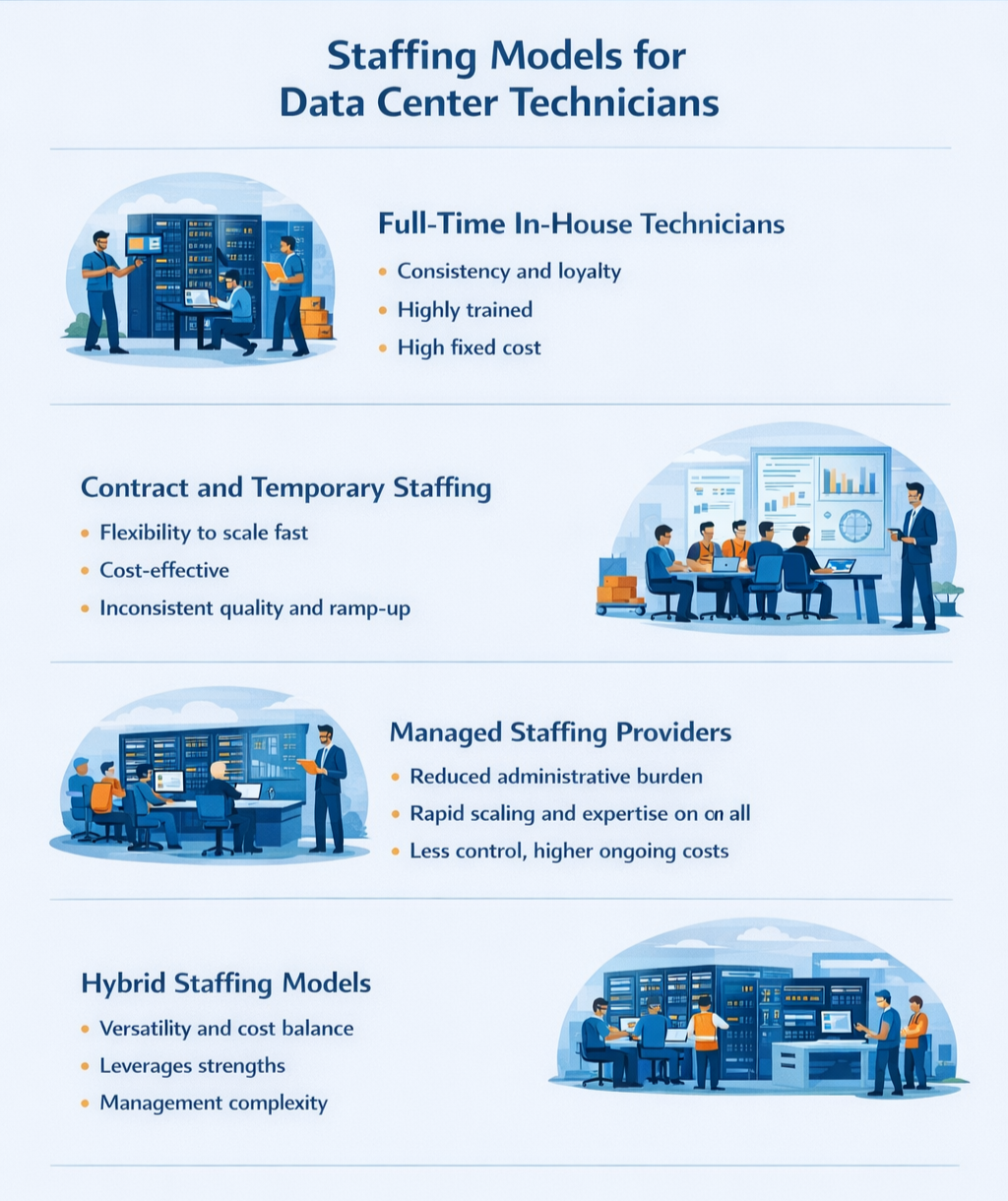
The main options are contractors, full-time employees, or managed services, with hybrid models combining elements of each approach.
Given the niche role of data center technicians and the shortage, there is no one-size-fits-all staffing approach that might work.
What we’ve learned is that the right approach depends heavily on factors like facility type, geographic location, growth plans, and internal operational maturity.
In practice, staffing decisions balance control, scalability, and cost. Below are the most common staffing models and the types of data center operators that typically benefit from each.
1. Full-Time In-House Technicians
An in-house team gives you the highest level of control and institutional knowledge. These technicians understand your core infrastructure, maintenance procedures, and customer expectations better than anyone.
In-house staffing is most common in large enterprise data centers and mature hyperscale operations where predictability and long-term optimization matter most.
Full-time teams excel at preventive maintenance across electrical systems, cooling systems, and security features.
Tradeoff: While effective for steady-state operations, this model incurs high fixed costs, including salary, benefits, and ongoing training. It can also be slow to scale during rapid expansion, new site launches, or large infrastructure refresh cycles.
2. Contract and Temporary Staffing
Contract technicians are commonly used during data center construction, commissioning, migrations, and surge periods. Temporary staffing allows operators to scale labor quickly without long-term headcount risk.
This model is frequently used for cabling, rack-and-stack, hardware refreshes, and short-term technical support engineer roles. It can also be used for electrical work specific to the construction.
As of 2025, there’s an estimated shortage of 439,000 skilled workers for data center construction projects. Contract and temp staffing could fill some of that shortage.
Tradeoff: Quality and ramp-up speed vary widely. Without standardized onboarding and oversight, contractors can introduce inconsistency in documentation, safety, and change control.
Read Next: Discover Top Contract IT Staffing Firms for Pre-Vetted Tech Teams
3. Managed Staffing Providers
Managed or outsourced staffing models go beyond individual contractors. Providers deliver end-to-end staffing services, handling recruiting, vetting, scheduling, payroll, and training.
Managed staffing is increasingly popular among colocation providers and rapidly growing cloud operators that need predictable coverage across shifts and sites.
The biggest benefit of having a staffing partner is speed. When you use a dedicated recruitment firm, particularly the ones that specialize in the data center workforce, you can significantly improve time-to-fill.
At Alpha Apex Group, the average time-to-fill is just 43 days across verticals.
The right partner might also already have candidates in their network, which essentially eliminates the time-consuming search stage.
Tradeoff: You give up some direct control over individual hires, and long-term costs may exceed in-house staffing if the model isn’t regularly benchmarked.
4. Hybrid Staffing Models
Most modern data center operators ultimately land on a hybrid approach, combining in-house technicians for stability with contract or managed staff for flexibility, and using recruiters when it makes sense to hire those technicians.
In our experience working with different data center teams, hybrid models work best when responsibilities are clearly defined. Core in-house technicians handle daily operations, escalations, and institutional knowledge, while external staff support expansions, AI data center rollouts, and regional coverage gaps.
We’ve observed that this approach is particularly effective for multi-site operations, edge computing deployments, and facilities supporting rapid cloud growth.
Where to Find Data Center Technicians?
The traditional job board approach is not the most optimized for data center technician jobs. That’s because you need very specific talent, likely with experience in existing data centers. Also, with layoffs in other verticals in IT, you’re likely to get applications that simply don’t fit the bill.
There are multiple channels you can explore for faster time-to-fill. And if you’re willing to provide training, you can widen the pool even further.
These are the channels we believe work best for hunting data center technicians:
- Employee referrals: Employee referrals consistently produce higher-quality candidates because existing technicians understand the realities of data center operations, shift work, and the culture of critical facilities. Referred candidates tend to ramp faster and stay longer. Industry hiring benchmarks show that referral hires have 10x the hire rate.
- Trade schools: Trade schools and technical colleges are strong pipelines for entry-level talent trained in electrical Systems, mechanical Systems, HVAC, and structured cabling. Many programs now align coursework with datacenter operations. These candidates need additional on-site training, but bring strong hands-on skills that translate well to critical facilities roles.
- Data center communities: Online and regional data center communities (forums, LinkedIn groups, and industry meetups) are valuable for sourcing experienced technicians who are already embedded in the data center industry. They can be great for passive talent hunting.
- Veteran programs: Military veterans are a proven talent pool for data centers, with experience in mission-critical systems, procedures, and security protocols. Veterans may bring transferable skills from roles involving electronics, power, HVAC, and critical facilities, along with strong documentation discipline and incident response training.
- Specialist recruitment firms: Specialist recruitment firms focused on staffing services for data centers (like Alpha Apex Group) improve and speed up hiring by tapping into pre-vetted pools of skilled talent. Unlike general recruiters, these firms understand the nuances of data center operations. They are particularly effective when entering new markets or sourcing hard-to-find expertise in hyperscale or AI data center environments.
How to Hire Data Center Technicians
Below is a practical, field-tested approach that can be used across hyperscale, colocation, and enterprise data center operations:
1. Define the Role as Per Your Specific Needs
Before posting a job or engaging recruiters, you need clarity on what problem this hire is solving. In our experience, many hiring failures happen because roles are defined too broadly.
Take your time to define the specific requirements of the job in terms of skills, the time they’ll need to commit, who they’ll report to, and what environment they’ll work in.
Also, plan for the capacity. You can’t expect one technician to see a huge facility spread over tens or hundreds of thousands of square feet.
Start by answering:
- Is this role focused on operations, construction/commissioning, or both?
- Will the technician support servers, structured cabling, cooling systems, or customer remote hands?
- What shift model applies (24/7 rotation, nights, on-call)?
- Is this supporting a steady-state facility or tied to cloud, AI, or expansion projects?
- Does the job require physical fitness (working with racks, cables, and other equipment)?
Tips on Writing the Job Description
When writing the job description, don’t be too general. We recommend clearly defining what the candidate must have and what’s nice to have. Also, be realistic about the demands; it can be demanding with night shifts, overtime, and perhaps some travel.
Lastly, mention the tools the technician is expected to use and clarify the level of training that can be provided. In practice, this transparency helps attract candidates who are better aligned with the role, and filters out those who aren’t.
2. Use Structured Interviews and Technical Assessment
Interviews should validate competence. In the data center industry, structured interviews paired with technical assessments outperform conversational interviews.
The goal is understand how a technician thinks, reacts, and communicates under real operational pressure.
Sample Interview Flow
- Initial screen (15 to 20 minutes): Validate baseline experience, facility exposure, shift availability, and safety awareness.
- Technical interview (45 to 60 minutes): Conducted by operations or facilities leaders to assess real-world troubleshooting ability.
- Practical or scenario-based assessment: Tests how the candidate thinks under pressure, documents actions, and escalates appropriately. We strongly recommend this step, as it mirrors real incident conditions.
Question to Ask
Focus on situational and experience-based questions:
- “Walk me through how you would respond to a temperature alarm on a high-density rack.”
- “Describe a time you caught an issue during a routine walkthrough that prevented downtime.”
- “How do you document work during a live incident with multiple teams involved?”
- “What systems have you worked with for ticketing or DCIM, and how were they used day to day?”
We’ve found that these types of questions reveal operational maturity, communication habits, and judgment far more effectively than theoretical prompts.
Technical Tests
Technical tests don’t need to be complex, but they must be realistic. Common examples include:
- Interpreting a rack elevation or cabling diagram
- Identifying proper escalation steps for power, cooling, or network alerts
- Reviewing a mock change request and spotting risks
- Explaining safe procedures around electrical supply or HVAC equipment
For customer-facing environments, we also suggest adding a short exercise on documenting work clearly and communicating status updates. In our experience, this small step can make a significant difference in day-to-day operations.
3. Apply a Consistent Scoring Rubric Across Interviewers
Set a scoring rubric that removes subjectivity and keeps hiring consistent across sites and interviewers.
A simple, effective rubric weighs candidates across:
- Technical competence
- Safety and procedural awareness
- Documentation and communication abilities
- Shift-fit reliability
- Growth potential (training, certifications, adaptability)
Each interviewer scores independently, then aligns during a debrief. This approach reduces bias and helps teams justify hiring decisions.
When and Why Should You Work with a Data Center Staffing Firm?
A recruitment firm, particularly one that focuses on data center staffing, can streamline the process. They take care of the search, screening, and, if needed, technical vetting, so you have a shortlist of technicians to choose from.
Working with a recruiter, at least a reliable one, can dramatically reduce time-to-hire. Plus, any sophisticated staffing agency would also offer a replacement guarantee, which, in turn, ensures that if the hire doesn’t work out, you have a replacement ready to go.
You should consider partnering with a staffing agency:
- When regular channels have failed
- When you’re entering new markets
- When you need an urgent hire
- When you want a continuous pipeline of talent for expanding facilities
Hire Data Center Technicians with Alpha Apex Group
At Alpha Apex Group, we understand the tremendous pressure data centers face to comply with regulations and uphold SLAs. After all, it’s the data centers powering the Internet.
We maintain a steady supply of data center talent from around the world, particularly in regions that are data-center heavy, like Virginia, California, Texas, Ontario, Amsterdam, Frankfurt, India, and Singapore.
Our search begins once we’ve established the job requirements, working directly with the client. Using our proprietary sourcing tools, we screen resumes of thousands of active and passive candidates. The first round of applicants arrive in your inbox within 72 hours.
All of that, combined with our expertise in this area, means we’re more than capable of delivering qualified data center technicians in the shortest possible time.
If speed and reliability matter to you, get in touch with us today.
FAQ
What is the salary of a data center technician?
Data center technician salaries vary by region, facility type, and skill level. According to Indeed, the average base salary of a data center technician is $97,132 per year. With demand high and supply low, companies may need to offer higher-than-base salaries and perks to attract talent.
How many technicians does a data center need?
There is no universal ratio. Staffing depends on:
- Facility size and design
- Power density and cooling complexity
- Customer model (single-tenant vs multi-tenant)
- Automation maturity and use of DCIM or control systems
Hyperscale and large colocation facilities may staff dozens of technicians across shifts, while edge computing sites may rely on just a few staff members.
What is the career path of a data center technician?
Most technicians progress through structured tiers (Entry-level or Smart Hands roles, Operations or mid-level technician, followed by senior or lead technician).
From there, the career path may branch into roles such as Facility Engineer, Critical Facility Manager, network specialization, or infrastructure-focused project roles. However, more training, certification, and learning may be needed to take on advanced roles.
What is the difference between a data center technician and an engineer?
Data center technicians are hands-on operators responsible for daily execution, such as racking hardware, responding to incidents, performing maintenance, and documenting work. Engineers typically focus on system design, optimization, and long-term infrastructure planning.
In practice, senior technicians sometimes perform engineer-level troubleshooting in data center operations, especially in smaller or fast-scaling environments.
How long does it take for Alpha Apex Group to source data center technician candidates?
Sourcing timelines depend on role complexity, location, and clearance requirements. Because we maintain an active pipeline of pre-vetted data center talent, many clients receive qualified candidates faster than through traditional recruitment channels, particularly for contract, temporary, or urgent operational roles. We try to fill the roles within 43 days.
Does Alpha Apex Group offer a replacement guarantee?
Yes. Like most specialist staffing services in the data center industry, we provide a 90-day replacement guarantee if a placed technician does not meet the agreed-upon expectations within a defined period.