Top 10 Fractional & Interim CIO Companies
Demand for fractional CIO services is rising as businesses take on more complex technology priorities.
According to Foundry, 69% of organizations expect their IT budgets to increase in 2026. Growing investment creates a greater need for experienced technology leadership.
However, many companies are not ready to hire a full-time chief information officer. Fractional and interim CIOs can fill this gap during technology transformations, leadership transitions, major IT projects, or periods of rapid growth.
Today, we’ll share leading fractional and interim CIO companies, their engagement models, typical costs, and the factors you should consider when choosing a provider.
Leading Fractional & Interim CIO Companies Overview
- Alpha Apex Group: Combines fractional CIO services, interim technology executive placement, and executive search for permanent CIO, CTO, and CISO roles. Its model gives companies one partner for short-term leadership, ongoing advisory support, and permanent executive hiring.
- InterimExecs: Stands out for fast executive deployment, using its highly selective RED Team network to place fractional and interim CIO leaders for urgent transformation, risk, and transition needs.
- Performance Improvement Partners: Best suited to private equity portfolio companies that need fractional CIO leadership tied directly to value creation, integration, EBITDA growth, and exit readiness.
- Net at Work: Combines fractional CIO strategy with in-house ERP, cybersecurity, cloud, analytics, and managed services execution, which makes it especially strong for companies that need both direction and implementation support.
- Freeman Clarke: Offers mid-market companies access to a deep bench of experienced fractional technology leaders who can embed within the senior team and provide long-term strategic guidance.
Fractional CIO vs. Interim CIO vs. Full-Time CIO
Fractional, interim, and full-time CIOs can all provide senior technology leadership, but they serve different business needs. The right model depends on how long you need support, how much time the executive must commit, and whether the role involves ongoing strategy or a defined transition.
Note: Costs vary based on company size, industry, location, scope, and executive experience. Full-time CIO compensation may also include bonuses, benefits, equity, and recruitment expenses.
A fractional CIO suits a company that needs ongoing technology direction but does not require a full-time executive. An interim CIO is usually brought in to lead through a defined transition, stabilize an IT function, or manage a major transformation. And a permanent CIO makes more sense when technology requires continuous executive oversight and a long-term seat on the leadership team.
10 Fractional and Interim CIO Firms for High-Stakes Technology Leadership
The firms below can help you bring in experienced CIO leadership when the stakes are high, and a full-time hire is not the right fit.
1. Alpha Apex Group
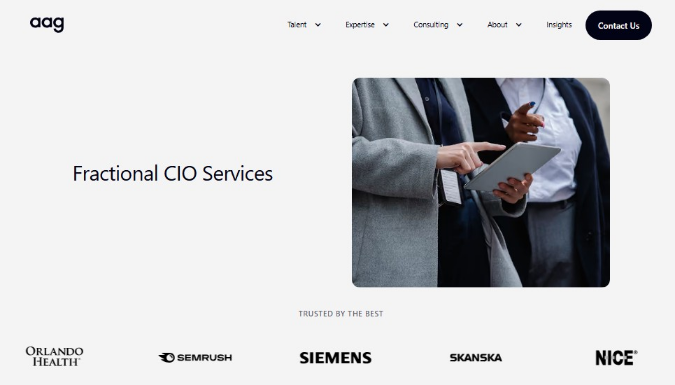
- CIO leadership focus: We provide fractional and interim CIO leadership for organizations that need IT strategy, digital transformation, technology governance, cybersecurity oversight, infrastructure modernization, vendor management, and executive technology guidance.
- Service model: Our technology leadership offering combines fractional CIO services, interim executive placement, and executive search for permanent CIOs, CTOs, CISOs, and other senior technology leaders.
What sets Alpha Apex Group apart is its ability to support the full technology leadership lifecycle. You can engage a fractional CIO for ongoing strategic direction, appoint an interim executive during a transition or critical project, or work with us to recruit a permanent technology leader.
This model gives you the flexibility to adjust your leadership structure as your organization grows, changes direction, or moves through a major technology transformation. We have completed more than 2,000 candidate placements worldwide. Clients can begin receiving candidate profiles within 72 hours, while our average time to fill a full-time role is 43 days, which is 60% faster than the national average.
2. InterimExecs
- CIO leadership focus: InterimExecs provides fractional, part-time, and interim CIOs for IT strategy, cybersecurity, ERP implementation, vendor management, digital transformation, and technology team leadership.
- Case study: In a national bank case study, InterimExecs placed an interim CIO/CISO-profile leader to assess IT structure, improve business processes, evaluate IT and security risk, and streamline technology initiatives. The executive brought prior experience across financial services, mortgage lending, and healthcare.
InterimExecs is more of an executive deployment network than a standard fractional CIO consultancy. Its RED Team model is the differentiator: the firm says it has screened 5,000+ executives and selects the top 2% for its RED Team. This makes it relevant when the issue is speed and executive fit.
This model may suit companies that need an experienced executive quickly and want the search focused on both technical expertise and leadership fit.
3. Performance Improvement Partners
- CIO leadership focus: Fractional CIO, CTO, and CISO leadership for growth-stage private equity portfolio companies, with a focus on IT strategy, governance, vendor management, cybersecurity, transformation, and exit readiness.
- Case study: PIP supported Lumanity by consolidating 20 acquisitions onto a unified NetSuite and Kantata platform, driving $26.8M EBITDA uplift and $18M in revenue growth through process alignment and systems integration.
PIP’s differentiator is its private-equity lens. Its fractional CIO work is built around helping portfolio companies align technology decisions with the investment thesis, growth plan, and eventual exit.
This makes it a good option when a portfolio company needs executive IT leadership tied to value creation. PIP’s fractional leadership page highlights IT roadmaps, modernization, governance, cybersecurity, team development, post-acquisition integration, and board-level visibility into IT performance and risks.
4. Net at Work
- CIO leadership focus: Fractional CIO advisory as part of a broader business technology services model. Its offering combines CIO-level strategy with ERP, managed IT, cybersecurity, cloud, analytics, and business application support.
- Case study: Net at Work’s Fractional CIO & Advisory Services helped UniWell Laboratories reimplement Sage X3 after a stalled rollout. According to the case study, the engagement reduced MRP run time from 8 hours to just minutes and contributed to 14% revenue growth.
Net at Work’s differentiator is that its fractional CIOs are backed by a large implementation and managed-services organization as opposed to an individual executive advisor. This matters when the CIO mandate includes fixing ERP, modernizing systems, improving reporting, or coordinating vendors across the technology stack.
It is a strong fit for companies that need a fractional CIO who can turn strategy into systems work. In the UniWell example, the engagement connected executive technology guidance with ERP re-implementation, supply chain optimization, and financial reporting improvements.
5. Freeman Clarke
- CIO leadership focus: Freeman Clarke provides fractional CIOs, CTOs, CISOs, and IT Directors for mid-market businesses that need senior technology leadership on a part-time or interim basis.
- Case study: In a JJS Manufacturing client story, Freeman Clarke provided a fractional CIO who reviewed the company’s IT infrastructure, developed a future-state technology roadmap, and joined the senior leadership team to help guide its long-term IT strategy.
Freeman Clarke’s differentiator is the depth of its fractional leadership bench. The firm describes itself as the largest and most experienced team of IT leaders, and its fractional CTO page says clients can draw on the institutional experience of 85+ CTOs and CIOs rather than relying only on one individual advisor.
This model is useful for mid-market companies that want a long-term senior IT leader inside the management team. Freeman Clarke’s client-story library includes examples across manufacturing, logistics, life sciences, professional services, retail, healthcare, and legal services.
6. Fortium Partners
- CIO leadership focus: Fortium provides fractional, interim, and project-based CIO, CTO, and CISO leadership through its Technology Leadership-as-a-Service® model.
- Case study: A financial services firm with $5B in annual revenue and 2,500 employees used Fortium to prepare for deepfake and synthetic identity cyberattacks.
Fortium’s differentiator is its scale as a dedicated fractional technology leadership firm. The company says it has a bench of 160+ named CIOs, CTOs, and CISOs. This allows clients to match with operators by industry experience, leadership style, technology domain expertise, and business need.
The model may suit companies that need greater coverage and continuity than a single independent fractional executive can offer. Fortium supports leadership vacancies, mergers and acquisitions, rapid growth, ownership changes, stalled technology projects, cybersecurity gaps, and underperforming IT investments.
7. BTA
- CIO leadership focus: BTA provides fractional CIO engagements for IT strategy, vendor and budget management, cybersecurity oversight, cloud/SASE modernization, AI infrastructure, data center modernization, and operational handoff.
- Engagement model: BTA does not publish detailed case studies with named clients and measurable outcomes. It does, however, outline six or 12-month engagements at 10 to 20 hours per week, with roadmaps, vendor and budget reviews, compliance assessments, progress reporting, and a Day 2 handoff.
BTA uses an architect-led execution model. The firm says its team designs the target environment, rolls out changes in stages, trains internal staff, and completes the engagement once the client’s IT team can manage ongoing operations.
This approach suits companies with a defined modernization, governance, or infrastructure program. It may be less suitable for businesses looking for an open-ended strategic adviser with no fixed implementation scope.
8. Alcott Enterprises

- CIO leadership focus: Alcott provides virtual CIO services for growing businesses that need IT strategy, technology roadmaps, budgeting, vendor management, cybersecurity planning, compliance support, and digital transformation guidance.
- Case Study: Alcott does not publish detailed case studies with measurable outcomes, but it shares client testimonials on its website. The firm also reports a 98% client renewal rate and offers a 60-day satisfaction guarantee.
Alcott’s differentiator is that its vCIO work is tied directly to managed IT execution. Instead of only creating a strategy deck, the firm pairs executive-level technology planning with helpdesk, network operations, cloud, cybersecurity, procurement, and compliance support.
This model suits small and mid-sized businesses that want one provider to oversee both strategic planning and day-to-day IT support.
9. FireOak Strategies
- CIO leadership focus: FireOak provides fractional CIO leadership for purpose-driven organizations that need technology strategy, governance, knowledge management, information security, AI readiness, and operational clarity.
- Case study: In a biotech startup case study, FireOak acted as fractional CIO and identified $100,000+ in unnecessary or misaligned software licenses and subscriptions, then built an internal intranet and started an information security program from scratch.
FireOak’s differentiator is its overlap between fractional CIO work and knowledge management. The firm’s work often centers on the places where systems, documentation, governance, and internal decision-making break down as organizations grow.
This makes it a good choice for nonprofits, startups, research organizations, NGOs, and mission-driven businesses that need calmer technology leadership without adding a full-time CIO. FireOak’s site specifically points to work with organizations navigating growth, platform transitions, audits, AI readiness, cybersecurity, and knowledge-sharing challenges.
10. Hartman Executive Advisors
- CIO leadership focus: Hartman provides fractional and interim CIO leadership for organizations that need accountable technology strategy, IT governance, vendor oversight, cybersecurity alignment, and executive-level IT decision-making.
- Case study: In a global food and consumer products manufacturer case study, Hartman stepped in during a critical CIO transition for an organization with tens of thousands of employees and operations across multiple continents, helping sustain IT governance, security initiatives, and executive confidence until a new CIO transition was completed.
Hartman’s differentiator is that it positions fractional CIO work as accountable leadership rather than outside advice. The firm emphasizes taking ownership of IT strategy, governance, team leadership, vendor management, and execution oversight, which is useful when an organization needs someone embedded with the executive team rather than a periodic advisor.
The firm works with mid-market companies, financial institutions, manufacturers, and growth-stage organizations that need clearer executive and board-level technology decisions. Its case studies include work with a global manufacturer, Farmers of Willard, Freedom Federal Credit Union, and community banks.
How to Evaluate a Fractional CIO Provider
The right fractional CIO should bring genuine executive leadership. This becomes even more important when 34% of IT leaders say staffing and skills shortages distract from strategic work. The challenge is even greater in services (42%) and manufacturing (40%).
Before signing an agreement, evaluate these five areas:
Make sure they have real CIO-level experience
Confirm that the proposed executive has held a Chief Information Officer, CTO, CISO, or comparable leadership role. Look for concrete evidence of ownership of IT budgets, technology strategy, security oversight, vendor relationships, and cross-functional decision-making.
Ask for measurable references
Ask for client references connected to specific outcomes, such as reduced technology costs, a completed cloud migration, improved cybersecurity measures, an ERP recovery, or successful technology roadmap execution. Testimonials can provide context, but they rarely show the full scope of the executive’s contribution.
Define the engagement in writing
Get clear on availability, deliverables, reporting cadence, decision-making authority, and responsibility for technology initiatives. The scope should distinguish strategic leadership from hands-on implementation and specify how the fractional CIO will work with the internal IT team.
Establish security and compliance ownership
Document who remains accountable for cybersecurity policies, risk assessments, regulatory compliance, incident response, and security gaps. This is even more important for organizations managing HIPAA compliance, regulatory audits, or sensitive customer data.
Examine the transition plan
A capable provider should address documentation, knowledge transfer, succession, and handoff from the start. The engagement should leave your organization with clearer processes, stronger internal ownership, and a practical plan for what happens next.
Why experienced CIO leadership matters
IT skills shortages can delay major technology initiatives even when companies are ready to invest.
In fact, 87% of North American IT leaders have reported digital transformation delays caused by insufficient IT skills. IDC also projected that more than 90% of organizations worldwide would experience similar disruption by the end of 2026, at a potential global cost of $5.5 trillion.
The CIO role has also become more strategic and central to business performance. Craig Stephenson, Senior Client Partner and Managing Director of Korn Ferry’s North American Technology Officers Practice, explains:
“During the past several years, the average age of CIOs in the 1,000 largest U.S. companies by revenue jumped significantly. This can be attributed in large part to the increased experience needed, as today's CIOs are more strategic and central to the success of an organization.”
For a closer look at the experience and leadership qualities that matter most, read our guide, 10 Unmistakable Traits of a Great CIO.
Find the Right Fractional CIO With Alpha Apex Group
A fractional CIO can provide the strategic leadership needed to stabilize IT operations, guide technology investments, and move critical initiatives forward without the delay or cost of a permanent hire.
Alpha Apex Group helps you place proven fractional and interim CIOs with the industry experience, decision-making capacity, and execution discipline to lead through transformation, transition, and growth.
Get in touch with us to find the right fractional CIO for your current technology priorities.
FAQs
How is a fractional CIO different from a virtual CIO?
A fractional CIO typically operates as a part-time executive with responsibility for technology strategy, leadership, budgeting, and transformation. A virtual CIO is usually tied to a managed service provider and may focus more narrowly on IT planning, infrastructure, and vendor recommendations.
Can a fractional CIO be accountable for a security incident?
Accountability depends on the contract and decision-making authority granted to the fractional CIO. The agreement should clearly define responsibility for cybersecurity policies, risk assessments, compliance, incident response, and security oversight.
Which industries does Alpha Apex Group serve?
Alpha Apex Group works across technology-intensive and operationally complex sectors, matching fractional CIOs based on industry experience, regulatory requirements, technology environment, and business priorities.
How quickly can Alpha Apex Group place a fractional or interim CIO?
Timing depends on the role’s complexity, industry requirements, location, and availability of qualified executives. Fractional and interim searches can generally move faster than permanent CIO searches because they focus on executives prepared to begin defined engagements quickly.
.jpg)

.jpg)