How to Comply with Pay Transparency Laws in 2026

Pay transparency laws have evolved from a few state-level rules to a major compliance issue for employers. HR teams now need to manage a growing mix of rules covering salary ranges in job postings, pay range disclosures for job applicants, and requirements that increasingly apply to remote positions and multi-state employers.
Many organizations are still unprepared.
In fact, according to Aon's 2024 North America Pay Transparency Readiness Study, only 31% of employers say they have a pay transparency communication strategy, despite rapidly expanding compliance requirements.
This guide explains how pay transparency laws work, which states require compliance in 2026, how they relate to the Equal Pay Act and other employment law obligations, and the practical steps HR teams can take to build compliant hiring and compensation processes.
What Are Pay Transparency Laws?
Pay transparency laws are state and local employment laws that require employers to disclose compensation information during the hiring process. While the specific rules vary by jurisdiction, they generally fall into three categories:
- Requiring employers to include a pay range, wage, or salary range in job postings and job advertisements.
- Requiring employers to provide salary information to job applicants or current employees at certain points in the hiring or employment process.
- Prohibiting employers from asking about a candidate's salary history to help reduce pay discrimination and long-term wage disparities.
Most pay transparency laws focus on disclosing salary ranges as opposed to publishing every employee's pay. Employers are generally expected to provide a good-faith pay range based on what they reasonably expect to pay for the role, along with other elements of total compensation where required.
At the federal level, the Equal Pay Act of 1963 prohibits sex-based pay discrimination for substantially equal work. Title VII of the Civil Rights Act of 1964 prohibits employment discrimination based on race, color, religion, sex, and national origin, including discriminatory compensation practices
However, neither law requires employers to proactively publish pay ranges in job postings. This requirement mainly comes from state and local laws, which is why compliance can get complicated for employers hiring across multiple jurisdictions.
As SHRM's James Atkinson explains,
"Employers must balance the demands of complying with pay transparency and equity laws with the flexibility to make salary decisions that align with the business."
Watch this short video for a quick overview of how pay transparency laws work:
Why Pay Transparency Laws Matter for Compliance
Pay transparency laws affect hiring practices, compensation strategy, pay equity, and legal risk across the organization. As more states introduce their own rules, compliance has become more challenging for multi-state employers and organizations hiring remote workers.
The biggest challenge is that no two laws are exactly alike.
Requirements differ by state in terms of:
- Employer size
- What must be included in job advertisements
- When salary information must be shared
- Which applicants or employees are covered
HR teams hiring across several states may need different posting rules for the same role, depending on where the work will be performed, where the employee reports, or where the candidate is located.
Remote hiring adds another layer of risk. In many jurisdictions, pay transparency requirements apply if a candidate in that state can apply for the position, even if the role is based elsewhere. A single remote job posting can therefore trigger multiple disclosure obligations.
Compliance also extends beyond salary posting. States including California, Illinois, and Massachusetts now require many larger employers to submit demographic pay data, which makes pay transparency closely connected to broader pay equity reporting and workforce planning.
Which States Have Pay Transparency Laws in 2026?
The number of state pay transparency laws has grown rapidly over the past several years, with more jurisdictions adopting new disclosure requirements each legislative session.
Today, employers must consider where they operate as well as where they recruit, since many laws apply to remote positions and job applicants located within a covered state.
The table below summarizes the states with active laws requiring pay range disclosures in job postings as of 2026.
Delaware has also enacted a pay transparency law for employers with 26 or more employees, which is scheduled to take effect on September 26, 2027.
Several cities and counties have additional city-level ordinances, including New York City, Ithaca, Jersey City, Westchester County, Cincinnati, Toledo, Cleveland, and Albany County. Employers hiring across multiple jurisdictions should account for both state and local requirements.
The overall trend points toward broader disclosure requirements rather than fewer. Proposed federal legislation, including the Salary Transparency Act, has not been enacted, which leaves employers to comply with an expanding patchwork of state pay transparency laws.
This makes proactive compliance particularly important for organizations with distributed workforces, remote jobs, or hiring across state lines.
Key Pay Transparency Laws to Know in Detail
Pay transparency laws share a similar goal, but the compliance details vary by jurisdiction. Employer thresholds, job posting language, recordkeeping duties, pay data reporting, and penalties can all differ from state to state.
Below are the states with some of the most detailed job posting disclosure requirements, along with the rules employers should review before advertising new roles.
California
Employer threshold: 15+ employees
California requires employers to include a good-faith pay scale in all job postings, including those published by an employment agency or third-party recruiter on the employer's behalf. Current employees may also request the pay scale for their existing position at any time.
California also has a separate pay data reporting requirement. Private employers with 100 or more payroll employees, and private client employers with 100 or more labor contractor employees, must report pay, demographic, and workforce data to the California Civil Rights Department each year.
As of January 1, 2026, SB 642 tightens California’s pay transparency rules. The law defines “pay scale” as a good-faith estimate of the salary or hourly wage range the employer reasonably expects to pay for the position upon hire.
It also changes certain Equal Pay Act wage recovery rules. Employees generally have up to three years after the last covered violation to bring a civil action, and recovery can cover up to six years of violations.
Civil penalties range from $100 to $10,000 per violation, although first-time violations may be waived if corrected promptly.
Colorado
Employer threshold: At least one employee in Colorado
Colorado has one of the broadest Pay Transparency law requirements in the country. Every job posting must include a pay range, a benefits description, and an application deadline. The law also applies to many remote positions when Colorado residents can apply.
In addition, employers must notify current employees of promotional opportunities on the same day a role is posted externally, subject to limited exceptions.
Violations can result in fines ranging from $500 to $10,000 per posting.
Connecticut
Employer threshold: One or more employees
Connecticut requires employers to provide the wage range for a position to job applicants upon the earliest of two points:
- When the applicant requests it, or
- Before or at the time the employer makes an offer of compensation.
Employers must also provide an employee with the wage range for their position when they are hired, when their position changes, or when they make their first request for the information.
The state also prohibits employers from asking, or directing a third party to ask, about a prospective employee’s wage and salary history unless the applicant voluntarily discloses it.
Hawaii
Employer threshold: 50+ employees
Effective January 1, 2024, Hawaii requires employers with 50 or more employees to include the hourly rate or salary range in job listings and job advertisements. The range must reasonably reflect the actual expected compensation for the position.
The law does not specify that the 50 employees must be based in Hawaii or work full time. It also excludes internal transfers and promotions within a current employer.
Illinois
Employer threshold: 15+ employees
Illinois requires employers to include both the pay scale and a general description of benefits in all internal and external job postings. Employers must also notify current employees about promotional opportunities within 14 calendar days of posting a position externally. The law applies to third-party recruiters and employment agencies advertising jobs on an employer's behalf.
Violations carry escalating penalties, starting at up to $500 for a first offense and reaching up to $10,000 for repeated violations.
Maryland
Employer threshold: All employers
Maryland requires employers to disclose the wage range, benefits, and any other compensation offered for a position in both internal and external job postings. The law applies to any role performed at least partly in Maryland, including many remote positions. Employers must also maintain compliance records for at least three years.
Civil penalties range from $300 to $1,000 per violation.
Massachusetts
Employer threshold: 25+ employees
Since October 29, 2025, Massachusetts employers with 25 or more employees must include a pay range in job postings for new positions, promotions, and transfers. Applicants and current employees may also request the pay range for a position.
Massachusetts also has a separate workforce data reporting requirement. Employers with 100 or more employees in the Commonwealth must submit EEO wage and workforce data reports to the Secretary of the Commonwealth, based on the filing schedule that applies to their report type.
Initial violations receive a written warning before civil penalties apply. A second offense can result in a fine of up to $500, and a third offense can result in a fine of up to $1,000.
Minnesota
Employer threshold: 30+ employees
Minnesota requires covered employers to include the starting salary range in each job posting, along with a general description of benefits and other compensation. If the employer does not plan to offer a salary range, it must list a fixed pay rate instead. The range cannot be open-ended.
Minnesota also protects employees’ rights to discuss their own wages. Employers that provide an employee handbook must include notice of those wage disclosure rights and remedies in the handbook.
Nevada
Employer threshold: All employers
Nevada requires employers to provide a wage range to job applicants after an interview and to employees offered a promotion or transfer. The state also enforces a salary history ban, which prevents employers from seeking compensation history during the hiring process.
New Jersey
Employer threshold: 10+ employees (over 20 calendar weeks)
New Jersey's law requires employers to disclose the hourly wage or salary range, benefits, and other compensation programs in all job postings, whether published on a job board website, company website, email, or social media. Employers must also make reasonable efforts to notify employees of promotional opportunities within affected departments.
Temporary help firms are exempt from job posting requirements but must disclose compensation before interviews or hiring.
New York
Employer threshold: 4+ employees
New York requires employers to include the minimum and maximum pay range in job postings for positions that will be performed at least partly in the state or report to a New York-based office or supervisor. The law also covers promotions and transfer opportunities.
New York City enforces similar requirements and may impose penalties of up to $250,000 for willful violations.
Rhode Island
Employer threshold: All employers
Rhode Island does not require employers to include pay ranges in job postings. Instead, employers must provide the wage range to job applicants upon request, preferably before discussing compensation.
Employers must also provide the wage range to employees at the time of hire, when they move into a new position, and during employment if they request it.
The law also prohibits employers from seeking or relying on an applicant’s wage history during hiring, except in limited situations after an initial offer with compensation has been made.
Vermont
Employer threshold: 5+ employees, with at least one employee in Vermont
Since July 1, 2025, Vermont requires covered employers to include the compensation or compensation range in written job advertisements. The rule applies to positions physically located in Vermont and remote roles that will predominantly perform work for a Vermont office or worksite.
The disclosed range must reflect the employer’s good-faith expectation of the minimum and maximum annual salary or hourly wage for the position. Commission-based roles and tipped roles have separate disclosure rules, so employers should identify those pay structures clearly in the posting.
Washington
Employer threshold: 15+ employees
Washington requires covered employers to include the wage scale or salary range in job postings, along with a general description of benefits and other compensation.
The rule applies to postings that recruit Washington-based employees, including remote roles that could be performed by a Washington-based employee. Employers must also provide the wage scale or salary range to employees offered an internal transfer or promotion.
Washington, D.C.
Employer threshold: All employers
Washington, D.C. requires employers to include the minimum and maximum salary or hourly pay in job postings and to disclose healthcare benefits before a candidate's first interview. The law applies regardless of where the employer is headquartered if it has employees in the District.
Penalties range from $1,000 to $20,000 per violation.
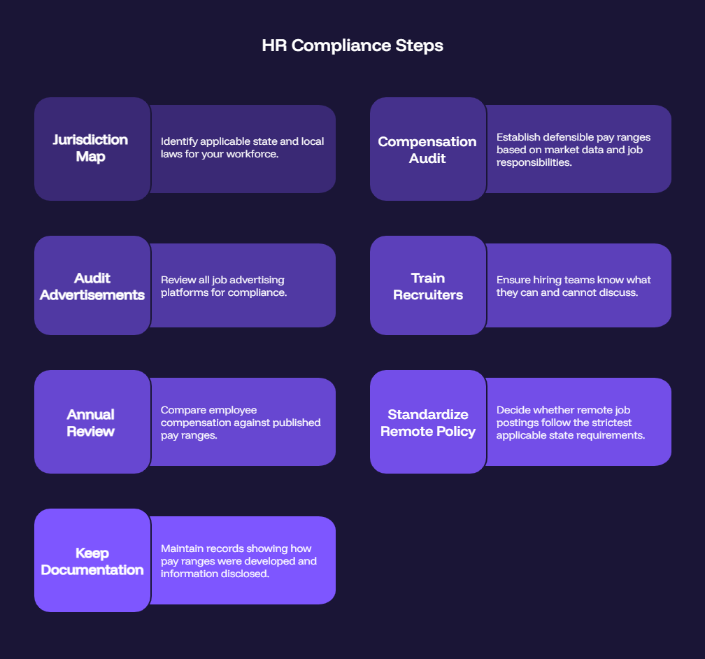
How to Stay Compliant: A Practical Guide for HR and Recruitment Teams
HR teams need consistent processes that account for different state requirements, remote hiring, and changing disclosure obligations. The following steps can help employers build a stronger compliance program.
1. Create a jurisdiction map
Identify every state and local law that applies to your workforce. Include employee work locations, hiring markets, and any remote positions so you know which pay transparency requirements apply before a job is posted.
2. Conduct a compensation audit
Before publishing salary information, establish defensible pay ranges based on market data, internal equity, and job responsibilities. Extremely broad pay ranges can undermine compliance and may not satisfy regulators looking for a good-faith estimate.
3. Audit every place you advertise jobs
Review your careers page, ATS, social media, employment agencies, and third-party job board websites. Do not overlook internal promotions or transfer opportunities, which are covered under several state laws.
4. Train recruiters and hiring managers
Hiring teams should know what they can and cannot discuss during the recruiting process. This includes complying with salary history bans, using approved recruiter scripts, and providing accurate salary information when required by state law. Run in-depth trainings, share documents, and encourage asking questions and seeking clarification.
5. Schedule an annual compensation review
Compare employee compensation against your published pay ranges, identify outliers, and document legitimate business reasons for pay differences before new salary postings go live.
6. Standardize your remote hiring policy
Decide whether remote job postings will follow the strictest applicable state requirements or vary by hiring location, then document that approach across recruiting and HR.
7. Keep thorough documentation
Maintain records showing how pay ranges were developed, when job postings were published, and what information was disclosed. Several states have record retention requirements, and strong documentation can help if your organization faces an audit or enforcement action.
These practices are becoming standard even where they are not legally required. According to SHRM's 2023 Pay Transparency Research, 67% of organizations now include pay information in job postings voluntarily at least some of the time, and nearly one-third adopted the practice within the previous year.
Salary History Bans: What Employers Need to Know
Salary history bans complement pay transparency laws by restricting what employers can ask during the hiring process. Their purpose is to prevent past pay disparities from influencing future compensation. As of 2026, about 20 states and Washington, D.C., have enacted some form of salary history ban.
For employers, this means:
- Do not ask job applicants about their current or previous salary in covered jurisdictions.
- Discuss salary expectations and the pay range for the role instead.
- Remove salary history questions from applications, ATS workflows, and recruiter scripts.
- Make sure employment agencies and third-party recruiters follow the same rules.
These laws can also support pay equity. A 2022 study by Yale economist Sourav Sinha found that salary history bans reduced the gender pay gap by about two percentage points, largely by increasing earnings for women who changed jobs.
Build a Pay Transparency Strategy with Alpha Apex Group
Complying with pay transparency laws requires more than updating job postings. Organizations also need competitive salary ranges, consistent compensation practices, and processes that can scale across multiple states and hiring teams.
Alpha Apex Group helps employers build compensation strategies that support both compliance and talent acquisition. From compensation benchmarking and pay equity assessments to HR consulting and organizational design, our team works with businesses to create pay practices that meet today's legal requirements while supporting long-term growth.
If you are preparing for new disclosure requirements or reviewing your current pay practices, Alpha Apex Group can help you build a practical, compliant strategy.
Request a pay transparency readiness review to find gaps in your compensation process before they turn into compliance risk.
FAQs
Do pay transparency laws apply to remote jobs?
Yes, they can. Some states apply pay range rules when a role can be performed in that state, even if the company is headquartered elsewhere. Remote hiring needs careful state-by-state review.
How are pay transparency and pay equity different?
Pay transparency laws focus on compensation disclosures, such as salary ranges in job postings. Pay equity laws focus on unfair pay differences between comparable employees. Many employers need processes for both.
Can employers post a broad salary range?
Usually, no. Most laws expect a good faith range that reflects what the employer reasonably expects to pay. A range like $50,000 to $200,000 may create compliance and candidate trust issues.
Who is responsible when recruiters post jobs?
The employer usually carries the compliance risk. Give recruiters approved pay ranges, benefits language, and posting rules for each role so third party listings match state requirements.
How can salary ranges become defensible?
Salary ranges become more defensible when they are based on market data, role scope, internal pay structure, location, experience level, and documented compensation criteria.
Can Alpha Apex Group review pay gaps?
Yes. Our experts at Alpha Apex Group help you review compensation data, identify unexplained pay differences, assess pay equity risk, and prioritize practical fixes before disclosure rules expose internal issues.
.jpg)
.jpg)

.jpg)