Top 10 ERP Implementation Challenges and Solutions
ERP implementation is one of the most important investments an organization can make to improve business processes, streamline operations, and support long-term growth. Yet even the best ERP system can fall short without the right implementation strategy.
Gartner predicts that by 2027, more than 70% of recently launched ERP initiatives will fail to fully achieve their original business case goals, with 25% failing catastrophically.
This guide explores the top ERP implementation challenges organizations face, along with practical solutions to help you avoid costly mistakes, improve user adoption, and get more value out of your ERP solution.
Why Organizations Need ERP Systems
Modern organizations rely on enterprise resource planning (ERP) systems to connect critical business processes across finance, human resources, procurement, inventory, manufacturing, and customer relationship management.
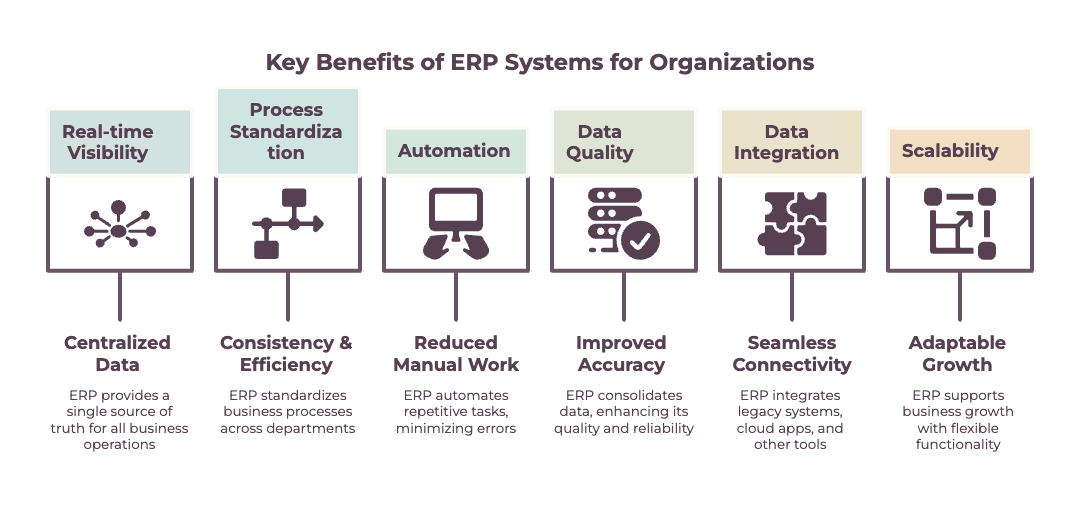
Instead of operating with disconnected tools and data silos, an ERP system creates a single source of truth through a centralized database, which gives leaders real-time visibility into business operations and supports better decision-making.
On top of making things more efficient, ERP implementation allows organizations to scale more effectively. A well-planned ERP solution helps businesses:
- Standardize business processes across departments to improve consistency and efficiency.
- Automate repetitive tasks to reduce manual work and minimize errors.
- Improve data quality by consolidating information into a single source of truth.
- Simplify data integration between legacy systems, cloud-based applications, and other business tools.
- Support business growth with flexible ERP functionality that can adapt as operational needs evolve.
An ERP system provides the visibility, control, and scalability organizations need to make better decisions and operate more efficiently.
The stakes, however, are high. According to McKinsey & Company, 17% of large IT projects perform so poorly that they can threaten the very existence of the organization. ERP projects depend as much on strong project management and governance as they do on the technology itself.
Pro tip: If you’re still mapping the project structure, our guide to the ERP implementation phases explains how to move from planning and configuration to testing, rollout, and post-go-live optimization.
Before exploring the most common ERP implementation challenges, this video provides a helpful overview of the root causes behind ERP project failures:
10 ERP Implementation Challenges and Solutions
Every ERP implementation presents unique obstacles, but the root causes of failure are remarkably consistent.
Below are the most common pitfalls organizations face and practical steps to overcome them.
1. Poor Project Management and Unclear Objectives
Many ERP projects begin with ambitious goals but no shared definition of success. Without a documented business case, measurable KPIs, and a steering committee empowered to make decisions, projects quickly lose focus. Stakeholders request new features, timelines become unrealistic, and teams struggle to prioritize competing demands.
According to Panorama Consulting Group's 2026 ERP Report, over 25% of companies went over their implementation budgets, and extra technology requirements seem to be the main reason why.
Meanwhile, McKinsey (in the report we saw earlier) found that large IT projects usually go over their budgets (45%) and even so, they deliver 56% less value than they’d want. Weak governance, then, comes at a cost.
Solutions:
- Define success before selecting an ERP solution. Establish measurable KPIs tied to business outcomes, such as reduced order processing times or improved inventory accuracy, before evaluating software vendors.
- Appoint an executive champion with decision-making authority. Unlike a passive project sponsor, an executive champion actively removes roadblocks, resolves cross-functional conflicts, and keeps the implementation aligned with business priorities.
- Implement formal change control. Every proposed scope change should include a documented assessment of its impact on cost, timelines, resources, and expected business value before approval.
2. Inadequate Change Management
Prosci's 2025 ERP research found that human factors are six times more important than technical factors in improving ERP benefits realization, which teaches us that user adoption is often the deciding factor between success and failure.
In other words, even the best ERP system will fail if employees don't understand why it's being introduced or how it will improve their work. While many organizations treat change management as a training exercise that begins shortly before go-live, good ERP consultants know that it should be embedded throughout the implementation process.
Solutions:
- Start change management on day one. Introduce the project's objectives early and explain how it supports broader business goals.
- Tailor communications for each stakeholder group. Address how the ERP implementation will affect day-to-day responsibilities rather than relying on generic project updates.
- Develop department "super users." Equip influential employees with additional training so they can support colleagues and reinforce adoption throughout the rollout.
3. Data Migration and Data Quality Problems
Data migration is one of the most underestimated stages of ERP implementation. Many organizations assume their existing data is ready to move, only to discover duplicate records, inconsistent formats, outdated customer information, and missing fields during the migration itself.
Poor-quality data undermines reporting, automation, and confidence in the new ERP system. Even worse, Gartner estimates poor data quality creates an average cost of $12.9 million annually, making data preparation a business priority rather than an IT task.
Solutions:
- Audit source systems before planning the migration. Identify duplicates, obsolete records, and inconsistent data structures early.
- Complete data cleansing before migration begins. Trying to clean and migrate data simultaneously increases errors and delays.
- Only migrate data that supports current business processes. Archiving outdated records can reduce cost while improving system performance.
4. Scope Creep
Scope creep rarely happens because of a single major decision. More often, it's the result of dozens of small requests that seem reasonable in isolation but collectively derail the implementation process. Without strong governance, ERP projects shift from delivering core functionality to accommodating every stakeholder request, increasing costs and extending timelines.
Solutions:
- Finalize the project scope before vendor selection is complete. Define what the ERP implementation will and won't include.
- Require an impact assessment for every change request. Evaluate the effect on budget, timelines, resources, and business value before approving additional work.
- Separate essential requirements from future enhancements. Not every improvement needs to be included in the initial implementation.
5. Excessive Customization
Customizing an ERP system to mirror legacy business processes may seem like the easiest path, but it can also create long-term technical debt. Extensive custom code increases implementation costs, complicates upgrades, and makes it harder to adopt new ERP functionality.
In many cases, organizations are better served by adapting their processes to established ERP best practices instead of recreating outdated workflows.
Solutions:
- Challenge every customization request. Ask whether the change creates genuine business value or simply preserves an existing habit.
- Prioritize configuration over custom development. Use built-in ERP functionality wherever possible.
- Review business processes before modifying the software. Process improvements are usually more valuable than software customization.
6. Inadequate User Training
All too often, training gets compressed into the final weeks before go-live, which leaves employees with little time to build confidence using the new ERP solution. Generic demonstrations don’t do a great job of preparing users for the tasks they'll perform every day, which leads to lower productivity, more support requests, and slower user adoption.
Prosci's 2025 ERP research identified training as the leading recommendation for improving implementation outcomes within people and change management.
Solutions:
- Deliver role-specific training sessions. Finance, procurement, operations, and HR teams each require different workflows and training materials.
- Train super users first. They can provide peer support long after formal training ends.
- Maintain post-go-live support. Office hours, refresher sessions, and knowledge resources help reinforce learning after implementation.
7. Weak Executive Sponsorship
ERP implementation requires active leadership. When executives disengage after project kickoff, decisions slow down, departmental priorities compete for resources, and accountability becomes unclear.
When your organization has visible executive leadership, it’s better positioned to resolve issues before they escalate. Research into ERP implementations found that 77% of organizations identified institutional leadership support as the most important success factor, and 60% highlighted effective stakeholder communication.
Solutions:
- Assign both an executive sponsor and an executive champion. One provides strategic oversight, while the other actively drives progress and removes obstacles.
- Hold regular steering committee meetings. Keep leadership involved in major decisions throughout the project lifecycle.
- Maintain visible executive engagement. Employees are more likely to embrace change when leaders consistently reinforce its importance.
8. Legacy System Integration Problems
Few organizations implement an ERP system in isolation. Most need to integrate with existing CRM platforms, payroll software, manufacturing systems, e-commerce tools, and other business applications.
Overlooking these dependencies can delay implementation, disrupt business operations, and create ongoing data integration issues after go-live. As cloud-based ERP solutions continue to evolve through regular updates, integration planning becomes even more important.
Solutions:
- Map every system integration before project planning begins. Include both internal applications and third-party platforms. Organizations that need extra support can also work with ERP selection consultants to find the right systems, compare the shortlisted ones, and reduce bias in the final decision.
- Develop an integration architecture early. Middleware and APIs should be planned instead of added later to solve unexpected problems.
- Prepare for ongoing SaaS updates. Assign ownership for testing integrations whenever cloud-based systems receive major releases.
9. Unrealistic Implementation Timelines
ERP implementation timelines are, in many cases, driven by fiscal deadlines or executive expectations. Although the organization's readiness is more important, it tends to be deprioritized in practice.
Here’s why that’s a mistake:
Compressing discovery, testing, employee training, or data validation might shorten the schedule on paper, but it significantly increases the likelihood of post-launch disruption. Successful ERP projects build timelines around the work required.
Solutions:
- Estimate timelines from the bottom up. Base schedules on individual workstreams rather than desired go-live dates.
- Avoid peak operational periods. Launching during seasonal demand or financial close increases business risk.
- Evaluate phased rollouts. In our experience, deploying the ERP solution in stages tends to reduce disruption and allows lessons learned to improve future phases.
10. Choosing the Wrong ERP or the Wrong Implementation Partner
Selecting software based on marketing demonstrations instead of operational fit can create years of frustration. Likewise, choosing an implementation partner without validating their industry experience or delivery approach can introduce unnecessary risk.
Software selection and implementation expertise are separate decisions, and both deserve independent evaluation.
Solutions:
- Define business requirements before issuing an RFP. Let operational needs drive software selection. Clear ERP selection criteria can help teams compare vendors based on operational fit, scalability, integration needs, cost, and implementation risk instead of relying on product demos alone.
- Evaluate implementation partners independently of software vendors. Look for proven experience with organizations of similar size and complexity.
- Speak with comparable customer references. Ask about project governance, communication, change management, and post-go-live support.
Real-World ERP Failures and What Went Wrong
Even organizations with substantial budgets and experienced implementation partners can encounter major ERP implementation challenges. These examples illustrate that technology is rarely the primary cause of failure. Instead, weak governance, rushed timelines, poor testing, and inadequate change management are far more common.
By understanding what went wrong, organizations can build stronger implementation strategies and avoid repeating the same costly mistakes.
1. Lamb Weston (2023-2024): $135 Million in Lost Sales After SAP Go-Live
North America's largest frozen potato supplier implemented SAP S/4HANA across its operations in late 2023. The rollout disrupted inventory visibility, order fulfillment, invoicing, and sales reporting, contributing to $135 million in lost net sales in a single quarter and a significant reduction in full-year guidance.
Key lesson: Avoid large-scale "big bang" implementations whenever possible. A phased rollout, supported by rigorous testing and clearly defined go/no-go criteria, helps contain risk before problems affect the entire business.
2. Zimmer Biomet (2024-2025): A $172 Million Lawsuit Over a Failed ERP Implementation
Medical device manufacturer Zimmer Biomet sued Deloitte for $172 million after alleging a troubled SAP S/4HANA implementation left the company unable to ship products, process invoices, or generate essential business reports. The project was delayed multiple times, accumulated dozens of change orders, and ultimately went live despite unresolved issues.
Key lesson: Do not treat ERP go-live as a date-driven milestone. Treat it as a business-readiness decision. Before launch, validate core workflows, reporting, shipping, invoicing, and production planning through independent assessments and real operational testing. Strong governance, stable implementation teams, and clear acceptance criteria can prevent unresolved issues from becoming business-wide disruption.
3. Birmingham City Council (2022–Ongoing): An ERP Project That Ballooned From £19 Million to More Than £144 Million
Birmingham City Council replaced its legacy SAP platform with Oracle Fusion Cloud to modernize finance, HR, payroll, and procurement. Extensive customization, incomplete testing, and governance failures led to severe operational issues, while project costs grew to more than £144 million.
Key lesson: Avoid turning a cloud ERP implementation into a custom rebuild of old processes. Birmingham’s Oracle program failed partly because the council moved away from standard Oracle functionality while also underestimating governance, user readiness, and business change. ERP leaders need clear design principles, honest risk escalation, strong program oversight, and enough internal capability before go-live.
How Alpha Apex Group Supports Successful ERP Transformations
The case studies above reinforce a common theme: ERP failures are rarely caused by software alone. More often, they stem from poor program oversight, poor integration planning, inadequate testing, and misalignment between the ERP system and the organization's actual business processes.
Alpha Apex Group helps organizations plan, implement, integrate, and optimize ERP systems with a practical focus on your business outcomes. Our ERP consulting services include custom ERP implementation, system integration, module development, ongoing support, optimization, and proactive risk management.
That combination helps companies become more efficient, improve data management, and make sure their ERP solution is built to support long-term growth.
If you’re planning an ERP rollout, recovering from a difficult implementation, or worried your current project has too many hidden risks, we can help you pressure-test the plan before small issues become expensive failures.
Book an ERP project review with Alpha Apex Group before your ERP project goes off track.
FAQs: ERP Implementation Challenges
What is the most common reason ERP implementations fail?
Poor planning and governance are the leading causes of ERP implementation failure. Without clear objectives, executive leadership, effective change management, and realistic timelines, projects are far more likely to experience delays, budget overruns, and low user adoption.
How long does a typical ERP implementation take, and what factors cause delays?
ERP implementations can take anywhere from a few months to more than a year, depending on project complexity. The most common causes of delays include scope creep, data migration issues, system integration challenges, and inadequate training.
What is scope creep in an ERP implementation, and how can you prevent it?
Scope creep happens when new requirements are added after a project begins without assessing their impact. It can be minimized by defining project requirements upfront, using formal change control, and postponing non-essential enhancements until after go-live.
What's the difference between ERP configuration and ERP customization?
Configuration uses the ERP system's built-in settings and features, while customization involves modifying the software with custom code. Configuration is generally easier to maintain, while excessive customization can increase costs and complicate future upgrades.
How does Alpha Apex Group support organizations through ERP-driven transformation?
Alpha Apex Group supports ERP-driven transformation through custom ERP implementation, system integration, module development, ongoing support, optimization, and proactive risk management.
Can Alpha Apex Group help with ERP implementation and integration?
Yes. Alpha Apex Group provides ERP consulting services that help organizations implement ERP systems, integrate them with existing platforms, and align the solution with their operational goals.
What role does ERP consulting play in Alpha Apex Group's advisory services?
ERP consulting helps organizations improve business operations, data management, scalability, and system performance. Alpha Apex Group focuses on tailoring ERP solutions to each client's business needs while reducing implementation risk.

.webp)
.jpg)
.jpg)