The Data Center Talent Shortage: Why It’s the #1 Threat to Uptime
For all the buzz around advanced cooling systems, fiber optics, and AI infrastructure, the real backbone of any modern data center is still its people. And right now, that backbone is under serious strain.
The data center talent shortage isn’t just a future risk; it’s already here.
Over half (58%) of data center operators say they struggle to attract and retain qualified staff, according to the Uptime Institute Data Center Staffing Survey 2023.
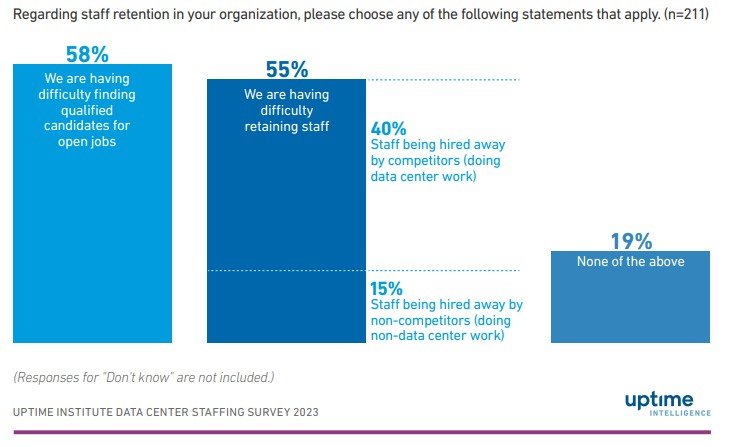
Image Source: Uptime Intelligence
At the same time, nearly 40% of data center employees plan to change employers within the next year, despite rising salaries and demand.
Skilled professionals are walking out the door, and it’s happening across roles, from electrical engineers and cooling specialists to cloud computing pros and AI infrastructure techs.
Each departure increases operational risk, stretches on-call teams thinner, and raises the odds of human error during incidents.
In this article, we’ll dig into what’s driving this global staffing shortage, how it’s putting uptime and digital infrastructure at risk, and most importantly, what data center leaders can actually do about it.
What’s Driving the Data Center Talent Shortage?
Before we talk solutions, it’s crucial to understand just how pervasive the data center talent shortage has become.
Across roles from data center operations and power systems specialists to electrical engineering experts and technicians handling network cables and fiber optics, the industry is facing a perfect storm of competing pressures.
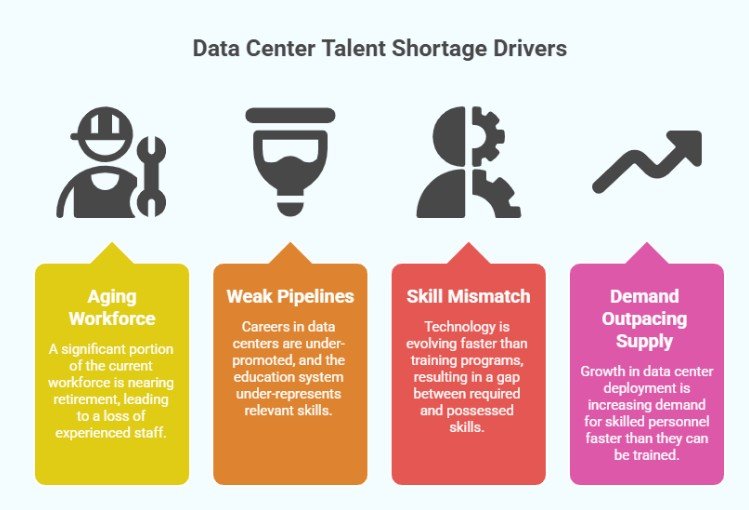
1. Aging Workforce and Retiring Legacy Operators
One of the biggest contributors to the talent crunch is demographics: a significant portion of the current workforce is nearing retirement.
In the U.K., 19% of data center professionals are over age 55, and in the U.S., about 16% are over 55, too. This means a large share of experienced staff could exit the field within a few years.
At the same time, the pipeline of newer talent remains thin. 16% (U.S.) and 29% (U.K.) of professionals have less than three years of experience, which suggests a lopsided workforce that leans heavily on long-tenured operators.
This imbalance has direct implications for uptime. Veteran personnel mostly hold deep knowledge of mission‑critical systems like uninterruptible power supply (UPS) units, complex cooling systems, redundancy planning, and site-specific failure scenarios. When these individuals leave, that institutional knowledge is difficult and slow to replace.
2. Weak Pipelines and Low Awareness Among Emerging Talent
Despite the explosive industry growth driven by cloud computing, AI applications, and the broader digital economy, careers in data centers are still surprisingly under‑promoted.
Many young professionals simply aren’t aware that roles in infrastructure services, edge computing, or AI infrastructure operations exist, let alone that they can offer stable and well‑paid career paths.
From what we’ve observed, this gap starts early. The education and training system still focuses heavily on software and general IT and under-represents skills such as physical plant maintenance, systems engineering, and digital infrastructure support.
Without strong awareness or visible career paths from high schools, colleges, and vocational programs, the pipeline won’t fill itself.
3. Skill Mismatch: Technology Evolving Faster Than Training Programs
Modern data centers demand a combination of mechanical, electrical, and digital expertise. Roles increasingly require fluency with cloud migration tools, automation platforms, hybrid infrastructure, and even analytics tied to AI workloads.
But training programs in community colleges, universities, and industry certificates mostly lag behind these real‑world requirements.
Industry data shows that only around 15% of applicants meet the minimum qualifications for many technical data center jobs.
So even if you can attract candidates, too many lack the skills needed to step into specialized positions. This mismatch clogs hiring pipelines and forces teams to invest more time and money in internal training, if they even have the resources to do so.
4. Demand Outpacing Supply
Growth in data center deployment isn’t slowing. Fueled by cloud services, streaming, e‑commerce, and AI workloads, facilities are multiplying worldwide, and so is demand for technicians, engineers, and managers to run them.
The fundamentals driving the talent shortage, retiring operators, slow pipelines, rapid tech evolution, and unprecedented growth, aren’t going away any time soon.
How the Data Center Talent Shortage Threatens Uptime
Ask any data center leader what keeps them up at night, and “downtime” will be near the top of the list.
But what’s less talked about is how deeply the data center talent shortage threatens uptime and creates ripple effects that can undermine even the best infrastructure.
The Domino Effect: Fewer People, Slower Response, Bigger Risk
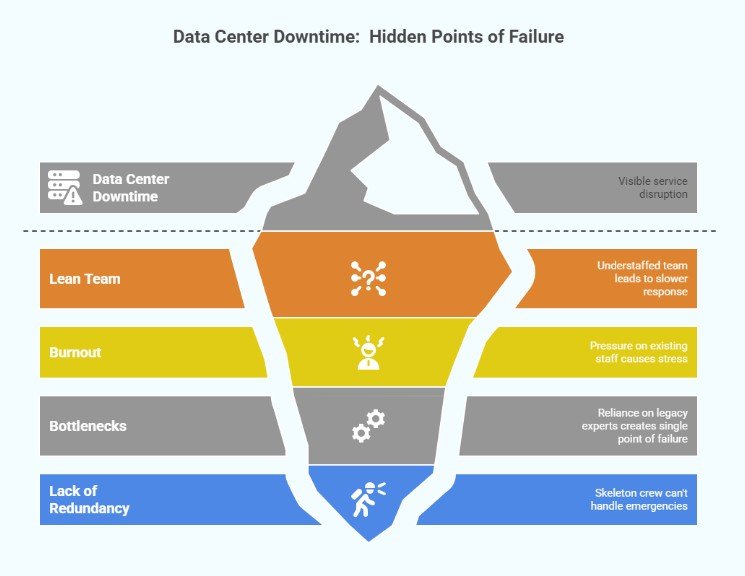
It starts with a lean team. When you're understaffed, every issue, no matter how routine, takes longer to resolve.
A power anomaly needs investigation, but the available engineer is already deep in a fiber line fault ticket. A cooling system starts behaving erratically, yet the one specialist with the right training is off shift or covering another facility.
We’ve observed in day-to-day operations that these delays are rarely caused by a lack of effort; they’re caused by a lack of coverage. As tasks pile up and response times stretch out, the risk of small issues snowballing into major outages grows fast.
In the Uptime Institute’s 2023 data center survey, four in five respondents said their most recent serious outage could have been prevented with better management, processes, and system configuration.
Having the right people available to monitor, respond, and intervene at the right time plays a critical role in preventing those failures.
Burnout, Bottlenecks, and Hidden Single Points of Failure
The shortage means more pressure on the people who are still there.
Talented engineers and technicians find themselves constantly “on,” fielding support calls outside hours, mentoring junior hires, and stretching beyond their original roles.
Over time, this leads to stress, mistakes, and high turnover, which only deepens the staffing shortage.
We have noticed that when a team is overly reliant on one or two legacy experts, like the only person who understands the quirks of a decades-old uninterruptible power supply, or a data center technician who knows a customized cooling automation system inside out, risk increases significantly. This reliance creates a critical single point of failure.
For example, consider a scenario. It’s 2 a.m. on a Sunday. An environmental sensor flags a temperature spike in one of the racks.
The facility has a skeleton crew, and the only technician on-site is troubleshooting a generator that failed to transfer during a routine test. The alert escalates, but there's no redundancy in the shift coverage.
By the time someone else can be dispatched, the affected rack has tripped offline, causing service disruption and a PR nightmare for the client running cloud applications on that node.
Now compare it with a fully staffed, cross-trained team operating on a rotation. Response is faster, escalation is controlled, and uptime and peace of mind are far easier to maintain.
The Hidden Costs of the Data Center Talent Shortage Beyond Outages
Yes, outages are the headline risk, but the data center talent shortage chips away at your operations long before anything actually goes offline.
Hiring Delays, Training Costs, and Operational Drag
Hiring for data center roles already takes time, and when talent is scarce, it takes even longer.
Many mission-critical roles, like data center technicians, electrical engineers, or infrastructure support specialists, sit open for 60+ days on average, according to JLL research.
Every unfilled position means increased strain on current staff, missed maintenance windows, and longer deployment cycles for new capacity.
Even once you find the right people, training isn’t cheap. Onboarding someone into a modern data center often requires weeks of orientation, shadowing, and role-specific instruction.
This is particularly true if they’re coming in with gaps in cloud services, AI workloads, or specialized systems like uninterruptible power supply hardware. And if that person leaves after a year or two? You’re back to square one.
Turnover Means Lost Knowledge and Slower Scaling
Institutional knowledge is hard to quantify until it’s gone.
From what we’ve observed, when senior operators walk out the door, they take with them years of real-world experience like the quirks of legacy cooling units, workarounds for unreliable backup systems, or the undocumented intricacies of your AI infrastructure. It’s the kind of knowledge you won't find in handbooks.
Without experienced hands guiding the next wave, teams move more slowly and expansion plans stall. Instead of focusing on innovation or scaling capacity, operators are forced to prioritize basic stability and day-to-day continuity.
Firefighting vs. Forward Progress
One of the most overlooked costs of being understaffed is opportunity cost. When your experienced engineers and operators are stuck putting out daily fires, there’s little time left for system optimization, sustainability improvements, or long-term capacity planning.
We’ve seen this firsthand with clients who came to Alpha Apex Group while spinning their wheels, stuck reacting, and never improving. By helping them fill roles strategically, we helped shift their focus from firefighting to future-proofing.
Remember that in this industry, survival isn’t enough. Scaling, adapting, and staying ahead of demand is where the real value lies, and you need the right team in place to make it happen.
Read Next: Avoiding Downtime: The Hiring Mistakes That Put Data Centers at Risk
How to Strengthen Your Data Center Team and Safeguard Uptime
The data center talent shortage isn’t going away anytime soon, but that doesn’t mean you’re powerless. In fact, the best-run facilities are already taking proactive steps to build stronger, more resilient teams.
Here’s how to get ahead of the curve before gaps turn into outages.
1. Succession Planning for Critical Roles
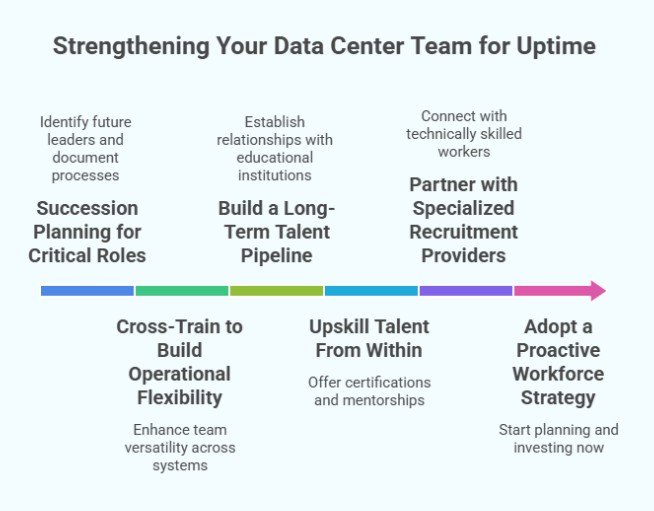
If you’ve got seasoned pros nearing retirement, or simply holding the keys to critical systems, it’s time to act. In our experience, the highest-risk environments are those where institutional knowledge lives with one person and nowhere else.
Effective succession planning means identifying future leaders early, documenting processes, and making sure there’s someone ready to step in. These steps reduce exposure to operational delays and improve continuity when transitions occur.
2. Cross-Train to Build Operational Flexibility
You can’t always hire new people, but you can make your current team more versatile. Cross-training staff across systems, like cooling systems, uninterruptible power supply (UPS) maintenance, network cables, or cloud infrastructure tools, means you’re not dependent on one person for any one task.
We’ve observed that teams with broader skill coverage respond faster to incidents and handle absences with less disruption. Cross-training also supports retention by giving employees clearer growth paths and more varied responsibilities.
3. Build a Long-Term Talent Pipeline
You won’t find future-ready data center pros if no one’s talking to them. Build relationships with local colleges, trade schools, and STEM programs.
Sponsor internships or apprenticeships. Advocate for data center career paths in educational spaces where cloud computing, electrical engineering, and AI applications are already being taught. The earlier you start, the better your odds of long-term staffing stability.
4. Upskill Talent From Within
Don’t overlook the potential in your current workforce.Entry-level techs, IT support, or mechanical assistants might be hungry to level up.
Offer certifications, hands-on learning, or mentorships focused on high-demand skills like AI infrastructure, power systems, or digital infrastructure scaling. This fills skill gaps and also strengthens loyalty and internal culture.
5. Partner with Specialized Recruitment Providers
Hiring in today's market is hard, particularly for mission-critical environments. Generalist recruiters usually lack the technical context needed to properly vet candidates, which leads to long shortlists, mismatched hires, and wasted time for already stretched teams.
That’s where an experienced partner like Alpha Apex Group can make a big difference. We specialize in connecting data centers with technically skilled workers who are vetted, capable, and ready to support real-world operations.
6. Adopt a Proactive Workforce Strategy
Too many data center leaders wait until something breaks or someone quits to think about staffing. But the cost of being reactive is always higher. Whether it’s formalizing training, strengthening retention, or bringing in the right hiring partner, the smartest play is starting now.
Uptime depends on your systems, but your systems depend on your people. Build the team that keeps it all running. Remember that investing in the right team today helps ensure reliability, resilience, and growth tomorrow.
Read Next: How to Build a Data Center Workforce for 24/7 Operations: A Hiring Playbook
What to Look for in a Data Center Talent Partner
Finding the right people for your data center helps you protect uptime, scale with confidence, and make sure your infrastructure doesn’t get held back by staffing gaps. And while partnering with a data center recruiting firm can be a smart move, not all staffing partners are built for this.
If you’re going to trust someone with your hiring pipeline, here’s what to look for, and what to avoid.
Deep Industry Knowledge
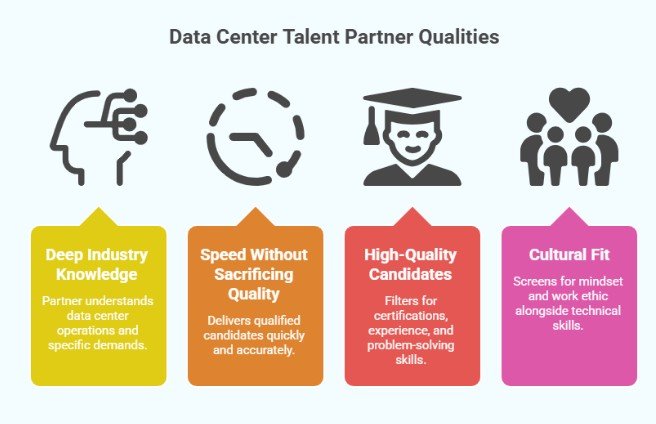
Your hiring partner should speak your language. This means understanding not just generic IT or engineering roles, but the specific demands of data center operations, from cooling systems and power systems to cloud migration, AI workloads, and edge computing.
Speed Without Sacrificing Quality
Data center roles can’t sit open for months at a time. But speed alone isn’t enough; it has to come with accuracy. The best partners deliver qualified, technically skilled candidates quickly because they already have vetted networks and proven processes.
High-Quality Candidates
This one might seem obvious, but it’s where many firms fall short. A good partner filters for certifications, hands-on experience, and a problem-solving mindset. They know what makes a great data center professional, and they won’t waste your time with mismatched resumes.
Cultural Fit
Technical chops matter, but so does how someone fits into your team. Can they handle shift work? Do they thrive in high-stakes environments? A solid data center staffing partner screens for mindset and work ethic as well as hard skills.
How Alpha Apex Group Helps You Stay Ahead of the Talent Gap
As this article has shown, the data center talent shortage is a direct threat to uptime, growth, and long-term resilience. From retiring legacy operators to the growing skills gap in AI infrastructure and cloud computing, the staffing challenges are real and growing. But you’re not in this alone.
The smartest data centers are already building stronger teams. Whether that means investing in upskilling, shoring up succession plans, or bringing in the right outside help, the key is to act before the gaps become emergencies.
This is where the right support can make a difference.
At Alpha Apex Group, we specialize in helping you connect with technically skilled professionals who are ready to step in and make a difference.
We help you build a rock-solid team so you can keep your infrastructure running, your clients happy, and your business growing.
Ready to future-proof your workforce? Let’s talk.
FAQs
What is causing the data center talent shortage?
The data center talent shortage is driven by several factors: an aging workforce, retiring legacy operators, rapid growth in digital infrastructure, and a widening skills gap as technologies like cloud computing and AI evolve faster than training programs can keep up.
How does the talent shortage affect data center uptime?
When teams are understaffed or lack critical skills, response times slow, maintenance gets delayed, and teams rely too heavily on a few key experts. All of that increases the risk of outages and makes it harder to maintain consistent uptime.
What skills are most in demand for data center roles?
High-demand skills include data center operations, electrical engineering, power systems, cooling systems, cloud services, AI infrastructure, network cabling, fiber optics, and experience supporting AI workloads and edge computing environments.
How can companies prepare for staffing gaps in their data centers?
Preparation starts with succession planning, cross-training existing staff, investing in upskilling, and building long-term talent pipelines through colleges, vocational programs, and apprenticeships. Partnering with specialized recruiters like Alpha Apex Group also helps fill gaps faster.
What strategies help retain top data center talent?
Retention improves when companies invest in training programs, offer clear career paths, reduce burnout through better staffing coverage, and give employees opportunities to grow into advanced technical or leadership roles.
How does Alpha Apex Group help companies overcome the data center talent shortage?
At Alpha Apex Group, we help data centers connect with technically skilled professionals who are vetted for real-world infrastructure environments. We focus on building reliable talent pipelines that support uptime, growth, and long-term resilience.
What makes AAG different from other staffing firms?
Unlike generalist recruiters, we understand the operational realities of data centers. We know the skills, certifications, and mindset required to support mission-critical environments, and we prioritize quality, speed, and cultural fit.
Can AAG provide both short-term and long-term hiring solutions for data centers?
Yes. We support both immediate staffing needs and long-term workforce planning, whether you need contract support, permanent hires, or help building a future-ready team as your data center scales.