Top 10 Benefits of Hiring Offshore AI Developers for Your Company
AI is now shaping how companies work, build products, and serve customers. It powers automation, faster decisions, and new digital tools across many industries. But while the need for AI teams keeps rising, the talent pool is still small.
Many companies struggle to find enough trained developers who can build and manage these systems. This gap pushes more brands to hire offshore teams, where they can access skilled engineers more quickly and keep projects moving without long delays.
Not sure if this solution works for you, too?
In this article, we'll show how offshore AI development helps you ship faster, improve delivery output, and protect budgets without sacrificing senior-level execution.
But first, let’s clarify who offshore AI developers actually are.
What Are Offshore AI Developers?
Offshore AI developers are remote AI engineers and specialists who build and maintain models, pipelines, and production-ready features from outside your home country. Their work spans machine learning, natural language processing, computer vision, generative AI, and other areas that support applied product delivery.
If you want to see how they differ from AI engineers, then feel free to check out this quick YouTube video:
Offshore AI developers include roles such as data scientists, ML engineers, NLP specialists, and experts focused on fine-tuning, model monitoring, or experimentation. They typically operate as dedicated teams or through a partner that manages recruiting, workflow, and technical alignment.
That offshore team model helps you expand execution capacity without building a full internal hiring pipeline.
But this demand for AI talent keeps growing. According to the SAS Institute, 63% of U.S. tech leaders report shortages in AI and ML skills. From our experience, this shortage is the main reason why so many companies look beyond local hiring constraints.
This leads us to our main point.
Key Benefits of Hiring Offshore AI Developers
Many companies turn to offshore talent to keep projects moving and meet growing AI demands. The reason for this is that this approach helps teams scale faster and stay productive. So, here are the main benefits you gain from hiring offshore AI developers.
1. Offshore AI Developers Are Cost-effective for Scaling Projects
Hiring remote AI talent cuts spending on engineering without forcing you to slow down feature delivery. The savings come from different labor costs across regions, where senior engineers charge far less than in onshore markets.
For context, offshore development typically costs 40-70% less due to regional living expenses. This is a direct financial advantage when you need multiple specialists.
We’ve seen first-hand how this cost structure makes scaling more realistic.
It also helps you reserve internal budget for areas that matter more, such as experimentation, data acquisition, or long-term architecture improvements.
And startups and mid-market teams benefit the most, since predictable spending makes AI hiring practical instead of risky.
2. Offshore AI Development Gives You Access to Global AI Talent
Most AI roadmaps require skills that rarely sit in one location. Tasks such as fine-tuning large models, optimizing inference costs, or building computer vision pipelines demand different specialists.
And relying on a single hiring market limits how fast you can staff those roles. So, working with offshore developers solves that constraint by giving you access to trained engineers across multiple regions.
This expansion is fueled by steady investment in technical education. For instance, India’s outsourcing sector grew to $54.1B in 2024 and is projected to reach $74.1B by 2033. This signals that more engineers are trained specifically in AI disciplines.
That growth creates a reliable pipeline of specialists in model engineering, NLP, data science, and generative AI. These skills take time to build, and hiring them locally usually costs more and slows down team expansion.
Because of this, markets like India, Poland, Vietnam, Argentina, and the Philippines now offer engineers who can support both research tasks and stable production features. This gives you staffing options without compromising on depth.
3. Offshore AI Teams Have a Faster Time-to-market
Work moves faster when engineering handoffs keep going after your team signs off for the day. And spreading work across regions lets offshore teams create a ‘follow-the-sun’ cycle, where research tasks, code reviews, and model training continue while your local team rests.
This rhythm shortens release timelines and product launches because features don’t sit idle waiting for the next workday. Also, outsourcing non-critical work can cut time-to-market by about 25%, since internal teams stay focused on core delivery instead of operational tasks.
So, we can conclude that faster onboarding and overlapping work hours mean you can move from prototype to MVP without the usual delay caused by blocked tasks or limited staffing. The result is a shorter time-to-market and a more predictable delivery of AI features.
4. Offshore AI Developers Offer Scalability and Flexibility
Scaling AI work is rarely linear. Some quarters demand heavy experimentation or data labeling. Meanwhile, others focus on reliability, inference cost reduction, or long-term maintenance.
Offshore hiring:
Lets you scale team size to match those needs without committing to a full internal headcount.
Reduces overhead, since you avoid extra infrastructure and facilities tied to domestic hiring.
This is why more companies choose flexible staffing for technical growth.
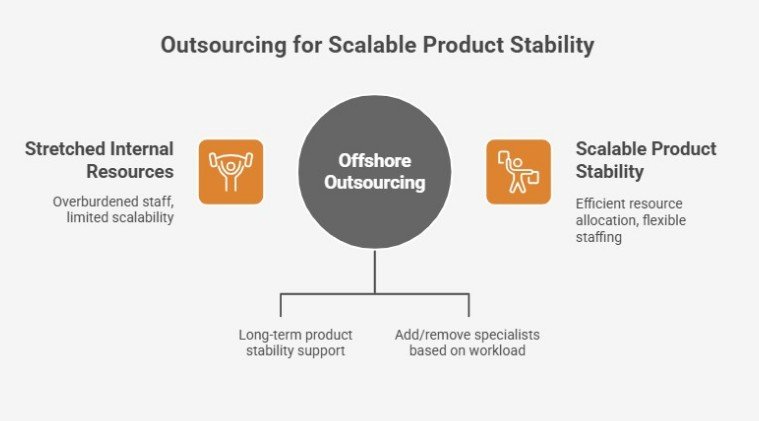
In fact, over 60% of businesses use outsourcing to scale without stretching internal resources. So, having a dedicated offshore model can support long-term product stability. It will also give you room to add or remove specialists based on actual workload instead of fixed staffing assumptions.
5. Offshore AI Development Lets You Focus on Core Business Activities
AI teams usually get stuck handling operational tasks such as model tuning, retraining cycles, and tooling support. Shifting this work to a qualified offshore partner frees your internal engineers to focus on architecture choices, technical direction, and product value.
In our experience, that kind of freedom impacts outcomes more than the budget alone.
Now, leadership can spend time on decisions that influence pricing models, data strategy, and customer impact.
This approach is common for technical leaders. And did you know that 65% of companies outsource to keep internal teams focused on core business priorities? Well, this reflects how frequently outsourcing supports roadmap control.
It's no wonder that with fewer operational distractions, you gain more bandwidth for research and improvements that strengthen your competitive edge.
6. Offshore AI Teams Maintain Productivity Around the Clock
Offshore partners help you keep development moving by covering work hours your local team can’t. Tasks such as data prep, fine-tuning, QA checks, or model validation progress instead of sitting idle overnight.
This setup creates wider production windows. And some studies show that a follow-the-sun workflow can keep engineering active for up to 16 hours a day, and even reach 24 hours with three coordinated sites. As a result, it can cut delivery duration by as much as 67% in ideal cases.
More active hours mean fewer stalls between reviews, quicker feedback loops, and smoother release cycles. It gives your AI roadmap a steady pace without relying only on local working hours.
7. Offshore AI Development Encourages Innovation Through Diversity
Innovation in artificial intelligence typically comes from contrasting ideas, research styles, or problem-solving methods. Offshore collaboration helps you gain those differences by combining engineers trained in different academic systems, research cultures, and industry practices.
When teams bring distinct methods to model tuning, feature engineering, or data interpretation, they find solutions that internal groups might overlook.
In our practice, we’ve seen how well this works for bias reduction and faster breakthroughs.
A Harvard Business Review study supports this impact. It shows that diverse teams solve problems 30% faster than uniform groups. That speed comes from varied thinking rather than extra hours worked.
With offshore talent feeding your projects, you gain experimentation paths you wouldn’t easily generate internally, which leads to better product decisions.
8. Offshore AI Developers Reduce Project Risks and Improve Stability
A single in-house team can become a single point of failure, especially with major release deadlines, model incidents, or unexpected outages. But distributing work across offshore partners:
Gives you operational resilience through regional redundancy.
Reduces disruption risk because delivery doesn’t depend on one physical location or time zone. This structure supports stability without slowing development.
Turns security into a shared responsibility with audited controls. Offshore partners typically follow strict compliance rules such as GDPR and ISO certifications. These are supported with NDA-based engagement for sensitive assets.
This gives you a reliable framework for protecting data, models, and proprietary methods while reducing exposure tied to local-only teams.
9. Offshore AI Development Gives You Access to Advanced AI Tools and Frameworks
Modern AI work depends on fast experimentation, strong model pipelines, and reliable infrastructure. Luckily, offshore engineers already work with frameworks such as PyTorch, TensorFlow, Scikit-Learn, Hugging Face, and cloud tooling such as AWS or Google Cloud.
That experience helps you avoid building expensive internal environments or training staff to manage them. Instead of waiting for infrastructure decisions or onboarding delays, you gain immediate access to teams who can ship models that meet production constraints.
For example, the Linux Foundation reports that over 70% of AI research implementations now use PyTorch, which shows where most innovation is happening.
This also changes your technical options.
With offshore expertise covering that toolset from day one, you skip setup cycles and accelerate engineering work tied to inference, cost control, and deployment paths.
10. Offshore AI Teams Improve Long-Term Project Quality and Performance
Maintaining high-quality pipelines for AI and machine learning requires:
Consistent code reviews
Reliable version control
Recoverable experiments
QA systems that flag hidden model failures early
Offshore specialists handle these routines every day because they support multiple production environments where repeatable outcomes matter more than fast experiments.
AI assistants strengthen that process even more. Tools like GitHub Copilot and ChatGPT boost both speed and accuracy by catching mistakes early. They can suggest cleaner structures and reduce the time spent on repetitive coding choices.
That combination of disciplined habits and AI-enhanced development reduces failures, speeds up iteration, and stabilizes long-term delivery. With this, you gain stronger output without stretching your internal team across research, infrastructure, and maintenance at the same time.
You can also check out this video to learn the pros and cons of hiring AI developers from a different perspective:
The next obvious step is to take a look at the challenges you might come across.
Common Challenges When Hiring Offshore AI Developers and How to Overcome Them
Offshore partnerships can strengthen your engineering capacity, but they also introduce execution risks if not managed with structure. Here are the challenges you need to control and the practices that keep delivery stable.
Offshore AI Development Can Face Communication Barriers
Misalignment happens when teams lack shared expectations about requirements, delivery steps, or priorities. This risk grows with distributed work because clarification usually depends on written communication.
Research indicates that about 55% of companies experience issues tied to communication, especially across remote teams. This shows how common this challenge is, and your team might be no different.
To avoid back-and-forth delays, we advise you to improve your communication with the right mindset and the right tools.
For example, you can create alignment through shared channels like Slack and Zoom. Meanwhile, tools such as Jira provide visibility into sprint work and timelines.
Short overlapping hours each day can support collaboration and help unblock tasks in real time.
Offshore AI Teams May Struggle With Cultural and Time Zone Differences
We’ve seen how different work habits, decision speeds, or feedback norms can slow delivery if left unmanaged. Time zone gaps make this even harder without a system for handoffs.
But cultural training, routine syncs, and shared documentation make collaboration smoother. At the same time, assigning a local coordinator helps bridge expectations on both sides. With this approach, distributed work becomes additive rather than disruptive.
Offshore AI Developers Must Follow Strict Data Security and Compliance
Sensitive data, model outputs, and training assets require careful control. So, vendors typically use NDAs, GDPR standards, and secure data privacy practices for protection.
And according to the Compliance Benchmark Report 2025, 81% of organizations now plan for or hold ISO 27001 certification. This shows how security has become a base requirement for external partners. Secure cloud environments and controlled access further safeguard engineering work.
Offshore AI Projects Require Strong Quality Control and Visibility
To avoid unexpected outcomes, AI work needs measurable checkpoints. Clear KPIs, sprint reviews, and code repositories make progress visible and confirm how models behave over time, especially when working with advanced AI technologies.
So, starting with a small trial project helps validate collaboration, standards, and reliability before scaling to broader workloads. To work with offshore AI teams effectively, you need practical methods that keep delivery predictable and collaboration smooth, even as projects expand into areas like predictive analytics.
Let's cover that next.
Best Practices for Working With Offshore AI Developers
Strong offshore partnerships depend on structure, alignment, and measurable delivery. Having a good framework removes friction and helps your team scale advanced work with confidence.
Here are the practices that keep offshore engineering output reliable and predictable.
Define clear objectives and KPIs early: Set measurable targets tied to model accuracy, inference cost, or release goals. This prevents unclear direction later in the project and helps you track meaningful outcomes instead of activity.
Choose the right outsourcing partner or platform: Select firms that support production-grade engineering. Some vendors have experience in pipelines that must withstand scaling and real-user performance.
Align on communication and reporting frameworks: Shared project management tools such as Jira, Slack, and Confluence establish a single source of truth for deadlines, requirements, and sprint output. Short overlap windows for work hours help unblock tasks quickly.
Implement Agile workflows with continuous feedback: Regular sprint reviews, code checkpoints, and model behavior checks confirm real progress. These cycles validate delivery without slowing it down.
Use hybrid models for strategic control and offshore scalability: Keep core architectural decisions internal while delegating implementation tasks, iteration, or research to offshore partners. This balance protects intellectual property and preserves strategic direction.
Conduct pilot projects to validate skills and collaboration: A small initial scope tests code quality, velocity expectations, and communication habits before scaling to deeper workloads.
Maintain consistent documentation and cultural onboarding: Shared documentation reduces misinterpretation, and basic exposure to team norms helps avoid confusion tied to cultural differences.
Now, we should discuss the best countries to hire offshore AI developers from.
Best Countries to Hire Offshore AI Developers in 2025
Different regions offer strong engineering pipelines, but each one brings its own advantages for scaling AI work. So, here are the leading destinations where you gain access to reliable global talent for advanced development.
| Country | Key Strengths | AI Talent Availability | English Proficiency | Cost Efficiency |
|---|---|---|---|---|
| India | Deep AI/ML expertise, massive talent pool | Very High | Excellent | Very High |
| Poland | Strong education, AI startups | High | Good | High |
| Philippines | Cultural compatibility, fluent English | Moderate | Excellent | High |
| Vietnam | Fast-growing tech hub | Moderate | Moderate | High |
| Argentina | Time-zone alignment with the US | High | Good | High |
To choose among these options with confidence, the next step is selecting the right offshore agency that can support your technical goals.
How to Choose the Right Agency to Hire Offshore AI Developers
Selecting the right partner determines how well your AI roadmap translates into production. You want a team that supports long-term delivery, rather than just short-term output.
Here are the factors that matter when evaluating offshore partners.
Assess technical depth: Look for experience with AI frameworks, production deployments, and case studies that show real performance gains. This doesn't mean just prototypes or research samples, especially in areas tied to Agile methodologies.
Review client testimonials and ratings: Third-party feedback shows how the partner handles delivery expectations, communication, and model stability after release.
Evaluate data privacy, communication, and workflow maturity: Strong vendors document security practices, use clear sprint reporting, and offer visibility into pipelines through dashboards or shared logs to reduce hidden risks.
Compare pricing models based on workload needs: Fixed pricing works for scoped features, while time & material fits research cycles. A dedicated team model is best when AI work includes continuous iteration and broader development solutions.
Check alignment with strategic goals and culture: You need a partner who adapts to your architecture choices, protects your direction, and scales without rewriting your technical identity.
Need Help Hiring Offshore AI Developers? Partner With Alpha Apex Group
Finding senior AI talent is difficult, but choosing the wrong hiring partner is even more expensive. You need a partner who understands the technical stakes behind AI solutions, can assess skills beyond buzzwords, and protects long-term delivery. That is where Alpha Apex Group stands out.
We help you hire AI specialists and leaders with real production experience, so your roadmap moves forward without slowing your internal team. Our recruiting strategy focuses on speed, technical clarity, and cultural alignment, and gives you a hiring process built for execution.
All of this is backed by an offshore hiring model that supports fast scaling.
What Alpha Apex Group Offers
Here’s how we help you hire senior AI talent with speed, accuracy, and long-term value.
Fast placement of niche AI roles: We fill senior AI leadership and specialist positions in about 43 days on average. You receive talent that aligns with your engineering strategy and organizational values instead of generic candidate lists.
Candidates delivered quickly when urgency matters: We typically present qualified options within 72 hours. Our placements range from CTO and CIO roles to ML engineers, data scientists, MLOps talent, and specialists in generative architectures or computer vision.
Support beyond hiring: Our team handles sourcing, onboarding, and integration to help AI engineers operate smoothly inside your environment. This is how you avoid invisible execution risks tied to rushed hiring.
Scalable AI and software engineering teams: We build flexible teams that expand with your workload and technical stack rather than forcing premature headcount decisions or rework.
Business-aligned advisory: We provide guidance on AI strategy, analytics, and automation so your talent supports long-term goals instead of short-term fixes.
We also operate a proprietary inbound system that generates more than 400 candidate requests daily. This gives you access to a larger pool without rising recruitment costs.
In addition, clients who work with us exclusively typically see 50-70% savings compared to traditional hiring models, while gaining stronger continuity and execution. And our 90-day replacement guarantee adds extra security, which shows how confident we are in the talent we deliver.
Why Work With Alpha Apex Group
These advantages show what makes our partnership reliable for scaling advanced AI work:
Global reach backed by deep technical understanding.
Proven record of delivering talent that fits culture and strategy.
Support from hiring to long-term integration and performance.
Ready to strengthen your AI team? Contact Alpha Apex Group today to find your next AI leader or build a high-performing offshore AI development team.
FAQs
What are the pros and cons of offshore software development?
The biggest upside is access to specialized talent and cost savings, especially when hiring at scale. Offshore partners also help you deliver faster by handling execution work. The downside is that you need structure to avoid communication gaps, which you can solve through alignment on tools, KPIs, and sprint visibility.
Which country has the best AI developers?
There isn’t a single best market. India offers scale, Poland provides strong engineering depth, Vietnam is growing fast, and Argentina aligns well with US time zones. The best location depends on your technical priorities and budget.
How to hire an AI developer?
Define what you need the AI developer to build, then look for someone with real production experience using tools such as PyTorch or TensorFlow. Check their case studies and do a small trial to confirm skill and communication before hiring long-term.
How much does it cost to hire an AI engineer?
Full-time AI engineers in the US typically cost $90k-$250k+ per year, while talent in regions such as Asia or Latin America can range from $20k-$110k. If you hire on contract, expect $40-$200+ per hour, with higher rates for skills in generative AI, NLP, or computer vision.