Employee Value Proposition (EVP): Framework & Examples
Employers have spent years trying to win talent with higher pay, better benefits, and more visible perks. Yet many employees still feel less connected to their work.
According to Gallup’s 2026 data, only 20% of employees worldwide are engaged at work, the lowest point Gallup has recorded.
This gap shows why companies need more than a competitive offer. They need a clear employee value proposition, or EVP, that explains what employees can expect from the organization and why the experience is worth joining, staying for, and contributing to.
In this guide, we’ll break down what an EVP is, how it differs from employer branding, the core pillars behind a strong EVP, and how to build, communicate, and measure one that reflects the real employee experience.
What Is an Employee Value Proposition (EVP)?
An EVP is the complete package of value a company offers employees in exchange for their time, skills, and contribution. It covers compensation, organizational culture, career paths, flexibility, and purpose. But it goes beyond a benefits summary. It explains why someone should join your company, why they should stay, and what they can expect in return for the work they do.
"A lot of leaders believe that the formula for attracting and keeping talent is simple: Just ask people what they want and give it to them. The problem is, that approach tends to address only the material aspects of jobs that are top of employees' minds at the moment, like pay or flexibility. And those offerings are easy for rivals to imitate and have the least enduring impact on retention. Companies instead should focus on what workers need to thrive over the long term, balancing material offerings with opportunities to grow, connection and community, and meaning and purpose." — Amy C. Edmondson, Novartis Professor of Leadership and Management, Harvard Business School
A strong EVP works like a clear agreement between the company and its people. The company commits to a defined set of rewards, experiences, and growth opportunities. Employees bring their effort, expertise, and trust in return.
When that exchange feels fair and consistent, employees are more likely to feel engaged and stay. When the promise does not match the real experience, trust breaks down and turnover becomes more likely.
Your EVP also shapes every stage of the talent lifecycle. It influences how candidates see your company before they apply, what new hires experience in their first 90 days, and whether long-term employees feel valued enough to stay. A well-built EVP keeps those moments connected to the same core promise.
Employee Value Proposition vs. Employer Brand: Understanding the Difference
These two terms get conflated constantly, but they serve very different functions.
Your EVP is the substance. It’s the actual set of rewards, experiences, and opportunities your organization delivers to employees. Your employer brand is how that value is seen by candidates and employees. It is the reputation you build in the talent market based on how well your EVP matches the real employee experience.
Here’s a simple way to frame it: your EVP is the product. Your employer brand is how that product gets positioned. A polished employer branding strategy built on a weak EVP creates a credibility gap. Candidates arrive expecting one thing and find another.
Why a Strong Employee Value Proposition Matters in Today’s Labor Market
Talent retention carries a real financial cost.
SHRM puts the price of replacing a single employee at anywhere from 50% to 200% of their annual salary. The exact figure shifts based on role complexity and seniority level. For organizations losing multiple people per quarter, those costs compound fast.
A well-defined EVP addresses employee needs directly. It gives people concrete reasons to stay and makes talent acquisition more efficient by clearly signaling what the company actually delivers before anyone accepts an offer.
Remote work options, advancement opportunities, and purpose-driven work have all moved up the priority list for today’s workforce. Companies that acknowledge these shifts inside their EVP are better positioned to compete for the people they actually want to hire.
The Core Components of an EVP Framework
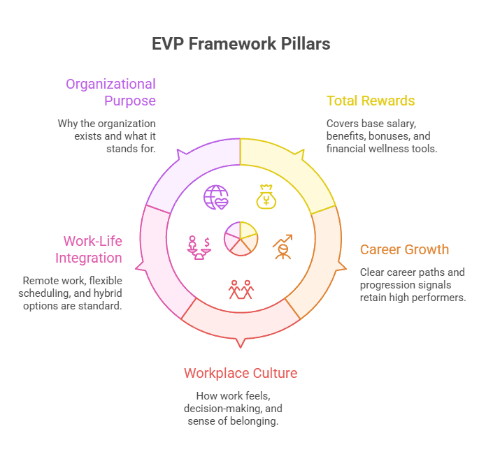
A strong EVP doesn’t rest on one pillar. It’s built across five distinct areas that together reflect what employees actually value when choosing where to work and deciding whether to stay.
1. Total Rewards and Compensation
Total rewards is the most visible part of any EVP, but it covers more than base salary. A complete benefits package typically includes health insurance, retirement savings, bonuses, equity, paid leave, and financial wellness tools.
88% of employers rate healthcare benefits as very or extremely important, making it the highest-ranked category in SHRM’s 2024 survey of more than 4,500 HR professionals. Retirement savings ranked second at 81%.
Pay and benefits packages have to be competitive to get candidates through the door. But they also need to feel fair once someone is already inside. Compensation sends a clear message about how much an organization values its people, and employees notice quickly when that message feels off.
2. Career Growth and Development
People want to know there’s somewhere to go. Career development, clear career paths, and visible career progression signals are what separate companies that retain high performers from those that train them for competitors.
Most organizations are falling short on this pillar. Only 33% of organizations have a formal internal mobility program, and just 1 in 5 employees feel confident in their ability to make an internal move.
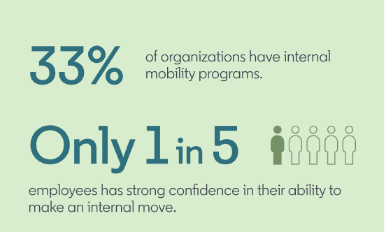
This part of the EVP tells employees whether the company plans to invest in them or simply extract output from them. That distinction matters.
3. Workplace Culture and Belonging
Organizational culture is how work feels on an ordinary Tuesday. It covers how decisions get made, how people treat each other, and whether employees have a real sense of belonging at their company.
Diversity, Equity, and Inclusion belongs here as a core dimension of culture instead of a standalone initiative. 76% of employees and job seekers say workforce diversity is an important factor when evaluating a company, and about 1 in 3 said they would not apply to a company that lacked it.
Company culture either reinforces the EVP or quietly undercuts it. There’s rarely a middle ground.
Read Next: 6 Inspiring Company Culture Examples You Can Learn From
4. Work-Life Integration and Flexibility
Work-life balance has moved from a perk to a baseline expectation. Remote work availability, flexible scheduling, and hybrid options are now standard factors candidates weigh when evaluating an offer. For many workers, flexibility isn't a bonus on top of the job. It's a condition of taking it.
According to a 2026 SurveyMonkey study, 29% of employees say they would consider leaving if their remote or hybrid role became fully office-based. That's nearly 1 in 3 people whose decision to stay is directly tied to how much control they have over their time and location. An EVP that treats flexibility as an afterthought is going to feel that way to the people you're trying to keep.
5. Organizational Purpose and Values
The final pillar is why the organization exists and what it actually stands for. Social purpose and clear values give employees a reason to care about their work beyond the paycheck.
Employees with a strong sense of purpose at work are 5.6 times more likely to be fully engaged, and far less likely to be burned out or actively looking for other jobs, according to a study of more than 4,400 U.S. workers.
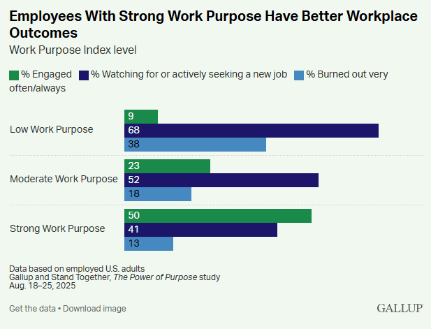
Purpose-driven EVPs attract people who align with the mission from the start and give them a reason to stay when other opportunities come along.
These five pillars define what your EVP needs to cover. The next section walks through how to actually build one from scratch, starting with an honest look at where your current employee experience stands.
How to Build an Employee Value Proposition (EVP): A Step-by-Step Framework
Most EVP projects fail not because the concept is wrong but because the build process is rushed.
Teams jump straight to the statement before they understand the real employee experience, or they create a polished message without a clear activation plan.
From what we have seen, this is where most teams mess up. They treat the EVP like a messaging exercise when it should start as an employee experience audit.
The framework below keeps the process grounded in what employees actually experience.
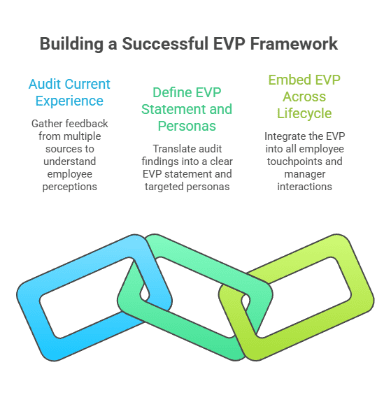
Step 1: Audit Your Current Employee Experience
Before you can define what your EVP should say, you need an honest picture of what employees actually experience. This means pulling from multiple sources instead of just a single engagement survey.
Start by collecting employee feedback across these inputs:
Internal surveys and focus groups to understand what current employees value and where they feel underserved
Exit interview data to identify patterns in why people leave
Competitor benchmarking and market research to see how your offer stacks up in the talent market
Manager observations to surface gaps that don't always appear in structured data
Each source tells a different part of the story. Internal surveys show sentiment. Exit data shows what finally pushed someone out. Benchmarking shows how your offer compares. Manager input surfaces the day-to-day friction that rarely makes it into formal feedback channels. No single source is enough on its own.
The audit's job is to close the gap between what the company thinks it's delivering and what employees actually receive. You can't build a credible EVP on assumptions. You build it on what the data actually shows.
This short video breaks down the most common mistakes organizations make when building their EVP and how to avoid them.
Step 2: Define Your EVP Statement and Talent Personas
With your audit data in hand, the next step is translating it into a clear EVP statement and a set of workforce personas that make it actionable across different employee segments.
Your EVP statement should answer one question: why would the right person choose to work here and stay? It needs to be specific enough to mean something and grounded enough in reality that current employees recognize it as true. Vague language about “dynamic teams” and “exciting opportunities” doesn’t cut it.
We have seen this happen often: teams write an EVP that sounds good in a brand deck, but it does not reflect how different employees actually make career decisions.
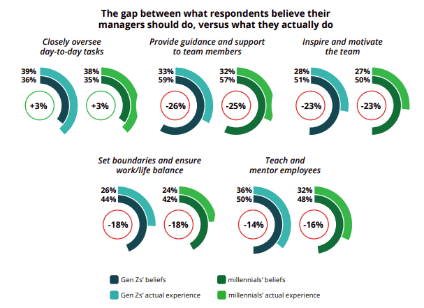
Talent personas help fix that. Different workforce segments prioritize different things. Deloitte found that work-life balance, opportunities to progress, and learning and development are the top three reasons younger workers chose their current employer.
An early-career persona built around these drivers looks very different from a senior-leader persona anchored in autonomy and strategic impact.
The chart below from the report above shows exactly how far managers are falling short of what younger workers expect, which is the kind of gap a well-built persona helps you close.
Strong EVP statements share a few qualities worth building toward.
They connect directly to the company’s actual mission, not aspirational filler
They reference specific programs, benefits, or cultural qualities rather than broad claims
They’re validated against real employee feedback gathered in the audit phase
They remain coherent across workforce segments without losing their core meaning
Hiring managers and talent acquisition teams should be part of this process. They hear what candidates actually ask about in interviews and where the current employer message falls apart in real conversations. This ground-level input sharpens the statement in ways that internal brand exercises rarely do.
Step 3: Embed the EVP Across the Employee Lifecycle
A defined EVP that only lives on a careers page is a brochure. The real work is weaving it into every touchpoint employees encounter, from the first job posting through annual performance reviews.
Practical integration points include.
Job descriptions and recruitment efforts, so candidates see the EVP before they apply
The interview process, so hiring conversations reflect what the company actually stands for
Onboarding programs, where new hires form their first real impression of whether the promise holds
Performance management cycles, so recognition and development reflect the EVP’s stated values
Onboarding is a key moment. New hires quickly decide whether the company experience matches what they were promised during hiring. Many companies still treat onboarding like paperwork, when it should be one of the strongest proof points for the EVP.
We recommend treating managers as the main delivery channel for your EVP. Employees experience culture through their manager far more than through a careers page or internal campaign.
The way a manager runs a one-on-one, gives recognition, talks about growth, or handles feedback can either support the EVP or weaken it. When managers understand their role in delivering the EVP, it becomes part of daily work instead of staying as a message on a slide.
Employee Value Proposition Examples
Seeing real EVPs in action is one of the fastest ways to understand what effective actually looks like in practice.
EVP Examples from Large Enterprises
Salesforce has built one of the most recognized EVPs in enterprise tech around three interlocking elements. The V2MOM framework (Vision, Values, Methods, Obstacles, Metrics) aligns every employee to company direction from day one.
The “Ohana” culture creates a belonging-driven internal identity. And the 1-1-1 philanthropy model (pledging 1% of equity, product, and employee time to communities) anchors the EVP to a social purpose employees can point to directly. Salesforce has appeared on the Fortune 100 Best Companies to Work For list for 17 consecutive years.
Unilever built its "Made by you" EVP around four pillars, with purpose at the center.
Purpose power positions sustainability as a core part of the employee experience.
Build a better business frames Unilever as a place that develops leaders for the world, not just for the company.
Brilliantly different together anchors the culture in inclusion and individual contribution.
Go beyond signals that employees will get more from the role than a standard job title suggests.
Ranked number one employer of choice in more than 52 countries, it's one of the clearest examples of an EVP built around specific, verifiable promises rather than generic brand language.
Both companies share a common trait: a named, specific framework tied to outcomes that go well beyond brand sentiment.
EVP Examples from Mid-Market and Growing Companies
You don’t need Fortune 500 scale to build an EVP that works.
HubSpot published its EVP through co-founder Dharmesh Shah’s “Culture Code,” a deck that has been viewed more than 5 million times and updated more than 25 times.
Its HEART values (Humble, Empathetic, Adaptable, Remarkable, Transparent) and “work+life, not work vs. life” commitment give candidates a clear, testable picture of what joining the company actually means. This transparency is a talent marketing asset that most companies never build.
Bombas takes a purpose-first approach. Its “Bee Better” values and 1:1 donation model run directly through the employee experience. 96% of Bombas employees say it’s a great place to work, compared to a 57% U.S. average according to Great Place to Work. A 39-point favorability gap doesn’t come from good messaging. It comes from a culture employees actually want to be part of.
Both examples show that mid-market EVPs perform best when they make specific, verifiable claims.
What Strong EVPs Have in Common
Across every example above, three qualities show up consistently: specificity, authenticity, and tight alignment between what the company says externally and what employees experience internally.
Nearly half of employees say their organization is failing to deliver the experience they were promised. This gap is almost always an authenticity and delivery problem instead of a messaging problem.
They make claims specific enough for employees to verify against their own experience
They keep candidate perceptions formed during recruitment aligned with the reality of joining
They connect internal culture to external employer branding strategy rather than treating them as separate workstreams
They evolve as workforce needs shift instead of locking in a single version indefinitely
The pattern is consistent. Specificity, authenticity, and alignment between internal culture and external messaging are what separate EVPs that perform from those that just exist.
How to Communicate Your EVP
Remember: a well-built EVP does nothing if people never hear about it. Communication is where many organizations lose the plot. They spend months building the EVP and then treat distribution as an afterthought. Internal and external communication require different approaches and different channels.
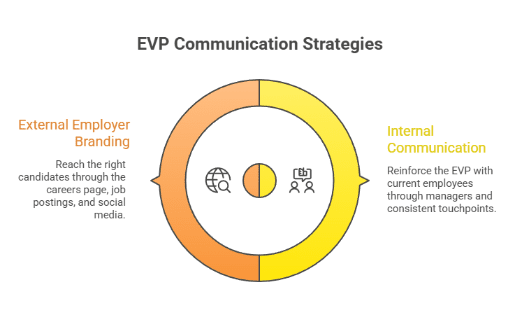
Internal Communication: Strengthening the EVP with Current Employees
Your current employees are both the audience and the proof point. If they don’t recognize the EVP in their daily experience, nothing you say externally will hold up.
In our daily practice, we’ve noticed that this is where many EVP rollouts lose momentum. Teams announce the EVP once, usually in an all-hands or internal email, and then expect it to stick.
The most effective internal communication runs through managers. 84% of organizations rely on managers for communication to some degree, and yet 3 in 5 say those managers are falling below expectations. That gap is exactly where EVP reinforcement breaks down.
Strengthening the EVP internally means embedding it across multiple touchpoints. A single all-hands mention won’t move the needle.
Effective internal communication channels for EVP reinforcement include.
Regular all-hands meetings where leadership ties business updates back to company values and mission
Internal newsletters and intranet content that highlight real employee stories as EVP proof points
Manager toolkits that give team leads specific language and examples for EVP conversations during one-on-ones and team meetings
Recognition programs that reward behaviors that directly reflect the EVP’s stated values
Insider tip: Frequency matters as much as format. Your EVP needs to show up consistently enough that it becomes part of how people describe their work.
External Employer Branding: Reaching the Right Candidates
External EVP communication is about reaching the right candidates through the right channels before they ever submit an application.
Start with your careers page. It's your highest-converting external asset. Career sites delivered 26% of hires from just 13% of total applications in 2024. This means candidates who apply through the company's own site are hired at nearly 4 times the rate of those coming through job boards.
In our experience, this is one of the most underused parts of employer branding. Many companies send candidates straight to job boards, while their own careers page does little more than list open roles.
Beyond the careers page, a strong external presence draws on.
Job postings that reflect the EVP’s language and values rather than generic role descriptions
LinkedIn presence including company page content, employee spotlights, and organic posts that reflect real culture
Employee testimonials embedded in the careers page and recruitment materials, since employees are far more credible to candidates than brand-produced content
Glassdoor management, including responding to reviews and maintaining an accurate, current company profile
Visual identity and consistent messaging across every candidate touchpoint signals that the employer brand reflects a deliberate strategy. Recruitment strategies that rely entirely on external agencies or job boards without a strong owned presence leave conversion on the table. A careers page that just lists open roles is a missed opportunity.
Build Your EVP with Confidence with Alpha Apex Group
A strong employee value proposition gives people a clear reason to join your organization and a stronger reason to stay. It connects compensation, growth, culture, flexibility, and purpose into one consistent employee experience.
But the real value of an EVP comes from delivery. When the promise you make to candidates matches what employees actually experience, your employer brand becomes more credible and your workforce becomes one of your strongest recruiting advantages.
Building that kind of EVP takes more than polished messaging. It requires honest feedback, a clear strategy, and consistent execution across the full employee lifecycle.
Alpha Apex Group helps you design people strategies that support both talent attraction and retention, including employee benefits consulting, EVP development, and employee experience planning.
If your organization needs help defining, strengthening, or communicating an EVP that reflects who you are, contact Alpha Apex Group today.
Frequently Asked Questions
What are the 5 pillars of EVP?
The five pillars of an employee value proposition are compensation and benefits, career growth, workplace culture, work-life balance, and organizational purpose. Together, these areas define what employees receive in exchange for their skills, time, and commitment.
What should be included in an employee value proposition?
An employee value proposition should include pay, benefits, career development, flexibility, company culture, leadership style, recognition, and purpose. It should clearly explain why someone would choose to work for the company and why current employees should stay.
Why is an employee value proposition framework important for attracting and retaining talent?
An EVP framework helps companies communicate what they offer employees in a clear and consistent way. When the promise matches the actual employee experience, it can improve recruiting, strengthen engagement, and give employees stronger reasons to stay.
How can companies measure the effectiveness of their employee value proposition framework?
Companies can measure EVP effectiveness by tracking employee engagement, retention, turnover, offer acceptance rates, internal mobility, and candidate feedback. They should also compare employee survey results with exit interview themes to see whether the EVP matches the real employee experience.
Research Appendix
- Gallup – State of the Global Workplace: Global Data
https://www.gallup.com/workplace/697904/state-of-the-global-workplace-global-data.aspx - Alpha Apex Group – Employee Engagement Best Practices
https://www.alphaapexgroup.com/blog/employee-engagement-best-practices - SHRM – The Myth of Replaceability
https://www.shrm.org/executive-network/insights/myth-replaceability-preparing-loss-key-employees - SHRM – 2024 Employee Benefits Survey
https://www.shrm.org/about/press-room/2024-shrm-employee-benefits-survey--health-and-flexible-work-ben0 - LinkedIn – Workplace Learning Report 2024
https://learning.linkedin.com/resources/workplace-learning-report-2024 - Alpha Apex Group – Types of Company Culture
https://www.alphaapexgroup.com/blog/types-of-company-culture - Glassdoor – Diversity & Inclusion Workplace Survey
https://www.glassdoor.com/blog/diversity-inclusion-workplace-survey/ - Alpha Apex Group – Inspiring Company Culture Examples
https://www.alphaapexgroup.com/blog/inspiring-company-culture-examples - SurveyMonkey – Remote and Hybrid Work Statistics
https://www.surveymonkey.com/learn/employee-feedback/remote-hybrid-work-statistics/ - Gallup – Purposeful Work Boosts Engagement (Few Experience It)
https://news.gallup.com/poll/697403/purposeful-work-boosts-engagement-few-experience.aspx - YouTube – How to Build an Authentic Employee Value Proposition (EVP) | Avoid These Common Mistakes!
https://youtu.be/ddu1bC3b0sg?si=1zWx3GOH4mDn2s1I - Deloitte – 2025 Gen Z and Millennial Survey
https://www.deloitte.com/content/dam/assets-shared/docs/campaigns/2025/2025-genz-millennial-survey.pdf - Salesforce – Our Values
https://www.salesforce.com/company/our-values/ - Salesforce – Philanthropy
https://www.salesforce.com/company/philanthropy/ - Unilever – At a Glance
https://www.unilever.com/our-company/at-a-glance/ - Link Humans – Unilever Employer Brand
https://linkhumans.com/unilever/ - HubSpot – Culture Code: Creating a Company We Love
https://blog.hubspot.com/blog/tabid/6307/bid/34234/the-hubspot-culture-code-creating-a-company-we-love.aspx - Bombas – About Us
https://bombas.com/pages/about-us - Great Place to Work – Bombas Company Profile
https://www.greatplacetowork.com/certified-company/7005361 - Kincentric – 2023 Employee Experience Research
https://www.prnewswire.com/news-releases/kincentric-2023-research-reveals-the-power-of-consistency-in-employee-experience-301886502.html - Gallagher – Internal Communications Study (AI Protocols and Employers)
https://www.prnewswire.com/news-releases/nearly-three-quarters-of-employers-do-not-have-ai-protocols-for-internal-communicators-gallagher-study-shows-302057144.html - StaffingHub – Recruiting Metrics Report (Company Pages & Referrals)
https://staffinghub.com/hiring/company-pages-referrals-result-in-more-hires-recruiting-metrics-report/ - Harvard Business Review – Rethink Your Employee Value Proposition
https://hbr.org/2023/01/rethink-your-employee-value-proposition
.jpg)
.jpg)