HR Due Diligence: Complete Guide for PE Acquirers

Most PE acquirers spend months stress-testing revenue models, working capital assumptions, and debt capacity. Yet the HR workstream mostly gets a fraction of that attention. That’s a costly oversight.
In a merger and acquisition deal, the people side of the business can materially shape post-close outcomes. According to Deloitte, roughly 30% of failed deals cite cultural integration issues as a root cause.
For PE acquirers, the risk is even sharper. Strategic acquirers typically have longer runways for operational change. PE acquirers don’t.
Compressed holding periods, fund return pressure, and investor expectations around operational integration make the HR workstream categorically different from what a corporate buyer would run. Decision makers who treat it like an administrative task leave real money on the table before the ink dries.
Every HR finding has the potential to adjust deal price, deal structure, or your 100-day plan.
At Alpha Apex Group, we help PE acquirers turn HR diligence findings into clearer integration plans, stronger leadership continuity, and post-close value creation through our post-merger integration consulting work.
This guide is built around that reality, and each section gives you findings you can act on.
Why HR Due Diligence Matters in PE Acquisitions
HR due diligence in a PE deal isn't the same as it is in a strategic acquisition. The timeline is shorter, the return expectations are explicit, and missed liabilities come straight out of your IRR. Here's what that means in practice.
Most deal teams treat it like a legal scan. Pull the employment agreements, check for obvious compliance gaps, flag anything clearly exposed, and move on. That approach leaves money on the table.
A strong HR due diligence checklist should not exist just to satisfy a process requirement. It should help surface every workforce, leadership, culture, and compliance issue that could reduce post-close value creation.
You're not acquiring a target company to operate it indefinitely. You're acquiring it to grow it, stabilize it, and sell it at a premium. Every HR finding that goes unexamined in diligence becomes a liability you inherit at close.
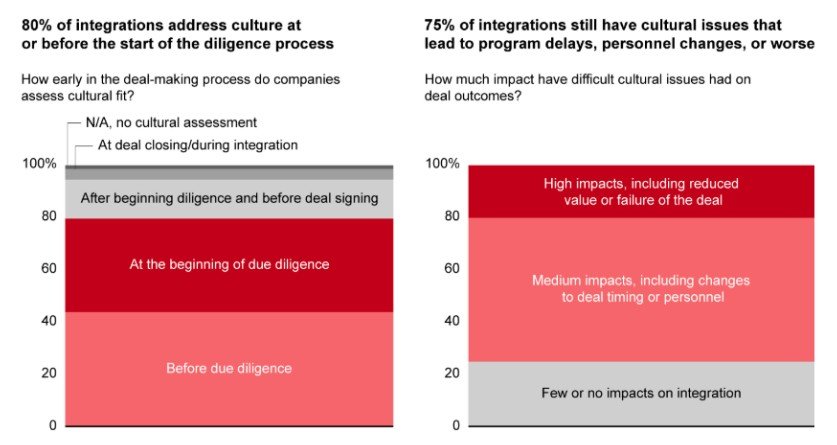
In fact, Bain's M&A Practitioners' Survey found that while culture is an early focus area for 80% of integrations, 75% of acquirers still struggle with cultural issues serious enough to require major interventions.
How HR Findings Directly Adjust Deal Economics
HR findings move the financial due diligence conversation in measurable ways:
Unresolved legal risks tied to wage claims, misclassified workers, or active litigation become escrow holdback items.
Change-in-control acceleration costs get priced into purchase consideration.
Rep and warranty coverage gets scoped around what the HR workstream actually uncovered.
Note: None of these findings are purely administrative. Each one can affect purchase price, indemnity exposure, integration costs, or the first 100-day value creation plan.
Culture and workforce issues can have the same financial weight. Research synthesizing Aon and Mercer data across 199 organizations found that cultural integration issues negatively impacted more than $1 million of deal value in over 70% of transactions.
This is why PE deal teams should treat HR due diligence as a direct input into deal economics, not a back-office checklist.
HR Legal and Compliance Due Diligence
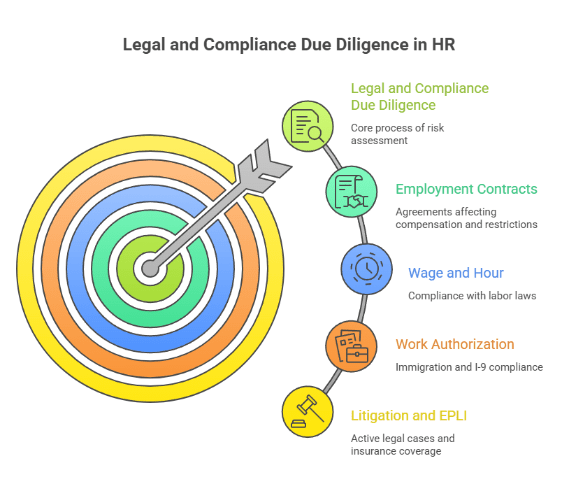
Legal exposure is where HR diligence most directly intersects with deal structure. The four areas below can each create measurable liability at close, and most become harder to resolve when they surface late.
1. Employment Contracts, Severance, and Non-Competes
Pull the full stack of employment agreements for senior leadership early in the process. Change-in-control clauses, severance multipliers, and golden parachute provisions can each add material cost to close.
Section 280G imposes a 20% excise tax on excess parachute payments above statutory thresholds triggered at a change of control, and the employer loses the deduction. Whether non-competes are enforceable in the bona-fide-sale context also directly affects how that parachute exposure gets sized and structured.
Non-competes require deal-by-deal review. The FTC’s proposed rule would have voided roughly 30 million existing agreements, but a federal court set it aside in August 2024, and the FTC dismissed its appeal in September 2025.
State law governs now. Four states have banned noncompete entirely (California, Minnesota, North Dakota, and Oklahoma), and California's AB-1076 extends that prohibition to agreements signed in other states, with civil penalties of up to $2,500 per violation.
Non-solicitation provisions deserve the same scrutiny. Enforceability varies dramatically by state, and restrictions that won't survive close scrutiny provide no protection at all.
2. Wage and Hour Compliance and Worker Classification
Worker misclassification is one of the most underestimated legal risks in any business transaction.
The DOL’s revised independent contractor rule, effective March 2024, reinstated a multi-factor economic-realities test for FLSA classification. Any 1099 contractor arrangement that functions like W-2 employment under that standard creates inherited liability you’ll own at close.
The financial exposure is not theoretical. The DOL’s Wage and Hour Division recovered $149.9 million in back wages for over 125,000 workers in FY 2024, with the vast majority tied to overtime violations.
Unpaid overtime exposure flows directly into indemnity carve-outs and escrow holdback sizing. Get employee classifications reviewed, documented, and defensible before you sign.
3. Work Authorization and I-9 Compliance
An immigration-dependent workforce creates layered exposure that most buyers underweight. The January 2025 DHS penalty update puts I-9 paperwork violations at $288 to $2,861 per form. Third-offense penalties for knowingly employing unauthorized workers reach $28,619 per violation.
ICE has also reclassified errors previously treated as technical into substantive violations subject to immediate fines, eliminating the 10-day correction window that employers previously relied on. The practical result is a narrower safe-harbor window and faster escalation to penalties.
For any target company with a concentration of H-1B workers or federal contractor obligations, an e-Verify audit before close is non-negotiable. Federal contractors are already subject to mandatory e-Verify participation, and any compliance gap creates successor liability.
Post-close I-9 remediation is expensive and slow, and it pulls management attention away from integration.
4. Employment Litigation and EPLI Coverage
The EEOC processed 88,201 new discrimination charges in FY 2025, roughly even with the record-high FY 2024 figure, with retaliation and sex or pregnancy discrimination accounting for the largest share of litigation activity.
We suggest reviewing the target's disclosure schedule carefully and cross-reference against available EEOC records. Any active or threatened litigation needs to be mapped against existing coverage before you finalize indemnity terms.
Employment Practices Liability Insurance typically excludes punitive damages and statutory fines. Coverage gaps frequently emerge around wage-and-hour claims, third-party harassment, and AI-based HR tools.
Legal counsel should evaluate the gap between actual exposure and what the existing EPLI tower actually covers. An employee handbook review often surfaces HR policies with inconsistencies that haven’t generated formal claims yet but represent real and immediate litigation risk.
Compensation, Benefits, and Long-Term Financial Liabilities
Legal exposure tells you what the deal could cost you. Compensation and benefits show what the business already costs to run, and whether that cost structure is sustainable after close.
Compensation Structure and Market Benchmarking
Total compensation review is where financial due diligence and HR diligence converge. The goal is to understand whether those pay levels create post-close risk in either direction.
Over-market structures inflate cost from day one and complicate integration planning. Under-market structures are a retention time bomb waiting for a close to trigger it.
Map base pay, variable compensation, and bonus structures against current market benchmarks for every role tier. Also, check whether compensation tracks the organizational structure accurately.
Title inflation and role creep are common in founder-led businesses. Both can create compensation correction costs that do not show up clearly in the financial model.
Pay equity gaps deserve the same scrutiny. In fact, SHRM reported that 75% of organizations now conduct regular pay equity analysis, so targets that don’t are increasingly the exception and may carry unaddressed legal exposure.
Remember: employee compensation data that isn’t benchmarked before close becomes a liability you price after it.
Health Benefits, COBRA, and Disability Obligations
Employee benefits are among the fastest-growing cost liabilities in any acquisition. Research found that average employer health benefit cost reached $17,496 per employee in 2025, a 6.0% increase year over year, with a projected 6.7% jump in 2026.
Model these cost trajectories into your post-close financials before you finalize your return assumptions. Assess plan quality and carrier concentration risk. A target that relies heavily on a single carrier or a self-insured structure introduces volatility that won’t appear in a standard audit.
COBRA continuation obligations require separate review. In M&A transactions, responsibility can depend on deal structure, whether the seller maintains a group health plan after close, and whether the buyer becomes a successor employer.
Treasury regulations specifically address which group health plan must make COBRA continuation coverage available to M&A qualified beneficiaries.
For asset purchases, particularly, buyers need to confirm which COBRA obligations transfer, how qualifying events have been tracked, and whether reserves are adequate.
Disability and leave obligations should also be reviewed before close. Pending STD/LTD claims, protected leave, accommodations, and unresolved return-to-work issues can create inherited cost and compliance exposure that affects both integration planning and workforce continuity.
Retirement Plans and Unfunded Liabilities
Retirement plans require dedicated review because they can carry both compliance exposure and long-term funding obligations.
For 401(k) plans, this means pulling:
Plan documents
Summary plan descriptions
Vesting schedules
Form 5500 audit history
Fiduciary structure
From what we have seen, retirement plan risk is mostly underweighted because it feels technical and back-office. This is exactly where teams miss late contributions, stale valuations, testing failures, or funding obligations that should have been reflected in the deal model
The decision to terminate, maintain, or merge a plan needs to be made before close. Leaving it unresolved creates ERISA fiduciary exposure and operational drag on day one.
Underfunded plans pay higher annual PBGC premiums, and buyers frequently inherit stale actuarial valuations that don’t reflect current funded status.
Demand an updated asset valuation as a condition of your diligence package. Unfunded pension liability is a hard-dollar obligation that belongs in the purchase price model, not in a post-close surprise.
Equity Plans and Change-in-Control Acceleration
Equity plan mechanics require precise review in any PE deal because they affect both deal economics and retention planning.
According to Carta’s 2025 PE Executive Equity Report, the median initial CEO equity grant at PE-backed corporations sits at approximately 2.6% of fully diluted equity. This shows how material executive equity can be in a PE-backed operating model.
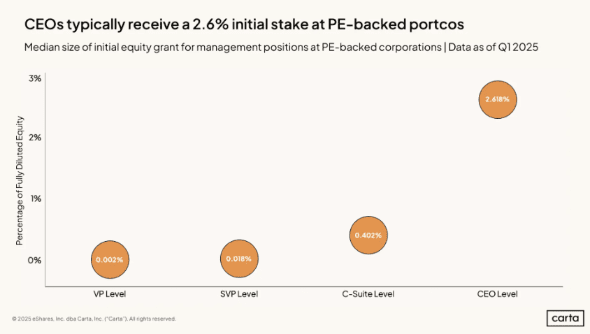
Unvested equity schedules and acceleration triggers at close determine both the cash cost to the buyer and the retention signal sent to the employee.
Therefore, we suggest identifying every acceleration trigger before you close. Double-trigger versus single-trigger provisions, phantom stock obligations, and option pool dilution all affect deal economics in ways that won’t surface in a standard financial statement review.
Section 409A deferred compensation exposure and equity rollover mechanics for key employees are the final variables to resolve. Talent management through the transition is far cleaner when the equity structure is clearly documented. When it isn’t, you’re negotiating the details while trying to run an integration.
Talent Assessment and Workforce Due Diligence
Legal and compensation findings tell you what you're inheriting. Talent assessment tells you whether you have the people to execute after close.
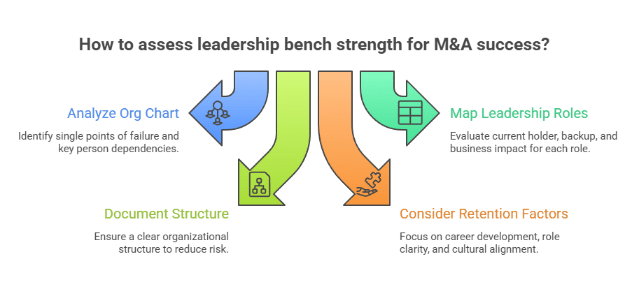
Org Chart Analysis and Leadership Bench Strength
The org chart is the starting point for any talent assessment, but what you’re looking for isn’t a clean hierarchy. You’re looking for single points of failure.
In our experience, this is where many deal teams miss the real risk. They review titles and reporting lines, but do not test what happens if a founder, CFO, sales leader, or operations lead leaves within the first 90 days.
Map each leadership role against three core variables.
Who currently holds it
Who backs them up if they leave in the first 90 days
What happens to the business if that role goes vacant at close
Key person dependencies at the CEO, CFO, or revenue-leadership level are the most common succession gaps that create post-close risk.
A well-documented organizational structure reduces that risk materially. An undocumented one obscures it until you’re already in the integration.
Replacing senior talent is expensive. SHRM research has found that total turnover costs can range from 90% to 200% of annual salary, depending on the role and context. For PE acquirers, this cost also shows up as lost momentum, delayed execution, and pressure on the value creation plan.
Research consistently shows that financial incentives alone aren’t enough to retain critical individuals. Career development, role clarity, and cultural alignment matter just as much.
Leadership bench strength determines whether your value-creation thesis survives the transition.
Key Talent Identification and Retention Risk
Talent retention risk is the human capital variable that most directly threatens post-close performance targets. The problem is that flight risk is largely invisible until it shows up in a resignation letter.
MIT Sloan research puts average first-year attrition for acquired-company employees at roughly 34%, compared to 12% for non-acquired new hires. This gap is the deal premium bleeding out before your integration plan is even operational.
What we usually see in diligence is that retention risk gets discussed too broadly. Teams know they need to retain “key people,” but they have not always defined who those people are, why they matter, or what would actually make them stay after close.
Pre-close talent management work should map the following:
Your critical employees, and whether existing retention agreements actually cover them
Non-solicitation provisions protecting the broader employee pool from competitor recruiting
Roles with no meaningful replacement depth where flight risk is elevated
Informal commitments or side arrangements made by prior ownership
Employee engagement signals belong in this review, too. Voluntary turnover trends, internal promotion rates, and any available engagement survey data all indicate how the workforce will respond to a change in control. Low engagement heading into a deal compounds the retention challenge on day one.
“To improve retention of employees in an M&A transaction, companies should focus on effective communication with the affected employees. Answer the questions you can, follow up when you say you will, and be transparent. This approach will help foster trust between the new employer and the employees. For the most essential employees, consider retention bonuses to help effectuate a smooth transition.” - Wesley Shelton, Associate at Proskauer Rose LLP
Workforce Metrics: Turnover, Productivity, and Skills Gaps
Quantitative workforce data belongs in every diligence package. Request at least three years of historical attrition broken down by department, seniority level, and voluntary versus involuntary separation. Look for spikes that align with leadership changes, restructuring events, or compensation adjustments.
Training program adequacy feeds directly into your post-close cost model. The average training cost per U.S. employee was $874 in 2024. If skills gaps are meaningful relative to your operating plan, that number scales fast across the workforce. Build remediation cost into your integration budget before close.
Pro tip: We recommend treating skills gaps as integration costs, not future HR projects. If the target’s workforce needs new systems training, manager enablement, sales process training, or technical upskilling to execute the value creation plan, those costs should be built into the integration budget before close.
Additional workforce metrics to pull and benchmark against industry peers.
Revenue or output per employee versus sector comparables
Internal promotion rate as a signal of pipeline depth
Time-to-fill for open roles, which reflects recruiting capability and employer brand perception
Absenteeism trends and leave utilization patterns
Upskilling liabilities are most common in businesses where technology adoption has outpaced the workforce. Quantify the gap early. It rarely shrinks on its own after close.
Cultural Due Diligence in PE Acquisitions
Cultural due diligence is the workstream most deal teams acknowledge, but few actually execute well. This gap is expensive.
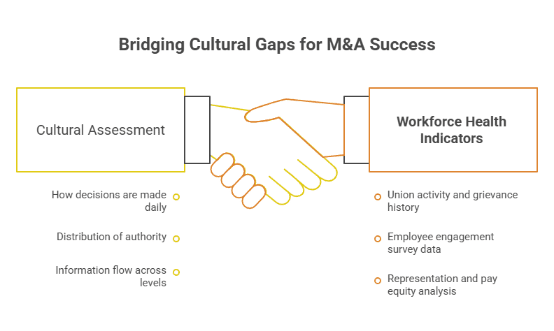
Up to 60% of M&A failures post-close trace directly to cultural misalignment.
The practical question in diligence is how to assess cultural differences between the acquirer and the target before close. This doesn’t require a lengthy off-site or a full culture survey. It requires honest answers across three dimensions:
Operating norms and how decisions actually get made day to day
Management style and whether authority is distributed or concentrated at the top
Communication patterns and how information flows across levels versus getting bottlenecked
When these dimensions diverge sharply from the acquirer’s operating model, integration timelines slip, and synergy capture delays follow. Map the gap before close and build the alignment cost into the 100-day plan explicitly.
Employee Relations and Workforce Morale
Union activity and grievance history are among the most overlooked signals of underlying workforce dysfunction in any merger process. Under NLRA successorship doctrine, stock purchases and mergers typically transfer collective-bargaining obligations directly to the buyer.
In asset purchases, the buyer may still qualify as a successor employer with Board obligations depending on workforce continuity and operational structure.
Review grievance filings, pending arbitrations, and any available employee engagement survey data. Morale problems that exist at signing almost always accelerate after the announcement. The workforce watches how leadership communicates and what changes first.
In our daily practice, we have noticed that a workforce with pre-existing dysfunction is harder and more expensive to stabilize than a clean one.
DEI, Pay Equity, and Talent Pipeline Health
DEI metrics function as organizational health proxies in diligence. Research across more than 1,000 companies found that top-quartile companies for ethnic diversity were 39% more likely to outperform bottom-quartile peers on profitability. The relationship between representation and performance isn't theoretical at this point.
We recommend looking at DEI data less as a values statement and more as a talent-system diagnostic. If certain groups are consistently missing from leadership feeder roles, promotion paths, or high-retention teams, that usually points to a deeper workforce issue that may affect post-close stability.
In practice, pull representation data across seniority levels, review any available pay equity gap analysis, and assess inclusion practices relative to peer companies. Pay equity gaps carry legal exposure that flows directly into rep and warranty discussions. Talent pipeline health is the other lens here.
A target with thin representation in leadership feeder roles has a structural talent retention problem that compounds post-close.
HR Technology and Data Compliance Due Diligence
Most buyers model integration costs around systems like ERP and CRM. HR infrastructure gets far less attention, and that's where the surprises tend to land.
HRIS and Payroll Systems Compatibility
Two incompatible HRIS or payroll platforms running simultaneously after close can create data integrity issues, payroll processing errors, duplicate workflows, and operational drag.
Start by mapping the target’s current HRIS and payroll platforms against your own.
The core questions for any HR due diligence checklist include the following:
Are the platforms compatible, or will a full migration be required?
How clean is the underlying employee data, and when was it last audited?
What third-party integrations exist (benefits carriers, time-tracking, ERP) that will break during migration?
HRIS implementation costs run from $3,000 to $75,000, depending on company size and system complexity. This range belongs in your integration budget before close.
AI-Assisted HR Tools and Regulatory Exposure
AI-assisted HR tools are common in recruiting, performance management, and workforce planning. They also carry regulatory exposure that most buyers don’t assess in diligence.
New York City’s Local Law 144 requires annual independent bias audits for any automated employment decision tool used in hiring or promotion, with penalties starting at $500 per violation per day. Colorado, Illinois, and New Jersey have layered additional AI employment obligations effective 2025 and 2026.
If the target uses algorithmic tools in any HR decision process, confirm compliance jurisdiction by jurisdiction before close.
Personnel Data Privacy and Security
HR data is among the most sensitive information a business holds, and also among the most costly to lose. The IBM 2025 Cost of a Data Breach Report found the average U.S. data breach cost hit a record $10.22 million, driven by regulatory fines and slower detection times. Employee PII is consistently among the most expensive record types involved in breaches.
In diligence, assess how the target collects, stores, and governs employee records, including contact information, pay history, benefits data, and performance evaluations.
Check for legacy systems that haven't been audited, breach history that may not appear in standard disclosure schedules, and any gaps between the target's stated data policies and actual practice.
For more details on data privacy, check out the video below:
How to Turn HR Due Diligence Findings into a Post-Close Integration Plan
The findings mean nothing if they don't translate into execution. How you structure the deal determines which workforce obligations you walk into on day one, and that shapes every people decision that follows.
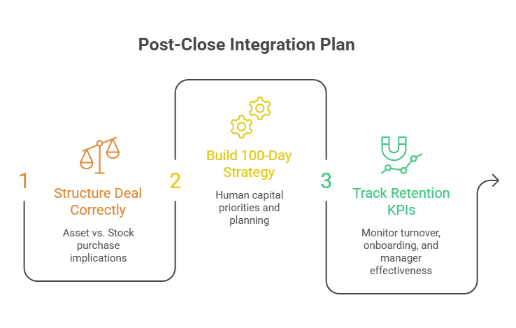
Asset Purchase vs. Stock Purchase Workforce Obligations
Deal structure determines which workforce obligations you assume at close and which you don’t. Getting this wrong creates legal exposure before your integration plan is a week old.
In a stock purchase, the target company generally remains the employer, so existing employment agreements, benefit plans, collective bargaining obligations, payroll arrangements, and workforce liabilities typically continue within the acquired entity.
In an asset purchase, employment does not transfer automatically. The seller typically terminates employment, and the buyer selectively rehires employees, which creates significant operational and compliance implications.
Under Goodwin’s 2025 guidance on asset acquisitions, every rehire is treated as a new hire for I-9 verification and employee benefits enrollment purposes. Selective rehire creates antidiscrimination exposure if selection criteria aren’t documented and defensible.
H-1B and other immigration-sponsored roles require separate review. New or amended filings may be required if the transaction does not qualify as a successor-in-interest arrangement or if there are material changes to job duties, work location, or employment terms.
Equity and incentive plans also need explicit review because they rarely carry over cleanly in an asset purchase without negotiated carve-outs.
WARN Act allocation follows a clear statutory line regardless of structure. The seller carries responsibility for notice obligations through the effective date of the sale. The buyer owns everything after.
Building the 100-Day Human Capital Strategy
The 100-day plan is an investment-thesis execution document, and the human capital components drive a disproportionate share of whether the thesis holds.
AlixPartners' 2025 PE Leadership Survey found that 62% of PE firms now employ a dedicated Human Capital Partner, and that firms with one in place report better leadership quality and fewer unplanned CEO transitions. This is a structural shift in how the industry thinks about people risk.
For PE acquirers, workforce planning is no longer a soft integration workstream. It is a baseline operational expectation.
We recommend sequencing the first 100 days around four human capital priorities:
Stabilize employee retention for your critical talent pool immediately at close
Complete a compensation review and address any under-market exposures before they become attrition drivers
Initiate HRIS and payroll systems integration with a specific go-live date and defined accountability
Execute culture alignment work with measurable milestones rather than open-ended goals
Retention KPIs, Onboarding Structure, and Early Communication
Employee retention risk peaks in the first 90 days. Data shows that 22% of workers leave a new job within their first 90 days, with 60% of those citing poor or disorganized training as the primary cause.
Strong onboarding programs deliver 82% higher retention and 70% higher productivity compared to peers with weak programs. In a PE-backed integration where performance targets are already live, that gap compounds fast.
Track these KPIs through the first 90 days.
Voluntary turnover rate versus the pre-close baseline
Retention agreement compliance for your critical employee pool
Onboarding completion rates by department and seniority level
Manager effectiveness signals from structured new-hire check-ins
Pro tip: Treat communication as part of the retention system. Tell employees what is changing, what is not changing, who they can ask for answers, and when the next update will come.
Attrition spikes that follow a poorly managed announcement are difficult to reverse once they start.
Turn HR Due Diligence Into Post-Close Value With Alpha Apex Group
HR due diligence is the highest-leverage workstream in a PE acquisition and the most consistently underinvested. Legal exposure, compensation liabilities, talent risk, cultural misalignment, and systems gaps don’t stay contained to their own categories. They compound. And they surface after close, when your options for addressing them are more limited and more expensive.
Human capital findings should inform deal price, deal structure, and the integration plan at the same time. When PE acquirers treat the HR workstream this way from the first day of diligence, it becomes a return driver. When they ignore it, it becomes a liability to manage instead of value to capture.
Our team at Alpha Apex Group helps PE acquirers build HR due diligence programs that connect workforce risk, leadership continuity, compliance exposure, and integration planning directly to deal economics and post-close execution.
Contact us to strengthen your human capital diligence before your next acquisition.
Frequently Asked Questions
What is HR due diligence, and why is it important in business transactions?
HR due diligence is the process of evaluating a target company's people-side risks before a deal closes. It covers employment agreements, compensation liabilities, talent quality, cultural fit, and systems infrastructure. In a PE acquisition, it matters because unexamined HR findings become inherited liabilities that affect deal price, deal structure, and post-close performance.
What are the key components evaluated in an HR due diligence process?
The core components are legal and compliance exposure, compensation and benefits liabilities, talent quality and retention risk, cultural alignment, HR systems infrastructure, and post-close integration planning. Each carries its own financial exposure, and findings in one area frequently affect decisions in another.
What are the common challenges faced during HR due diligence?
The most common challenges are compressed timelines, incomplete HR records at the target company, difficulty quantifying cultural misalignment, and underestimating systems integration costs. All four surface after close when they're more expensive to fix.
What are the 4 P's of due diligence?
The 4 P's are People, Process, Performance, and Potential. In an HR context, People covers talent and retention risk, Process covers compliance and systems infrastructure, Performance covers workforce productivity and compensation benchmarking, and Potential covers cultural fit and the organization's capacity to execute the buyer's value-creation thesis.
Research Appendix
- The Future of Human Capital in M&A
- Cultural Integration in M&A Report 2023
- Merger & Acquisition Culture
- FTC Bans Noncompetes Effective September 4, 2024
- FTC Announces Rule Banning Noncompetes
- States Restrict or Ban Noncompetes
- FLSA Misclassification
- DOL New Report on FLSA Mistakes
- ICE Rewrites the Rules on Form I-9 Violations
- EEOC Highlights Record-Breaking Results in Agency Reports
- Employment Practices Liability Insurance
- Research on Pay Equity Audits
- Employer Health Insurance Cost Expected to Exceed $18,500 per Employee in 2026
- Employee Benefits in Mergers and Acquisitions: Defined Benefit Pension Plans
- 2025 PE Executive Equity Report
- Talent Retention and Selection in M&A
- The Myth of Replaceability: Preparing for the Loss of Key Employees
- M&A Challenges: Employee Engagement and Retention
- Employee Retention: The Real Cost of Losing an Employee
- Culture: The Key to M&A Success
- Mergers and Acquisitions: WARN and the NLRA
- Diversity Matters Even More: The Case for Holistic Impact
- Breaking Down the Costs of HRIS Systems
- Automated Employment Decision Tools
- Illinois Joins Colorado and NYC in Restricting Generative AI in HR
- 2025 Cost of a Data Breach Report
- Data Privacy in M&A: Navigating Risks from Diligence to Integration
- How to Secure and Retain Top Talent
- 10th Annual PE Leadership Survey
- Employee Onboarding Statistics
- Why Onboarding Matters and Affects Retention in the Long Term
.jpg)
.jpg)