The Real Reason Culture Breaks After a Merger
When two companies merge, things can look solid on paper. Financials align, strategies are mapped out, and the announcement is polished. But within 18 months, key people leave, productivity drops, and teams struggle to agree on basic decisions.
This is a post-merger culture failure, and it quietly undermines deals that seemed well planned.
Despite $8.3 trillion in M&A activity over the past decade, between 70% and 90% of deals fail to deliver expected value. Research shows that mismanaging people and organizational culture accounts for nearly two-thirds of those failures, while almost half of executives cite cultural fit and integration challenges as a primary cause.
As David Burns puts it,
“The number #1 reason mergers fail? It’s not execution, it’s culture. Teams that don’t align won’t execute.”
What most companies miss is where the problem actually begins. It rarely starts with financials or operations. Cultural misalignment builds gradually and disrupts how teams make decisions and work together.
In practice, these issues typically stay hidden until execution starts to break down. Teams slow down, alignment weakens, and decision-making becomes inconsistent.
This is exactly where structured support becomes critical. Alpha Apex Group works with you at this stage to align leadership, define clear ways of working, and turn corporate culture into something teams can actually act on.
What Is Post-Merger Culture Failure (And Why Is It So Easy to Miss)?
Post-merger culture failure occurs when two organizations fail to align how people actually work after a merger. This includes how decisions are made, how teams communicate, and what behaviors are rewarded.
This is what makes it so easy to miss. Culture doesn’t show up in due diligence reports or financial models, so leaders mostly assume culture compatibility based on surface-level similarities. Two companies may both claim to be “customer-focused,” for example, yet operate with completely different decision-making styles, leadership approaches, and communication norms.
The result is what many organizations experience as perpetual integration mode: a state where the integration process never truly ends. Under pressure, teams revert to legacy behaviors and fall back into silos instead of building a unified company culture.
Even though 95% of executives say cultural integration is critical, and 80% of deals prioritize it early, 75% of acquirers still face serious cultural challenges post-deal. The gap comes from misunderstanding culture itself and underestimating how deeply cultural incompatibility shapes behavior.
Check out this YouTube video for a deeper dive on how culture contributes to failed mergers:
Signs of Post-Merger Culture Failure (Early Warning Indicators)
Post-merger culture failure typically first shows in your teams' behavior.
Common early warning signs include:
Rising voluntary attrition, particularly among high performers
“Us vs. them” dynamics between legacy teams
Slower or conflicted decision-making
Communication breakdowns across departments
Leadership misalignment and mixed messaging
Declining employee engagement, employee morale, and productivity
An integration process that drags far beyond expected timelines
These signals mostly emerge months before a measurable business impact. This makes them critical indicators of deeper merger culture integration problems that shouldn’t be ignored.
Top Reasons for Post-Merger Culture Failure (and Integration Problems)
Post-merger culture failure rarely stems from a single issue. It’s the result of interconnected breakdowns that compound over time. One friction point triggers another to create a cascade of merger culture integration problems.
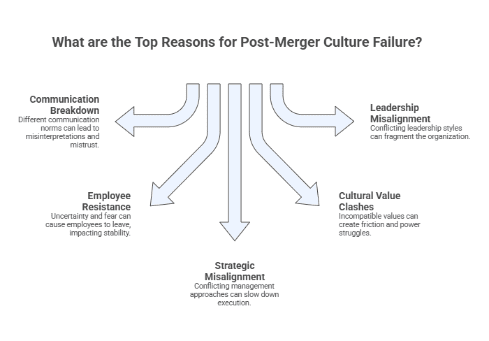
Below, we have shared some of the biggest reasons that contribute to failed mergers.
1. Communication Breakdown Between Merging Companies
Every organization has its own communication norms. Some examples here are formal vs informal, top-down vs collaborative, and synchronous vs asynchronous. When these collide, teams misinterpret intent, duplicate work, or avoid collaboration altogether.
The result is confusion, mistrust, and siloed thinking, which undermines corporate communication as well as your day-to-day operations.
2. Employee Resistance During Culture Integration
Resistance is usually psychological. Mergers disrupt the psychological contract between employer and employee, triggering uncertainty, identity threat, and fear around employee motivations like job security and career opportunities.
The data reflects this reality: 33% of acquired employees leave within the first year, compared to just 12% of similar hires. Overall turnover jumps by 45% after a merger.
We have noticed that when this goes unaddressed, it damages employee wellbeing and employee satisfaction. It reduces engagement, impacts morale, and weakens retention at a time when stability matters most.
3. Strategic Misalignment After a Merger
Even when leadership agrees at a high level, differences in management approach quickly surface. One company may prioritize scale, the other specialization. One focuses on short-term wins, the other on long-term innovation.
These conflicting decision-making styles create daily friction, which slows down execution and weakens the intended value of the deal.
4. Cultural Value Clashes in Mergers
At the core of many failures is cultural incompatibility. This includes differences in risk tolerance, organizational values, and behavioral expectations.
A hierarchical culture may clash with a team-oriented culture. A fast-moving, experimental environment may conflict with one built on control and process.
In our experience, teams don’t always recognize how deep these differences run until they start affecting trust and accountability.
This is where many integrations begin to lose momentum. What starts as discomfort can turn into power struggles, inconsistent standards, and breakdowns in trust.
5. Leadership Misalignment in Post-Merger Integration
Culture is shaped from the top. When leaders model conflicting behaviors or fail to align on a unified cultural leadership style, the entire organization fragments.
Cultural gaps at the leader level cascade downward and create confusion across teams. Instead of moving toward integration, teams drift further apart.
What makes these factors dangerous is how they interact. Communication breakdown fuels employee resistance, resistance intensifies value clashes, and leadership misalignment stops any resolution.
This creates a cycle that continues to build and drive post-merger culture failure long before financial results begin to reflect the impact.
You can explore this further in our detailed guide on how the right Merger and Acquisition Consulting partner can help you manage culture more effectively after a merger.
Talent Loss: The Hidden Cost of Post-Merger Culture Failure
The most underestimated consequence of post-merger culture failure is talent loss.
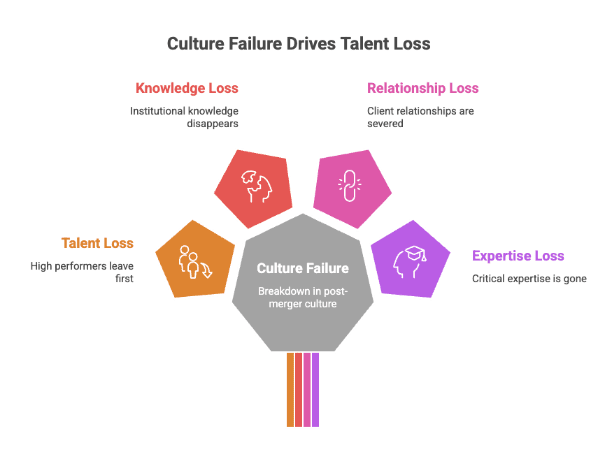
When culture breaks down, employees leave. And this isn’t random attrition, either. The first to go are typically high performers and high-mobility employees. In other words, the people with the strongest networks, the most options, and the greatest impact on performance.
The numbers make this clear: acquired firms lose 4 out of 10 managers within the first 24 months, which is three times the normal turnover rate. Even though 72% of acquirers invest in retention programs, financial incentives alone fail to address deeper issues tied to organizational culture and employee experience.
What’s walking out the door here? Among other valuable things, you’re losing institutional knowledge, client relationships, and critical expertise. As a result, companies don’t just lose people, they lose the very capabilities the merger was meant to strengthen.
We have seen this play out across different teams. During merger culture integration problems, attrition hits the talent you can least afford to lose.
How to Prevent Post-Merger Culture Failure: 6 Proven Integration Strategies)
If you want to avoid post-merger culture failure, you need disciplined, hands-on execution across the entire integration lifecycle.
The following steps you need to take to give your teams the best chance of success.
1. Conduct Cultural Due Diligence Before the Deal Closes
Most companies assess culture too late or keep the process too vague. Effective cultural due diligence needs to be structured and based on real data.
In our experience, this is where many teams fall short. Culture is discussed, but not measured in a way that reveals real differences.
This includes:
Running parallel culture diagnostics instead of joint ones to uncover real differences
Mapping both organizations against frameworks like the Competing Values Framework to identify gaps in control vs flexibility, or internal vs external focus
Auditing decision-making styles: Who actually makes decisions? How fast? With how much data?
Analyzing communication norms using internal comms samples (emails, Slack/Teams patterns, meeting cadences)
Reviewing external signals (for example, Glassdoor and exit interviews) to uncover hidden friction points
The goal is to identify non-negotiable differences that will create friction during the integration process.
2. Build a Shared Culture Instead of Forcing One
“Culture blending” only works if it’s intentional. In practice, most integrations default to dominance, and usually by the acquirer.
A better approach is to:
Identifycritical behaviors to preserve from both organizations (e.g., speed vs rigor, autonomy vs control)
Define3-5 operating principles that will guide the new company culture
Get clear on a unifieddecision-making approach. This is where most integrations fail in practice.
Test the new culture through real scenarios (How would we handle a missed revenue target? A product failure?)
From what we have seen, alignment under pressure is the real test. If leaders can’t agree on how decisions get made under pressure, the cultural and organizational marriage you’re aiming for isn’t happening.
3. Create a Structured Culture Integration Plan
Culture fails when it’s treated as an abstract concept instead of an operational system.A strong integration plan connects culture directly to how teams work every day.
It should include:
A culture workstream within the broader integration management office (IMO), with clear ownership
A defined set of “cultural fault lines” (for example, risk tolerance, leadership style, and performance expectations) tied to business outcomes
A 90-day roadmap with specific interventions (leadership alignment sessions, cross-team pilots, and decision-rights clarification)
Close involvement from both HR and business leaders, with shared responsibility for execution
We have observed that teams make progress when culture is tied directly to execution. It needs to show up in how decisions are made, how teams collaborate, and how performance is managed.
4. Retain Key Talent During Culture Integration
Employee retention efforts fall short because they focus on compensation instead of control and clarity. To retain top talent, identify mission-critical individuals early. This includes not just senior leaders, but also informal influencers and key knowledge holders.
Conduct stay interviews rather than waiting for exit interviews. Ask what might cause them to leave now, and address those concerns directly. Give key employees visible roles in the integration process to build ownership and reduce uncertainty.
You should also clarify career pathways within the first 60-90 days. This is most important in areas impacted by leadership changes. Also, always protect key elements of employee well-being like flexibility, autonomy, and access to leadership.
Remember that high performers don’t leave for money; they leave when they lose trust in the future.
5. Use Transparent Communication to Reduce Resistance
A lot of internal communication strategies fail because they are one-directional and overly polished.
Effective corporate communication during integration looks like:
Weekly leadership updates that address what’s changing, what’s not, and what’s still unknown
Consistent messaging across leaders to avoid communication tangles and conflicting narratives
Structured feedback loops via pulse surveys, anonymous Q&A, and live forums, with visible follow-through
Clear articulation of why decisions are being made, not just what decisions are being made
6. Measure Cultural Integration with Clear Metrics
If you are not measuring culture, you are managing it without clear visibility. We suggest moving beyond generic engagement surveys and track metrics that reflect how teams actually work together.
Based on our experience, these metrics help you spot issues early and take action before they start affecting performance.
| Metric | What it shows |
|---|---|
| Decision velocity | How long does it take for teams to make cross-functional decisions after the merger |
| Cross-functional collaboration rates | The level of collaboration between legacy teams through joint projects |
| Attrition by performance segment | Whether high performers are leaving at a higher rate |
| Time to productivity | How quickly acquired employees reach expected performance levels |
| Employee sentiment trends | How employee perception changes across different integration milestones |
These metrics turn culture from a vague concept into a manageable system, and allow you to intervene before small issues become systemic failures.
Handle Post-Merger Culture with Confidence with Alpha Apex Group
Most organizations underestimate how complex the human side of mergers and acquisitions really is until post-merger culture failure is already underway.
At Alpha Apex Group, we bring a structured, data-driven approach to corporate cultural integration, combining deep expertise in cultural due diligence, organizational change management, and leadership alignment.
We work directly with leadership teams to diagnose cultural risks early, design practical integration strategies, and stabilize organizations that are experiencing merger culture integration and organizational problems.
Whether you're preparing for a deal, navigating a difficult integration, or recovering from a breakdown in organizational culture, our team provides the clarity, tools, and execution support needed to move forward with confidence.
If you want to avoid costly culture mistakes in your next merger, connect with Alpha Apex Group to start the conversation.
FAQs
Why do so many mergers fail due to cultural issues?
Because leaders underestimate cultural differences during due diligence. Misalignment in values, leadership styles, and ways of working disrupts execution after the deal.
What are the most common signs of merger culture integration problems?
Early signs include rising attrition, “us vs. them” dynamics, slower decision-making, leadership misalignment, and declining employee engagement.
How early should cultural due diligence begin?
Cultural due diligence should begin in the pre-deal phase, alongside financial and legal analysis, to identify risks before integration planning starts.
What role does leadership play in post-merger culture failure?
Leadership sets the tone for integration, while misaligned leadership behaviors and messaging can quickly cascade into organization-wide confusion and fragmentation.
How does Alpha Apex Group approach cultural integration in M&A?
Our team at Alpha Apex Group takes a structured, data-driven approach that combines cultural diagnostics, leadership alignment, and practical integration execution to ensure lasting results.
Appendix
- Bain & Company — How to Avoid the Fault Lines Sending Tremors through Cultural Integration in M&A (2023 M&A Report)
https://www.bain.com/insights/cultural-integration-m-and-a-report-2023/ - WTW — 2024 M&A Retention Study
https://www.wtwco.com/en-us/insights/2024/03/2024-m-and-a-retention-study - McKinsey & Company — The Importance of Cultural Integration in M&A: The Path to Success (2024)
https://www.mckinsey.com/industries/oil-and-gas/our-insights/the-importance-of-cultural-integration-in-m-and-a-the-path-to-success - Deloitte Luxembourg — The Future of Human Capital in M&A
https://www.deloitte.com/lu/en/our-thinking/future-of-advice/the-future-of-human-capital-in-m-and-a.html - ECGI / Wharton School — Race, Gender, and Employee Turnover: Evidence from Mergers and Acquisitions (2024)
https://www.ecgi.global/publications/blog/race-gender-and-employee-turnover-evidence-from-mergers-and-acquisitions - SHRM — Culture in M&A (HR Magazine)
https://www.shrm.org/content/dam/en/shrm/topics-tools/news/hr-magazine/CMS_011564.pdf - Pepperdine University — Cultural Due Diligence in Mergers and Acquisitions (Academic Research)
https://digitalcommons.pepperdine.edu/etd/1385/ - KPMG Canada — The Culture Blind Spot: Why Mergers Fail (2025)
https://kpmg.com/ca/en/insights/2025/04/mergers-fail-when-cultures-clash.html - BCG — Breaking the Culture Barrier in Postmerger Integrations (2016)
https://www.bcg.com/publications/2016/breaking-the-culture-barrier-in-postmerger-integrations - WTW / Consultancy-ME — Why Post-Merger Integrations Fail from a Change and Culture Perspective (2025)
https://www.consultancy-me.com/news/10285/why-post-merger-integrations-fail-from-a-change-and-culture-perspective - EY UK — How Culture Can Unlock M&A Performance
https://www.ey.com/en_uk/insights/workforce/how-culture-can-unlock-m-a-performance - MarshBerry — M&A Cultural Due Diligence: Don't Forget the Culture (2024)
https://www.marshberry.com/resource/due-diligence-dont-forget-the-culture/ - MIT Sloan Management Review — Your Acquired Hires Are Leaving. Here's Why (Daniel Kim, 2019)
https://mitsloan.mit.edu/ideas-made-to-matter/your-acquired-hires-are-leaving-heres-why - Financier Worldwide — Culture Clashes in M&A: New Perspectives
https://www.financierworldwide.com/culture-clashes-in-ma-new-perspectives - Financier Worldwide — M&A Challenges: Employee Engagement and Retention
https://www.financierworldwide.com/ma-challenges-employee-engagement-and-retention - Harvard Business Review — The Big Idea: The New M&A Playbook (2011)
https://hbr.org/2011/03/the-big-idea-the-new-ma-playbook
 Most Trusted Total Rewards Consulting Firms in 2026
  Top 10 Professional Employer Organization (PEO) Companies for 2026: Best Options for HR, Payroll, and Compliance
  Employee Value Proposition (EVP): Framework & Examples
  HR Due Diligence: Complete Guide for PE Acquirers
  Best 12 PMI Consulting Firms in 2026 for Successful Post-Merger Integration
  Best-in-Class Workplace Investigation Consulting Firms to Watch in 2026 The Real Reason Culture Breaks After a Merger
  Employee Experience Consulting: Aligning Culture for Executive Success
  Culture Audit After an Acquisition: What to Assess First
  Top 14 US Employee Experience Consulting Companies to Watch in 2026
  Merger and Acquisition Consulting: People & Culture Integration for PE Success
  Top 35+ HR Assistant Interview Questions
  40+ HR Manager Interview Questions & Answers
  Employee Onboarding Checklist: Complete Guide
  What Most Companies Get Wrong When Hiring SRE Teams (And What To Do Instead)
  How To Measure Company Culture in 2026: 8 Effective Methods
  Top 10 Company Culture Consulting Firms in Denver in 2026
  Startup Culture: What It Is, Why It Matters, and How to Build It
  Role of Company Culture in Employee Engagement
  Where to Find ServiceNow Developers: Best Talent Pools
 .jpg)
.jpg)

.jpg)

.jpg)
.jpg)