Merger and Acquisition Consulting: People & Culture Integration for PE Success
Most M&A (mergers and acquisitions) deals don’t fail because of the numbers. They fail because of people.
70–90% of mergers and acquisitions fail to deliver expected value, and cultural misalignment is consistently ranked as the top reason why.
You can structure a clean deal, validate the financials, and still lose value post-close when teams fail to align.
For Private Equity (PE) firms, the margin for error is even smaller. Compressed hold periods, aggressive value creation timelines, and investor return expectations mean there's no room for a slow, reactive integration.
Every month of cultural drift or talent loss is a month of EBITDA you're not capturing.
This is where people and culture integration becomes critical. It spans the full lifecycle: pre-deal diligence, post-close org design, change management, and synergy execution.
In this article, we break down what effective integration looks like in a PE context, and what separates firms that capture modeled returns from those that leave value on the table.
We’ll cover:
What M&A consulting looks like in a PE context
Where people and culture fit across the deal lifecycle
Key integration risks like culture clash and talent loss
How to assess people and orgs during due diligence
What effective post-close integration requires
Org design and its role in value creation
How to choose the right consulting partner
The role of data and AI in integration
What to expect from a people integration engagement
P.S. Are you confident your portfolio companies won’t lose value post-close due to people and culture misalignment?Alpha Apex Group helps PE firms align talent, leadership, and operating structures to protect EBITDA and accelerate value realization.
What Merger and Acquisition (M&A) Consulting Actually Covers in a PE Context
M&A consulting is usually used as a catch-all term, but the actual scope varies significantly depending on where you are in the deal and what transaction type you're running. At its broadest, the field spans investment banking advisory, commercial due diligence, operational transformation, tax structuring, and post-merger integration.
In a PE context, the advisory work is more compressed, more operationally focused, and more directly tied to value creation. Clarity on scope helps you choose the right partners and avoid issues that slow down integration.
Core Advisory Services Relevant to PE Deals
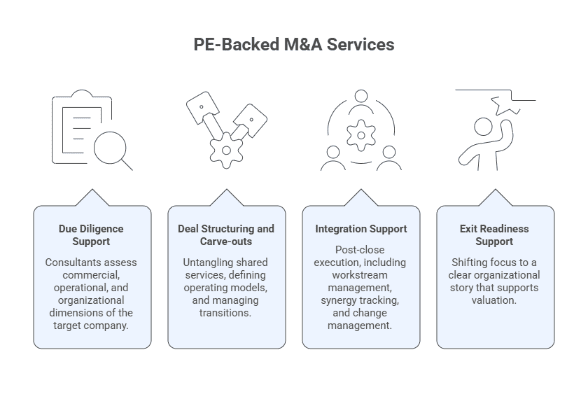
The core services that matter most in PE-backed M&A transactions fall into four areas.
Due diligence support is where most engagements begin. Consultants assess the target company across commercial, operational, and organizational dimensions, giving the deal team a clearer picture of what they're actually buying. This goes beyond financial reporting and looks at the underlying capabilities, workforce structure, and management quality of the acquisition target.
Deal structuring and carve-outs add another layer of complexity. When a PE firm is separating a business unit from a larger parent, the consulting work includes untangling shared services, defining the new entity's operating model, and managing the transition of vendor management platforms, HR systems, and legal entities.
Integration support covers post-close execution: workstream management, synergy tracking, and change management.
Exit readiness support. As you move toward the exit, the focus shifts. You need a clear organizational story that supports valuation in the next transaction process.
Where People & Culture Consulting Fits in the M&A Lifecycle
People and culture work doesn't start at close. It runs across the entire lifecycle, and the firms that treat it as a post-close cleanup job consistently leave value on the table.
This is where most teams get it wrong.
In the pre-deal phase, people consulting feeds directly into diligence. A capabilities assessment of the leadership team happens here, compensation benchmarking identifies cost exposure, and early cultural diagnostics give acquirers a read on integration risk before a letter of intent is signed.
From what we have seen, this stage is usually under-scoped. Access to data is limited due to confidentiality agreements, so you need frameworks that work with incomplete information. Without that, early assumptions carry forward and create issues after the close.
The post-close phase is where the real integration work plays out. Culture alignment, talent retention, org design, and synergy realization all require sustained execution over the first 100 days and beyond.
We have observed that teams that delay people's decisions early on struggle to recover later.
McKinsey found that organizations committed to implementation rigor, people-focused goals like employee experience and talent management, and appropriate resourcing are 3.4 times more likelyto achieve and sustain their transformation gains for more than three years.
In the PE context, where M&A activity is evaluated against hard return targets, that performance gap shows up in the multiple.
The People & Culture Risks PE Firms Can't Afford to Ignore
Integration risk isn't evenly distributed. Most technical work (systems migrations, legal entity consolidations, financial reporting alignment) has a clear owner and a defined endpoint.
People and culture risk are different. It's slower-moving, harder to quantify, and far more likely to compound quietly until it becomes a serious problem.
For PE firms running on tight hold periods, this combination is particularly dangerous.
Why Culture Clashes Destroy Deal Value
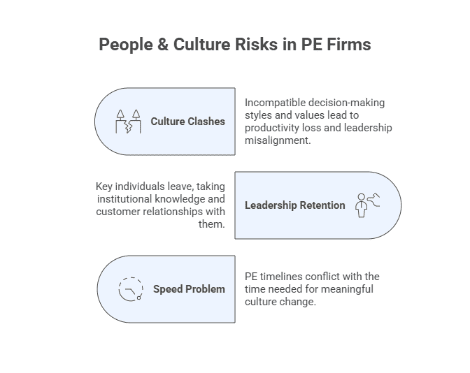
Culture incompatibility carries direct, measurable consequences. When two organizations operate with different decision-making styles, norms, or values, friction builds quickly without a clear integration plan. This shows up in productivity loss, leadership misalignment, and disruption at the customer level.
A Mercer analysis of 1,400 M&A deals found cultural issues cited in roughly 30% of failed integrations as a primary cause of missed financial targets. In joint ventures and platform acquisitions where two distinct management cultures must operate as one, that risk is even more concentrated.
We have noticed that culture clashes rarely stay contained. They mostly trigger talent flight.
When employees feel a disconnect with the new operating model, the most capable people start exploring other options first. This talent loss feeds directly into the next risk.
Leadership Retention Risk and Talent Flight Post-Close
Key-person dependency is one of the most underestimated risks in business acquisition.
In lower middle market deals, value is usually concentrated in a small number of individuals. This could be the founder, a top sales producer, or a technical lead holding critical proprietary insight about the product or customer relationships.
When these people leave post-close, they take institutional knowledge, customer relationships, and team stability with them.
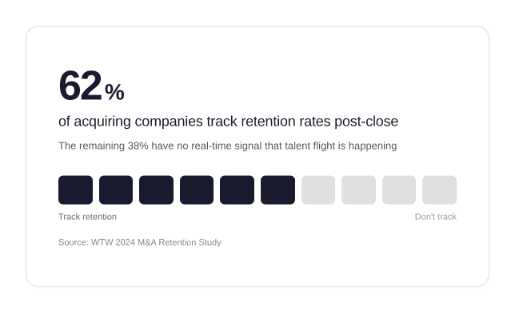
The WTW 2024 M&A Retention Study found that only 62% of acquiring companies even track retention rates as a success metric. This means many teams lack early visibility into talent flight and only react once performance is already impacted.
Consider a lower middle market services business where the founder has run sales for 15 years and holds most key client relationships personally. The acquirer models revenue retention at 90% but has no formal plan to transition those relationships or retain the founder through a structured earn-out.
By month six, the founder has disengaged, and two anchor clients have followed. The revenue retention assumption collapses. This scenario plays out across PE portfolios more often than deal teams acknowledge. Retention planning (stay bonuses, equity participation, role clarity) needs to be in motion before close.
The Speed Problem: PE Timelines vs. Culture Change Realities
Culture change takes time, and so does capturing the value from organizational transformation.
McKinsey research shows that roughly half of the transformation value is realized within the first 18 months, with the remaining value taking longer to capture. This timeline often extends beyond the early integration window.
PE hold periods typically run 3 to 5 years, and the value creation window is shorter once exit preparation is factored in.
We have noticed that pushing alignment too quickly creates resistance. Waiting too long creates drift that becomes harder to fix later. Both paths slow down value capture.
A more practical approach is a phased alignment. Focus on what needs to be standardized early, then allow bigger changes to develop over time. Operational norms, reporting structures, and communication cadences can be standardized quickly.
Deeper culture shifts around values and ways of working require more time and deliberate change management investment. Where digital transformation is part of the value creation thesis, technology change and culture change have to move in parallel. Neither can stall the other.
People & Culture Due Diligence: What to Assess Before the Deal Closes
Most PE firms have a well-worn diligence checklist for financials, legal, and commercial risk. The people and culture side gets less systematic attention, and that gap shows up later.
In our experience, the firms that treat organizational diligence as a first-class workstream come out of close with fewer surprises, better retention outcomes, and a more actionable integration plan.
1. Cultural Diagnostic Frameworks
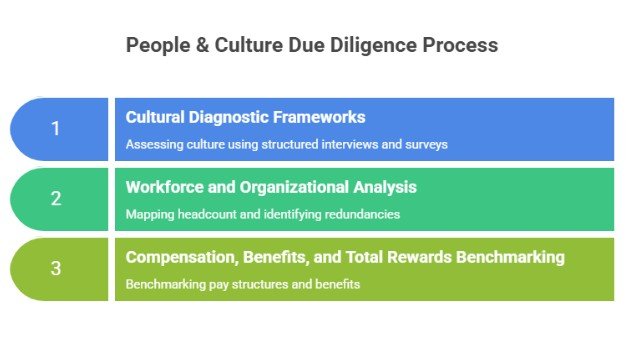
You can't fix a culture problem you didn't see coming. Cultural assessment has to happen before the letter of intent converts into a signed deal, not after.
Culture is harder to measure than headcount or EBITDA, so consultants need structured frameworks rather than gut feel.
The most commonly used approaches include:
Structured leadership interviews (typically 6 to 10 sessions) covering decision-making style, risk tolerance, conflict resolution, and accountability norms, producing a scored cultural profile and a red flag log.
Employee sentiment analysis from engagement surveys, exit data, or third-party tools benchmarked against industry norms.
Cultural archetype mapping using frameworks like the Competing Values Framework, generating a one-page culture comparison between the acquirer and the target.
When access is limited due to confidentiality constraints, indirect signals become important. This includes Glassdoor data, turnover patterns, and communication dynamics during management presentations.
In many cases, strong diagnostics do not rely on perfect data. They rely on clear frameworks that work with limited visibility.
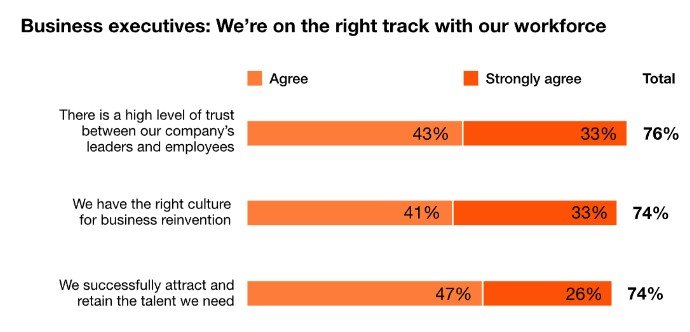
This matters because perception and reality often do not align. According to PwC's Pulse Survey on business reinvention, 74% of executives believe they have the right culture in place for transformation.
However, the same research shows a different view at the employee level. Only 35% said their manager tolerates small-scale failures, and just 33% said their manager encourages dissent and debate.
This gap between leadership perception and day-to-day experience is exactly what cultural diagnostics are meant to uncover.
2. Workforce and Organizational Analysis
Cultural fit matters, but so does the structural reality of what you're acquiring. Workforce and organizational analysis during diligence gives the deal team a clear picture of the human capital footprint and where the redundancies, gaps, and risks actually live.
This work typically covers:
Headcount by function and location mapped against the acquirer's org structure.
Spans-and-layers analysis identifying where the target is over-managed or under-resourced.
Role redundancy mapping across functions like finance, HR, and sales operations.
In platform acquisitions with bolt-on deals to follow, org mapping becomes a repeatable input into each new acquisition target assessment, building pattern recognition across the portfolio.
Role redundancy analysis is particularly important in corporate acquisitions where the investment thesis includes cost synergies.
If consolidation decisions are laid out in diligence rather than improvised after close, execution is cleaner and faster.
3. Compensation, Benefits, and Total Rewards Benchmarking
Compensation surprises post-close are expensive and avoidable. Total rewards benchmarking maps the target's pay structure against market data, flags outliers in either direction, and surfaces the cost exposure of harmonizing benefits across two organizations.
The key risk areas to assess include:
Base salary gaps where below-market pay signal higher retention risk than headcount numbers suggest
Above-market compensation that inflates cost synergy assumptions in the model
Benefits harmonization costs around health plans, retirement matching, and equity participation, particularly where employee liabilities transfer as part of an asset sale
This is usually underestimated during diligence. The cost only becomes clear once integration is underway.
Post-Merger Integration: How to Build One Culture Without Losing Value
Closing the deal is where the real work begins. The first 100 days are where M&A transactions either gain traction or start falling apart, and the difference almost always comes down to how well the people and culture workstream was planned before signing.
Structure, communication, and talent decisions made in this window set the trajectory for everything that follows.
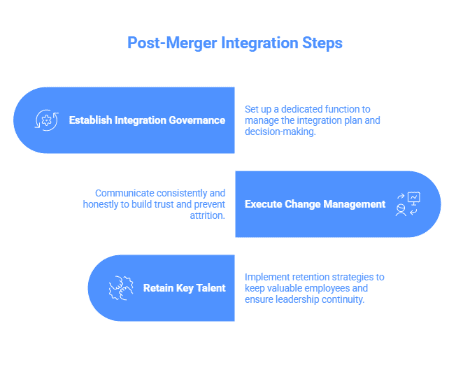
1. Establish Integration Governance and Clear Decision Structures
Without clear governance, integration work fragments. Teams make conflicting decisions, workstreams stall waiting for approvals, and people inside both organizations lose confidence that anyone is actually in charge.
The standard solution is an Integration Management Office (IMO), a dedicated function that owns the overall integration plan, tracks workstream progress, and escalates decisions needing executive resolution.
In a PE context, the IMO typically includes:
A senior integration lead with decision-making authority, not just a coordination role
Workstream owners across HR, finance, operations, IT, and commercial functions
A decision rights framework defining what gets resolved at the workstream level vs. leadership
A weekly cross-functional reporting cadence tied to synergy milestones
In practice, governance is typically treated as a coordination layer rather than a decision system. That is where delays begin.
Getting the IMO structure right early prevents the decision bottlenecks that slow synergy capture. In M&A consulting engagements, this governance setup is usually the first deliverable. Nothing else moves cleanly without it.
2. Execute Change Management and Communication Effectively
Remember that employees don't need perfect information. They need consistent, honest communication from people they trust. When that's missing, the vacuum fills with rumors, and rumors drive the attrition you were trying to prevent.
A structured change management approach covers three things:
The messaging architecture (what gets communicated, by whom, and on what cadence)
Manager enablement so team leads can answer what their people are actually asking
Feedback loops so leadership can track employee sentiment in real time, rather than finding out about problems after people have already decided to leave
A common mistake at this stage is relying too heavily on top-down communication. In reality, the employee experience is shaped by direct managers, not company-wide updates.
Prosci research found that projects with excellent change management are 7 times more likelyto meet their objectives than those with poor change management.
Across many integrations, we have seen that consistency matters more than volume. Regular updates signal stability. Gaps in communication create uncertainty, and uncertainty tends to accelerate talent loss.
When digital transformation is part of the plan, communication becomes even more important. Employees are adapting to both cultural and operational changes at the same time, so clarity and timing need to stay aligned throughout the process.
3. Retain Key Talent and Plan Leadership Continuity
Retention risk peaks in the 90 days after close. This is when uncertainty is highest, competing offers are most likely to land, and the people with the most options are most likely to act on them.
Waiting until someone hands in notice to think about retention is already too late.
Effective retention planning in a post-merger context includes:
Stay bonuses tied to specific milestones rather than arbitrary time horizons, so the incentive aligns with integration progress
Equity participation for senior leaders critical to the investment thesis
Role clarity conversations in the first two weeks, not the first two months
A top-grading process identifying which roles need upgrading and which leaders can genuinely scale with the business
Succession planning usually gets deferred, but it's directly connected to retention. We have noticed that when high performers see a credible path forward in the combined org, they're far less likely to engage with recruiters.
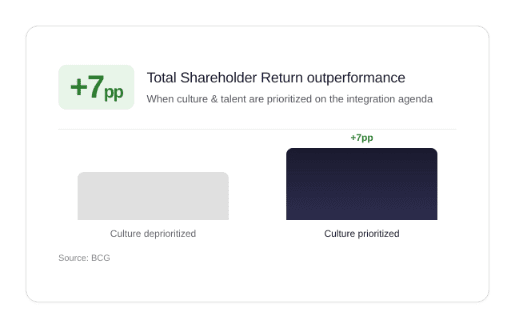
BCG found that companies prioritizing culture and talent in integration generate 7 percentage points more TSR outperformance than those that don't.
In a PE deal where key people are part of the value, succession planning is a core part of risk management.
Operating Model and Org Design in Private Equity M&A
Org design doesn't get enough credit as a value creation tool. Most PE firms think about it defensively (avoiding chaos post-close) rather than offensively, as a way to accelerate the investment thesis.
Insider tip: The firms that treat organizational structure as a deliberate strategic variable consistently capture more of the value they underwrote when evaluating acquisition targets.
Aligning Org Structure to the Investment Thesis
The right operating model depends on how value is expected to be created.
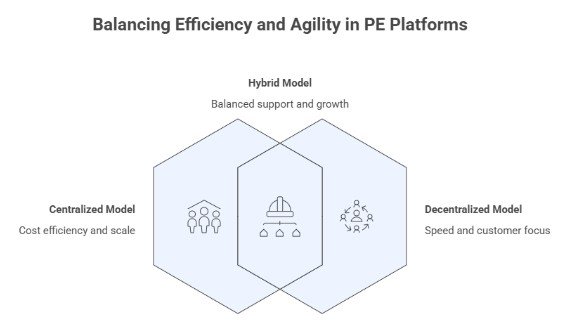
A centralized model consolidates functions like finance, HR, and procurement at the platform level. This supports cost efficiency across bolt-on acquisitions but can slow down teams that need speed to capture market opportunities.
A decentralized model keeps decision-making closer to the customer. This supports revenue growth but often increases overhead as functions get duplicated across the platform.
In practice, most PE-backed platforms land somewhere in between, with centralized support functions and decentralized commercial operations.
The key is making that choice intentionally during target sourcing and early integration planning. When this decision is made early, execution becomes smoother and avoids the cost of reorganizing later.
Synergy Realization Through People-Side Execution
Synergies get modeled in the deal process. Whether they get captured comes down to people-side execution.
Cost synergies that involve headcount consolidation require clear role elimination decisions and retention of the right people through the transition.
Revenue synergies depend on alignment across teams. Sales integration, shared incentives, and consistent ways of working all need to be in place for collaboration to happen.
In practice, this is where many teams fall short. Execution on paper does not always translate into execution in the organization.
Key execution levers include:
Consolidating redundant functions on a timeline matching synergy capture targets in the model
Designing incentive structures that reward behaviors aligned with the combined business strategy rather than legacy individual metrics
Building shared services capabilities that support scale without adding proportional headcount
BCG research shows that more than half of all M&A deals fail to generate returns that outperform their industry. The firms that succeed treat people-side execution as inseparable from financial and operational integration.
In PE, where the difference between a good exit and a great one can come down to a fraction of an EBITDA turn, that distinction matters.
How to Choose the Right M&A People & Culture Consulting Partner
The quality of your integration outcome is directly tied to the quality of the people advising it. PE firms routinely underprice this decision, treating consulting partner selection as an afterthought rather than a critical input into deal execution.
Remember: the right partner brings:
PE fluency
Operational speed, and
Genuine cultural fit with your team.
Whereas the wrong one brings a generic playbook and a team that's never seen the inside of a portfolio company.
Specialist Boutiques vs. Large Consulting Firms
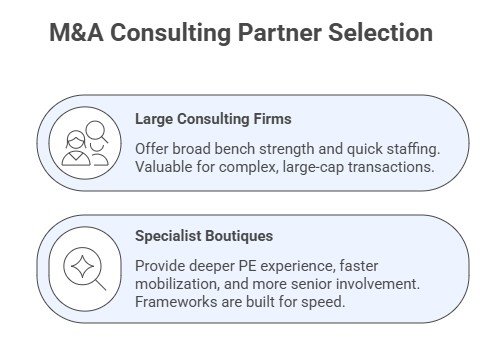
Large management consulting firms bring broad bench strength and the ability to staff up quickly across multiple workstreams. In complex, large-cap transactions across regions, this level of coverage can be valuable.
However, this model does not always translate well to middle-market deals. Senior attention is usually limited, and teams are typically staffed with junior resources. This can slow down execution at a stage where speed matters.
Specialist boutiques take a different approach. They bring deeper PE experience, faster mobilization, and more senior involvement throughout the engagement. Their frameworks are built for speed, and their teams are used to operating within the constraints of a 100-day plan.
This comes with a trade-off. Boutiques may not have the capacity to support a full transformation across every function at the same time.
The right choice depends on deal complexity, hold period timeline, and how much integration work you want a single partner to own.
For most middle-market corporate acquisitions, a specialist boutique with genuine PE experience will outperform a large firm fielding a junior team.
What to Look for: PE Experience, Speed, and Cultural Fit
Whether you're evaluating consultancy buyers or building a shortlist from scratch, the same criteria separate genuine PE fluency from firms that have added 'PE practice' to their website.
Key things to assess:
Direct experience with PE-backed integrations at a comparable deal size, not just large-cap M&A activity with different dynamics
The ability to be operational within days of engagement, since Day 1 readiness doesn't wait for a lengthy onboarding process
A track record on retention outcomes and synergy capture, not just process delivery
Honest answers during a confidential discovery call about where their capabilities assessment ends and where they'd recommend bringing in additional support
Red flags to watch for: over-reliance on proprietary insight that can't be explained clearly, vague case studies that don't connect to measurable outcomes, and proposals that look identical regardless of your investment thesis.
A good partner asks hard questions before they pitch solutions. That's the clearest signal they understand how PE deals actually work.
The Role of Data and Technology in Private Equity M&A Integration
Technology is changing how integration work is executed, particularly on the people-and-culture side.
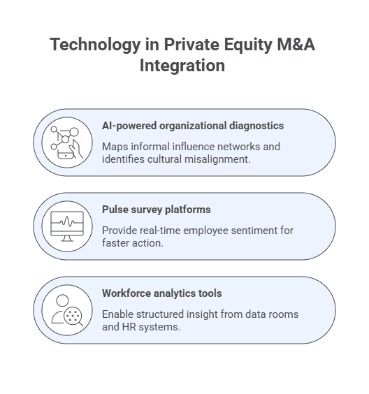
AI-powered organizational diagnostics can now map informal influence networks, identify flight risk patterns, and surface cultural misalignment faster than traditional survey methods.
Pulse survey platforms give integration teams real-time employee sentiment rather than lagging indicators that arrive too late to act on.
Workforce analytics tools are also changing how consultants approach target companies, enabling structured insight from data rooms and HR systems early in diligence.
In practice, teams that use these tools move faster and make more informed decisions during integration.
In fact, McKinsey found that firms using gen AI in M&A report deal cycles 30 to 50% faster than those running traditional processes. Partners who haven't built these capabilities into their delivery model are already behind.
Turn M&A Strategy into Measurable Outcomes with Alpha Apex Group
People and culture integration carries the same weight as any core advisory function in a PE deal, because it directly shapes how much value actually gets realized after close.
Cultural misalignment reduces value, talent loss weakens the capabilities you invested in, and org design decisions that are not aligned with the investment thesis create friction that slows execution.
These outcomes are not inevitable. In most cases, they stem from underinvesting in the people side at the moments that matter most during the deal lifecycle.
A structured integration approach helps address this early, covering pre-close diagnostics, post-close governance, and retention planning through the first phase of execution.
If your firm is preparing for an acquisition, executing a carve-out, or building a platform with additional deals ahead, your integration strategy needs to be defined before the deal is signed.
Get ahead of the risk. Connect with Alpha Apex Group today to identify gaps early and build a structured, execution-ready integration strategy for your next deal.
Frequently Asked Questions
Why do 70% of M&A deals fail?
Most M&A failures trace back to people and culture problems rather than financial or strategic ones. When two organizations with different operating norms, leadership styles, and values are forced together without a deliberate integration plan, the friction compounds quickly into talent flight, productivity loss, and missed synergy targets.
Why is M&A so stressful?
M&A creates uncertainty at every level of an organization, and uncertainty is what drives attrition. Employees don't know if their role is secure, managers don't have answers to give their teams, and leaders are being asked to run two businesses at once while also executing an integration under a compressed timeline.
What are the 4 types of M&A?
The four main transaction types are mergers, where two companies combine into a single entity; acquisitions, where one company purchases another outright; consolidations, where both companies dissolve to form a new combined business; and tender offers or asset sales, where a buyer acquires specific assets or a controlling stake rather than the full business.
What is the role of HR in M&A integration?
HR is responsible for the people-side execution that determines whether a deal actually delivers its modeled value, covering retention planning, compensation harmonization, org design, and change management. In high-performing integrations, HR is brought in during diligence rather than after close, so the people risks are identified and planned for before they become problems.
Appendix
- Harvard Business Review — The Big Idea: The New M&A Playbook
- YouTube — Intro to M&A: Mergers & Acquisitions Explained
- McKinsey & Company — How to Implement Transformations for Long-Term Impact
- Hunt Scanlon Media — Managing Cultural Friction Along the M&A Deal Cycle
- WTW — 2024 M&A Retention Study
- McKinsey & Company — The Science Behind Transformations: Maximizing Value During Implementation
- PwC — Pulse Survey: Business Reinvention
- Prosci — The Correlation Between Change Management and Project Success
- Boston Consulting Group (BCG) — Successfully Integrating While Transforming
- Boston Consulting Group (BCG) — Post-Merger Integration
- McKinsey & Company — Gen AI in M&A: From Theory to Practice to High Performance
.jpg)
.jpg)