Where to Find ServiceNow Developers: Best Talent Pools

The demand for skilled ServiceNow Developers has never been higher. Enterprises accelerating digital transformation and expanding their use of the ServiceNow platform need reliable developer talent with ServiceNow certifications and experience.
But quality talent can be hard to find.
Whether you’re looking for a certified application developer or a certified implementation specialist, knowing where to look is the first step in the right direction.
Now, there are many options, ranging from in-house talent development to recruiting agencies to the good old job boards. Each option has its merits and challenges.
As a dedicated recruiter for ServiceNow developers, we know firsthand where to source talent. In this guide, we’ll explore all the options of finding ServiceNow developers, including, of course, working with a recruiter like us.
Keep reading below to learn more.
What Are ServiceNow Developers?
ServiceNow Developers are IT professionals who design, build, and maintain solutions on the ServiceNow platform.
They help organizations meet their business needs using ServiceNow products like:
Workflow automation and integration with REST/SOAP APIs
Custom applications and support for core IT Service Management (ITSM) and IT Operations Management (ITOM) processes
Developers use JavaScript and ServiceNow’s proprietary APIs (like GlideScript) to configure, customize, and automate workflows. That way, they streamline service requests, incident handling, CMDB updates, and more.
This includes:
Building custom modules in ServiceNow Studio
Integrating third-party tools via platform integration
Scripting OAuth connections
Additionally, they might also be responsible for troubleshooting errors, ensuring seamless support of your ServiceNow implementation, and helping teams adopt industry best practices for scalable solutions.
7 Best Places to Find ServiceNow Developers
When looking for a ServiceNow developer for your organization, you have the usual channels, like online job boards, LinkedIn, and freelance marketplaces. However, for ServiceNow, in particular, there are also more niche choices like specialty hiring agencies, ServiceNow community channels, and even events that the company hosts.
Let’s look at all one by one:
1. In-House Talent Pools
From our experience, building your own in-house talent pool of ServiceNow Developers and platform specialists can deliver tremendous strategic value. Given the growing skills gap in the market, many recruitment efforts fail to secure the right technical expertise.
In that context, tapping internal resources can stabilize capacity and align talent with long-term business needs.
In-house hiring could involve two solutions:
Training and upskilling: invest in the learning and development of existing developers with ServiceNow courses and certifications.
Employee referrals: ask current employees to refer ServiceNow developers with relevant expertise, certifications, and/or years of experience.
Benefits of In-House Recruitment
Deep platform expertise: Developers and engineers who have been trained on your specific instance, configuration, and custom applications can deliver high-impact work more quickly. These internal candidates already understand your project goals, CMDB structure, and compliance needs. Plus, you won’t be spending weeks searching external channels.
Continuity across the lifecycle of a ServiceNow initiative: You get consistency in implementation and support through ongoing ITOM enhancements and security operations workflows. Developers familiar with your environment are more effective at preventing and resolving errors in APIs & Integration and applying industry best practices.
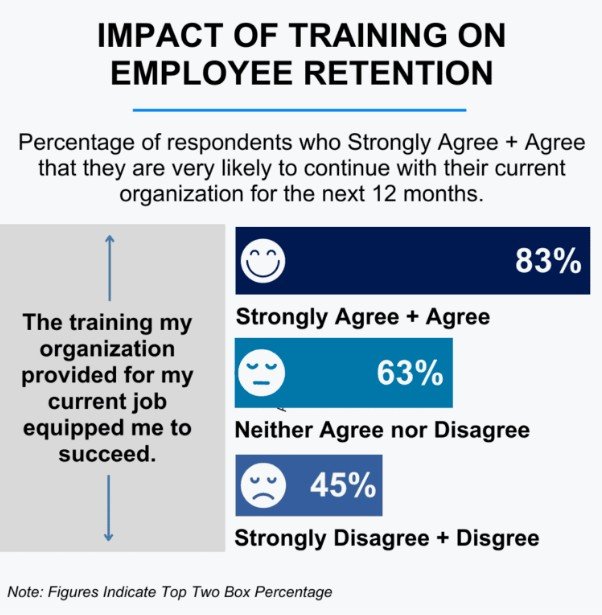
Potentially higher retention rate: In most instances, you’d need a ServiceNow developer for the long haul. Training and upskilling employees usually result in a better retention rate. Gallup found that organizations that invest in learning and development are twice as likely to retain employees.
Challenges to Watch Out for
Over the years, we noticed that the major challenge of this approach is the upfront investment. You must be prepared to invest in training sessions, certification reimbursement, and perhaps trainee roles on real ServiceNow Projects.
It also means more time to fill the actual role. Training and certification could take anywhere from weeks to months. So, it’s not the best option if you’re in a hurry to fill the ServiceNow developer role.
When It’s Best to Use
In-house talent ServiceNow talent development is best when ServiceNow is a long-term strategic platform. And you need consistent ownership, stability, and platform expertise tied closely to internal operations.
2. Specialized ServiceNow Staffing Agencies
When demand for ServiceNow Developers is more urgent, tapping specialized staffing agencies can dramatically accelerate your ability to source and hire talent. Working with a ServiceNow recruiter essentially passes the burden of searching, screening, and, in some cases, onboarding, too, to the recruiter.
But this option works best when the recruitment partner has expertise in ServiceNow talent and, ideally, an extensive network already.
For instance, at Alpha Apex Group, we specialize in ServiceNow recruitment and use proprietary sourcing tools to develop a database of relevant talent worldwide. That helps us live up to our guarantee of delivering resumes in as little as 72 hours.
Our hiring model also decreases costs by 50-70% for most of our clients.
Why Work with a Recruiter
Agencies that focus on ServiceNow have deep networks of professionals with hands-on experience across core modules like IT Service Management (ITSM), CMDB, workflow automation, integration, and Security Operations (SecOps).
They pre-qualify candidates on real platform skills such as REST APIs, GlideScript, ServiceNow Studio, and custom applications.
Another advantage of staffing partners is their ability to scale based on project demands. Whether you need a semi-senior ServiceNow Developer for a 3-month integration sprint or a team of experts for a full implementation, we have your back.
Plus, our 80%+ placement success rate proves the strength of our methodology and candidate engagement model.
Specialized staffing agencies can significantly boost your ability to find, evaluate, and hire the right ServiceNow talent when internal pipelines are insufficient or when your hiring timeline is compressed.
3. Job Boards and Professional Networks
One of the most direct ways to find ServiceNow Developers is through job boards and professional networks (like LinkedIn).
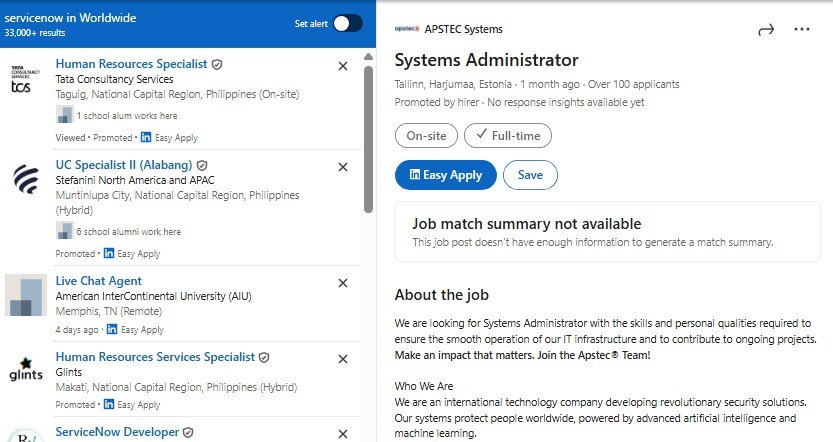
These platforms expose your openings to tens of thousands of active candidates.
Pro tip: We advise you to leverage LinkedIn recruiter to headhunt passive talent: developers not actively looking for a new job.
Besides LinkedIn, general job boards like Indeed also host hundreds of ServiceNow roles with varying requirements. These can be entry-level positions or those held by seasoned developers commanding higher salaries.
Beyond generic boards, tech-focused platforms like Dice provide advanced filters that let you target ServiceNow candidates with particular coding skills or platform certifications. For example, you may need to look for specific certifications for a SecOps developer for ServiceNow.
Pros
A strategic job board and professional network approach allows you to cast a wide net while still honing in on specific platform expertise.
It’s useful when combined with tools like automated alerts and candidate tracking integrated into your recruitment workflow.
You have more control over the entire hiring process and visibility into the current talent market, which can inform future decisions.
Cons
The traditional approach to hiring, with the help of job boards and LinkedIn, means your organization has to take on the whole responsibility. That means creating job posts, screening resumes, conducting interviews/tests–the whole nine yards of hiring.
That can result in more resources and time being spent on filling the roles. Also, it may only work if you have a dedicated recruitment wing in your Human Resources department.
4. Freelance and Contract Marketplaces
Freelance and contract marketplaces are powerful channels for finding ServiceNow admins, architects, and developers when your organization needs flexible, niche expertise without the long lead times of traditional hiring.
These platforms connect you with professionals experienced in integration, workflow automation, and custom applications. However, they’re typically good for short-term projects, urgent support, or specialized phases of your ServiceNow implementation.
Where to Look
Platforms like Upwork and Toptal host thousands of freelance developers who may have ServiceNow-specific profiles. For example, searches for “ServiceNow Developer” on Upwork return hundreds of active freelancers with verified work histories and client ratings.
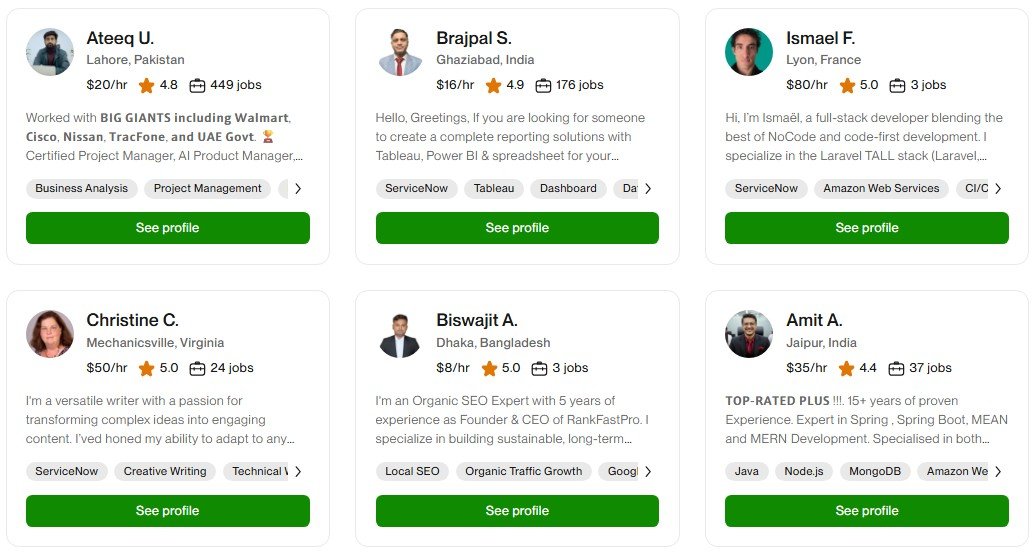
Toptal, known for vetting its talent pool, advertises that clients can hire top-tier ServiceNow experts quickly. So, it’s ideal when timelines are tight or when internal capacity is maxed out.
Pro tip: Another thing we like about Toptal is that it screens freelancers on its platforms. Conversely, on Upwork and other similar marketplaces, you’d need to screen and test candidates.
Marketplaces such as Freelancer.comand Guru also provide access to global talent. These are cheaper, and can be especially useful for organizations seeking cost-effective support for specific needs.
But should you hire freelancers in the first place?
That brings us to the next point.
Benefits and Challenges of Working with Freelancers
One advantage of hiring freelancers is the ability to scale your developer resources up or down based on the rhythm of your ServiceNow roadmap. If you need extra bandwidth, freelance experts can augment your team without long-term commitments.
Freelancers, especially from certain regions, can be cheap to hire. But for continuous work, it may not be feasible or cost-effective to work with a freelancer long-term.
Also, successful use of freelance marketplaces requires:
Clear scopes of work
Strong vetting (including sample tasks or short coding tests)
And structured onboarding
Pro tip: The biggest issue, however, in our experience is that external developers should access your development instance securely and effectively. So make sure to tackle that first.
If you do it right, though, contract marketplaces can give you a flexible, immediate, and cost-efficient path to high-quality ServiceNow talent.
5. ServiceNow Community and Ecosystem Channels
ServiceNow Community and broader ecosystem channels can be one of the most effective ways to find and engage with ServiceNow developers. These are individuals who actively contribute to discussions about the ServiceNow platform.
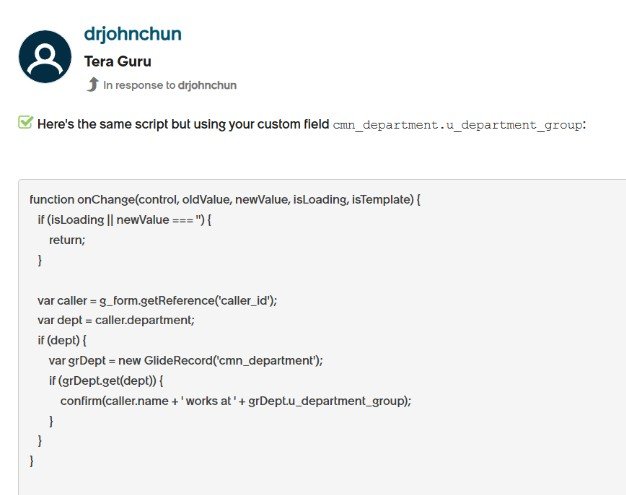
The official ServiceNow Community is a vibrant hub where developers, admins, architects, and professionals gather to share solutions, ask questions, and help each other solve real-world problems.
They even help each other with coding issues, like so:
Pro tip: The community includes specific forums and groups. As you’re after developers, the Developer Forum should be of most interest to you.
These channels also host local meetups (SNUGs), virtual events like “Ask the Experts,” and community-run developer meetups that help you spot engaged talent who are actively solving problems or mentoring peers.
We advise you to tap into all these ecosystem channels to get access to potential candidates and to a broader network of professionals who are passionate about the platform.
Side note: Our in-house recruiters are active on these platforms too, so we know that practically speaking, this route can also be time-consuming and challenging. Still, it’s a viable option, especially if you’re looking passively.
6. Universities, Bootcamps, and Training Programs
To build a sustained pipeline of qualified ServiceNow Developers, many organizations turn to universities, bootcamps, and training programs that prepare talent with the skills needed to support the platform.
One popular route we know of is intensive bootcamps designed specifically for ServiceNow skills. This kind of intensive ServiceNow bootcamp offers focused training in core development concepts and hands-on experience with platform tools.
The developers it churns out may be printed to join your workforce immediately, with some additional training.
So, how do you recruit ServiceNow developers via bootcamps?

Remember: ServiceNow itself operates training and certification pathways through ServiceNow University, including self-guided learning, live instructor-led classes, and certification prep programs.
7. ServiceNow Events and Industry Conferences
ServiceNow’s global events and industry conferences are premier venues to connect with top-tier talent, including developers, consultants, and professionals. These gatherings bring together thousands of practitioners, from hands-on developers to project managers and platform architects.
One of the biggest of these events is ServiceNow Knowledge, the company’s flagship annual conference. For instance, Knowledge 2025, held May 6-8 in Las Vegas, attracted a broad spectrum of practitioners and enterprise teams with 20,000+ attendees from around the world.
In addition to Knowledge, ServiceNow hosts World Forum events in major cities such as Amsterdam, New York, London, and Munich, where developers and adopters gather to share knowledge and network with peers.
Across these summits, you’ll find everything from short technical talks to full-day workshops on new features.
ServiceNow also organizes smaller summits and Live on ServiceNow sessions (both virtual and in-person) focused on specific product areas and challenges.
This route can complement your ServiceNow developer team building in the long run. But it may not be helpful for filling roles quickly. For that, again, a recruiter is your best bet.
Comparing Talent Pools for ServiceNow Developers: Which Is Right for You?
Choosing the right talent pool for ServiceNow Developers depends on how quickly you need to deliver, the complexity of your ServiceNow implementation, and how closely the role must align with long-term business needs.
Each channel performs differently across speed, cost, and ownership. Here’s a quick guide:
Speed of Hire vs. Long-Term Value
If speed is your top priority, staffing agencies and freelance marketplaces typically outperform other options. Industry hiring benchmarks show that the average time-to-hire for specialized IT roles is over 60 days, while staffing agencies (like ours) can reduce that to 1 to 3 weeks for niche platform roles like ServiceNow.
In contrast, in-house hiring may deliver higher long-term value through deeper platform knowledge and ownership but usually takes longer due to interviews, onboarding, and training.
Cost Comparison Across Channels
Cost structures can vary significantly. Full-time in-house developers in the U.S. earn an average of $99,000-$151,000 annually, depending on experience and module expertise.
Freelance and contract ServiceNow professionals may charge $75-$150 per hour, which can be cost-effective for short projects but expensive for long-term support or continuous workflow automation.
Staffing agencies add a premium, but that cost offsets reduced hiring risk and faster project delivery.
Module Complexity and Project Maturity
For mature environments involving advanced integration, ITOM, CMDB, or large-scale automation, in-house teams or experienced agency-placed developers usually perform best.
Early-stage projects, proofs of concept, or narrowly scoped tasks (for example, building custom workflows or API connections) may be well-suited to freelancers who specialize in specific ServiceNow platform features.
You may even be able to save by working with offshore, remote developers for such projects.
Internal Ownership vs. External Delivery
In-house teams offer stronger internal ownership, governance, and alignment with evolving IT workflows, while external delivery models provide flexibility and rapid scaling. From what we’ve seen, many enterprises adopt a hybrid approach: maintaining a core internal ServiceNow team while augmenting with external developers during peak demand or complex projects.
Further Reading: How to Build a High-Performing ServiceNow Team
How to Evaluate ServiceNow Developers Across Talent Pools
We know that a lot of organizations stress searching for talent and less so on accurate evaluation. And that’s all the more important for developer roles, perhaps even more so for ServiceNow-related roles.
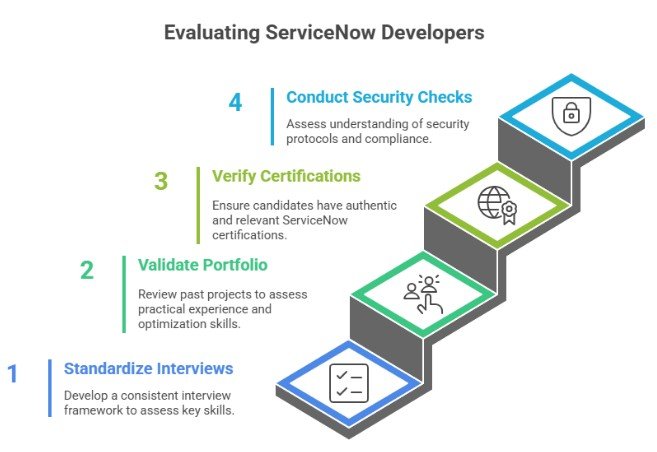
From our experience, the evaluation process becomes far easier when you’re working with a recruiter, as you get vetted and ready to hire candidates. But even then, it helps to know how to properly evaluate candidates on your end.
Standardizing interviews and technical assessments: Create a consistent interview framework that covers key areas such as JavaScript, APIs & Integration, workflow automation, and module-specific scenarios. Use practical tests that mimic real tasks, such as building a scoped app or working with REST APIs to connect third-party tools.
Pro tip: For remote hiring, platforms like HackerRank or Codility can be customized to include ServiceNow-relevant challenges.
Portfolio and project validation: Require candidates to walk through past ServiceNow implementations, showing work on system configuration, custom workflows, and integrations (e.g., IntegrationHub or Flow Designer). We like to look for concrete examples of how they optimized processes or reduced errors in environments similar to yours.
Certification verification: Certifications show formal training on the ServiceNow platform and adherence to industry best practices. When reviewing candidates from staffing agencies or job boards, verify their credentials via ServiceNow’s official certification registry. We always advise our clients to ensure authenticity and relevance to the modules you depend on.
Security and compliance checks: Given the sensitivity of enterprise data and integrations, include security checkpoints in your evaluation process. Ask questions that check if your candidates understand secure integration patterns, role-based access control configurations, and governance models. Of course, all these should align with your IT and security policies.
Common Mistakes to Avoid When Hiring ServiceNow Developers
When recruiting ServiceNow Developers, even experienced recruitment teams can make missteps that slow hiring, increase costs, or lead to poor long-term outcomes. Watch out for:
Overvaluing certifications alone: While ServiceNow certifications are great, we don’t advise you to rely on them as the sole hiring criterion. Real project success depends on practical experience with the ServiceNow platform, which we always verify and test.
Hiring ITSM-only developers for advanced modules: Some recruiters fall into the trap of hiring developers with only basic ITSM experience. Remember, ServiceNow has many different modules. This mismatch increases the risk of errors in areas such as automated discovery, Service Mapping, or third-party tool integrations.
Underestimating integration and automation needs: Modern ServiceNow implementations extend far beyond incident and request workflows. Platforms increasingly touch Customer Service Management (CSM), AI-driven solutions like AI Agents, and complex organizational processes.
Pro tip: We always check if our candidates lack deep integration experience; if they do, they can stall delivery and create problematic technical debt.
Choosing speed over fit: We know that filling a role quickly can be tempting, especially with staffing pressures. But hiring someone based on availability rather than skill alignment will lead to frequent errors, extended support cycles, and expensive rework.
Find the Best ServiceNow Talent with AAG
Ready to hire your next ServiceNow developer? Work with Alpha Apex Group to find talent with the right credentials, field experience, and alignment with your business goals.
Our process is thorough and customized to your organization. We begin with a detailed consultation to understand the business and job requirements to create the ‘ideal candidate profile.’ We use that profile to match candidates in our database and hunt for more.
Our 43-day average time-to-fill means you have a developer in your team just in time to roll out new systems or features with the ServiceNow platform. And everything is backed by numbers to keep things transparent.
Contact us today and let’s power your team together!
FAQ
Where is the best place to find experienced ServiceNow developers?
The best place depends on your urgency and scope. For senior or niche needs (advanced integration, IT Operations Management, or complex workflow automation), specialized staffing agencies and the ServiceNow Community tend to surface the most experienced ServiceNow developers.
Is it better to hire a contract or full-time ServiceNow developer?
If your project is time-bound or focused on a specific module, contract developers can deliver faster results with lower long-term commitment. Full-time hires make more sense when ServiceNow is core to ongoing IT Service Management (ITSM), internal ownership, and long-term business needs.
Do ServiceNow Partners offer developer sourcing?
Yes. Many ServiceNow partners and consultants, like AAG, provide both implementation services and talent sourcing. We can supply pre-vetted developers with proven experience in ServiceNow implementations, custom applications, and automation.
How long does it typically take to hire a ServiceNow developer?
Timelines vary by channel. Direct hiring through job boards or networks can take several weeks to months, while staffing agencies or contract marketplaces place developers faster. Roles requiring advanced platform expertise, APIs, or cross-module experience usually take longer due to limited candidate supply.
How do you vet a ServiceNow recruiting partner?
Look for partners with a proven track record in ServiceNow recruitment, transparent screening processes, and access to developers with real-world experience. Ask how they validate JavaScript skills, integration experience, and understanding of enterprise IT workflows, and whether they can align candidates with your business objectives.
.jpg)
.jpg)