ServiceNow Developer Recruitment: In-House vs Outsourcing vs Staffing Firm
Hiring the right ServiceNow developers is no longer just an HR decision. It affects platform performance, delivery speed, and how quickly you see value from your ServiceNow investment.
As ServiceNow expands across ITSM, HR, finance, and customer support, finding the right talent has become more difficult and more urgent.
This challenge is widespread. Research shows that 87% of companies worldwide already face a skills gap or expect one soon, particularly across enterprise IT and digital transformation roles.
With experienced ServiceNow talent in short supply, your recruitment choices can keep projects moving or bring them to a halt.
Most organizations weigh three options: hiring in-house, outsourcing development, or working with a ServiceNow staffing firm. Each path affects cost, control, speed, and long-term platform maturity.
This guide helps you compare those options clearly, so you can choose with confidence instead of reacting under pressure.
We’ll cover:
How in-house ServiceNow recruitment works and where it delivers the most value
When outsourcing ServiceNow development makes sense, and where it introduces risk
How ServiceNow staffing firms differ from traditional IT outsourcing models
A side-by-side comparison of cost, speed, control, and flexibility
Key factors to consider before choosing a ServiceNow staffing model
P.S. Struggling to fill ServiceNow roles without delaying projects or overloading your HR team? Don't worry, Alpha Apex Group helps you close ServiceNow talent gaps quickly with pre-vetted developers, flexible staffing models, and deep ecosystem insight.
Why ServiceNow Developer Recruitment Is a Strategic Decision
ServiceNow developer recruitment directly shapes how your platform performs every day. The right talent improves stability, supports scalability, and shortens time-to-value. Poor hiring choices slow releases, increase rework, and affect customer experience across core business functions.
From what we’ve seen, demand makes this decision harder.
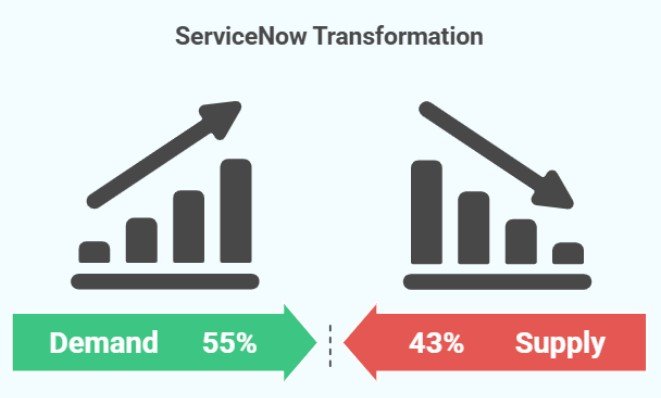
Industry reports show that demand for ServiceNow transformation services grew by roughly 55% year over year, while the supply of skilled professionals increased by only around 43%. This gap leaves many organizations competing for the same limited talent pool.
Moreover, the broader labor market story backs this up.
Software developers overall, including platform specialists like ServiceNow devs, are one of the fastest-growing occupations. The U.S. Bureau of Labor Statistics projects around 22% growth in developer rolesthrough the decade, far above the average for all jobs.
Your hiring model also shifts cost and risk.
In-house recruitment builds long-term capability, but it increases infrastructure costs, training and development needs, and pressure on your HR team.
Outsourcing or working with a staffing agency can speed delivery, yet it introduces data security, regulatory compliance, and vendor management considerations.
This is why we believe that ServiceNow recruitment deserves strategic attention. The model you choose influences project scope, delivery confidence, and how well ServiceNow supports long-term strategic initiatives.
When hiring aligns with your IT resource management model, scaling feels intentional instead of reactive.
Read Next:Why ServiceNow Talent Is Hard to Find
Option 1: In-House ServiceNow Developer Recruitment
In-house ServiceNow recruitment means hiring full-time developers who work exclusively on your platform. These roles sit within your enterprise IT team and support ServiceNow as part of day-to-day business operations. Your HR team typically manages job profiling, interviews, onboarding, and ongoing training and development.
We noticed that over time, internal developers gain deep familiarity with your systems, workflows, and operating priorities. This consistency supports stable team dynamics and helps ServiceNow evolve in line with long-term digital transformation goals.
Pros of Hiring In-House ServiceNow Developers
Below are the key advantages of hiring ServiceNow developers in-house. In our experience, these are especially valuable for organizations with long-term platform goals.
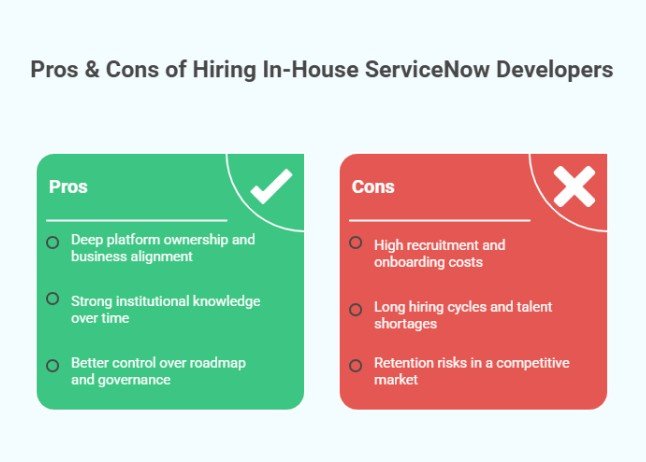
Deep platform ownership and business alignment: Your internal developers work closely with stakeholders across business functions. This proximity helps align configurations, workflows, and integrations with real operational needs, so new employees don’t start with generic project assumptions.
Strong institutional knowledge over time: In-house teams build context that no third-party service can replicate quickly. They understand past decisions, custom logic, and dependencies, which improves knowledge transfer and reduces repeated rework.
Better control over roadmap and governance: We appreciate that internal ownership makes it easier to manage security procedures, regulatory compliance, and data security standards. You also gain clearer control over priorities, release cycles, and long-term platform direction.
Cons of In-House ServiceNow Recruitment
Now that you know the benefits, it’s just as important to look at the trade-offs. These are the main challenges to weigh before committing fully to an in-house ServiceNow hiring model:
High recruitment and onboarding costs: Hiring full-time, skilled platform developers comes with significant overhead before you even reach salaries and benefits. Recruiting experienced technical talent mostly costs $8,000 to $28,000 per hire on average. Plus, your HR team needs to invest considerable time in full-cycle recruitment and onboarding.
Long hiring cycles and talent shortages: ServiceNow developers are in high demand, and experienced candidates usually juggle multiple offers. Around 45% of companies report that recruiting tech roles has become more competitive. We’ve noticed in our own practice that this stretches hiring timelines and delays project delivery.
Retention risks in a competitive market: We’ve frequently seen how trained in-house developers become attractive targets for other IT companies. Attrition can reopen skill gaps and force teams back into urgent hiring mode.
When In-House ServiceNow Hiring Works Best
In-house hiring works best in specific scenarios. From our point of view, you’re more likely to see value from this model when the following conditions apply:
Mature ServiceNow programs: Your platform already supports well-defined processes across enterprise IT and core business functions, with limited experimentation or major redesigns.
Long-term platform investment: ServiceNow is treated as a strategic, long-term platform, with ongoing investment in internal capability, governance, and knowledge retention.
Stable, predictable workloads: Demand remains consistent, with clear project scope and timelines that allow full-time teams to plan work without frequent scaling adjustments.
Option 2: Outsourcing ServiceNow Development
ServiceNow outsourcing means working with a third-party service provider to deliver development work outside your internal team. This usually happens through project-based engagements or managed services, where delivery follows a defined project scope, timeline, and set of responsibilities.
You can choose different delivery models based on cost, speed, and coverage needs. We also know that many organizations enjoy being able to rely on offshore staff, nearshore teams, or hybrid setups that blend global talent with local oversight. This approach helps you address short-term skill gaps and project-based needs without committing to full-time hires.
Pros of Outsourcing ServiceNow Developers
When you need ServiceNow expertise fast, outsourcing is the quickest path forward. These are the main benefits teams usually see in our experience.
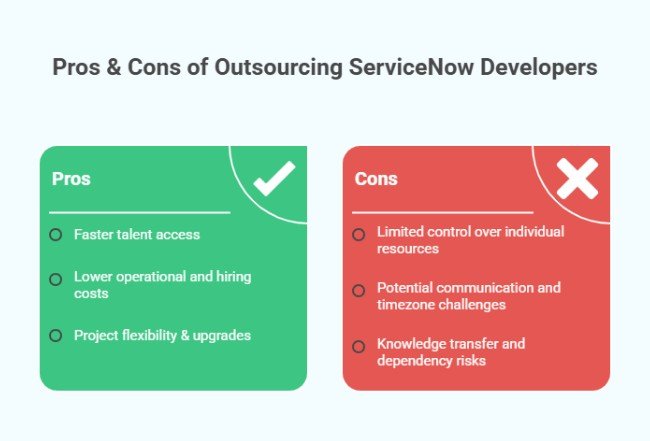
Faster access to skilled ServiceNow talent: Outsourcing gives you immediate access to global talent without waiting through long hiring cycles. We recommend this especially when your internal team faces a skill gap or a sudden project-based need.
Lower operational and hiring costs: Working with offshore staffing or specialized vendors can reduce infrastructure costs, recruitment spend, and training overhead. You pay for delivery instead of carrying the cost of full-time in-house employees. Around 70% of companies say outsourcing is more economical than maintaining full internal teams.
Flexibility for projects and upgrades: Outsourced teams scale up or down based on project scope and timelines. Many of our clients are happy because they can more easily handle upgrades, new modules, or short-term initiatives without disrupting internal team dynamics.
Cons of ServiceNow Outsourcing
Remember that outsourcing can solve short-term gaps, but it also has some drawbacks you should consider before committing to this model.
Limited control over individual resources: You work through a third-party service, not direct employees. This can limit visibility into day-to-day priorities, workload distribution, and how quickly issues get addressed.
Potential communication and timezone challenges: Offshore or hybrid delivery models mostly involve time differences and cultural gaps. These factors can slow feedback loops, affect project management, and create friction during fast-moving releases.
Knowledge transfer and dependency risks: External teams may hold critical platform knowledge. We warn our clients that, with time, this can increase dependency on the vendor and make transitions harder when project scope changes or contracts end.
Best Use Cases for Outsourced ServiceNow Development
Outsourcing works best when you treat it as a targeted solution rather than a default setup. The following are the scenarios where we’ve seen this approach deliver the most value.
Short-term implementations and upgrades: We suggest outsourcing when you need to deliver a defined project quickly, such as a module rollout, system upgrade, or integration. External teams can step in, execute against a clear project scope, and exit once delivery is complete.
Budget-sensitive initiatives: Outsourcing usually makes sense when cost efficiencies are a priority. If funding is limited or approval cycles are tight, working with offshore staff or specialized vendors can move initiatives forward without the overhead of full-time hires.
Rapid scaling needs: When demand spikes suddenly, outsourced teams help you scale without disrupting internal team dynamics. We’ve seen this lead to fast execution while giving you time to reassess long-term staffing decisions.
Option 3: ServiceNow Staffing Firms
ServiceNow staffing firms sit between in-house hiring and outsourcing. Instead of managing long recruitment cycles or full project delivery, you bring in vetted ServiceNow talent to work directly within your team. This model supports contract, contract-to-hire, or permanent placements based on your staffing needs.
You gain access to pre-vetted ServiceNow developers and architects who can step in quickly and align with your tools, processes, and project timelines. This approach works well when you need specific expertise fast but still want day-to-day control over delivery.
Pros of Using a ServiceNow Staffing Firm
If you want to move fast without overloading your HR team, a staffing firm can help. These are the main benefits teams usually see.
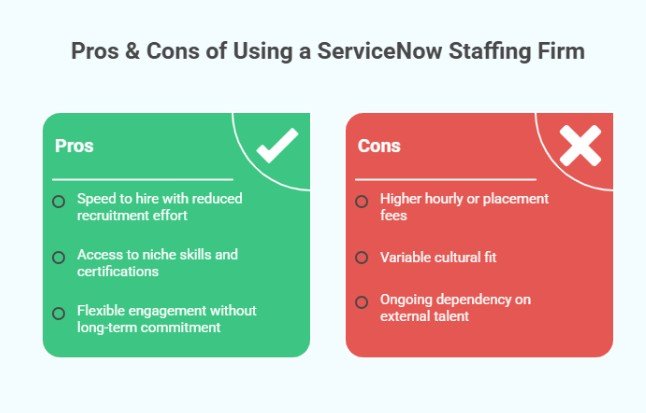
Speed to hire with reduced recruitment effort: Staffing firms shorten hiring cycles by handling sourcing, screening, and initial evaluations. You review qualified candidates instead of starting from scratch, which keeps project timelines on track.
Access to niche ServiceNow skills and certifications: You can tap into specialists with specific platform expertise, certifications, or domain experience. Trust us: these people are difficult to find through standard in-house recruitment.
Flexible engagement without long-term commitment: Contract and contract-to-hire options let you scale teams based on project scope and timelines. This flexibility helps you fill gaps without locking into permanent headcount too early.
Cons of ServiceNow Staffing Agencies
Staffing firms offer speed and flexibility, but this model still comes with a few cons. Understanding these points helps you set the right expectations and choose the right partner.
Higher hourly or placement fees: Staffing agencies mostly charge more per hour or placement compared to direct hiring. These costs reflect faster access to talent, pre-vetting, and reduced recruitment effort. However, with the right partner, this premium can be offset by shorter time-to-hire and fewer delivery delays.
Variable cultural fit: External hires may need time to adapt to your team dynamics and business environment. This risk is lower when you work with ServiceNow-focused consulting firms like Alpha Apex Group, where candidate engagement, role alignment, and long-term fit are part of the screening process.
Ongoing dependency on external talent: Relying heavily on contract staff can limit long-term knowledge retention. This risk stays manageable when staffing supports defined gaps or project-based needs instead of replacing core internal roles.
When a ServiceNow Staffing Firm Is the Right Choice
A staffing firm makes sense when timing, expertise, or flexibility matter more than building permanent headcount.
In our experience, this model works best in the following situations.
Urgent skill gaps: We suggest using a staffing firm when critical roles remain open, and projects cannot wait. Pre-vetted ServiceNow developers can step in fast and keep delivery moving.
Interim or project-based needs: Staffing works well for defined initiatives such as upgrades, new module rollouts, or temporary coverage. You get focused support without reshaping your long-term staffing model.
Hard-to-find ServiceNow expertise: Certain certifications or niche platform skills are difficult to source through traditional recruitment. Staffing firms help you access specialized talent without extended search cycles.
In case you’re looking for a reliable, ServiceNow-focused firm, Alpha Apex Group can help. Our team emphasizes candidate engagement, role alignment, and cultural fit during screening. At the same time, we keep staffing support focused on defined gaps or project-based needs, without replacing core internal roles.
ServiceNow Developer Recruitment: In-House vs Outsourcing vs Staffing Firm Side-by-Side Comparison
Now that you understand the strengths and limits of each option, this comparison makes it easier to see which one fits your needs.
1. Cost Comparison
Cost differs across all three models. In-house hiring brings fixed expenses such as salaries, benefits, and training, even when demand slows. Outsourcing can lower upfront costs, but scope changes can increase spend. Staffing firms usually charge higher rates, yet you avoid long hiring cycles and pay only for active work.
We suggest choosing the model that matches how predictable your workload and budget really are.
2. Speed to Hire
Speed mostly becomes the deciding factor when ServiceNow work cannot wait.
In-house hiring usually takes the longest, since sourcing, interviews, and approvals move through multiple steps. Outsourcing speeds things up, but onboarding and coordination still take time. Staffing firms move fastest because candidates are already screened and ready to start.
For example, ServiceNow-focused partners like Alpha Apex Group can surface qualified candidates within 72 hours, cutting time-to-fill by up to 60% compared to national averages, with many full-time roles filled in around 43 days.
We suggest prioritizing speed when project timelines are tight or delivery risks are high. In those cases, reducing time-to-hire may matter more than finding a perfect long-term fit.
3. Skill Availability & Expertise Depth
Skill availability decides how far your ServiceNow platform can go.
In-house teams usually build strong platform knowledge over time, but depth can be limited when new modules, integrations, or technologies emerge. This pressure is widespread. Gartner found that the lack of talent availability is the top barrier to adoption for 64% of emerging technologies.
As a result, many teams look beyond internal hiring to close gaps faster. Outsourcing expands access to global talent, yet expertise may vary based on the vendor and project scope.
On the other hand, staffing firms give you quicker access to specialists with specific certifications or domain experience, without long search cycles.
Our recommendation is to map skills to actual needs before choosing a model. Stable, well-known requirements mostly suit in-house teams, while niche expertise or advanced capabilities are easier to source through staffing or targeted outsourcing.
4. Flexibility & Scalability
Flexibility matters when ServiceNow demand changes unexpectedly.
In-house teams scale slowly, since adding or reducing headcount takes time and planning. Outsourcing offers more elasticity, but shifts in project scope typically require contract changes.
In contrast, staffing firms give you the most control here, since you can scale teams up or down based on real workload needs.
We suggest leaning toward flexible models when your roadmap includes upgrades, expansions, or uncertain timelines. When demand stabilizes, in-house teams regain their advantage.
5. Risk, Control & Compliance
Risk and control become more visible as ServiceNow supports sensitive data and critical workflows.
In-house teams give you the highest level of oversight, since security procedures, regulatory compliance, and data security stay fully internal. This model works well when governance requirements are strict.
Outsourcing, on the other hand, reduces internal load, but it introduces third-party risk. Access controls, compliance standards, and data handling practices depend heavily on vendor discipline.
Staffing firms sit between these two options. You retain day-to-day control, while external talent works within your policies and systems.
We recommend prioritizing control when ServiceNow touches regulated data or core enterprise IT systems. In less sensitive environments, flexible models can work well with the right safeguards in place.
Read Next:How to Build a High-Performing ServiceNow Team
In-house vs Outsourcing vs Staffing Firm: Quick Comparison Table
| Decision factor | In-house hiring | Outsourcing | Staffing firm |
|---|---|---|---|
| Cost structure | Fixed costs from salaries, benefits, training, and infrastructure, even during slow periods | Lower upfront costs, but the spend can rise with scope changes and vendor management | Higher hourly or placement rates, but you pay only for active work |
| Speed to hire | Slowest option due to sourcing, interviews, and internal approvals | Faster than in-house, though onboarding still takes time | Fastest option, since candidates are pre-vetted and ready to start |
| Skill availability & expertise depth | Strong internal knowledge over time, but limited depth for niche skills | Access to global talent, with expertise varying by vendor | Quick access to specialized ServiceNow skills and certifications |
| Flexibility & scalability | Limited flexibility, since headcount changes take time | Moderate flexibility, with changes tied to contracts | High flexibility, with teams scaling up or down based on workload |
| Control over delivery | Full control over priorities, workflows, and roadmap | Shared control, often dependent on vendor processes | High day-to-day control, with talent working inside your team |
| Risk & compliance | Strong oversight of security procedures and regulatory compliance | Higher third-party risk tied to data handling and access controls | Balanced risk when talent operates under your policies and systems |
| Knowledge retention | Knowledge stays internal and compounds over time | Risk of dependency on external vendors | Manageable when staffing fills defined gaps instead of core roles |
| Best fit scenarios | Mature programs with stable, long-term workloads | Short-term projects or budget-sensitive initiatives | Urgent gaps, interim needs, or hard-to-find expertise |
Hire the Right ServiceNow Developer Talent with Alpha Apex Group
ServiceNow developer recruitment shapes how effectively your platform supports business goals. In-house hiring, outsourcing, and staffing firms each solve different challenges.
The right choice depends on your timeline, budget, governance maturity, and long-term roadmap. When recruitment decisions align with delivery needs, ServiceNow becomes easier to scale, govern, and optimize.
Key takeaways
ServiceNow recruitment decisions directly affect delivery speed, platform stability, and long-term value.
In-house hiring works best for mature programs with stable workloads and long-term investment plans.
Outsourcing fits short-term projects, upgrades, and budget-sensitive initiatives.
Staffing firms offer the fastest way to close urgent skill gaps without long hiring cycles.
Each model carries different costs, risks, and control trade-offs that must be evaluated carefully.
Flexibility becomes critical when ServiceNow demand fluctuates or project scope changes.
Strong governance and clear role definitions reduce risk across all recruitment models.
If you’re looking to hire ServiceNow talent without slowing delivery or overloading your internal teams, Alpha Apex Group can help.
Contact us to explore ServiceNow recruitment, staffing, and consulting support designed to fit your platform goals, timelines, and governance needs.
FAQs
Is it better to hire ServiceNow developers in-house, outsource, or use a staffing firm?
There is no single best option for every organization. In-house hiring suits mature ServiceNow programs with stable workloads. Outsourcing works well for short-term or budget-sensitive initiatives. Staffing firms, on the other hand, fit urgent skill gaps, interim needs, or hard-to-find expertise. The right choice depends on your timeline, governance maturity, and long-term platform goals.
How fast can a ServiceNow staffing firm fill a role?
Speed depends on role complexity, but ServiceNow-focused staffing firms move much faster than traditional hiring. For example, Alpha Apex Group helps teams fill full-time ServiceNow roles in an average of 43 days, which reduces prolonged hiring delays.
What factors should influence my ServiceNow hiring decision?
Key factors include project complexity, delivery timelines, budget predictability, internal governance strength, and your long-term ServiceNow roadmap. Also, you should assess how critical ServiceNow is to core business functions and whether demand is stable or fluctuating.
How does Alpha Apex Group differ from traditional IT staffing agencies?
Alpha Apex Group focuses specifically on the ServiceNow ecosystem. Our team emphasizes candidate engagement, role alignment, and cultural fit during screening, rather than general IT placements. This ServiceNow-first approach helps us reduce mismatches and supports stronger delivery outcomes.
Does Alpha Apex Group support both short-term projects and long-term roles?
Yes. Alpha Apex Group supports contract, contract-to-hire, and permanent placements. Staffing solutions stay focused on defined gaps or project-based needs, while long-term roles align with platform strategy and internal team structures.
.jpg)
.jpg)