How to Build Company Culture Remotely: A Complete Guide
Remote work is no longer a temporary shift. It is how many teams operate today. In this setup, company culture does not disappear. It either grows with intention or slowly weakens.
The numbers explain the risk. Gallup reports that only 21% of employees feel engaged at work, and engagement drops further when remote teams lack clear communication and leadership visibility.
Separate research also shows that nearly 19% of remote employees struggle to build strong relationships at work, which directly affects trust, collaboration, and long-term employee morale.
Without daily in-office cues, workplace culture must be designed on purpose. Trust, psychological safety, employee well-being, and work-life balance now depend on clear systems, shared company values, and consistent leadership.
This guide covers:
What remote company culture actually means and where many teams get it wrong
The biggest challenges remote teams face and how they affect employee morale
The core pillars behind a strong remote work culture and organizational culture
A step-by-step framework to build culture across hybrid teams and fully remote teams
Real examples from successful remote companies you can apply right away
How to measure culture using clear KPIs instead of vague signals
P.S. Struggling with building company culture remotely when your team rarely meets face-to-face?Alpha Apex Group helps remote and hybrid teams create strong, connected workplace cultures rooted in trust, clarity, and shared values. Our culture consulting approach turns your company values into daily habits, even across distributed teams.
What Is Remote Company Culture?
Remote company culture is how people work, communicate, and make decisions inside a remote environment. It shows up in communication protocols, collaboration standards, leadership behavior, and how teams treat each other when no one shares the same office. In remote work, culture lives in daily habits rather than in physical spaces.
Many teams misunderstand what remote team culture really means. These assumptions may create gaps in trust, employee engagement, and psychological safety.
Common misconceptions about remote company culture
Culture only matters for in-office teams
Culture happens naturally if you hire the right people
Slack channels and video calls are enough to build a connection
Remote teams cannot have a strong workplace culture
Culture is the HR team’s responsibility, not leadership’s
In our experience, a strong remote-first work culture stems from deliberate choices. Team leaders model expectations. Collaboration platforms support clarity. And recognition, feedback, and relationship building happen on purpose.
Before diving into the challenges, it helps to understand why culture matters in the first place. Our guide on why company culture is important explains how culture shapes your entire organization.
The Biggest Challenges of Building Culture Remotely
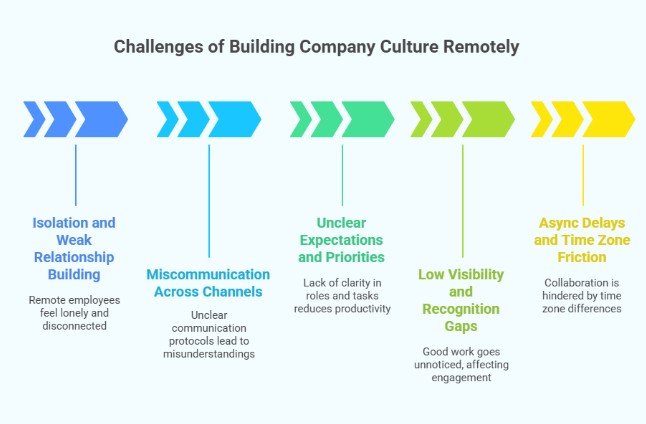
Building culture in a remote environment comes with real friction. Teams do not struggle because they lack talent. They struggle because daily signals of connection, clarity, and support are easier to miss in remote work.
Here are the most common problems remote teams face.
Isolation and Weak Relationship Building
Remote employees mostly work alone for long stretches. Without informal check-ins or a virtual water cooler, relationships stay shallow. Research shows that 25% of remote employees report feeling lonely on a daily basis, a rate significantly higher than that of onsite workers (16%).
We’ve seen how over time, this isolation affects trust, psychological safety, and the overall employee experience.
Miscommunication Across Channels
Instant message chats, video calls, and asynchronous communication all serve different purposes. When communication protocols are unclear, messages get missed, tone gets misunderstood, and minor issues turn into bigger problems.
Surveys show that nearly41% remote employees say communication within their remote team is their biggest challenge. This explains why small issues can grow into bigger problems.
Unclear expectations and priorities
In-office teams frequently rely on visual cues and quick conversations. Remote teams need written clarity. Gallup data shows that only about half of employees clearly understand what is expected of them at work, which makes confusion more likely in a remote environment.
Without shared documentation, project management tools, and clear ownership, employee productivity slows.
Low Visibility and Recognition Gaps
Good work can go unnoticed in distributed teams. When employee recognition is inconsistent, people feel disconnected from company values and corporate culture. Research shows that about 82% remote workers feel their contributions are not recognized, which explains why engagement usually drops over time.
Async Delays and Time Zone Friction
Hybrid teams and global remote teams depend on collaboration standards that respect time zones. Without clear async rules, decisions stall, and frustration builds, especially across leadership and individual contributors.
These challenges do not mean your remote team culture is weaker. They mean it requires more intention. In our experience, teams that address these issues early create healthier communication, stronger alignment, and a more resilient workplace culture.
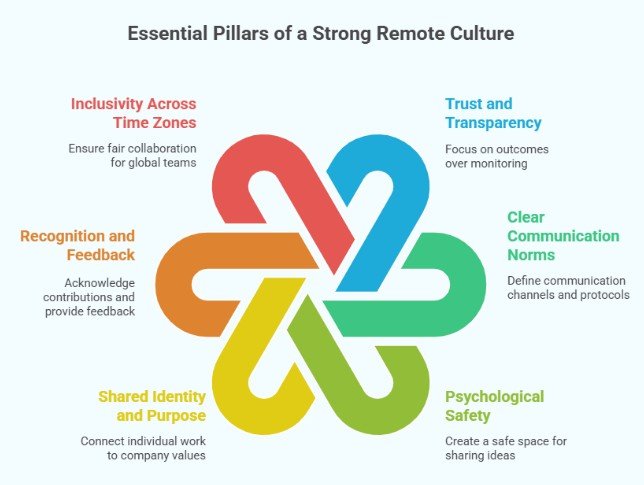
Essential Pillars of a Strong Remote Culture
Remember that a strong remote team culture does not happen through perks or tools alone. It grows from a few core pillars that shape how people work together inside a remote environment.
When these pillars are clear, employee engagement, trust, and collaboration improve across distributed teams. Let’s explore them:
Trust and transparency: Remote teams perform best when leaders focus on outcomes instead of constant monitoring. Open communication around decisions, priorities, and company policies builds trust and improves employee morale.
Clear communication norms: Remote work needs structure. Teams should define when to use instant message chats, video calls, or asynchronous communication. Clear protocols reduce confusion across Slack channels, Microsoft Teams, and other remote collaboration platforms.
Psychological safety: Employees should feel safe sharing ideas, raising concerns, and asking questions. A psychologically safe space supports mental health and reduces employee burnout, particularly in fast-moving remote environments.
Shared identity and purpose: Remote teams still need a strong sense of belonging. Clear company values and a shared mission connect individual work to the bigger picture. We recommend town hall meetings, leadership updates, and visible goals to reinforce organizational culture.
Recognition and feedback: Recognition keeps remote employees connected to their work. Public praise, peer recognition, and regular feedback strengthen employee experience and motivation. Simple systems make employee recognition consistent, even when teams rarely meet live.
Inclusivity across time zones: Global teams need fair collaboration standards. Rotating meeting times, async updates, and documented decisions help hybrid teams and remote teams feel equally included.
How to Build Company Culture Remotely: Step-by-Step Framework
Building company culture remotely does not need to feel overwhelming. With the right structure, small, consistent actions create clarity, trust, and connection across remote teams.
In our practice, we apply the framework below. Take a look; it breaks everything down into simple, practical steps you can apply immediately.
Step 1: Define and Codify your Cultural Values
This is where building company culture remotely begins. Without clear values, remote teams fill gaps with assumptions, which leads to misalignment and disengagement.
Company values should describe how work actually happens. In a remote environment, they guide communication, decisions, and relationship building when no one is watching. They give team leaders and employees a shared reference point.
Here’s what we suggest:
Write values in plain language that people use daily
Connect each value to clear, real behaviors
Show how values apply to remote work, video calls, and async communication
Make values visible in onboarding docs and collaboration tools
We also recommend involving your remote team. Ask what builds trust and what breaks it. This strengthens psychological safety and employee engagement early on.
Once defined, values should guide hiring, onboarding, feedback, and recognition. When values become daily habits, a remote-first work culture scales naturally.
If you want to understand how these values directly shape motivation and performance, check out our guide on the “Role of Company Culture in Employee Engagement.”
Step 2: Set Clear Communication Guidelines
After values are clear, communication becomes the next priority. In remote work, confusion usually comes from how people communicate.
Research shows that about 35% of remote workers find communication and collaboration harder than in-person work. This explains why frustration builds quickly when guidelines are unclear.
However, we’ve seen how clear communication guidelines remove that uncertainty. They help remote teams move faster, reduce misunderstandings, and protect employee well-being.
We suggest using the following best practices:
Define when to use instant message chats versus video calls
Set expectations for response times in async communication
Clarify what needs a live discussion and what can stay documented
Agree on where final decisions live, not just where they are discussed
Make sure to keep guidelines visible and straightforward. Trust us: a short playbook inside your employee portal or collaboration platform works better than a lengthy document no one revisits.
Strong communication protocols support psychological safety. People feel more confident speaking up when they know how and where conversations should happen.
Over time, this clarity improves collaboration, reduces employee burnout, and strengthens remote team culture.
Step 3: Build Trust Rituals (1:1s, Async Updates)
Trust in remote work grows through consistency and repetition. This becomes even more important when communication pressure stays high.
Research shows that nearly 74% of employees feel pressure to reply to work emails immediately, and 85% also expect fast responses from coworkers
From our perspective, regular one-on-ones are one of the most effective trust rituals. These conversations should focus on support and alignment. We suggest keeping them consistent and personal.
Ask how work feels and where help is needed. This strengthens psychological safety and improves the employee experience.
Moreover, async updates also support trust. Short written check-ins improve visibility and reduce meeting overload. They respect time zones and support Work-Life Balance. Simple formats tend to work best.
Trust rituals we’ve tried and vouch for are:
Weekly one-on-ones centered on support
Async team updates to maintain visibility
Written weekly wins to highlight progress
Leadership updates that explain decisions clearly
These rituals create rhythm and predictability. Over time, they reduce stress, strengthen relationships, and make the remote team culture feel more human.
Step 4: Create Structured Onboarding for Remote Hires
Onboarding matters even more in remote work. Without structure, new hires spend their first weeks guessing instead of settling in. That uncertainty hurts confidence and early employee engagement.
Structured remote onboarding creates clarity from day one. It shows how communication works, where resources live, and who to reach out to. We suggest treating onboarding as part of your culture, instead of a checklist.
What works well for us is:
Clear first-week priorities and expectations
Guided access to tools and documentation
Early team introductions through video hangouts
A buddy or mentorship program for support
We also recommend spreading onboarding over time. Short sessions, recorded walkthroughs, and written resources help new hires absorb information without overload.
When onboarding feels intentional, remote employees build confidence faster and connect more deeply with your culture.
Step 5: Reinforce Culture Through Leadership Modeling
Remote teams watch leadership behavior closely. In a remote environment, what leaders do shapes your workplace culture more than written guidelines.
Research shows that managers influence up to 70% of the variation in employee engagement. This makes leadership modeling more important in distributed teams.
Culture becomes real through daily actions. How your team leaders communicate, handle feedback, respect time boundaries, and show up in meetings sets expectations for everyone else.
Leaders should stay visible and consistent, particularly during moments of change or pressure.
Leadership behaviors that we use to reinforce culture are:
Communicate clearly across channels
Respect time zones and work-life balance
Invite feedback and respond with openness
Recognize good work publicly
Pro tip: Always try to share context around decisions. When leaders explain the why behind choices, trust grows, and psychological safety follows.
Step 6: Use the Right Remote Collaboration Tools
Collaboration has a direct impact on performance. Research shows that organizations with strong collaboration practices are five times more likely to be high performing, which makes tool choices especially important in remote work.
Remember that tools do not create culture on their own, but the wrong ones can slow teams down. In a remote environment, collaboration tools shape how people communicate, share progress, and stay aligned.
The goal is simplicity. Therefore, we suggest choosing tools that support clarity instead of adding noise.
What usually works best:
One central communication hub, like Slack channels or Microsoft Teams
A shared space for documentation and decisions using Notion
Clear project management tools, such as ClickUp, to track ownership and progress
Video-conferencing software, like Google Meet, for discussions that need real-time focus
We also recommend setting collaboration standards. When teams know where updates live and how tools are used, collaboration feels easier, and employee productivity improves naturally.
Step 7: Build a Remote Social Connection Intentionally
Social connection does not happen on its own in remote work. Surveys show that about half of remote workers feel more isolated and lonely when working from home, which makes intentional connection an absolute culture priority.
Remote social connection works best when it feels optional and light. We suggest creating spaces that invite interaction without forcing participation. Small moments of connection go a long way for employee morale and mental health.
Approaches we mostly recommend are:
A virtual water cooler Slack channel for casual updates
Short show-and-tell moments during team meetings
Optional online games or quick social check-ins
Interest-based groups that support relationship building, e.g., a pet or a gaming channel
We also suggest mixing formats. Async conversations include quieter voices, while occasional live sessions add warmth. When connection feels natural and low-pressure, remote team culture becomes more human and resilient.
Step 8: Support Well-Being and Work-Life Balance
Remote work can blur boundaries fast. Without clear signals to stop, people stay online longer, respond faster, and carry work into personal time. Over time, this pressure affects mental health, employee wellbeing, and long-term engagement.
As Chantel Cohen, a former Forbes Councils member, points out:
“In today's fast-paced world, the boundaries between our personal and professional lives have become increasingly blurred. Advances in technology, along with the recent shift to remote work, have made it challenging to disconnect and maintain a healthy work-life balance. Whereas things like emails and calls were once limited to the office, they now spill into everyday life.” (Chantel Cohen)
Supporting well-being starts with setting healthy norms. We suggest making balance visible and acceptable, especially at the leadership level. When leaders respect boundaries, teams feel safer doing the same.
Here are a few practices we recommend:
Set clear expectations around response times
Protect focus time and meeting-free blocks
Encourage time off without guilt or follow-ups
Normalize conversations about workload and burnout
We also suggest checking in regularly. Simple questions about energy, workload, and stress help teams stay healthy. When work-life balance is supported consistently, remote teams stay engaged, productive, and sustainable.
Step 9: Continuously Measure and Adapt Culture
Remember that culture is not a one-time setup. In remote work, it shifts as teams grow, roles change, and hybrid schedules evolve. When you measure culture, it helps you spot small issues early, before they turn into bigger problems.
Keep measurement simple and consistent. The goal is awareness, instead of over-analysis. A few clear signals mostly say more than long surveys.
Metrics we recommend tracking are:
eNPS: Shows how likely employees are to recommend your company
Belonging index: Reveals whether people feel connected and included
Manager 1:1 quality: Highlights the health of day-to-day relationships
Recognition frequency: Shows how often good work is acknowledged
Turnover trends: Point to deeper cultural gaps over time
We also suggest closing the loop. Share what you learn, explain what will change, and follow up. When employees see feedback lead to action, trust grows, and the remote team culture stays strong.
In case you want a deeper breakdown, check out our detailed guide on How to Measure Company Culture: X Methods.
Need help turning these steps into real habits across your remote team?
Alpha Apex Group partners with your organization to design culture systems that stick and bring leadership, communication, and employee experience into clear alignment.
Examples of Building Company Culture Remotely
Strong remote culture is not theoretical. Some companies have been doing it well for years. Their success comes from clear systems, written norms, and leadership consistency.
These examples show what works and what other remote teams can realistically copy.
1. GitLab
GitLab is one of the largest all-remote companies in the world, with more than 2,300 team members (as of 2025) across 65+ countries. Their remote work culture works because it is built on clarity and documentation.
Through GitLab’s All Remote Manifesto, they prioritize written processes, open access to information, async communication, and flexible working hours over fixed schedules and constant meetings.
Instead of tracking activity, GitLab focuses on outcomes and impact. This approach removes confusion, supports autonomy, and keeps teams aligned across time zones.
In the video below, GitLab team members share how the company’s remote-first culture supports both their work and personal lives.
2. Zapier
Zapier has been remote since day one. Founded in 2011, the company has never had a physical office and now operates as a fully distributed team with more than 800 employees across 40 countries. Zapier builds company culture remotely by creating space for human connection beyond work tasks.
When Business Insider asked Zapier’s CEO, Wade Forbes, about building company culture, he explained the importance of recreating informal connections in a remote environment:
“There's a few things that make it possible, the first is making sure employees have a place to talk about non-work topics, in the same way they might in an office setting. Zapier uses Slack channels assigned by topics like gardening or cooking.”
He also shared another simple but effective practice Zapier uses to strengthen relationships. The company pairs employees at random and encourages them to schedule a short, informal video chat. These conversations focus on getting to know each other, learning about different roles, or sharing personal interests, rather than discussing work.
3. Buffer
Buffer has been remote for more than a decade, hiring distributed teammates since 2011 and fully closing its office in 2015. Today, the team includes over 80 employees working across 25 time zones.
Buffer builds company culture remotely by centering everything around transparency, trust, and autonomy. Team members, known as Bufferoos, have the freedom to work from anywhere while staying aligned through open communication and shared values.
This culture of transparency helps employees feel trusted, included, and connected, even across a global remote environment.
For more real-world examples, check out our blog on 6 Inspiring Company Culture Examples You Can Learn From.
Transform Your Remote Company Culture with Alpha Apex Group
Company culture in a remote environment takes intention, clarity, and consistency. When teams do not share a physical space, culture shows up through systems, habits, and leadership behavior.
Strong remote teams focus on trust, communication, connection, and well-being. With the right structure in place, remote culture becomes part of daily work, rather than something leaders chase reactively.
Key takeaways
A remote company culture is shaped by daily habits.
Clear values give remote teams a shared reference point for decisions
Communication guidelines reduce confusion and protect employee well-being
Trust grows through consistent rituals like one-on-ones and async updates
Strong onboarding helps new hires connect faster in a remote environment
Leadership behavior sets the tone for culture across distributed teams
Social connection needs structure to work in remote settings
Culture improves when teams measure, reflect, and adapt regularly
If you are looking to turn these ideas into real systems that work across remote or hybrid teams,Alpha Apex Group can help.
Contact us to design a culture approach that aligns leadership, supports employees, and scales with your organization.
FAQs
Can company culture be built remotely?
Yes, company culture can be built remotely with intention. Remote culture grows through clear values, consistent leadership behavior, structured communication, and systems that support trust, connection, and accountability across distributed teams.
How do you keep employees engaged remotely?
Employee engagement improves when expectations are clear, and people feel supported. Regular check-ins, meaningful recognition, growth opportunities, and respect for work-life balance help remote employees stay motivated and connected to their work.
How do you stay connected with the company’s culture when working from home?
Staying connected starts with visibility and participation. Joining team rituals, attending town halls, using shared communication channels, and understanding company values help employees feel aligned, even while working from home.
Can a strong company culture be maintained in a remote work environment?
A strong culture can thrive in a remote environment when it is supported by clear systems. Consistent communication, leadership modeling, inclusive practices, and regular feedback help maintain culture as teams grow and change.
What makes Alpha Apex Group (AAG) different from other culture consulting firms?
Alpha Apex Group focuses on practical culture systems, instead of surface-level initiatives. Our approach aligns leadership behavior, communication, and employee experience to create a culture that works in real, remote environments.
How does AAG begin the culture consulting process?
AAG starts by understanding how your organization currently operates. Then we assess your leadership alignment, communication patterns, and employee experience to identify gaps and design culture solutions that fit your team’s structure and goals.
Can AAG support remote or hybrid teams?
Yes, Alpha Apex Group works with both remote and hybrid teams. Our culture consulting frameworks are designed to support distributed work models, global teams, and flexible schedules without relying on office-based assumptions.
.jpg)
.jpg)