Role of Company Culture in Employee Engagement
Ever notice how some teams show up energized, speak up in meetings, and actually care about outcomes, while others just clock in and out?
That difference rarely comes down to perks or pay alone. It usually comes down to company culture.
Workplace culture shapes how people feel, communicate, and perform every single day. When culture feels clear, supportive, and consistent, engagement levels rise naturally. And when culture feels unclear or performative, employee satisfaction drops, trust erodes, and turnover rates climb.
Data backs this connection as well. Gallup found that highly engaged teams see up to 18% higher productivity and 23% higher profitability.
In practice, this means culture directly influences performance, retention, and results. When culture works, engagement follows. And when it doesn’t, no incentive plan can fully fix it.
That’s why in this blog, we’ll cover:
What company culture really means
How employee engagement differs from satisfaction and motivation
The specific culture drivers that shape engagement levels
The business impact of strong and weak cultures
Practical ways organizations can improve workplace culture and engagement
How to measure culture and engagement
P.S. Are you seeing high employee attrition, low engagement scores, or internal disconnects despite strong strategies on paper? Alpha Apex Group can help you diagnose cultural gaps, align leadership behavior with core values, and design engagement strategies that actually work.
What Is Company Culture?
Company culture is how work actually gets done when no one is watching. It shows up in everyday decisions, conversations, and behaviors across the organization. You see it in how leaders respond to feedback, how teams collaborate under pressure, and how clearly people understand what matters most.
We have observed that policies may define expectations on paper, but organizational culture determines how employees experience work in real life. At its core, workplace culture reflects shared values, habits, and unwritten rules.
What Is Employee Engagement?
Employee engagement describes how connected you feel to your work, your team, and your organization’s purpose. It goes beyond showing up and completing tasks. Engaged employees care about outcomes, speak up with ideas, and take ownership even when challenges show up.
From our experience working with different organizations, engagement separates teams that move with intent from teams that simply react to problems.
We also know that many leaders confuse engagement with satisfaction or motivation. And that confusion usually leads to surface-level fixes that never meaningfully increase engagement.
Here’s how these concepts differ:
Employee satisfaction: How satisfied you feel with pay, benefits, and work conditions. Satisfaction alone does not guarantee performance or commitment.
Employee motivation: The short-term drive to complete tasks, typically influenced by performance incentives or deadlines. Motivation can fade quickly.
Employee engagement: The ongoing emotional and intellectual connection to your role, team, and organizational goals. Engagement shapes effort, loyalty, and consistency.
We have seen teams with strong satisfaction scores and motivated individuals still struggle with employee attrition and weak collaboration when engagement is missing.
How Company Culture Influences Employee Engagement
Company culture influences engagement long before formal programs or tools come into play. You feel it in how leaders show up, how decisions get made, and how safe it feels to speak honestly.
We have seen in practice that engagement rises or falls based on everyday cultural signals, rather than one-off initiatives.
Let’s break down the culture drivers that shape engagement levels most directly.
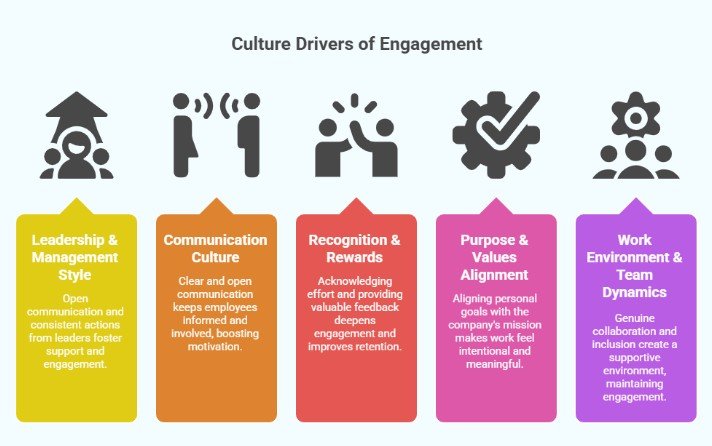
1. Leadership & Management Style
Leadership sets the emotional tone for the organization. When leaders communicate openly, stay accessible, and act consistently, employees feel supported and engaged. In contrast, when leadership communication feels unclear or distant, morale drops quickly.
Gallup backs this up. The report states that up to 70% of the variance in an individual employee’s engagement level is directly tied to their leader.
We have noticed that transparency builds trust faster than incentives ever could. Employees value honest context, clear expectations, and leaders who actually listen.
A Salesforce study supports this as well. It shows that employees who feel heard are 4.6 times more likely to feel empowered to do their best work, a strong signal of deep engagement. From our point of view, engagement becomes sustainable when leadership behavior strengthens trust every day.
2. Communication Culture
Remember that communication culture directly affects how connected you feel at work. When communication stays clear and open, people feel informed and involved.
Research shows that 85% of employees say effective communication makes them feel more motivated and connected to their work. On the other hand, when messages feel inconsistent or vague, engagement starts slipping quickly.
Across the teams we have worked with, we have observed that engagement improves when leaders share context instead of just updates. Therefore, we always advise leaders to slow down and explain their decisions rather than assume alignment.
On the flip side, poor communication creates real risk. One study found that 61% of employees have considered leaving their job because of weak internal communication. We believe strong communication is less about volume and more about clarity, consistency, and listening.
3. Recognition & Rewards
Recognition and rewards shape how valued you feel at work. When effort gets noticed and acknowledged, engagement deepens and retention improves.
Studies show that employees who receive valuable feedback from the people they work with are five times more likely to stay engaged. Regular, meaningful recognition also plays a big role, with nearly 80% of employees saying it helps them feel a sense of belonging.
From what we consistently observe in real teams, recognition works best when it feels timely and personal. In many cases, we advise leaders to focus less on formal programs and more on everyday acknowledgment.
Peer recognition, direct feedback, and growth-focused rewards resonate more than one-off incentives. Our recommendation is simple. When appreciation feels genuine and consistent, engagement takes care of itself.
4. Purpose & Values Alignment
Purpose and values alignment has a strong influence on how invested you feel in your work. When your personal goals line up with the company's mission and core values, work feels intentional.
In fact,73% of employees who say they work for a purpose-driven organization report being engaged, compared to just 23% at companies without a clear sense of purpose.
Speaking honestly, alignment is one of the first things we look for when engagement starts slipping. We have learned over time that employees pay close attention to whether leaders act in line with stated values, particularly during moments of pressure. Therefore, we usually suggest stress-testing values against real decisions.
When culture and values stay consistent in everyday actions, employees trust the organization more, and engagement holds steady.
5. Work Environment & Team Dynamics
Your work environment and team dynamics play a big role in whether you feel supported or isolated at work. When collaboration feels genuine, and inclusion is part of everyday interactions, people stay engaged. However, when teams feel fragmented or competitive in the wrong ways, engagement quietly drops.
Based on what we have observed over time, teams perform better when connection is treated as part of the work itself. Remember that culture shows up in small moments, who gets included in conversations, how support is offered, and how conflicts are handled.
Remote and hybrid setups add extra pressure here. We have observed that distance can weaken trust if teams rely only on tools and deadlines. Therefore, thoughtful check-ins and intentional team interaction help maintain strong engagement across locations.
Read Next:How to Build Company Culture Remotely: A Complete Guide
Benefits of a Strong Culture on Employee Engagement
When company culture is strong, the benefits show up quickly and compound over time. You feel it in how people work together, how long they stay, and how invested they are in outcomes.
From what we have experienced firsthand, culture often does more for engagement than any standalone engagement strategy.
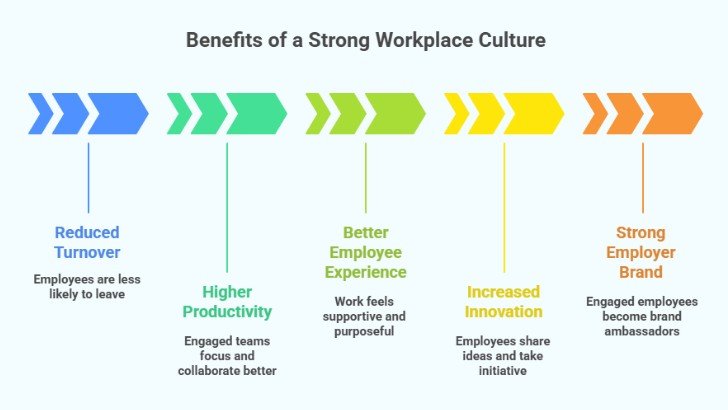
A strong workplace culture typically leads to:
Reduced turnover: Employees are less likely to leave when they feel valued, heard, and aligned with organizational goals. In fact, research shows that highly engaged organizations experience up to 59% lower employee turnover. This explains the connection between culture, engagement, and long-term retention.
Higher productivity: As we have already shared above, engaged teams focus better, collaborate more effectively, and meet performance expectations more consistently.
Better employee experience: Work feels supportive, clear, and purposeful across the employee life cycle. Organizations that rank in the top 25% for employee experience mostly see nearly three times the return on assets and double the return on sales. These numbers show how experience connects directly to business outcomes.
Increased innovation and initiative: People speak up, share ideas, and take ownership without being asked.
A strong employer brand: Engaged employees naturally become brand ambassadors, which supports talent attraction and retention. When culture is strong, companies often spend up to 50% less on hiring while attracting nearlytwice as many qualified candidates, which turns employer brand into a real recruiting advantage.
From our perspective, these outcomes are connected. When culture supports people, engagement rises. And when engagement rises, organizational success follows. Our recommendation is to view culture as a long-term investment.
Trust us, the return shows up not just in morale, but in business performance, customer service, and profit margins.
How Organizations Can Improve Company Culture to Increase Engagement
Now that you understand how company culture shapes engagement, the next step is action. Improving culture does not require massive overhauls or flashy programs alone. We usually recommend focusing on everyday behaviors and systems employees interact with regularly.
Let’s look at practical ways organizations can strengthen workplace culture and improve engagement in a meaningful, lasting way.
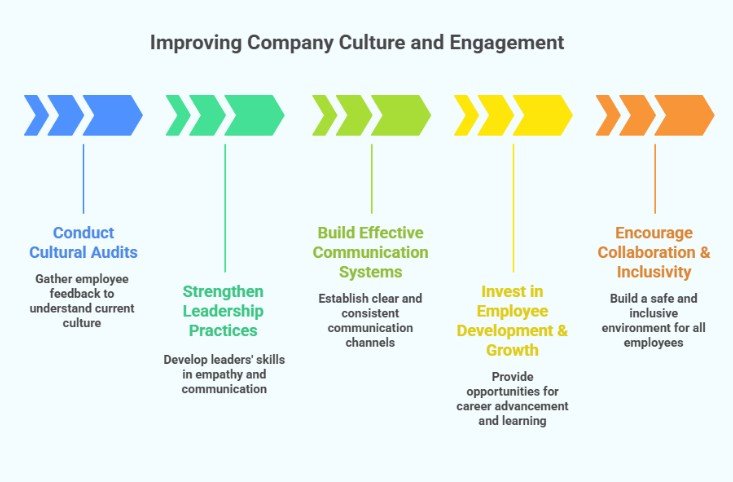
1. Conduct Cultural Audits
If you want to improve culture, you first need to understand how it actually feels to your employees. Cultural audits help you uncover gaps between leadership intent and employee experience. Tools like employee surveys, pulse checks, and feedback loops give you a clearer picture of what is working and what is not.
From our experience, the value is not just in collecting feedback, but in how you respond to it. We usually suggest keeping surveys short, running them regularly, and closing the loop with visible action. When employees see their input taken seriously, trust grows, and engagement starts improving almost immediately.
2. Strengthen Leadership Practices
Leadership practices shape culture faster than any policy ever will. To improve engagement, leaders need ongoing support to grow their skills. Coaching, emotional intelligence, and trust-building training help leaders respond better to real team challenges.
In fact, research shows that organizations investing in leadership development see up to 25% better business outcomes.
From what we have learned working closely with leadership teams, these skills make a real difference over time. Listening better, responding with empathy, and handling tough conversations with clarity gradually build trust.
When employees trust their leaders, engagement becomes easier to sustain, and culture starts shifting in a healthier, more consistent direction.
3. Build Effective Communication Systems
Effective communication systems help you stay aligned without constant follow-ups or confusion. Transparent channels and routine updates make it easier for employees to understand priorities, decisions, and expectations. When communication feels predictable and clear, engagement levels stay more stable.
From our point of view, the strongest systems are simple and consistent. We usually recommend setting clear communication channels for different needs and sticking to regular update rhythms. Teams engage more when they know where to find information and when to expect it.
Trust us, clarity beats volume every time, and consistent communication systems remove friction before it turns into disengagement.
4. Invest in Employee Development & Growth
Employee development affects whether you see a future inside the organization. Clear career paths, role expectations, and learning opportunities help employees understand how they can grow. When growth feels vague, engagement usually drops first.
From how we approach this in practice, development works best when it feels practical and visible. We recommend structured career conversations, skill-based learning plans, and stretch projects tied to real goals. In our experience, employees stay more engaged when growth feels intentional instead of promised. When people can see what comes next, commitment becomes easier to sustain.
5. Encourage Collaboration & Inclusivity
Collaboration and inclusivity shape how safe you feel contributing at work. When psychological safety exists, employees share ideas, ask questions, and challenge assumptions without fear.
In fact, research from McKinsey shows that teams in more diverse organizations are about 35% more likely to outperform their peers. This shows how inclusion directly connects to performance and engagement.
From how we approach this in practice, inclusivity goes beyond policies or statements. We suggest focusing on daily behaviors that invite participation, such as inclusive meetings, fair decision-making, and visible follow-through on employee feedback. DEI strategies work best when they show up consistently in how teams collaborate.
From our point of view, when people feel respected and included, engagement becomes stronger and collaboration improves naturally.
Read Next:How to Change Company Culture Without Breaking Your Business
Real-World Examples of How Company Culture Drives Employee Engagement
Strong culture is easier to understand when you see it in action. Some organizations consistently maintain high engagement because their culture shows up clearly in leadership behavior, communication, and everyday work practices.
Let’s look at real-world examples that show how intentional culture building leads to stronger employee engagement and better business outcomes.
1. Netflix
Netflix built a high-performance culture around a simple idea: freedom paired with responsibility. Instead of relying on heavy rules or approval layers, employees are trusted to use sound judgment.
Open communication, clear expectations, and direct feedback help teams move fast without confusion. This approach creates an environment where people feel trusted to make decisions while still being accountable for outcomes.
What makes this culture work is clarity. Netflix shares context widely so employees understand priorities and can act without waiting for permission. Hiring stays selective, standards stay high, and feedback stays direct.
This combination of trust, transparency, and responsibility creates strong engagement and clear accountability across teams. That cultural foundation also supports performance, with Netflix generating around $3.1 million in revenue per employee, one of the highest figures in its industry.
2. HubSpot
HubSpot built a people-first culture around transparency, trust, and shared values. Its Culture Code outlines clear principles summarized as HEART: humble, empathetic, adaptable, remarkable,andtransparent. Instead of treating culture as fixed, HubSpot positions it as a work in progress that evolves as the company grows. Knowledge sharing, open access to leadership, and a strong focus on results over rigid work structures help employees feel trusted and included.
What makes this approach effective is how intentionally it was built. HubSpot’s leadership opened the culture conversation to employees early, inviting feedback, questions, and debate before finalizing it.
The company then made the Culture Code public, signaling consistency and accountability. This openness helps align employees, candidates, and customers around the same values, which strengthens engagement and attracts people who genuinely fit the culture.
Read Next:6 Inspiring Company Culture Examples You Can Learn From
Build an Engaged, People-First Culture with Alpha Apex Group
Company culture plays a defining role in how employees show up, contribute, and stay committed over time. When culture feels clear, consistent, and people-focused, engagement becomes part of daily work rather than something leaders have to chase.
Strong leadership, open communication, recognition, purpose, and inclusion all work together to shape a healthier employee experience.
Key takeaways
Company culture influences employee engagement long before formal programs or tools are introduced.
Leadership behavior and leadership development directly shape trust, morale, and engagement levels.
Clear, consistent communication reduces confusion and prevents quiet disengagement.
Meaningful recognition helps employees feel valued and strengthens retention
Purpose and values alignment make work feel intentional and motivating.
Supportive work environments improve collaboration across in-office and remote teams.
Employee development creates commitment by showing people a future within the organization.
Inclusive cultures encourage participation, innovation, and stronger team connections.
If you are looking to strengthen company culture and improve employee engagement in a practical, sustainable way, Alpha Apex Group can help. Our team works with organizations to assess cultural gaps, align leadership practices, and design people-first strategies that support long-term growth.
Contact us today to start building a culture that truly engages your workforce!
FAQs
What is the role of company culture in employee engagement?
Company culture shapes how employees experience work every day. It influences trust, motivation, communication, and alignment with organizational goals. When culture feels supportive and consistent, employees feel more connected to their roles.
What are the key elements of company culture that affect employee engagement?
The most influential elements include leadership behavior, communication norms, recognition practices, purpose and values alignment, and team dynamics. These factors shape employee experience and determine whether people feel heard, supported, and valued. Consistency across these elements plays a major role in sustaining engagement.
How can leaders shape company culture to enhance employee engagement?
Leaders shape culture through everyday actions and decisions. Clear communication, transparency, empathy, and follow-through build trust and psychological safety. When leaders model expected behaviors and invest in their own development, employees feel more confident and engaged. Leadership consistency matters more than formal policies or statements.
How does Alpha Apex Group assess company culture?
Alpha Apex Group uses a mix of cultural audits, employee surveys, leadership interviews, and feedback loops to understand how culture is experienced across the organization.
Can Alpha Apex Group support engagement in remote or hybrid teams?
Yes. Alpha Apex Group helps organizations strengthen communication, collaboration, and inclusion across remote and hybrid teams by designing culture practices that work beyond physical offices.
What makes Alpha Apex Group different from other culture consulting firms?
Alpha Apex Group focuses on practical culture building tied to leadership behavior, employee experience, and engagement outcomes. We never use generic frameworks or one-size-fits-all programs.
.jpg)
.jpg)