How to Build a High-Performing ServiceNow Team (Admins, Developers, Architects, BAs)
Building a high-performing ServiceNow team determines how well your organization delivers value. Many enterprises face slow implementations, growing technical debt, repeated incidents, and weak adoption due to unclear roles, ownership gaps, and misaligned skills.
Talent shortages make the problem harder. A recent survey found that 74% of organizations see skills gaps as the biggest barrier to digital progress. When roles, accountability, and capability planning fall short, ServiceNow performance suffers.
A structured team that includes admins, developers, architects, and business analysts supports faster delivery, fewer support tickets, stronger governance, and consistent platform health.
In this blog, we’ll explore:
Why a high-performing ServiceNow team matters, common outcomes, and signs your team is underpowered
A step-by-step guide covering vision, roles, operating model, governance, and quality practices
How to measure performance with clear KPIs and decide when to hire, upskill, or partner
Common mistakes to avoid and answers to key questions leaders often ask
P.S. Struggling with long backlog queues or recurring ServiceNow outages that slow delivery?Alpha Apex Group helps you build and scale the right ServiceNow team quickly. We connect you with experienced ServiceNow professionals who reduce risk, improve delivery, and strengthen governance.
Why Building a High-Performing ServiceNow Team Matters
From our experience, ServiceNow succeeds or fails based on how you treat it.
When you run it like a series of one-off projects, delivery slows, and problems pile up. When you treat it as a living platform, teams plan ahead, protect quality, and build capabilities that compound over time.
If you approach ServiceNow as projects, you focus on deadlines and features. Ownership fades once delivery ends and technical debt grows quietly. Each new request feels harder than the last.
In contrast, a platform mindset changes that. You plan for scale, upgrades, and long-term adoption. Your team owns outcomes, instead of tickets. Decisions align with where the platform needs to be six, twelve, and twenty-four months from now.
What High-Performing ServiceNow Teams Consistently Deliver
When the right people sit in the right roles, patterns start to shift quickly. Delivery feels calmer, decisions make sense, and the platform stops fighting back.
There’s solid data behind this.
In a Forrester study, organizations that modernized IT Service Management reported a 20% increase in IT productivity and a 25% reduction in P1 incidents. Over three years, they achieved $17.3 million in present value benefits and an ROI of 195%.
Those gains came from stronger operating models and better team design rather than isolated feature launches.
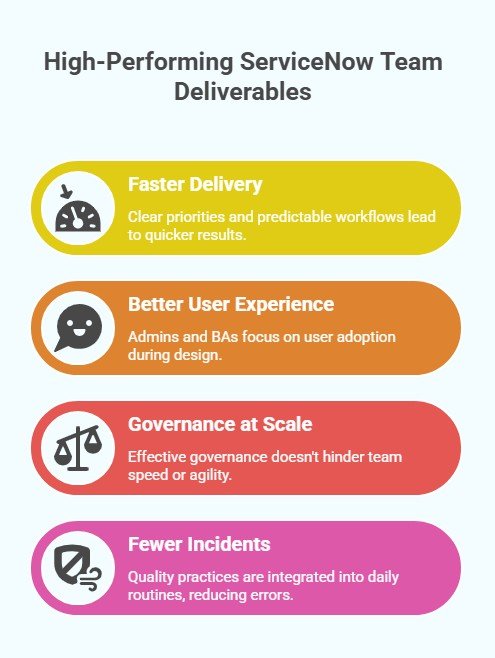
In practice, high-performing teams achieve:
Faster delivery because priorities are clear and workflows are predictable
Better user experience since admins and BAs design with adoption in mind
Governance at scale without slowing teams down
Fewer incidents as quality practices become part of daily work
These outcomes come from clarity and structure, which is what we advise our clients to implement first.
Signs Your ServiceNow Team is Underpowered
If you are seeing these issues, the problem is rarely the tool. Instead, you may be facing:
Backlog chaos where nothing feels truly prioritized
Low adoption despite heavy investment in new modules
Constant rework caused by unclear requirements or weak architecture
Developers fixing issues that should never reach production
These signals usually point to gaps in roles, decision rights, or skills coverage. Once you fix the team structure, the platform starts working the way it should.
How to Build a High-Performing ServiceNow Team (Step-by-Step Guide)
This is where most teams either get real traction or stay stuck. Tools, roles, and frameworks help, but only when you put them together in the right order.
Below, we’ve shared a practical, step-by-step approach that we’ve seen work across organizations at different maturity levels.
Step 1: Define Vision, Outcomes, and a Team Charter
This step sets the tone for everything that follows. If you skip it or rush it, the rest of your decisions start to feel reactive. We suggest slowing down here and getting intentional before you touch roles, hiring, or custom configurations.
Start with the outcomes you want from the ServiceNow platform, rather than the features you plan to deploy. Ask yourself what real progress looks like over the next year.
For many teams, that includes:
Stronger ITSM maturity with cleaner processes, better knowledge management, and fewer escalations.
ESM expansion that improves employee experience through HR Service Delivery, Employee Workflows, or Customer Service Management. In many organizations, ESM initiatives are rated as transformational, with around 38% of respondents reporting stronger IT–business relationships and higher satisfaction.
Automation that reduces manual work using Flow Designer, business rules, and built-in automation capabilities
Once those outcomes are clear, align your ServiceNow roadmap to business priorities.
If the organization is focused on digital transformation, employee satisfaction, or enterprise transformation, your platform goals should support that direction directly. This is where stakeholder engagement matters.
Bring in IT, HR, Security Operations, and business leaders early so the roadmap reflects shared priorities. Isolated requests are not a good way to drive sustainable platform decisions.
Next, draft a simple team charter. Keep it practical; one page is enough.
We usually suggest covering three things:
What the ServiceNow team owns end-to-end, including platform management, scoped apps, and platform architecture
What the team supports in partnership with others, such as Security, Governance, Risk, and Compliance, or IT Asset Management
What sits outside your scope, even if requests come in loudly or often
Trust us: this clarity saves time later. It reduces friction, improves stakeholder management, and helps remote teams and virtual teams understand how to engage with you.
When your vision, outcomes, and charter are clear, decisions around architecture, automation, and governance become much easier. You are no longer reacting to tickets. You are building toward business value realization with purpose.
Step 2: Choose the Right Team Model
Once your vision and charter are clear, the next question is structure. How should your ServiceNow team actually work day to day? There’s no universal answer, but there is a model that fits your scale, maturity, and goals.
We suggest starting with how decisions are made today and where work naturally sits. The right model should remove friction rather than add coordination overhead.
Centralized vs federated vs product-aligned teams
| Team model | How it works | Best fit for |
|---|---|---|
| Centralized | One core team owns the ServiceNow platform end-to-end. Standards stay tight, platform architecture remains clean, and governance is easier to manage. | Teams early in their ServiceNow journey, building ITSM maturity, Security Operations, or Governance, Risk, and Compliance foundations. |
| Federated | A central platform team sets standards and guardrails, while distributed teams own delivery for specific areas like HR Service Delivery, Customer Service Management, or Field Service Management. | Organizations scaling ServiceNow across multiple functions without losing control. |
| Product-aligned | Teams align to ServiceNow product areas such as Employee Workflows, IT Operations Management, or Strategic Portfolio Management, treating each as an internal product. | Mature environments focused on employee experience and faster business value realization. |
What stays central vs distributed? Remember thatthis split needs to be clear from the start.
Keep central:
ServiceNow Architecture and platform architecture
Governance, security, and compliance, and security by design
Business rules, system properties, update sets, and scoped applications
Automated testing framework and workflow audits
Distribute:
Catalog items and case management design
User feedback and experience improvements
Product-specific configurations within guardrails
Stakeholder engagement for HR, Security, and operations teams
If you work with remote teams or virtual teams, clarity here matters even more. We usually suggest starting more centralized than you think. You can always distribute later. Fixing fragmentation is much harder.
Step 3: Define Roles + RACI (Who Owns What)
This is where many ServiceNow teams start to feel relief. After roles and decision rights are clear, work moves faster and confusion drops. If everyone touches the platform but no one truly owns it, delivery always slows down.
We suggest starting with a small set of baseline roles, then layering in higher-maturity roles as your ServiceNow platform grows.
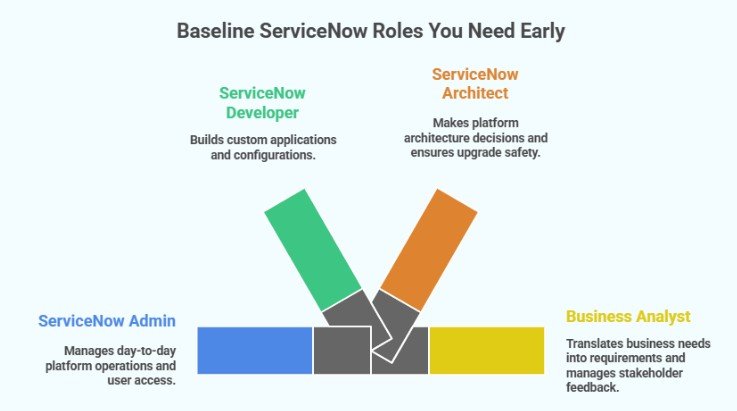
Baseline ServiceNow roles you need early
These roles form the core of most teams, even in smaller environments.
ServiceNow admin: Owns day-to-day platform management, system properties, catalog items, user access, and basic platform functionality
ServiceNow developer: Builds scoped applications, business rules, Flow Designer logic, and custom configurations within agreed guardrails
ServiceNow architect: Owns ServiceNow Architecture, platform architecture decisions, integration patterns, and upgrade safety
Business analyst: Translates business needs into clear requirements, manages stakeholder engagement, and incorporates user feedback
If you are supporting ITSM, HR Service Delivery, or Customer Service Management, these roles alone can cover a lot when ownership is clear.
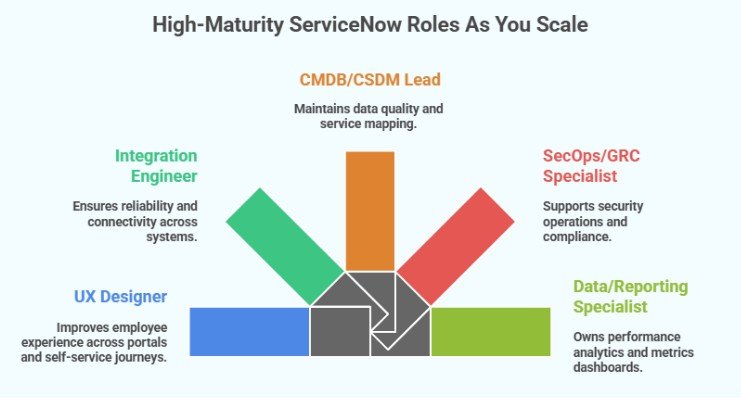
High-maturity ServiceNow roles as you scale
As your ServiceNow platform grows across product suites and workflows, generalist roles are no longer sufficient. This is where specialist ownership starts to matter.
We suggest adding these roles based on complexity:
UX designer: Improves employee experience across portals, Next Experience, and self-service journeys.
Integration engineer: Owns APIs, iPaaS flows, MID servers, and reliability across connected systems.
CMDB or CSDM lead: Maintains data quality, service mapping, and model integrity as IT operations Management expands.
SecOps or GRC specialist: Supports security operations, vulnerability response, and governance, risk, and compliance when risk exposure increases.
Data or reporting specialist: Owns performance analytics, metrics dashboards, and performance and compliance tracking tools.
Decision rights and accountability mapping
A simple RACI (Responsible, Accountable, Consulted, Informed) framework makes a big difference here. Keep it practical and focus on decisions, instead of tasks.
Define who:
Approves platform architecture changes
Owns security and compliance decisions
Decides when to configure versus customize
Signs off on releases and lifecycle events
When decision rights are visible, meetings get shorter, and escalations drop. As a result, your team starts operating with confidence.
Once roles and RACI are clear, the ServiceNow platform becomes easier to scale without burning people out.
Step 4: Build a Skills Matrix and Upskilling Plan
At this stage, the structure is in place and ownership is clearer.
Now the question shifts to capability. Do you actually have the skills to support the ServiceNow platform you are trying to scale?
This matters more than ever. Organizations are reporting a roughly 55% year-over-year increase in ServiceNow demand, and that growth is outpacing available skilled talent. Skills gaps on implementation and platform teams are becoming the norm now.
We suggest starting with a simple skills matrix; nothing complex.
List your team members on one side and the skills that matter on the other. Focus on what you need today and what you will need six to twelve months from now.
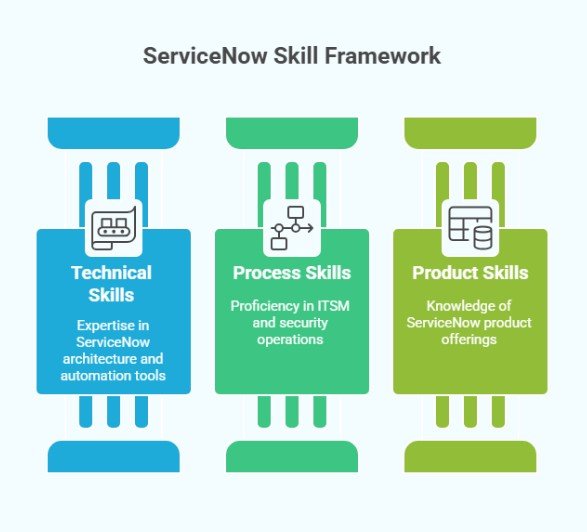
Cover three skill areas. High-performing teams balance depth and breadth across three areas.
Technical skills: ServiceNow Architecture, scoped applications, Flow Designer, business rules, system properties, Update sets, integration basics, and automation capabilities
Process skills: ITSM, IT Operations Management, Security Operations, Governance, Risk, and Compliance, and lifecycle events across services
Product skills: HR Service Delivery, Employee Workflows, Customer Service Management, knowledge management, IT Asset Management, and Field Service Management
This makes gaps visible quickly and helps you avoid overloading a few senior people with everything.
Plan for T-shaped capability
We usually suggest aiming for T-shaped skills. Each person goes deep in one or two areas while maintaining working knowledge across the ServiceNow platform.
For example, a developer might specialize in automation and integrations while still understanding ITSM flows and employee self-service. And a business analyst may focus on HR transformation while staying comfortable with catalog items and case management.
From there, build an upskilling plan that fits how your team actually works. Training programs, learning management tools, and hands-on pairing tend to stick better than one-off courses, especially for remote teams and virtual teams.
Nearly all organizations (about 99%) say they’ve benefited from upskilling efforts. And half (51%) report that upskilling has actually closed skills gaps within their workforce.
When skills are visible and growth paths are clear, confidence rises and burnout drops. Your team can now improve platform functionality with intent.
Step 5: Set Up the Operating Model
This is where strategy turns into execution. A clear operating model keeps the ServiceNow platform moving and prevents backlog chaos. If intake, delivery, or release is unclear, even strong teams slow down.
We suggest keeping this simple and visible. Everyone should understand how work enters the system, how it gets built, and how it reaches users.
Demand intake and prioritization
Use a single intake path, as multiple channels create noise.
Use standardized requests tied to catalog items or case management so demand is easy to compare. Prioritize based on business value realization, risk, and impact on employee experience.
Moreover, involve stakeholders early. Strong stakeholder engagement reduces rework later and keeps expectations realistic.
Delivery method
Pick a delivery approach your team can sustain.
Many teams use sprint-based Agile methodologies for new features and enhancements, while Kanban-style flow works well for support, defects, and Security Operations work. Use project management tools that support remote teams and virtual teams.
We usually suggest mixing approaches when needed, as long as ownership stays clear.
Release rhythm and environments
Set a predictable release rhythm. Smaller, frequent releases lower risk and improve user productivity.
Maintain clear development, test, and production environments. Use Update sets, scoped apps, and the Automated Test Framework to protect quality. Workflow audits help catch issues before they reach users.
When the operating model is clear, delivery feels calmer and more reliable. Next, we’ll move into governance guardrails, where speed and control start to balance out.
Step 6: Put Governance Guardrails in Place
Governance does not have to slow you down. When done right, it actually protects speed. The goal here is simple. Set clear boundaries so teams can move fast without breaking the ServiceNow platform.
We suggest starting with a lightweight architecture review board. Keep it small and focused. This group reviews platform architecture decisions, integration patterns, and high-impact changes. Short reviews work best. Long meetings usually signal unclear guardrails.
Next, define practical guardrails everyone can follow:
Naming standards and data model rules to keep reporting clean
Reuse-first policies to avoid rebuilding what already exists
Clear rules for configuration versus customization so developers don’t default to code
Upgrade safety should guide every decision. Favor scoped apps, Flow Designer, and platform functionality over hard-coded logic. Avoid changes that block upgrades or increase technical risk.
When governance feels predictable, teams trust it. You reduce rework, protect security and compliance, and keep delivery moving. Strong guardrails let the ServiceNow platform scale without turning governance into a bottleneck.
Step 7: Establish Quality Practices
Quality keeps the ServiceNow platform stable as it grows. You do not need a heavy process, but you do need habits that teams follow consistently.
We suggest focusing on a few practices that deliver the most impact:
Peer reviews for code and configurations: A second set of eyes catches issues early and spreads knowledge.
Automated testing with ATF: Use regression suites for high-risk workflows to protect every release.
Simple documentation standards: Document intent, ownership, and dependencies, and keep it current.
Post-incident learning loops: Run short reviews after issues to improve platform functionality and avoid repeats.
When these practices become routine, releases feel safer, and the team spends less time firefighting.
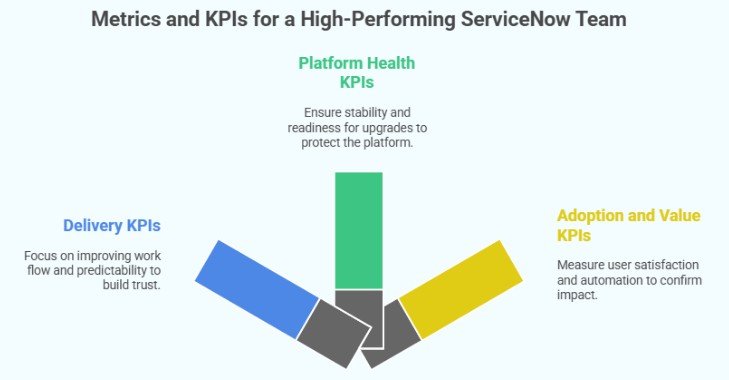
Metrics and KPIs for a High-Performing ServiceNow Team
If you are not measuring the right things, it is hard to know whether the team is improving or just staying busy. Metrics should guide decisions at a team level, not create pressure for individuals. We suggest keeping them few, visible, and tied to outcomes you actually care about.
Delivery KPIs
These show how smoothly work flows through the team.
Lead time: How long it takes to move from intake to release
Throughput: How much work the team completes in a given period
Predictability: How often delivery matches planned commitments
When these improve, planning conversations get easier and trust builds.
Platform health KPIs
These protect the ServiceNow platform over time.
Performance: Response times, errors, and stability
Technical debt: Backlog caused by shortcuts or outdated patterns
Upgrade readiness: Ability to stay current without disruption
We usually suggest reviewing these before every major release.
Adoption and value KPIs
These confirm whether your work matters to users.
CSAT and user feedback: Shows how satisfied users are with ServiceNow experiences and where friction still exists.
Deflection rates through knowledge management and self-service: Measures how often users resolve issues without opening tickets.
Automation rate across workflows: Tracks how much manual work is eliminated through automated ServiceNow processes.
Read Next:Why ServiceNow Talent Is Hard to Find (and How to Attract Better Candidates)
Hiring vs Upskilling vs Partnering (What to Do When)
At some point, every ServiceNow leader hits this decision. Do you hire, train the team you have, or bring in outside help? The right answer depends on urgency, complexity, and long-term goals.
We suggest thinking in terms of time and impact, and not necessarily focus on headcount.
Hire when the capability is core and long-term. Platform owners, architects, and admins who carry institutional knowledge are worth investing in. Hiring makes sense when the work is continuous and tied closely to platform management.
Upskill when the foundation is already strong. If your team understands the ServiceNow platform and business context, targeted training programs can close gaps faster than hiring. This approach supports retention and builds depth over time.
Partner or borrow when speed or specialization matters. Short-term needs like integrations, Security Operations, or large releases often benefit from experienced partners. The focus should stay on knowledge transfer and long-term team strength.
P.S. If you need help deciding when to hire, upskill, or bring in outside expertise, Alpha Apex Groupcan support you at every stage. From ServiceNow consulting to executive search, we help you move faster.
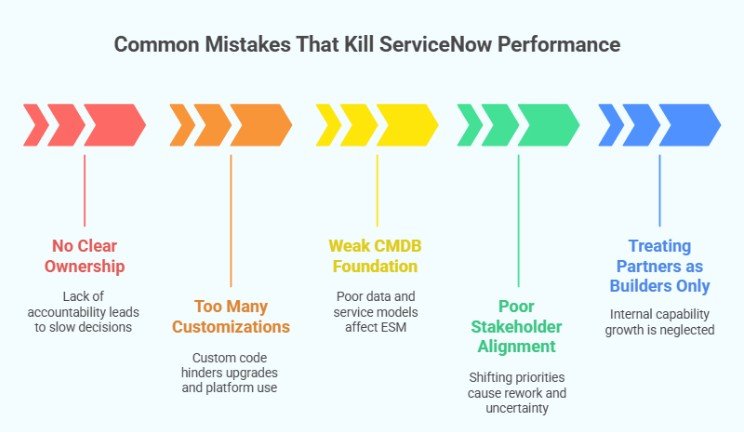
Common Mistakes That Kill ServiceNow Performance
Even strong teams can stall if a few patterns creep in. If any of these feel familiar, you are not alone. We’ve seen most of these issues show up when ownership, structure, or intent drift over time.
No clear ownership: Everyone touches the platform, but no one owns outcomes. As a result, decisions slow down, and accountability fades.
Too many customizations: Teams solve short-term problems with custom code. Over time, upgrades become harder, and platform functionality gets sidelined.
Weak CMDB foundation with big ESM promises: ESM looks great on paper, but without clean data and service models, IT Operations Management struggles to deliver value.
Poor stakeholder alignment: Priorities change midstream, and requirements shift. As a result, rework becomes normal, and delivery confidence drops.
Treating partners as builders only: Work gets delivered, but internal capability does not grow. We suggest using partners to strengthen your team while execution continues.
This structure keeps the logic clear and makes each risk easy to spot and fix.
Build Your High-Performing ServiceNow Team with Alpha Apex Group
A high-performing ServiceNow team depends more on clarity than tools. When you define ownership, choose the right team model, invest in skills, and operate with purpose, the platform starts delivering consistent value.
Treat ServiceNow as a long-term platform, not a stream of projects, and your team gains speed, stability, and trust across the business.
Key takeaways
High-performing ServiceNow teams succeed when the platform is treated as a long-term product rather than a series of disconnected projects.
Clear vision, outcomes, and a simple team charter prevent confusion and reduce friction across stakeholders.
The right team model depends on maturity, scale, and goals, not a one-size-fits-all structure.
Defined roles and RACI bring accountability, faster decisions, and smoother delivery.
Skills matrices and upskilling plans help teams keep pace with growing platform demand.
A clear operating model keeps intake, delivery, and release predictable and calm.
Lightweight governance guardrails protect speed while keeping the platform upgrade-ready.
Quality practices and meaningful KPIs keep performance steady as complexity grows.
If you are looking to strengthen your ServiceNow team, close skill gaps, or scale delivery with confidence, Alpha Apex Group can help.
Contact us to get the right mix of ServiceNow talent and consulting support to move your platform forward.
FAQs
How many people do you need for ServiceNow?
There is no fixed number. The right team size depends on platform scope, adoption, and complexity. Small environments may run well with a core admin, developer, and architect. As ServiceNow expands into ESM, Security Operations, or HR Service Delivery, additional roles become necessary to maintain quality and speed.
Should ServiceNow sit in IT, Digital, or shared services?
ServiceNow often starts in IT, but it works best as a shared platform over time. Many organizations move ownership into shared services or a Center of Excellence to support HR, Security, and business teams. The key is clear governance. Ownership should match how widely the platform is used.
What is the best way to build a high-performance ServiceNow team?
Start with clarity. Define platform vision, outcomes, and ownership before hiring or scaling. Choose a team model that fits your maturity, assign clear roles with RACI, and invest in skills development. High-performing teams treat ServiceNow as a long-term platform, rather than a series of projects.
How can you improve the performance of a ServiceNow instance?
Performance improves when teams focus on fundamentals. Reduce unnecessary customizations, strengthen architecture and governance, and use automated testing to protect quality. Clear intake, predictable releases, and regular platform health reviews help prevent issues before users feel them.
How does Alpha Apex Group help build high-performing ServiceNow teams?
Alpha Apex Group supports teams through ServiceNow consulting and talent solutions. We help you define team structure, close skill gaps, and align roles with platform goals to improve delivery, governance, and long-term performance.
Can Alpha Apex Group support ServiceNow teams at different maturity levels?
Yes. Alpha Apex Group works with organizations early in their ServiceNow journey and those scaling across ESM, Security Operations, and HR Service Delivery. Our support adjusts based on your platform maturity and business priorities.
Does Alpha Apex Group provide both ServiceNow consulting and staffing?
Yes. Alpha Apex Group offers both ServiceNow consulting and executive search and staffing. This approach helps you get the strategic guidance and the right talent without relying on one-size-fits-all solutions.
.jpg)

![Top 10 AI Executive Search Firms & Recruiters [2026 Update]](https://cdn.prod.website-files.com/6a1ef6de349095f1fcc34ccb/6a26d0533a7c25762c14664a_Top%2BAI%2BExecutive%2BSearch%2BFirms%2B_26%2BRecruiters%2B_282_29.jpeg)