Employee Onboarding Checklist: Complete Guide

It’s tempting to think of onboarding as just HR admin, but it’s much more than that.
Onboarding is a performance, retention, and risk issue. The way a new hire is brought into the business shapes how quickly they become productive, how confident they feel, and whether they stay.
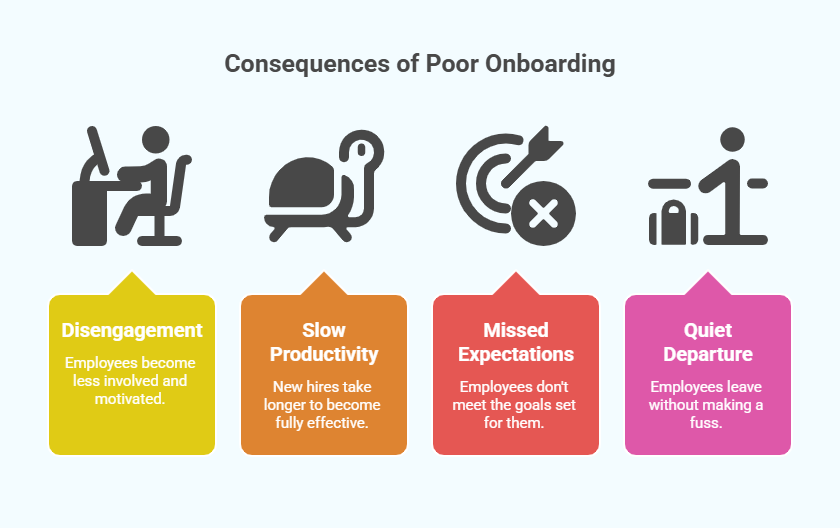
When onboarding is treated as a one-off event, the cost shows up in the form of disengagement, slow ramp-up, and early exits.
The data support that. According to Gallup, employees who experience effective onboarding are 2.6X more likely to be extremely satisfied at work.
In this article, we’ll show you why onboarding is so important and share a checklist to help you bring on new team members in the best way possible.
P.S. Struggling with slow ramp-up, inconsistent onboarding experiences, or early attrition within the first 90 days? Alpha Apex Group helps you design structured, scalable onboarding systems that reduce risk, accelerate productivity, and turn new hires into high-performing contributors from day one.
The Real Cost of Poor Onboarding (What Most Companies Get Wrong)
Poor onboarding rarely fails in obvious ways, with one single breaking point. Instead, the damage shows up gradually through disengagement, slow time to productivity, missed expectations, and employees quietly checking out. Because the fallout isn’t immediate, it’s easy for hiring managers to underestimate just how expensive weak onboarding really is.
That blind spot is widespread. The Gallup research we shared above also found that only 12% of employees strongly agree their organization does a great job onboarding new hires.
This means nearly 9 out of 10 employees start their role without the clarity, support, or structure they need to succeed. The result here is lower satisfaction, reduced performance, higher turnover risk, and strain on team capacity.
A lot of onboarding guides out there focus vaguely on retention, but few connect the dots between onboarding quality, productivity drag, and long-term performance. That’s the gap this guide is designed to close.
What “Great Onboarding” Actually Means
Too many organizations confuse onboarding with orientation. Paperwork gets completed, system access is activated, and a company overview is delivered; then the structure disappears. Great onboarding goes much further. It is a defined 30–90 day performance integration plan that reduces ambiguity, accelerates ramp-up, and embeds the employee into team workflows.
As SHRM notes:
“Onboarding is a prime opportunity for employers to win the hearts and minds of new employees.”
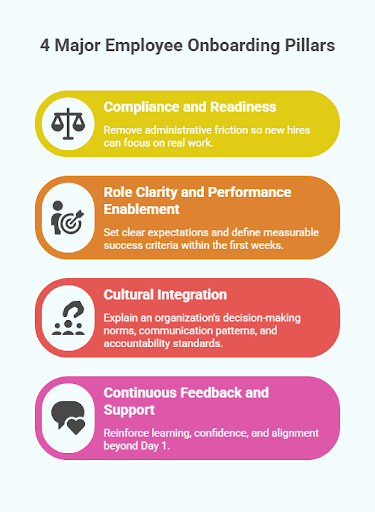
To deliver results consistently, onboarding should rest on four strategic pillars:
- Compliance and readiness to remove administrative friction so new hires can focus on real work
- Role clarity and performance enablement, where you set clear expectations and define measurable success criteria within the first weeks.
- Cultural integration to explain an organization's decision-making norms, communication patterns, and accountability standards.
- Continuous feedback and support to reinforce learning, confidence, and alignment beyond Day 1
This structure matters because engagement drives outcomes. Gallup research shows that highly engaged employees deliver 14% higher productivity, measured through production records and performance evaluations.
When onboarding skips the “why” behind each step, engagement and performance both suffer.
The Complete Employee Onboarding Checklist
Most onboarding checklists focus on what needs to be done, but ignore when it should happen, who owns it, and what outcome it’s meant to achieve. The result is a process that looks good on paper but breaks down in reality.
The checklist below is timed, assigned, and outcome-driven, designed to support performance and engagement from pre-boarding through the first 90 days.
As recruiter Stacy Zapar puts it, “Onboarding is not a one-time event, it’s a process.” This section treats it exactly that way.
1. Pre-Boarding (Offer Accepted, Day 0)
Pre-boarding sets the tone for everything that follows. When it’s handled well, new hires arrive focused, confident, and ready to contribute. When it’s not, Day 1 is spent fixing problems that should never have existed in the first place.
Compliance and Legal Prep
This is about removing friction early. All documentation should be completed before the employee’s first day, including signed offer letters, employment contracts, right-to-work and tax forms, background checks, and creation of the employee record in the HRIS. Day 1 should never be slowed down by avoidable admin.
IT and Work Environment Readiness
New hires should have immediate access to the tools they need to work. Make sure to provide email credentials and system access in advance, order and configure hardware, set up role-based permissions, and prepare workspaces. This applies to both onsite and remote roles.
Manager Enablement
Pre-boarding isn’t just HR’s responsibility. Managers should document clear 30-60-90 day success criteria, finalize the first-week agenda, and prepare an internal announcement.
Outcome: The new hire arrives ready to hit the ground running, with no administrative friction on Day 1.
This matters more than many HR teams realize. Peer-reviewed research shows that onboarding strengthens employees’ identification with the organization and workplace well-being. And in one study, onboarding quality explained 65.4% of the variance in turnover intention. Remember that the early stages are a powerful indicator of who stays and who leaves.
2. Day One Experience (Orientation Done Right)
Day One is about clarity, connection, and confidence. A strong first day helps new hires understand how your organization works and reassures them that they’re set up to succeed.
Orientation Program Essentials
Foundational context should be covered early and clearly. This includes the company’s mission, values, and operating principles, as well as company policies, benefits, and key administrative processes.
A guided office or virtual walkthrough should include practical details such as communication platforms, escalation paths, and where to access resources. Early clarity prevents unnecessary friction.
Human Connection
Day One should feel personal and warm. A direct welcome from the manager, intentional team introductions, and the assignment of an onboarding buddy or mentor are all great ways to show belonging and support. These actions show the new hire that they aren’t alone.
Role Clarity
You must ensure that new hires leave Day One with a clear understanding of why their role exists and what success looks like. Managers should explain the purpose of their role, set clear immediate priorities, and explicitly create space for questions.
Outcome: The new hire understands success criteria, reporting relationships, and how to navigate the organization from Day 1.
3. First Week (Days 1-7)
The first week is when onboarding shifts from orientation to execution. This is where new hires begin forming habits, building confidence, and understanding how work actually gets done.
The goal at this stage is simple: remove ambiguity and give your new employee what they need to perform.
Performance Enablement
Training should be role-specific and applied. New hires need hands-on guidance with tools and systems, clear access to SOPs and documentation, and opportunities to learn through shadowing or real examples.
As roles become increasingly technology-enabled, clarity around system workflows and responsibilities is critical. Confusion at this stage slows ramp-up and compounds performance gaps.
Deloitte research shows that 54% of workers and leaders are concerned about blurred distinctions between work done by humans and technology. This emphasze the need for clarity around tools, processes, and responsibilities.
Cultural Integration
Culture is learned through behavior. The first week should clarify the communication cadence, meeting norms, escalation protocols, and decision-making processes. Plus, Introductions to key stakeholders should focus on collaboration expectations instead of just visibility.
Check out our guide on the role of company culture in employee engagement.
Checkpoints
Execution requires feedback. Therefore, make sure to schedule the first formal check-in within Week One and confirm documented 30-day deliverables so your new starter is clear on what progress looks like and what is expected of them.
Outcome: The new hire understands operational workflows, stakeholder expectations, and how performance will be measured.
4. First 30, 60, and 90 Days
The first three months determine whether early structure converts into sustained performance. This phase shifts from integration to accountability, where expectations are tested against measurable output.
30 Days
At the 30-day mark, the focus should be on assessment and reinforcement. Managers should evaluate skills gaps, gather early feedback from both sides, and recognize quick wins. These early signals build confidence and help course-correct before small issues become long-term problems.
60 Days
By the 60-day mark, responsibility should expand. Your training plan should be adjusted based on observed performance, and you should nurture culture fit through real employee feedback and continued integration with the team.
Development conversations become more important at this stage. According to the LinkedIn Workplace Learning Report, 88% of organizations are concerned about employee retention, and providing learning opportunities is cited as the number one retention strategy. This is a critical window for conversations about growth and the future.
90 Days
At 90 days, transition from onboarding to ongoing performance management. Conduct a formal review against 30-60-90 goals, clarify forward-looking expectations, and close the onboarding feedback loop with documented improvements.
Outcome: The employee demonstrates independent productivity, alignment with performance standards, and clarity about long-term growth.
5. Remote and Hybrid Onboarding
Remote and hybrid onboarding requires more structure than on-site roles. Without physical proximity, ambiguity around communication, tool access, and performance expectations compounds quickly and slows ramp-up.
Preparation starts before Day 1. Equipment should be delivered and set up in advance, with system access tested beforehand. Assigning a virtual buddy gives new hires a clear point of contact for day-to-day questions, while structured async documentation helps make sure critical information isn’t lost across meetings or time zones.
Manager involvement is particularly important in remote settings. Frequent check-ins help replace the feedback that would normally happen organically. Meanwhile, intentionally touching base via virtual meetings and coffees, team check-ins, or shared channels helps prevent isolation during the early weeks.
Research found that 36% of remote workers described their onboarding experience as confusing. This shows how easily remote hires can feel disconnected without a deliberate approach.
Want to learn more about building a strong culture in your remote team? Here’s our guide on that.
Download the Free Full Employee Onboarding Checklist
A structured onboarding system only works if it’s executed consistently. Download the printable, outcome-driven checklist to assign ownership, track progress, and ensure no critical step is missed from pre-boarding through 90 days. Use it as your operational blueprint.
Red Flags That Your Onboarding Is Failing
Most onboarding programs don’t fail loudly and obviously, which can be a problem. The warning signs usually appear weeks later, after disengagement has already set in. Spotting these red flags early is critical if you want onboarding to actually protect retention and performance.
Common red flags include:
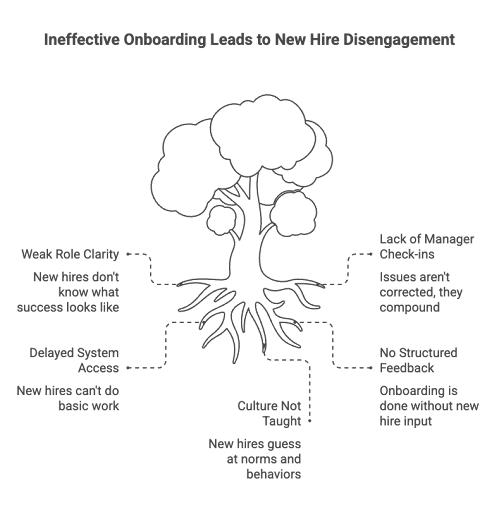
- New hires cannot articulate 30-day success criteria: If an employee cannot clearly define expected outcomes in their first month, role clarity is missing. Without defined targets, effort becomes misdirected and productivity slows.
- No scheduled manager check-ins within the first 30 days: When you rely on informal or reactive conversations, small performance gaps go uncorrected. A defined feedback cadence prevents early drift and reinforces accountability.
- System or tool access is delayed: If a new hire cannot perform basic job functions in their first week, coordination has already broken down. Technical friction directly extends ramp-up time and weakens early momentum.
- No structured feedback is gathered from the new hire: When you fail to ask what is working and what is not, you operate on assumptions. Early friction remains hidden until disengagement surfaces.
- Cultural norms are implied rather than explained: If communication standards, escalation paths, and decision authority are unclear, you force new hires to learn through trial and error. That inconsistency slows integration and performance alignment.
The impact of these failures is measurable. Gallup research shows that only 29% of millennials are engaged at work, while 16% are actively disengaged. This means a lot of workers out there are emotionally disconnected, which can potentially hurt performance. Poor onboarding is a major contributor to that early disengagement.
How to Measure Onboarding Success
If onboarding isn’t measured, it isn’t managed. Too many organizations rely on completion checklists instead of tracking the right outcomes, which makes it impossible to know whether onboarding is actually working.
Effective onboarding programs monitor a focused set of KPIs tied directly to productivity and retention:
- Time to productivity: How quickly a new hire reaches independent performance against defined success criteria.
- 30-60-90 day goal attainment: The percentage of documented onboarding milestones completed on schedule.
- 90-day retention: The proportion of new hires who remain beyond the initial integration window.
- Manager-rated readiness: Direct manager assessment of the employee’s ability to execute core responsibilities.
- New hire engagement or NPS: Early experience indicators that signal advocacy, alignment, and commitment.
These metrics matter because they connect onboarding quality to measurable business outcomes. Research shows that organizations with highly engaged employees outperform their peers across key outcomes, including 18% higher productivity, 23% higher profitability, 78% lower absenteeism, and 21% lower turnover.
When onboarding KPIs are tied to these outcomes, you’ll get better visibility into what’s working and what isn’t. This shows you where to intervene early before disengagement turns into attrition.
How Alpha Apex Group Helps Organizations Get Onboarding Right
Remember that when onboarding is treated strategically, it accelerates productivity, strengthens engagement, reduces early turnover, and reinforces culture from the very first interaction.
Not all HR initiatives offer the same return.
At Alpha Apex Group (AAG), we help you move beyond ad hoc checklists and turn onboarding into a scalable, repeatable system that delivers measurable results.
Our work focuses on the areas where onboarding usually breaks down. This includes process design that holds up as teams grow, technology alignment that removes friction rather than creating it, change management that drives adoption across the business, and manager enablement that makes onboarding a shared responsibility rather than an HR task.
The result is consistency across roles and locations and better visibility into what’s working.
We help you transform onboarding into a strategic advantage, one that scales with your business, delivers consistent employee experiences, and produces measurable outcomes leaders can rely on.
Ready to upgrade your onboarding process? Connect with Alpha Apex Group today and start building a system that drives performance from day one.
FAQs
What is employee onboarding?
Employee onboarding is the process of integrating new hires into an organization so they can become productive, engaged, and aligned with company performance goals.
How long should the onboarding process last?
A structured onboarding process should typically span the first 90 days and, for many roles, continues informally through the first year.
Why is onboarding so important for retention?
Strong onboarding builds clarity, confidence, and connection early, all of which reduce the risk of disengagement and early turnover.
What are the most important onboarding KPIs to track?
Time to productivity, 90-day retention, engagement scores, and new hire NPS provide the clearest view of onboarding effectiveness.
How does Alpha Apex Group help improve onboarding?
We design scalable onboarding systems that align process, technology, and manager ownership to deliver consistent, measurable outcomes.
Can Alpha Apex Group support remote or hybrid onboarding programs?
Yes, we help organizations design remote and hybrid onboarding experiences that maintain clarity, connection, and performance from Day 1.
When should organizations work with Alpha Apex Group on onboarding?
Organizations typically partner with Alpha Apex Group when onboarding feels inconsistent, doesn’t scale, or isn’t delivering measurable business impact.
.jpg)
.jpg)

.jpg)

.jpg)
.jpg)