Top 35+ HR Assistant Interview Questions
Hiring the right HR assistant has a direct and major impact on compliance accuracy, employee experience, onboarding efficiency, and operational stability.
While the role is usually viewed as administrative, HR assistants sit at the center of documentation, data handling, policy execution, and employee communication. When this hire goes wrong, errors ripple quickly across payroll, contracts, benefits, and manager support.
The financial implications alone make interview quality critical. The average cost per hire is approximately $5,475. This means weak interview decisions have measurable financial consequences before productivity loss, turnover disruption, or compliance exposure are even factored in.
Yet many HR assistant interviews remain informal and inconsistent. Questions vary by interviewer, evaluation criteria are unclear, and candidates are assessed on likability instead of accuracy, judgment, and process discipline.
Most online guides simply list questions. What they fail to explain is why each question matters and what strong answers actually sound like.
This guide takes a more structured approach. You’ll find:
- 30+ high-signal HR assistant interview questions
- Clear breakdowns of what each question is designed to test
- What strong answers reveal about real-world performance
- Common red flags to watch for
- A repeatable framework for evaluating candidates consistently
P.S. If your HR assistant interviews feel inconsistent or overly subjective, you may be increasing compliance risk and turnover without realizing it. Alpha Apex Group (AAG) builds structured interview systems and delivers full recruiting support to help you hire with clarity, accuracy, and confidence.
What Does an HR Assistant Do?
An HR assistant supports the operational backbone of the HR function. In many organizations, HR assistants are the first point of contact for policy questions, benefits queries, onboarding documentation, and employee records management.
Their role may appear administrative, but it directly affects compliance accuracy, data integrity, and internal responsiveness.
According to McKinsey’s State of Organizations report, only 5% of organizations say they already have the capabilities they need. Capability gaps often surface first in operational execution. where processes break down, documentation lags, and systems are not updated accurately.
HR assistants play a critical role in preventing those breakdowns. By maintaining structured processes and accurate records, they help stabilize the HR function and enable larger workforce and transformation initiatives to succeed.
What Skills are Required for an HR Assistant?
Although the HR assistant role is usually considered junior, it demands a high level of precision, judgment, and discipline. The position requires strong attention to detail, confidentiality awareness, structured thinking, and the ability to communicate clearly across departments.
Beyond technical accuracy, adaptability is increasingly critical. According to the World Economic Forum’s Future of Jobs Report 2023, 44% of workers’ core skills are expected to change by 2027.
As skill requirements evolve, hiring for learning agility, systems literacy, and problem-solving ability becomes just as important as evaluating current experience. Clearly defining these competencies before building your HR assistant interview questions separates reactive hiring from structured, forward-looking selection.
Key HR Assistant Interview Questions & Answers
The questions below are designed to move beyond surface-level experience and uncover how candidates actually operate in real HR environments.
Each section focuses on a specific capability area, from administrative precision and HR systems literacy to compliance awareness and employee interaction. Within each category, you’ll see:
- What the question is designed to test
- What strong answers typically reveal
- Common red flags to watch for
Used together, these HR assistant interview questions give you a structured framework for comparing candidates fairly, reducing bias, and identifying individuals who can strengthen your HR operations.
General HR Assistant Interview Questions (8 Questions)
These questions assess mindset, structure, and operational maturity.
At this stage, you're not testing deep technical expertise yet, so the focus is on soft skills like discipline, realism, and understanding of HR department demands. Most weak hires fail here because teams evaluate personality instead of process orientation.
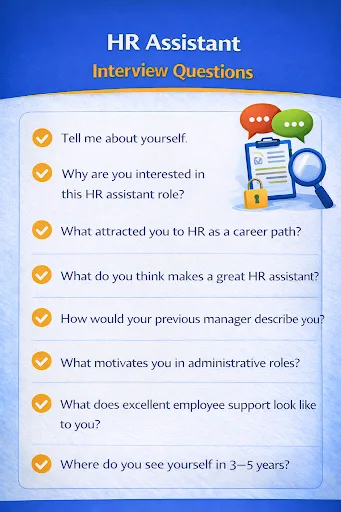
1. Tell me about yourself.
Look for: A structured, role-relevant summary (60-90 seconds) that connects prior experience directly to HR operations such as onboarding coordination, HRIS updates, payroll documentation, or compliance tracking.
Strong answer: A candidate briefly outlines their background, then anchors it in operational work. For example: supporting onboarding for a 120-person organization, maintaining digital employee files, making sure contracts were signed before payroll deadlines, and introducing a checklist that reduced missing documentation. The answer is chronological, relevant, and outcome-oriented.
Red flags: Rambling life history with no mention of documentation, systems, deadlines, or process improvement. Framing prior roles in a vague way, like saying, “just admin work” without ownership or results.
2. Why are you interested in this HR assistant role?
Look for: Realistic understanding of the job’s repetitive and compliance-heavy nature, and of structured work.
Strong answer: The candidate references specific responsibilities, such as maintaining accurate records, supporting onboarding workflows, and ensuring policy documentation is complete. They show comfort working behind the scenes to prevent payroll errors or compliance gaps, and see value in operational consistency.
Red flags: Only talking about “helping people” without mentioning systems or documentation, or treating the role as a stepping stone with no serious long-term interest.
3. What attracted you to HR as a career path?
Look for: Balance between people interaction and policy/process governance.
Strong answer: They describe HR as a function that combines fairness, structure, and employee support. They talk about interest in policy consistency, compliance standards, or maintaining clear documentation alongside employee communication.
Red flags: Viewing HR solely as emotional support, with no awareness of compliance, documentation, or structured policy enforcement.
4. What do you think makes a great HR assistant?
Look for: Awareness of risk, confidentiality, and escalation boundaries.
Strong answer: The candidate mentions double-checking documentation before payroll cutoffs, keeping files audit-ready, protecting confidential employee data, and escalating unclear policy questions rather than improvising. They understand that small administrative errors can create larger compliance problems down the road.
Red flags: Listing off generic traits like “organized” or “friendly” without linking them to concrete business outcomes or risk prevention.
5. How would your previous manager describe you?
Look for: Specific behavioral evidence rather than just surface-level adjectives.
Strong answer: They reference specific feedback such as being reliable during high-volume periods (e.g., open enrollment), improving document accuracy, or consistently meeting payroll deadlines. They provide one measurable example or defined responsibility.
Red flags: Vague descriptors like “hardworking” or “team player” without proof, and an inability to reference real feedback.
6. What motivates you in administrative roles?
Look for: Genuine interest in process stability and task completion.
Strong answer: The candidate explains satisfaction in creating clean systems, standardizing workflows, or preventing errors. For example, consolidating onboarding tracking into a shared dashboard to reduce missed tasks.
Red flags: Describing administrative work as temporary, boring, or purely transactional.
7. What does excellent employee support look like to you?
Look for: Defined response standards, clear boundaries, and process discipline. As employee expectations evolve, HR responsiveness becomes more visible. According to Edelman’s Trust at Work report, 72% of employees say they want employers to rethink what work means — which increases demand for clarity, transparency, and timely communication.
Strong answer: They reference timely follow-up (for example, responding within 24-48 hours), explaining policy clearly, documenting conversations, and escalating complex concerns appropriately. They avoid overpromising.
Red flags: Promising to solve everything independently, blurring confidentiality lines, and having no defined response process.
8. Where do you see yourself in 3-5 years?
Look for: Long-term alignment with HR operations.
Strong answer: The candidate sees growth within HR, and possibly deeper involvement in compliance, HR systems, or employee relations support, all while maintaining focus. They should be able to outline skill development goals tied to HR.
Red flags: Plans unrelated to HR, or a lack of clarity about career direction. Indications of short tenure intent.
Across these general questions, you’re assessing structure, discretion, process discipline, and retention likelihood. As Simon Sinek puts it:
“You don’t hire for skills, you hire for attitude. You can always teach skills.”
Administrative and Organizational Related Questions
This is where HR assistant interviews become practical. These questions test whether the candidate can handle volume, deadlines, and detail without supervision.
Most administrative breakdowns happen here, in the form of missed payroll cutoffs, incomplete onboarding files, and inconsistent documentation.
What Strong Answers Show
Across these questions, you’re looking for signs of operational maturity.
Strong candidates demonstrate:
- Process discipline under deadline pressure
- Defined verification routines
- Ownership of workflow improvements
- Systems that reduce error risk
This is where HR assistants protect the organization. Administrative precision may not always be immediately visible when it works, but when it fails, it becomes very obvious very quickly.
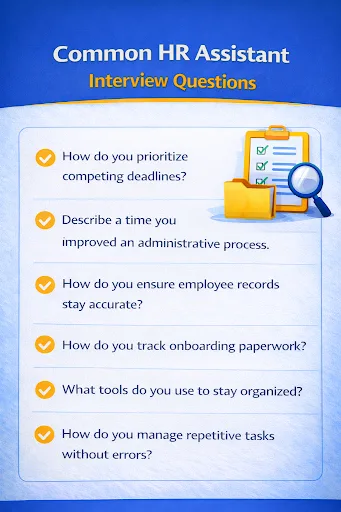
9. How do you prioritize competing deadlines?
Look for: A clear prioritization framework, as opposed to simply saying, “I just handle the urgent ones first.”
Strong answer: The candidate explains how they assess impact and cutoff risk. For example, payroll deadlines override internal admin tasks. Compliance documentation with legal implications is prioritized over routine scheduling. They may reference using task tracking tools, deadline flags, or batching work by urgency tiers. The key is visible logic.
Red flags: Just saying, “I multitask”, with no mention of payroll cycles, legal risk, or escalation when overloaded, and no sign of any system for triaging work.
10. Describe a time you improved an administrative process.
Look for: Defined understanding of before-and-after improvement with a concrete, measurable impact shown.
Strong answer: They describe a real inefficiency, like onboarding documents being submitted through email threads, causing delays. They implemented a shared tracker or automated workflow, reducing missed documents and shortening onboarding completion time. Even modest improvements like cutting document follow-up emails by 30% show clear ownership.
Red flags: Describing participation instead of ownership, being unable to show a measurable outcome, and framing improvements vaguely as “we streamlined things.”
11. How do you make sure employee records stay accurate?
Look for: Clearly defined verification routines and audit habits.
Strong answer: They describe double-entry checks, reconciliation before payroll runs, version control for contracts, or monthly file spot-checks. Strong candidates reference proactive verification instead of waiting for errors to surface.
Red flags: “I try to be careful.” No mention of review cycles, audits, or structured cross-checking.
12. How do you track onboarding paperwork?
Look for: Defined workflow, accountability checkpoints, and deadline visibility.
Strong answer: They explain maintaining a checklist aligned with start dates, sending reminders before payroll submission, and confirming document completion before activating system access. They may describe a 30-60-90 day onboarding tracker to make sure required compliance forms were completed early in the cycle.
Red flags: Relying entirely on email follow-ups, no central tracker, and no escalation plan for missing documentation before the start date.
13. What tools do you use to stay organized?
Look for: Specific tools and structured use cases, with a clear understanding of what these tools do and where they fall short.
Strong answer: They mention task management platforms, shared dashboards, HRIS workflows, calendar deadline blocking, or standardized naming conventions for digital files. Strong candidates will explain how the tool reduces error risk and where it isn’t so useful.
Red flags: Listing tools without explaining how they use them or relying solely on memory.
14. How do you manage repetitive tasks without errors?
Look for: Signs of how the candidate safeguards against complacency with the help of structured processes.
Strong answer: They describe using checklists, batching tasks, setting calendar reminders before payroll cutoffs, or implementing periodic review breaks to prevent fatigue errors. They understand that repetition increases error risk and build controls accordingly.
Red flags: Saying, “I just focus” with no structured prevention mechanisms and no acknowledgment that repetitive work increases risk.
HR Systems and Data Handling Questions
HR assistants operate inside systems all day. These questions are about data integrity, payroll accuracy, audit readiness, and confidentiality controls.
A candidate who claims to be comfortable with HRIS but lacks verification discipline can create expensive errors.
What Strong Answers Show
Across these HR systems questions, you’re looking for:
- Technical fluency beyond surface-level usage
- Awareness of payroll and compliance risk
- Structured verification routines
- Data security discipline
- Controlled update processes
An HR assistant who treats systems casually creates invisible risk. A strong one, on the other hand, treats every update as a controlled operational event.
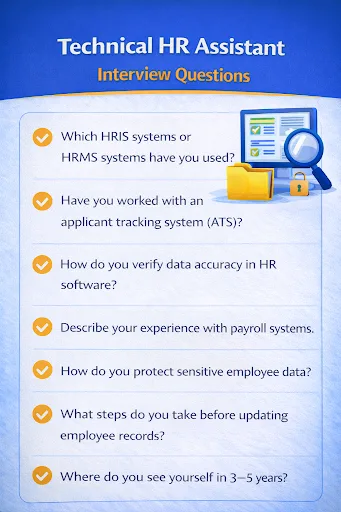
15. Which HRIS or HRMS systems have you used?
Look for: The candidate should describe specific modules used (like onboarding, benefits, time tracking, and document management), types of updates performed (like compensation changes, status changes, and terminations), and whether they generated reports or managed user permissions.
Strong answer: They explain working in systems such as Workday, BambooHR, ADP, or similar systems, and describe maintaining employee records, processing status changes, updating compensation data, and running monthly headcount or compliance reports. They may mention identifying duplicate records or correcting data inconsistencies.
Red flags: Simply listing system names, or describing usage as “basic data entry” with no mention of verification, reporting, or cross-checking.
16. Have you worked with an applicant tracking system (ATS)?
Look for: Understanding of candidate lifecycle workflows, including job posting, resume screening coordination, interview scheduling, offer documentation, and data migration into HRIS. Strong candidates should understand how errors in ATS data affect onboarding and reporting.
Strong answer: They describe managing candidate stages, making sure offer letters are uploaded correctly, confirming signed documents before transferring records into the HRIS, and maintaining clean candidate records for compliance tracking.
Red flags: Only mentioning scheduling interviews and showing no awareness of data continuity between ATS and HRIS.
17. How do you verify data accuracy in HR software?
Look for: A defined verification process. This may include dual-review steps before payroll submission, reconciling HRIS data against signed contracts, running exception reports, or spot-checking employee files monthly. Strong candidates acknowledge that system errors are rarely obvious and must be actively searched for.
Strong answer: They describe reviewing compensation updates before payroll cutoff, reconciling new hire data against offer letters, or running periodic reports to identify missing fields or inconsistencies. They may reference error logs or audit reports.
Red flags: Simply saying, “I check my work”, with no structured validation routine or mention of reconciliation, reporting, or periodic audits.
18. Describe your experience with payroll systems.
Look for: Understanding of payroll cycles, cutoff deadlines, pre-payroll validation, and post-payroll reconciliation. Strong candidates should recognize the financial and compliance risk of errors in compensation, tax codes, or benefits deductions.
Strong answer: They explain preparing payroll inputs, validating time entries, reviewing compensation changes before submission, and confirming totals before final approval. They may reference catching discrepancies before payroll processing and correcting them proactively.
Red flags: Describing payroll as “sending information to finance”, and showing no awareness of cutoff risk or reconciliation.
19. How do you protect sensitive employee data?
Look for: Concrete confidentiality controls like role-based system access, secure document storage, password hygiene, avoiding sharing data via unsecured channels, and understanding escalation procedures for suspected breaches. Strong candidates understand that HR data exposure carries legal and reputational consequences.
Strong answer: They describe limiting access based on role, locking physical files, using secure document portals, and escalating suspicious access or requests immediately. They mention never sharing compensation data outside of defined authorization.
Red flags: Vague statements like “I keep things confidential” with no clear understanding of access controls or escalation protocol.
20. What steps do you take before updating employee records?
Look for: A pause-and-verify mindset. The candidate should confirm written authorization, validate supporting documentation like a signed contract amendment, confirm effective dates, and understand downstream system impacts before making changes.
Strong answer: They describe confirming written approval from HR leadership, checking effective dates, reviewing payroll implications, and documenting the change before updating the system. They may mention notifying payroll or benefits teams when updates impact deductions.
Red flags: Making updates based on verbal requests with no mention of documentation, effective dates, or downstream impact checks.
Compliance and Employment Law Related Questions
Compliance is where HR assistants protect the organization from legal exposure. While they may not design policy, they handle documentation, updates, and recordkeeping that directly affect audit outcomes and regulatory risk.
What Strong Answers Show
These compliance questions help you evaluate:
- Governance awareness beyond basic administration
- Escalation discipline under pressure
- Structured documentation practices
- Audit-readiness mindset
- Respect for policy consistency
Remember that compliance failures rarely begin with dramatic decisions. They begin with small documentation shortcuts, and strong HR assistants understand that precision protects the organization.
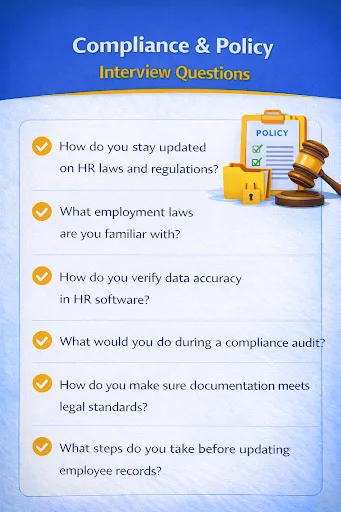
21. How do you stay updated on HR laws and regulations?
Look for: A structured update process instead of passive awareness. Strong candidates reference specific sources like SHRM updates, government labor websites, and internal legal briefings, scheduled review cadence, and how they translate regulatory updates into documentation or workflow adjustments. They should understand that compliance requires active monitoring.
Strong answer: The candidate describes subscribing to formal HR updates, attending periodic compliance briefings, or reviewing government labor site updates quarterly. They explain how they update templates, onboarding documentation, or policy forms when regulations change.
Red flags: Saying, “I rely on my manager to tell me”, not providing any defined information sources, and having no clear process for incorporating regulatory changes into workflows.
22. What employment laws are you familiar with?
Look for: Baseline knowledge relevant to HR assistant responsibilities, like wage and hour laws, overtime rules, anti-discrimination regulations, leave policies, and data privacy standards.
Strong answer: They mention familiarity with laws like FLSA (or local equivalents), anti-discrimination regulations, family/medical leave requirements, or payroll compliance standards. They clarify that while they may not interpret laws independently, they understand how documentation and payroll accuracy intersect with compliance.
Red flags: Claiming deep legal authority without context or conversely, showing no awareness of employment law exposure at all.
23. How would you respond if a manager asked you to bypass policy?
Look for: Judgment under pressure. The candidate should reference escalation protocols, documentation standards, and maintaining policy consistency, especially when authority figures push for shortcuts.
Strong answer: They explain that they would clarify the request, reference policy language, and escalate to HR leadership if necessary rather than making unilateral exceptions. They maintain professionalism without confrontation. Strong candidates understand that inconsistent policy enforcement increases legal risk.
Red flags: Saying, “I’d just do what the manager asks.” Or, overly confrontational responses that lack escalation structure.
24. What would you do during a compliance audit?
Look for: Preparation mindset. Strong candidates mention organized recordkeeping, document retrieval processes, and maintaining audit-ready files year-round rather than scrambling reactively when an audit begins.
Strong answer: They describe ensuring employee files are complete, verifying that required forms are signed and stored properly, cross-checking payroll documentation, and coordinating requested records efficiently. They treat audit readiness as an ongoing discipline rather than a one-time event.
Red flags: Saying, “I’d gather the documents if needed”, and failing to mention pre-audit organization or documentation standards.
25. How do you make sure documentation meets legal standards?
Look for: Structured documentation controls like version management, standardized templates, required signature tracking, effective date clarity, and secure storage protocols. Strong candidates understand that incomplete documentation creates compliance vulnerability.
Strong answer: They mention using approved templates, confirming signatures before filing, maintaining consistent file naming conventions, and checking that effective dates align with payroll and policy changes. They may mention periodic file audits.
Red flags: Relying on informal templates, with no mention of version control, signature tracking, or document retention practices.
Employee Training and Engagement Related Questions
HR assistants mostly play a hands-on role in onboarding coordination, training logistics, and employee communications. While they may not design an engagement strategy, they directly influence how new hires experience their first 30-90 days and how clearly company policies are understood across the organization.
What Strong Answers Show
Across these training and engagement questions, you’re evaluating:
- Structured onboarding coordination
- Documentation discipline tied to training compliance
- Operational support for engagement measurement
- Clear, trackable communication practices
Engagement and onboarding are typically framed as cultural initiatives, but operational execution determines whether they actually work. Strong HR assistants understand that structure creates experience.
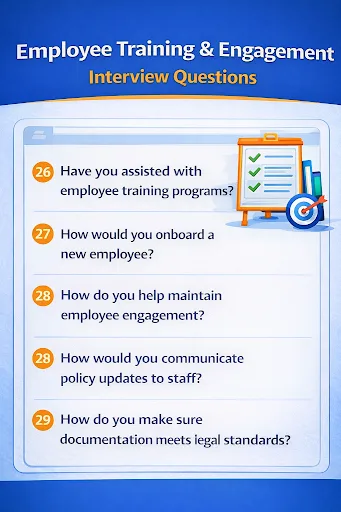
26. Have you assisted with employee training programs?
Look for: Hands-on involvement beyond scheduling calendars. Strong candidates describe coordinating materials, tracking attendance, maintaining completion records, managing LMS systems, or making sure compliance training deadlines are met. They should understand how training documentation ties into compliance and performance tracking.
Strong answer: They explain coordinating onboarding sessions, tracking mandatory compliance training completion, sending reminders before deadlines, and generating participation reports. They may describe improving attendance tracking or consolidating training records into a centralized dashboard.
Red flags: Only mentioning booking meeting rooms with no awareness of tracking completion, documentation requirements, or follow-up.
27. How would you onboard a new employee?
Look for: A structured 30-60-90 day mindset rather than just Day 1 orientation. Strong candidates reference documentation completion before payroll deadlines, system access coordination, manager alignment, and clear milestone tracking.
Strong answer: They describe pre-boarding (contract signed, documentation verified, and system access ready), a structured Day 1 agenda, and ongoing check-ins tied to 30-60-90 day milestones. They mention confirming that compliance forms are complete early and tracking onboarding progress against defined checkpoints.
Red flags: Framing onboarding as a welcome email and orientation session only, and failing to mention documentation, payroll timing, or structured follow-up.
28. How do you help maintain employee engagement?
Look for: Operational support of engagement initiatives, including survey distribution, tracking participation, follow-up documentation, and communication consistency. They should understand that engagement is measured and monitored rather than assumed.
Strong answer: They describe assisting with engagement surveys, tracking response rates, coordinating focus group logistics, and helping make sure action plans are documented and communicated. They may mention supporting recognition programs or milestone tracking.
Red flags: Reducing engagement to “planning fun events”, and ignoring measurement, follow-up, or structured feedback processes.
29. How would you communicate policy updates to staff?
Look for: Clarity, consistency, and documentation discipline. Strong candidates mention structured announcements, confirmation of acknowledgment, and storing signed policy updates. They should understand that communication without tracking acknowledgment creates compliance risk.
Strong answer: They explain distributing policy updates via official channels, summarizing key changes clearly, collecting acknowledgment signatures where required, and storing documentation properly. They may reference FAQ documents or manager briefing support.
Red flags: Sending informal emails without tracking acknowledgment, with no version control or documentation of who received updates.
Conflict Resolution and Mediation Related Questions
HR assistants are usually the first point of contact when tensions surface. While they may not lead formal investigations independently, they frequently document concerns, coordinate next steps, and maintain confidentiality during sensitive situations.
These questions test judgment under pressure, neutrality, documentation discipline, and escalation awareness. This is where HR credibility is either strengthened or undermined.
What Strong Answers Show
Across these conflict-related questions, you should be paying attention to:
- Neutral fact-gathering discipline
- Controlled escalation under pressure
- Documentation rigor
- Awareness of legal and reputational risk
- Emotional steadiness during sensitive situations
Conflict management is where HR assistants shape employee trust. Structured, documented, and neutral handling protects both individuals and the organization.
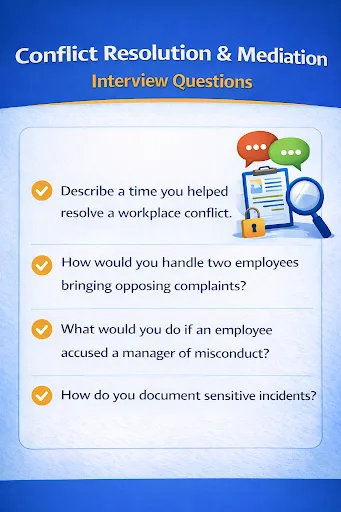
30. Describe a time you helped resolve a workplace conflict.
Look for: A structured approach based on fact-finding, neutrality, documentation, and follow-up. The candidate should describe listening separately to each party, clarifying facts versus perception, and escalating appropriately if required. Strong answers show calm sequencing rather than emotional reaction.
Strong answer: They explain meeting with both individuals independently, documenting each perspective, identifying the root issue (this could be unclear responsibilities or a communication breakdown), and facilitating a mediated discussion if appropriate. They reference following up after resolution to ensure the conflict does not resurface.
Red flags: Simply saying, “I told them to work it out”, taking sides prematurely, and having no documentation or follow-up.
31. How would you handle two employees bringing opposing complaints?
Look for: Neutral intake procedures, confidentiality boundaries, consistent documentation, and avoidance of bias. Strong candidates should describe gathering information before forming conclusions and escalating when the issue exceeds their authority.
Strong answer: They describe interviewing each employee separately, documenting timelines and specific behaviors, reviewing any relevant communication records, and escalating to HR leadership if the issue involves policy or misconduct concerns. They maintain professional neutrality throughout.
Red flags: Agreeing with the first employee who reports the issue, promising confidentiality without clarifying limits, and offering solutions before collecting full context.
32. What would you do if an employee accused a manager of misconduct?
Look for: Immediate documentation, seriousness of response, and escalation discipline. Strong candidates understand that allegations involving authority figures carry higher legal and reputational risk.
Strong answer: They explain documenting the complaint objectively, clarifying confidentiality boundaries, notifying the appropriate HR lead or compliance authority, and avoiding independent investigation beyond their scope. They maintain neutrality and make sure no retaliation occurs during review.
Red flags: Dismissing the complaint as “probably a misunderstanding,” investigating independently without authority, and failing to escalate appropriately.
33. How do you document sensitive incidents?
Look for: Clear documentation standards: objective language, factual timelines, secure storage, and controlled access. Strong candidates understand that documentation may be reviewed during legal or compliance proceedings.
Strong answer: They describe recording dates, direct quotes where appropriate, factual descriptions rather than opinions, and storing documentation in secure, access-controlled systems. They may mention confirming documentation accuracy with HR leadership.
Red flags: Relying on informal notes, including subjective opinions in documentation, and storing sensitive information in unsecured locations.
Behavioural and Situational Related Questions
Behavioural and situational questions are where you test how a candidate actually thinks under pressure. Anyone can say they’re organized or confidential, but these questions force them to show how they respond when something goes wrong.
This is where most teams get surface-level answers. The key is listening for sequencing, ownership, documentation, and escalation discipline.
What Strong Answers Show
Across these behavioural questions, you should be assessing:
- Accountability under pressure
- Escalation judgment
- Documentation discipline
- Learning mindset
- Risk awareness
Here, most hiring decisions become clear. When something goes wrong (and it will), you want someone who follows process, communicates clearly, and protects the organization without creating unnecessary friction.
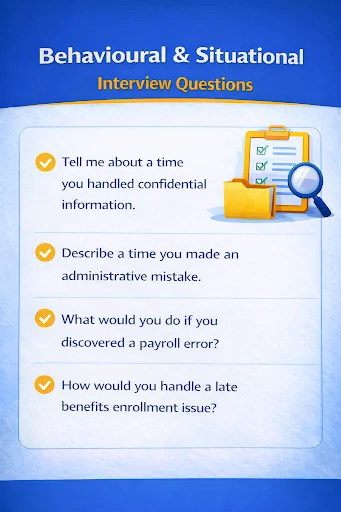
34. Tell me about a time you handled confidential information.
Look for: Specific examples involving compensation data, employee records, medical documentation, disciplinary notes, or payroll information. Strong candidates explain access controls, discretion boundaries, and how they avoided informal sharing. You want to hear specifically how they protected the information.
Strong answer: They describe handling salary adjustment files or employee medical documentation, limiting access to authorized personnel only, avoiding discussions in open areas, and securely storing documents in restricted HR folders. They may mention declining to share information with unauthorized managers.
Red flags: Vague examples like “I handled private data”, with no mention of access control, secure storage, or boundaries.
35. Describe a time you made an administrative mistake.
Look for: Ownership, correction speed, and prevention measures. Strong candidates acknowledge errors without defensiveness and explain what systems they put in place to prevent recurrence.
Strong answer: They describe missing a document deadline or entering incorrect data, immediately notifying their manager, correcting the issue before payroll cutoff, and introducing a checklist or reminder system afterward. They show learning, not excuses.
Red flags: Being unable to think of any specific mistakes, blaming workload or other team members without ownership, and no evidence of preventive action taken afterward.
36. What would you do if you discovered a payroll error?
Look for: Urgency, clear escalation, and controlled communication. Payroll errors affect employee trust quickly, so sequencing matters.
Strong answer: They explain verifying the discrepancy, confirming documentation, notifying HR leadership or payroll immediately, documenting the correction, and communicating clearly with the affected employee once resolved. They prioritize accuracy before speculation.
Red flags: Waiting until the next payroll cycle, trying to fix it quietly without documentation, and informing the employee before verifying the issue.
37. How would you handle a late benefits enrollment issue?
Look for: Policy awareness, documentation discipline, and communication boundaries. Strong candidates know that benefits deadlines have compliance implications.
Strong answer: They describe reviewing policy guidelines, confirming whether qualifying life events apply, escalating to HR leadership if exceptions are unclear, documenting all communication, and clearly explaining next steps to the employee. They avoid promising outcomes before confirming eligibility.
Red flags: Making exceptions independently, giving the employee incorrect assurances, and failing to document the interaction.
Common Challenges When Interviewing HR Assistants (and Why They Exist)
If hiring managers don’t understand the systemic problems behind weak interviews, they are doomed to repeat the same mistakes. This means inconsistent questions, rushed evaluations, and gut-feel decisions.
Before improving your HR assistant interview process, it’s worth understanding what usually goes wrong.
Let’s take a look at 3 common challenges when interviewing HR assistants and how to approach them.
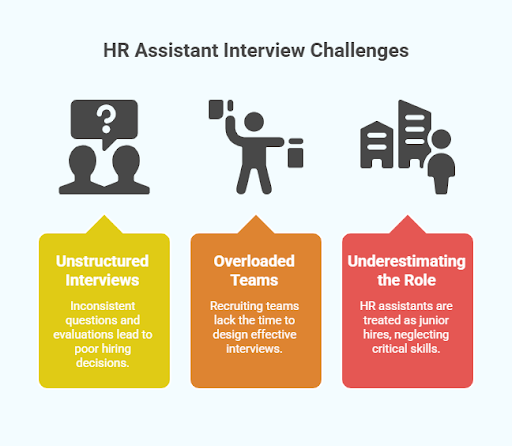
Challenge 1: Unstructured Interviews
Many HR assistant interviews feel conversational and informal. Different interviewers ask different questions. Evaluation criteria aren’t aligned, notes are inconsistent, and decisions are made based on recall rather than evidence.
This is where most teams lose objectivity. Research has consistently shown that structure matters. As Schmidt & Hunter found:
Structured interviews have a predictive validity of ~0.51, compared to ~0.38 for unstructured interviews.
That difference is not small. It means structured interviews are significantly better at predicting future job performance.
Here’s what “structured” actually means in practice:
- Defined competencies before interviews begin
- The same core questions asked to all candidates
- Clear scoring criteria tied to real job outcomes
- Written notes captured during the interview, not after
Most teams believe they are structured, but few actually are. Focusing on this can significantly improve your hiring outcomes.
Challenge 2: Overloaded HR and Recruiting Teams
Interview design takes time, and most recruiting teams don’t have it.
Recruiters today juggle multiple open roles at once. Benchmarking data shows the average recruiter is managing around 14 open requisitions at any one time, a 56% increase compared to just a few years ago.
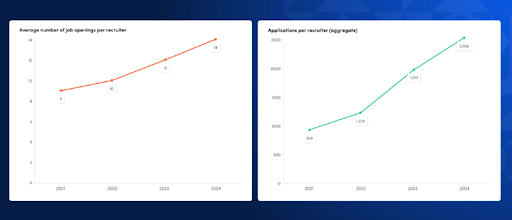
Image Source: Gem
When recruiters are stretched across 10-15 open roles, interviews default to templates or generic questions. There’s little time to tailor evaluation criteria for a role like HR assistant, which requires nuance around documentation discipline and confidentiality.
But the cost shows up later, in mis-hires, performance gaps, or compliance errors that weren’t tested during interviews.
Challenge 3: Underestimating the HR Assistant Role
HR assistants are mostly treated as junior administrative hires. As a result:
- Interviews focus on personality instead of process discipline
- Confidentiality isn’t tested through scenarios
- Payroll and documentation accuracy aren’t stress-tested
- Escalation judgment isn’t evaluated
But HR assistants sit in high-risk workflows dealing with payroll data, employee documentation, compliance tracking, benefits enrollment, and sensitive investigations.
Small administrative errors can cascade, so that:
- A missed payroll change creates trust issues
- Incomplete documentation creates audit exposure
- Improper data handling creates legal risk
When interviews fail to test judgment, documentation discipline, and escalation boundaries, teams unintentionally hire for friendliness instead of competence and reliability.
How to Structure an Effective HR Assistant Interview Process
Once you understand the common failure points of unstructured interviews, overloaded teams, and underestimating the role, the solution becomes clear: you need better structure.
Structure means clarity before conversation. According to SHRM, replacing a poor hire can cost 50-200% of the employee's annual salary.
For an HR assistant earning $55,000, that’s potentially $27,500 to $110,000 in direct and indirect costs, before you even factor in compliance exposure or lost trust. That’s why interview structure is so important.
Here’s how to get it right.
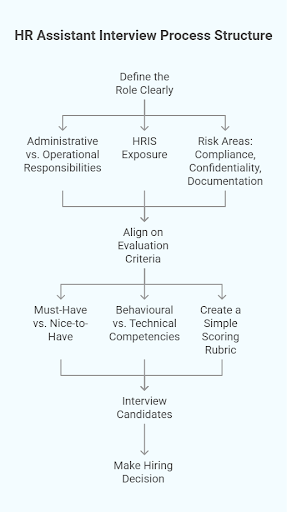
Step 1: Define the Role Clearly
This is where most teams are too vague. Before interviews begin, you should be able to answer three things with precision:
Administrative vs. Operational Responsibilities
Is this primarily:
- Data entry and document coordination?
- Or workflow ownership across onboarding, payroll inputs, and compliance tracking?
If the assistant is expected to independently manage onboarding documentation for 15 hires per month, that’s going beyond basic admin support.
Clarity here determines the difficulty of your questions.
HRIS Exposure
Will they:
- Update compensation and status changes?
- Run reports?
- Handle payroll inputs before cutoff deadlines?
- Maintain digital employee files for audit readiness?
If system errors impact payroll or compliance reporting, you need to test verification habits instead of focusing purely on system familiarity.
A lot of teams here just ask, “Have you used Workday?” instead of, “Walk me through how you validate a compensation change before payroll closes.”
Risk Areas: Compliance, Confidentiality, Documentation
HR assistants typically:
- Handle sensitive salary data
- Process leave documentation
- Store disciplinary records
- Maintain benefit enrollment files
If documentation errors could surface in an audit, your interview needs to include scenario testing around escalation and verification.
Without defining risk exposure first, you can’t design high-signal questions.
Step 2: Align on Evaluation Criteria
Once the role is clear, make sure your interviewers are clear on how you’ll evaluate candidates. This prevents “I liked them” vs. “I didn’t feel confident” feedback.
Must-Have vs. Nice-to-Have
Must-haves for most HR assistant roles:
- Documentation accuracy
- Confidentiality discipline
- Payroll deadline awareness
- Escalation judgment
Nice-to-haves:
- Advanced reporting
- Process automation experience
- Training coordination ownership
When interviewers aren’t aligned on this distinction, decisions tend to drift toward personality instead of capability.
Behavioural vs. Technical Competencies
You should test both:
Technical:
- HRIS data validation
- Payroll input sequencing
- Documentation control
- Audit readiness
Behavioural:
- Accountability under pressure
- Response to authority conflict
- Ownership of mistakes
- Communication clarity with boundaries
As per our experience, most weak interviews over-index on friendliness and under-index on controlled execution.
Create a Simple Scoring Rubric
Even a basic 1–5 scale per competency dramatically improves decision quality. For example:
| Competency | 1 | 3 | 5 |
|---|---|---|---|
| Documentation Discipline | Vague answers | Mentions checklists | Explains specific verification routines with examples |
| Confidentiality Judgment | “I keep it private.” | Describes discretion | Explains access control, escalation protocol, and secure storage |
Without a rubric, interviewers rely on memory, and memory favors recent or charismatic candidates.
Build a Stronger HR Assistant Hiring System with AAG
HR assistant interviews are not entry-level formalities. They directly impact payroll accuracy, compliance risk, employee trust, and operational stability.
When interviews lack structure, hiring decisions drift toward personality instead of documented competence. Over time, unchecked gaps in verification habits, escalation judgment, and confidentiality discipline create measurable risk.
Structured interviews change that. They reduce bias, improve comparability, and ensure candidates are evaluated against clearly defined operational standards.
At Alpha Apex Group, we use a structured, evidence-based approach to hiring. From defining role risk exposure to building scorecards and aligning interview panels, we help HR teams create scalable, defensible hiring systems that consistently deliver better outcomes.
Ready to hire smarter and build a stronger HR team? Connect with Alpha Apex Grouptoday and start elevating your hiring process with confidence.
FAQs
What are the most important skills to look for in an HR assistant interview?
Look for candidates who can handle administrative tasks with precision, understand HR policies, navigate HR software tools confidently, and support broader HR initiatives without compromising accuracy or confidentiality.
How many interview stages should an HR assistant hiring process include?
Two to three structured stages are typically sufficient, which is enough to assess technical skills, scenario judgment, and cultural alignment while maintaining a strong candidate experience.
How do you assess confidentiality and ethics in an HR assistant interview?
Use scenario-based questions tied to HR policies, payroll data, and employee mental health discussions to evaluate escalation judgment, documentation discipline, and discretion under pressure.
What common mistakes do employers make when interviewing HR assistants?
Many teams focus too heavily on personality and overlook process rigor, failing to test real administrative tasks, system verification habits, and knowledge of HR software tools.
How does AAG help companies hire better HR assistants?
AAG builds structured interview frameworks aligned to HR initiatives, compliance exposure, and candidate experience standards. This helps us hire reliable, risk-aware HR support professionals.
Can AAG help design structured interview questions for HR roles?
Yes, AAG develops competency-based interview questions tied to HR policies, Recruitment Marketing alignment, system proficiency, and operational execution across HR software tools.
Does AAG support hiring beyond HR assistants, such as HR managers or broader people operations roles?
Absolutely. AAG supports hiring across the full HR function, from HR assistants to HR managers and broader people operations teams. We design scalable, structured hiring systems that align with long-term HR strategy and organizational growth.
.jpg)
.jpg)