Employee Experience Consulting: Aligning Culture for Executive Success
When culture breaks down, the numbers follow.
In fact, 8 million workers have dropped out of the engaged employee category since 2020, sitting at a decade low of just 31% in 2024.
Most organizations don't lack good intentions around culture. They lack the diagnostic rigor, leadership alignment, and structural tools to close the gap between the employee experience they claim to offer and the one people actually have.
This gap drives turnover, stalls transformation, and quietly erodes the kind of organizational trust that executive teams spend years trying to build.
Employee experience consulting focuses on diagnosing and aligning how people actually experience work with the outcomes the business needs to achieve.
This article breaks down:
- What employee experience consulting includes in practice
- Why organizations bring in external partners
- How EX initiatives move from diagnosis to measurable outcomes
- What to evaluate when selecting the right consulting partner
P.S. If your culture initiatives aren’t translating into performance, it’s not a people problem; it’s a systems problem. Alpha Apex Group brings the structure, diagnostics, and leadership alignment needed to make culture drive results.
What Is Employee Experience Consulting?
Employee experience consulting companies focus on designing and aligning every stage of the employee journey to improve engagement, performance, and business outcomes.
It connects culture, leadership, and workplace systems to how people actually experience work day to day.
Unlike traditional HR consulting, which addresses specific functions like compensation or compliance, EX consulting takes a holistic view. It examines the full employee lifecycle, from attraction and onboarding to development, retention, and exit.
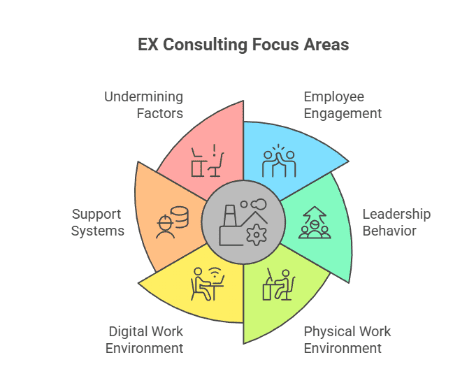
This includes culture, leadership behavior, work environment, and the systems that either support or undermine engagement. As organizations move beyond transactional HR, investment in employee experience continues to grow, with the market projected to reach $12.9 billion by 2035.
The Strategic Role of an EX Consultant
An employee experience consultant helps you assess culture objectively, design better employee journeys, and align internal systems with business goals.
Internal HR teams already manage critical responsibilities, but capacity is a real constraint. 58% of HR executives say their biggest barrier to hitting department priorities is a lack of time and dedicated personnel. More than half report working beyond typical capacity.
When internal teams are stretched thin, strategic work gets deprioritized in favor of operational demands.
An EX consultant brings specialized expertise that most internal teams haven't had time to build. They identify patterns, inconsistencies, and blind spots that are harder to see from inside the organization, particularly when internal teams are close to the systems they are evaluating.
Their value comes from assessing objectively, designing structured solutions, and advising without internal constraints. For complex culture challenges, that level of clarity can determine whether initiatives move forward or stall.
Why You Should Hire Employee Experience Consultants
From what we have seen, organizations rarely bring in an EX consultant for a single reason. It usually comes down to a mix of performance pressure, internal capacity limits, and a growing recognition that culture problems don't resolve themselves.
Here's what typically drives the decision.
1. Closing the Gap Between Culture and Business Performance
Culture directly impacts business outcomes. Companies with top-quartile cultures achieve 2.5 times the return on invested capital of organizations in the bottom quartile. This is a measurable performance gap, and it shows up on the balance sheet.
The problem is that most organizations can't clearly see their own culture from the inside.
Leadership teams mostly operate with an inflated view of how aligned their workplace culture actually is with the employee value proposition they advertise. And the day-to-day employee experience tells a different story.
We have observed that this misalignment is where performance starts to break down. Productivity slows, engagement weakens, and friction builds across teams.
This is where most teams get stuck. They recognize the issue, but lack the structure to diagnose and act on it.
EX consulting exists to close this gap. It brings structured methodology to a problem that most executive teams recognize but struggle to act on systematically.
The impact is measurable. Better culture alignment produces better leadership effectiveness, lower turnover costs, and stronger bottom-line results. These are the outcomes executive teams are prioritizing today.
2. Gaps in Internal Capacity and Expertise
Some culture challenges exceed what internal teams can realistically manage. They require time, specialization, and objectivity that are difficult to maintain from within the organization.
Rapid growth strains the existing culture faster than HR can adapt. Leadership transitions create uncertainty that spreads quickly if it isn't addressed deliberately.
And mergers and acquisitions create even more complexity, where alignment needs to happen across entirely different cultures.
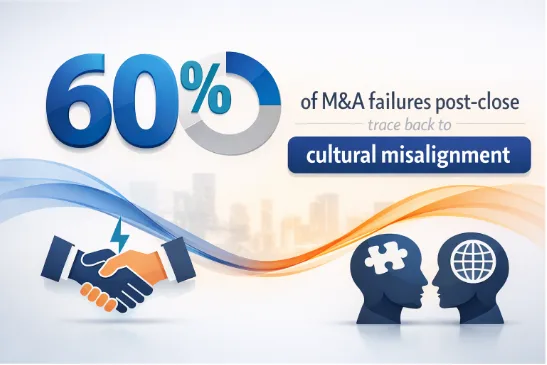
Up to 60% of M&A failures post-close trace back to cultural misalignment, and the internal teams on both sides of a deal are rarely equipped to manage that integration objectively.
We have noticed that culture drift is another common trigger. It happens gradually, then becomes visible all at once.
By the time leadership notices the symptoms, the gap between the stated culture and the lived experience has grown wide enough to affect retention, performance, and morale.
This is where external support becomes necessary. An EX consultant brings the capacity, structure, and neutrality required to address challenges that internal teams are not positioned to solve alone.
3. Digital Transformation and the Changing Nature of Work
Most digital transformation initiatives fail not because of the technology but because of the people. Data shows that around 70% of digital transformation efforts still fall short of their objectives, and the cost of those failures runs into the trillions globally each year.
Organizations focus heavily on systems and tools but underestimate the employee experience required to support adoption.
When organizations roll out new systems without aligning the employee experience to support adoption, they create friction that compounds over time. Employees disengage, workarounds multiply, and the ROI on the technology investment evaporates.
This is where most transformation efforts lose momentum. The issue is not the technology itself, but how people experience the change.
An EX consultant bridges this gap between tech adoption and human readiness.
This includes designing communication structures, supporting leadership alignment, and ensuring employees understand how new systems connect to their day-to-day work.
Pro tip: When employee experience is built into the transformation plan from the start, adoption improves, and the organization is more likely to see returns on its investment.
The Core Pillars of Employee Experience
Understanding the consulting process is one part of the equation. You also need to understand what that process is designed to improve.
EX consulting works by diagnosing and improving the foundational elements that shape how employees experience work every day.
These pillars determine whether culture supports performance or holds it back.
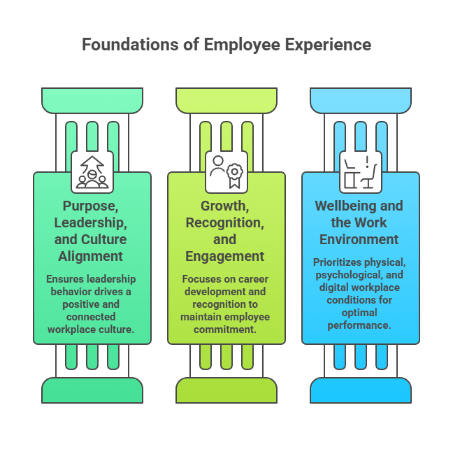
1. Purpose, Leadership, and Culture Alignment
Leadership behavior has the strongest influence on workplace culture.
It comes down to:
- What managers actually do
- How they communicate
- How they treat people, and
- Whether they connect employees' daily work to a broader purpose.
Only 21% of employees strongly agree that their manager explains how the organization's culture connects to their work.
This gap has direct consequences. When employees can't connect their daily work to organizational purpose, engagement drops and retention follows.
We have seen that alignment at the leadership level is where many organizations struggle. Values may be clearly defined, but they are not consistently reflected in day-to-day behavior.
The impact is measurable. Employees with mentors are twice as likely to be engaged, and businesses with highly engaged employees achieve 18% greater productivity than those with disengaged workers.
These outcomes are tied to how leaders show up and how consistently they reinforce culture.
EX consulting identifies where those behaviors are missing, builds the strategic guidance to develop them, and creates accountability structures that make culture alignment a sustained leadership practice rather than a one-time initiative.
2. Growth, Recognition, and Engagement Across the Lifecycle
Engagement changes over time. What drives it at the start of an employee’s journey is different from what matters later.
- Early tenure is shaped heavily by onboarding quality and an effective employee onboarding checklist, alongside early development signals.
- Mid-tenure engagement hinges on career growth, recognition, and whether employees feel their contribution is seen.
- Later stages are influenced by purpose, autonomy, and the quality of the exit interview process when someone does decide to leave. Each stage requires a different approach.
We have seen that many organizations treat engagement as a single metric instead of something that evolves. This is where gaps start to form.
Recognition plays a key role across every stage. Employees receiving high-quality recognition are 65% less likely to be actively job-seeking. And 93% of employees say they're more likely to stay with an organization that invests in their career development.
These are structural elements of an experience management strategy that keep people engaged, growing, and committed across the full arc of their time with the organization.
Action planning around these lifecycle stages is where EX consulting turns employee voices and feedback into tangible retention outcomes.
3. Well-being and the Work Environment
Employee well-being reflects the overall conditions people work in every day. This includes physical space, psychological safety, and the digital tools they rely on.
When these conditions are poor, performance degrades, and attrition follows. When they're designed intentionally, the return is measurable.
95% of companies that measure the ROI of their wellbeing programs report positive returns, with nearly two-thirds seeing at least two dollars back for every one dollar spent. That's a strong signal that employee well-being investment isn't charity. It's a business decision.
The digital work environment matters just as much as the physical one. Tools that create friction, fragment communication, or add cognitive load undermine the experience regardless of how strong the culture is elsewhere.
EX consulting treats technology as an enabler of experience, not a substitute for it. The environment has to support the culture, not work against it.
The Employee Experience Consulting Process
Every EX engagement looks different depending on the organization, but the underlying process follows a consistent arc. Discovery informs strategy. Strategy shapes implementation. Implementation gets measured and refined.
Here's how each phase works in practice.
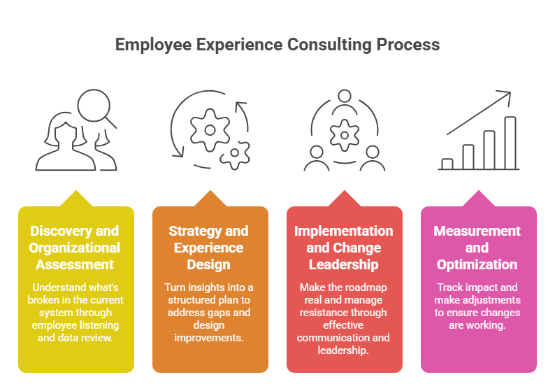
Phase 1 – Discovery and Organizational Assessment
You can't design a better employee experience without first understanding what's broken in the current system. Discovery is where that understanding gets built.
This phase centers on structured employee listening. This means engagement surveys, focus groups, exit interview analysis, pulse checks, and stay interviews.
It also involves reviewing internal data and mapping the employee journey to understand how people experience different stages of work. The goal is to identify the gap between the experience employees report and what leadership believes is happening.
The business case for investing in this phase is hard to argue with. Organizations with the most mature employee listening strategy are 6 times more likely to exceed their financial targets. A thorough discovery phase is the foundation on which everything else is built.
Phase 2 – Strategy and Experience Design
Once the gaps are clear, the focus shifts to defining how to address them. This phase turns insights from discovery into a structured plan.
The consultant works with leadership to design improvements across the employee lifecycle. This can include refining onboarding, strengthening recognition systems, or addressing gaps between stated values and day-to-day management behavior.
Employees in organizations that prioritize people-centered practices are 11 times more likely to report a positive experience during change. This highlights the importance of designing a strategy around how employees experience transitions, not just how processes are structured.
The outcome of this phase is a clear, actionable roadmap. It connects employee experience improvements to measurable business goals, so leadership can track progress and make informed decisions.
Phase 3 – Implementation and Change Leadership
Strategy without execution is just documentation. Phase three is where the roadmap becomes real, and where most initiatives run into trouble.
Between 60% and 70% of change initiatives fail, with employee resistance cited as a factor in the majority of those failures.
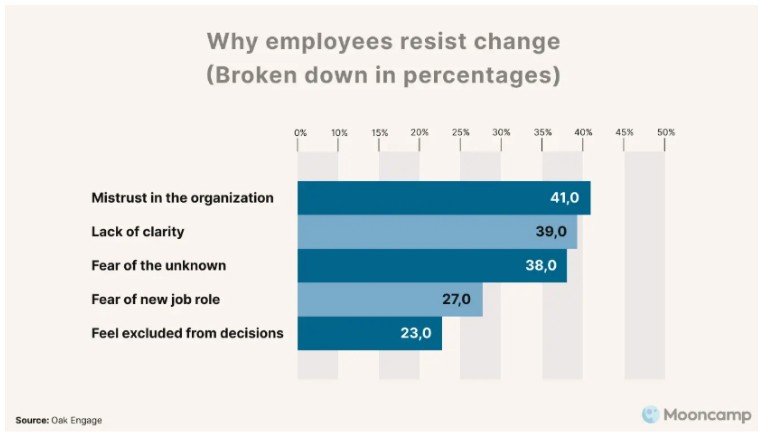
That resistance isn't irrational. It usually reflects poor communication, insufficient leadership modeling, or a rollout that prioritized speed over adoption.
Effective implementation means managing that resistance directly. It means equipping managers to lead through uncertainty, building organizational agility through clear communication channels, and creating the conditions for adoption before problems compound.
The consultant's role here is active leadership enablement throughout the entire rollout.
Phase 4 – Measurement and Optimization
After implementation begins, the focus shifts to tracking impact and making adjustments.
This phase establishes the KPIs and feedback loops that tell the organization whether the changes are working.
This includes engagement scores, turnover data, productivity indicators, and action planning processes that convert insights into adjustments. The goal is a continuous loop, not a one-time snapshot.
We have noticed that measurement alone does not drive results. The real challenge is follow-through. Only 51% of employees say their organization takes meaningful action after collecting feedback.
Closing that gap is critical. When insights are consistently translated into action, employee experience improves over time, and the organization builds momentum instead of losing it.
Workforce Dynamics Every Employee Experience Strategy Must Address
A well-designed employee experience strategy can't operate on assumptions about who the workforce is. The dynamics shaping how people work, what they expect, and how they engage have shifted substantially.
Any EX strategy that doesn't account for these realities will underperform before it's fully implemented.
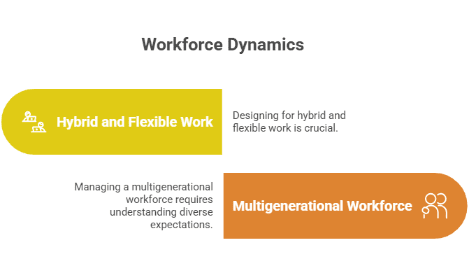
Designing for Hybrid and Flexible Work
Hybrid work is now a standard model for many organizations. It introduces new challenges around communication, visibility, and consistency across teams
The engagement data makes a strong case for getting hybrid and remote work right.
Fully remote workers report the highest engagement at 36%, with hybrid employees close behind at 35%, while fully in-office workers trail significantly, with only 50% reporting they are thriving compared to 62% of hybrid employees.
But high engagement averages don't tell the whole story. The bigger challenge is equity.
Flexible work arrangements are disproportionately available to senior employees. In Q4 2025 job postings, 30% of senior roles offered hybrid options compared to just 18% of entry-level positions.
This gap creates a two-tier experience inside the same organization, which undermines the inclusion goals most companies say they're committed to.
A strong EX strategy builds consistency across work arrangements through:
- Clear communication channels that work equally well for remote and in-office employees
- Recognition and feedback collection systems that don't favor physical presence
- Manager training that accounts for leading distributed teams
- Technology infrastructure that creates equivalent access regardless of location
Managing a Multigenerational Workforce
For the first time in modern history, organizations are managing employees across four distinct generations simultaneously. Each brings different expectations around purpose, flexibility, feedback, and career growth. Treating them as a single audience produces an experience that works for no one particularly well.
Gen Z is the sharpest illustration of this tension. 89% of Gen Z employees want purpose-driven work, and their average job tenure sits at just 1.1 years.
This mobility reflects what happens when purpose, growth, and flexibility expectations go unmet. And the friction isn't only between Gen Z and older generations. 35% of employees say generational differences have contributed to workplace incivility they've witnessed or experienced directly.
An effective EX strategy does not create separate cultures for each generation. It focuses on building flexible systems that can support different needs within a shared structure.
This includes:
- Pulse checks and stay interviews structured to capture what matters to different employee groups
- Career development pathways that account for varying definitions of advancement
- Recognition approaches that resonate across different values and communication preferences
- Wellbeing support that addresses Gen Z's stronger emphasis on mental health alongside broader employee wellbeing priorities
The organizations that get this right don't fragment their culture. They build one strong enough to hold genuinely different people together.
How to Measure the ROI of Employee Experience Consulting
A common concern with EX consulting is how to measure its impact. In practice, the outcomes are measurable and closely tied to business performance. The key is tracking the right indicators at the right time.
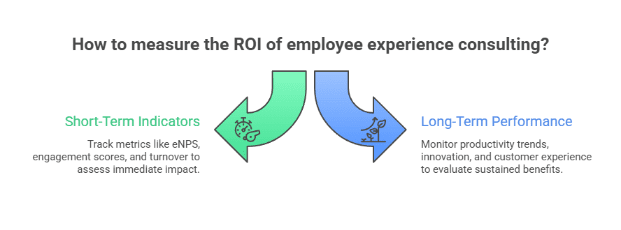
Short-Term Indicators
The first signs that an EX engagement is working show up relatively quickly, usually within the first 6 to 12 months. But capturing them requires establishing a baseline before the engagement begins. Without a starting point, there's no way to demonstrate movement.
The metrics worth tracking from day one include eNPS, engagement scores, absenteeism rates, time-to-productivity for new hires, and voluntary turnover.
These are the numbers that signal whether the changes are landing at the employee level. Industry eNPS benchmarks provide useful context. The overall eNPS benchmark hit 27 in Q3 2024, with significant variation by sector, giving organizations a realistic target range based on their industry.
Engagement surveys and employee feedback mechanisms are the primary tools for tracking movement across these indicators. The business case for improvement is clear.
Organizations in the top quartile of employee engagement show 78% less absenteeism and 51% less turnover than those in the bottom quartile.
Those reductions translate directly into hard dollar savings that are straightforward to calculate and present to leadership.
Long-Term Organizational Performance
Short-term metrics confirm the engagement is working. Long-term metrics confirm it's building something durable.
The indicators that matter at the board level are productivity trends, innovation capacity, executive retention, and the relationship between employee experience and customer experience.
That last connection is more direct than most organizations realize. Companies that prioritize both employee experience solutions and customer experience report 1.8 times higher revenue growth than those focused on customer experience alone.
Investing across all elements of employee experience can yield savings and productivity gains equivalent to up to 12.6% of total revenue. That's a figure that reframes EX consulting from an HR initiative into a financial strategy.
When talent success outcomes ladder up to profitability, retention, and revenue growth, the conversation shifts from "can we afford this" to "what does it cost us not to."
At this stage, EX is treated as a core part of how the organization operates and competes.
How to Choose the Right Employee Experience Consulting Partner
Choosing the right consulting partner has a direct impact on how successful your EX efforts will be. A poor fit can slow progress, create confusion, and reduce confidence in future initiatives. This decision needs the same level of rigor as any strategic investment.
What to Look for in Expertise and Track Record
The failure rate in this space is high. Around 70% of organizational transformation efforts fail to meet their objectives, with insufficient capability building as a key factor. This makes it important to evaluate how a consulting partner actually works, not just what they promise.
When evaluating a potential partner, the questions worth asking include:
- Do they have documented case studies with measurable outcomes, not just testimonials?
- Is their methodology transparent and tailored, or does it look like a repackaged off-the-shelf framework?
- Can they demonstrate experience with organizations at a similar stage, size, or in a comparable industry?
- Do they have a clear measurement framework built into their engagement model from the start?
Red flags to watch for include one-size-fits-all approaches, vague language around deliverables, and no defined process for tracking results. A credible EX consulting partner should be able to tell you exactly how they'll know if the engagement is working.
Aligning the Engagement to Your Organizational Goals
Even a highly qualified consulting partner will underdeliver if the engagement isn't structured correctly from the start.
Organizational culture has risen to the number two CHRO priority in 2025, which means the expectations placed on culture work have never been higher. The partnership structure has to match that level of ambition.
Figure 1
Top Priorities within
the CHRO Function
2025 1Leader &
Manager Development 2Culture 3Strategic Workforce Planning 4Organizational Design 5Change Management 2024 Organizational Design &
Change Management Leadership Development Organizational Culture Workforce Strategy &
Planning Employee Experience & EVP 2023 Leadership Development &
Succession Planning Talent Retention Organizational Culture Employee Experience & EVP Diversity, Equity & Inclusion Image Source: Gartner
This means getting specific before the engagement begins:
- Define the scope clearly, with agreed boundaries around what's in and what's out
- Establish success criteria that connect to business outcomes, not just activity metrics
- Assign internal accountability so the engagement has an owner on the organization's side
- Agree on communication cadence and escalation paths upfront
Cultural fit between the consultant and the organization matters too. The best strategic guidance comes from a partner who understands your context deeply, not one who parachutes in with a predetermined answer.
The right partner challenges your thinking. The wrong one just validates it.
Advance Your Organization with Employee Experience Consulting
The gap between the culture an organization intends to build and the one employees actually experience has a real cost. It shows up in turnover, stalled transformations, disengaged teams, and financial results that fall short of their potential.
Employee experience consulting helps close this gap, with the diagnostic rigor, external perspective, and implementation discipline that most internal teams can't deliver alone.
If you’re looking to take a more structured, results-driven approach, Alpha Apex Group partners with executive teams to design and implement employee experience strategies that strengthen retention, elevate performance, and drive long-term alignment.
Ready to turn employee experience into a competitive advantage? Connect with Alpha Apex Group today and start building a strategy that delivers measurable impact.
Frequently Asked Questions
What does an employee experience consultant do?
An employee experience consultant diagnoses gaps across the full employee journey and builds strategies to close them. They use listening methods like employee surveys, stay interviews, and focus groups to surface what's driving or undermining engagement. The goal is a clear, evidence-based roadmap for improving culture, retention, and performance.
How is employee experience consulting different from HR consulting?
Traditional HR consulting focuses on policies, compliance, and individual processes. Employee experience consulting takes a broader view, using employee journey mapping to understand where friction, disengagement, or misalignment is costing the business. It's strategic and diagnostic rather than transactional.
When should a company hire an employee experience consultant?
Most organizations bring in outside help during inflection points like rapid growth, mergers, or leadership transitions. Transformative organizations also use EX consultants proactively to build leadership pipelines and design digital workflows before problems compound. If your internal team is too close to the problem to see it clearly, that's usually the sign.
What methods do EX consultants use to gather employee feedback?
Consultants draw on pulse surveys, full employee surveys, focus groups, stay interviews, and transition feedback collected at key lifecycle moments. The best engagements use multiple channels simultaneously to build a complete picture rather than relying on a single data source. That layered approach is what separates a meaningful diagnosis from a surface-level snapshot.
How do you measure the ROI of employee experience consulting?
ROI is tracked through short-term indicators like eNPS and voluntary turnover, and longer-term metrics like revenue growth and productivity trends. Establishing a baseline before the engagement begins is essential because without it, there's no way to demonstrate movement. The strongest engagements tie every initiative back to measurable business outcomes from day one.
Can Alpha Apex Group support both strategy and implementation for EX initiatives?
Yes, we support both strategy and implementation. We don’t stop at identifying gaps or building a roadmap. Our team works alongside you to execute initiatives, align internal stakeholders, and ensure changes are adopted across the organization. This approach helps turn strategy into measurable outcomes instead of leaving it at the planning stage.
Does Alpha Apex Group work with leadership teams directly during EX engagements?
Yes, we work closely with leadership teams throughout the engagement. We collaborate with executives and managers to align on priorities, strengthen leadership behaviors, and ensure decisions reflect the desired employee experience. This direct involvement helps create consistency between strategy and day-to-day execution.
Research Appendix
- Gallup, State of the Global Workplace: 2025 Report — https://www.gallup.com/workplace/349484/state-of-the-global-workplace.aspx
- Research and Markets, Employee Experience Management Market — Global Forecast 2025–2030 — https://www.researchandmarkets.com/reports/5968386/employee-experience-management-market-global
- SHRM, State of the Workplace Report 2023–2024 — https://www.shrm.org/content/dam/en/shrm/research/2023-2024-State-of-the-Workplace-Report.pdf
- McKinsey & Company, When Building New Businesses, Culture Matters — https://www.mckinsey.com/capabilities/business-building/our-insights/when-building-new-businesses-culture-matters
- HR Daily Advisor, Culture: The Key to M&A Success — https://hrdailyadvisor.com/2025/05/12/culture-the-key-to-ma-success/
- MeltingSpot, Why Digital Transformation Projects Fail — https://blog.meltingspot.io/why-digital-transformation-projects-fail/
- Perceptyx, State of Employee Listening 2024 Report — https://blog.perceptyx.com/from-insight-to-action-new-data-on-the-state-of-employee-listening
- O.C. Tanner, 2025 Global Culture Report — https://www.octanner.com/global-culture-report
- Mooncamp, Change Management Statistics — https://mooncamp.com/blog/change-management-statistics
- Apollo Technical, Organizational Change Management Statistics — https://www.apollotechnical.com/organizational-change-management-statistics/
- Perceptyx, State of Employee Listening 2025 Report — https://blog.perceptyx.com/multi-channel-employee-listening-grows-but-action-struggles-persist
- HIGH5 Test, Company Culture Statistics — https://high5test.com/company-culture-statistics/
- Gallup and Workhuman, Employee Retention Depends on Getting Recognition Right — https://www.gallup.com/workplace/650174/employee-retention-depends-getting-recognition-right.aspx
- Thirst, Employee Retention Statistics 2025 — https://thirst.io/blog/employee-retention-statistics-2025/
- Wellhub, 2024 Return on Wellbeing Report — https://wellhub.com/en-us/blog/press-releases/study-reveals-strong-return-on-investment-for-corporate-wellness-programs/
- Gallup, Global Indicator: Hybrid Work — https://www.gallup.com/401384/indicator-hybrid-work.aspx
- Robert Half, Remote Work Statistics and Trends for 2026 — https://www.roberthalf.com/us/en/insights/research/remote-work-statistics-and-trends
- Deloitte, Global Gen Z and Millennial Survey 2025 — https://www.deloitte.com/global/en/issues/work/genz-millennial-survey.html
- SHRM, The Truth About Gen Z's Mental Health Expectations at Work — https://www.shrm.org/enterprise-solutions/insights/truth-about-gen-zs-mental-health-expectations-at-work
- SurveySparrow, Employee Experience Metrics 2025 — https://surveysparrow.com/blog/employee-experience-metrics-2025/
- The Grossman Group, Employee Engagement Statistics — https://www.yourthoughtpartner.com/blog/employee-engagement-statistics
- OnRamp, Customer Experience Statistics — https://onramp.us/blog/customer-experience-statistics
- PwC Netherlands, The Benefits of Investing in People — https://www.pwc.nl/en/insights-and-publications/services-and-industries/people-and-organisation/investment-in-employee-experience-reduces-absenteeism-and-turnover.html
- McKinsey & Company, Perspectives on Transformation — https://www.mckinsey.com/capabilities/transformation/our-insights/perspectives-on-transformation
- Gartner/Evanta, 2025 CHRO Leadership Perspectives — https://www.evanta.com/resources/chro/infographic/2025-chro-leadership-perspectives
- Harvard Law School Forum on Corporate Governance, Americas Board Priorities 2025 — https://corpgov.law.harvard.edu/2025/01/29/americas-board-priorities-2025/
.jpg)
.jpg)

.jpg)
.jpg)
.jpg)