Culture Audit After an Acquisition: What to Assess First
Did you know that between 70 and 75% of mergers and acquisitions fail to deliver their promised value?
And one of the most cited reasons is culture.
When two organizations combine, success depends on the human side of the deal. How people work, make decisions, and relate to each other either holds everything together or quietly tears it apart.
Most integration teams find this out too late. By the time cultural friction shows up in attrition numbers or stalled synergies, the window to address it has already narrowed.
A culture audit is how you get ahead of this risk. It’s a structured assessment of an organization’s actual values, behaviors, and norms. The ones that drive actual decisions every day.
In this article, we’ll cover:
- Why culture should be assessed first in an acquisition, and how it shapes integration decisions
- How cultural mismatch impacts deal value, retention, and execution
- What a culture audit includes and how it differs from engagement surveys
- The key dimensions to assess, including values, leadership style, and communication patterns
- A step-by-step framework to run a culture audit and analyze findings
- How to turn audit insights into a practical post-acquisition integration strategy
- Common challenges during culture audits and how to handle them effectively
P.S. Seeing cultural friction slow down your integration or push key talent out the door? Alpha Apex Group helps you identify what’s breaking alignment and turn it into a clear, actionable integration plan. Contact us to get started.
Why Culture Is the First Thing to Assess After an Acquisition
Culture should be assessed first because it shapes every other integration decision you make.
The org structure you design, the leadership team you build, the systems you prioritize: all of it will either work with the cultural reality on the ground or run straight into it.
Most M&A teams find this out the hard way. Culture gets added after financials and org charts, usually when something has already gone wrong.
The window to avoid this is narrow. Perceptions harden fast after a deal closes. Informal alliances form between employees from both sides, leadership behaviors set expectations, and norms begin to calcify before any formal integration work begins.
We have observed that once these patterns settle, changing them becomes significantly harder. What could have been an early assessment turns into damage control.
By the time culture surfaces as a problem, you are not assessing it anymore. You are managing the fallout from it.
How Cultural Mismatch Derails M&A Value
Understanding why culture fails after mergers starts with looking at what happens when companies with mismatched cultural norms merge, their return on assets drops by an average of $200 million in net income annually, 3 years post-merger. Severe mismatches push that number past $600 million per year.
From what we have seen, the damage shows up in talent loss first. An EY study found that 47% of employees leave within the first year after an M&A, and 75% are gone within three years.
The employees who leave first are mostly the high performers who have the most options. When key talent walks, institutional knowledge goes with them, client relationships weaken, and the operational synergies the deal was designed to produce become much harder to capture.
Cultural differences also stall the integration process itself. According to Mercer’s M&A Readiness Research, 43% of M&A transactions worldwide experienced culture issues severe enough to delay deals, lower purchase prices, or cause terminations outright. Cultural misalignment is one of the most direct causes of deal deterioration.
We have observed that cultural misalignment is one of the most direct drivers of deal deterioration, even when everything else looks right on paper.
What a Culture Audit Is (and How It Differs from an Engagement Survey)
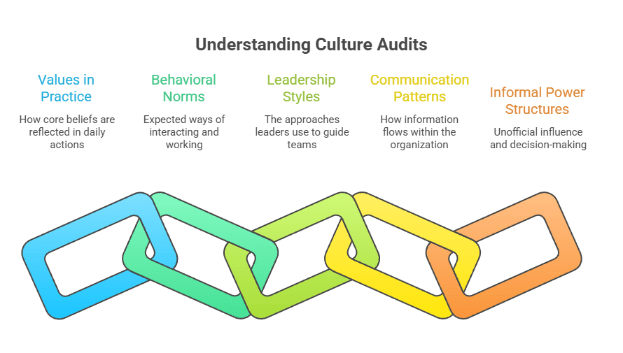
A culture audit is a structured diagnostic that maps how an organization actually operates. It examines values in practice, behavioral norms, leadership styles, communication patterns, and the informal power structures that shape daily decisions.
The goal is an honest picture of organizational culture before integration planning locks in assumptions that may be wrong.
This is where it differs from a standard employee engagement survey.
Engagement surveys measure how people feel about their work: satisfaction, morale, and motivation.A culture audit, on the other hand, goes deeper. It surfaces the assumptions underneath the behavior. It asks why decisions get made the way they do, who holds real influence, and what norms are actually rewarded regardless of what’s written in a values document.
The gap between stated and real culture is significant. According to a PwC Global Culture Survey, 63% of C-suite leaders believe their stated values match actual behavior, but only 41% of employees agree. This perception gap is exactly what a culture audit is designed to close.
Additionally, the same survey says only half of the polled executives said culture was even included in their change management programs. A culture audit turns a vague intention into a repeatable, evidence-based pre-acquisition assessment that gives integration teams something concrete to work with.
The Core Dimensions of Company Culture to Audit
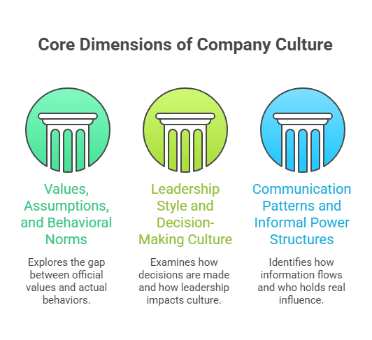
A culture audit isn’t one single diagnostic. It’s a structured look across several distinct dimensions, each one capable of hiding the friction that derails an integration.
If you assess only the surface layer (mission statements, values docs, org charts) you’ll miss most of what actually drives behavior.
Here are the three dimensions that matter most.
1. Values, Assumptions, and Behavioral Norms
Every organization has two cultures running at the same time. There’s the official one: the values on the website, the language in the employee handbook, the talking points from leadership.
Then there’s the real version: the unspoken rules about who gets promoted, how mistakes get handled, and what behavior actually gets rewarded. The gap between those two is where cultural misalignment lives.
Edgar Schein’s cultural model calls this the difference between espoused values and underlying assumptions.
In an M&A context, these underlying assumptions determine how employees from each company will respond to integration decisions. When two sets of assumptions collide without anyone naming them, the result is confusion, mistrust, and resistance that looks like a people problem but is really a cultural one.
Research supports this. Deloitte found that almost 30% of failed M&As cite cultural integration issues as a root cause, with misaligned values and behavioral norms consistently among the primary drivers.
2. Leadership Style and Decision-Making Culture
How decisions get made is one of the clearest expressions of company culture, and one of the sharpest points of friction in any integration.
When a consensus-driven acquired company suddenly reports to a top-down leadership structure, the disconnect shows up almost immediately. Timelines slip, people disengage, and key talent leaves without ever clearly explaining why.
Decision-making styles vary across organizations, and none is inherently better. What matters is understanding the differences early.
For example:
- Some companies require executive sign-off on most decisions; others push authority to frontline managers
- Some cultures reward speed and iteration; others prize thoroughness and deliberation
- Some rely on consensus before moving; others expect leaders to decide without waiting for alignment
The problem is when neither side knows a difference exists, and integration proceeds as if everyone operates the same way.
Leadership coaching becomes important at this stage. In many cases, audit reveals that individual leaders need to adapt their approach for the combined culture to work. This process starts with understanding what each organization’s leadership model actually is.
In our daily practice, we have noticed that leadership behavior directly shapes how teams respond during integration. Employees who trust senior leaders during an integration are 10 times more likely to report full engagement.
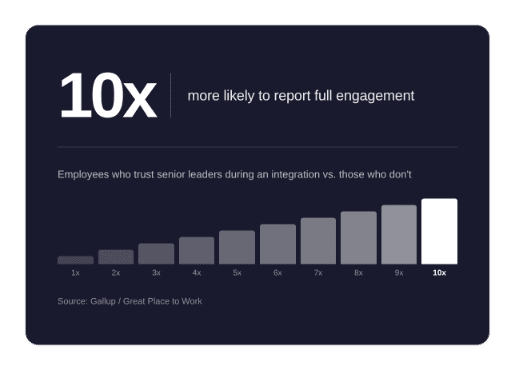
This connection ties leadership style directly to retention and performance outcomes. When you assess decision-making culture early, you can identify where integration is most likely to break down and address those gaps before they escalate.
3. Communication Patterns and Informal Power Structures
The org chart shows who holds formal authority. A culture audit needs to show who holds real influence.
In most organizations, influence doesn’t sit neatly at the top. There are individuals outside leadership roles whose opinions shape decisions, who others turn to during uncertainty, and whose support determines whether change moves forward or quietly stalls. These informal networks don’t appear on paper, but they carry real weight.
This is where many integrations start to break down. Teams assume authority flows through structure, while decisions are actually shaped through relationships and informal alignment.
Communication patterns are closely tied to this. Some organizations communicate openly, with updates flowing across levels and functions. Others operate in silos where information moves up and down a chain but rarely sideways.
In a merger, those differences create immediate friction. Employees from a transparent organization dropped into a closed-information environment will interpret it as distrust.
On the other side, employees from a hierarchy-first company may be disoriented by the expectation that they contribute openly in cross-functional meetings.
Poor communication quality has measurable consequences. According to Staffbase, 63% of employees who are considering leaving their jobs cite poor internal communication as a contributing factor.
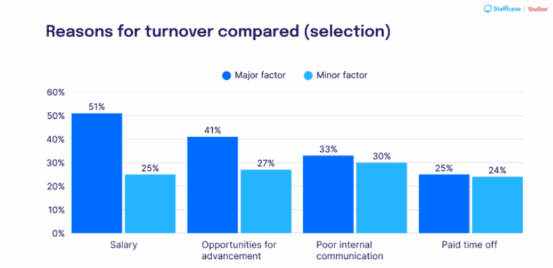
When reviewing this area during a culture audit, focus on how communication and influence actually work in practice.
We suggest looking at:
- How all-hands meetings are run and who actually speaks in them
- How decisions get communicated down through the organization
- Whether employees act on information they receive or wait for further direction
- Which informal networks exist and who sits at the center of them
Get this right, and you start to see how the organization truly functions beneath the surface. Miss it, and you risk designing an integration plan that looks right on paper but fails in execution.
These three dimensions (values and norms, leadership and decision-making, and communication and informal power) form the foundation of the audit.
In the next section we’ll cover how to actually collect that information, make sense of it, and present it in a way that drives action.
How to Conduct the Culture Audit: A Step-by-Step Framework
The following framework breaks the culture audit into three stages, each building on the last. When followed in sequence, they give you an evidence-based picture of both organizations before integration decisions get locked in.
Step 1: Data Collection: Surveys, Interviews, and Observation
The goal of data collection is to build an evidence base that reflects how culture actually operates at every level of both organizations. This requires more than one method.
Culture surveys are the starting point. They allow you to gather structured data across large employee populations quickly and establish a quantitative baseline you can measure against later. Response rates matter here.
According to Perceptyx research, census surveys across their client base average 72 to 88 percent participation, while pulse surveys land between 55 and 81 percent. When you setting realistic targets upfront; it helps you gauge whether the data is representative enough to draw conclusions.
However, surveys alone won’t get you there. They capture what employees are willing to say in a structured format, not what they actually think.
This is where interviews become critical.
Interviews go deeper. One-on-one conversations with employees across levels, from frontline staff to senior leaders, surface the assumptions and informal norms that survey questions don’t reach.
Focus groups add another layer, particularly when you want to understand how teams interpret shared experiences differently. A cross-functional group with employees from both organizations can reveal friction points that no survey would catch.
One thing we consistently notice is that observation is skipped too often. It requires more effort, but it gives you insights that no survey or interview can provide. Watching how meetings run, who influences decisions, and how people respond in real time shows how the organization actually functions.
The most important discipline in this step is coverage. Data should come from multiple levels and both organizations.
Remember: if your assessment relies only on leadership input, you end up with a top-down view that misses how work actually happens day to day.
Step 2: Gap Analysis: Mapping Clashes, Overlaps, and Shared Values
Once you have data, the next step is to make sense of it.
A gap analysis takes the cultural profiles of both organizations and maps them against each other to identify three categories:
- Genuine clashes
- Areas of meaningful overlap, and
- Shared values that can serve as integration anchors.
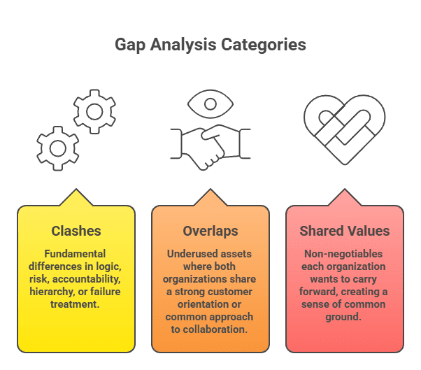
Clashes are where the two cultures operate on fundamentally different logic. This includes different approaches to risk, accountability, hierarchy, and how failure is treated. These differences need to be named explicitly, because they won’t resolve themselves through proximity alone.
Overlaps are underused assets in most integrations. When both organizations share a strong customer orientation or a common approach to collaboration, those areas of cultural fit become the foundation you build from. They reduce friction and give employees from both sides a concrete sense of common ground.
Shared values are the non-negotiables each organization wants to carry forward. This step requires clarity. The goal is to understand what matters on both sides, where conflict exists, and what is worth preserving as the combined culture takes shape.
Data shows that more than 60% of companies now include a culture assessment during due diligence and make it part of the go or no-go decision. Culture assessment is also becoming a more important part of HR due diligence, helping buyers identify people and culture risks before integration decisions are finalized.
To structure this analysis, you can use a combination of frameworks and tools:
- The Competing Values Framework, which maps both organizations across four culture types (collaboration, results, control, and innovation), and produces a visual profile that makes differences immediately comparable
- Culture analytics platforms like Culture Amp, Qualtrics, and Perceptyx, which can run validated culture surveys across both organizations simultaneously and generate side-by-side output
The value of using structured tools here is that the output is directly comparable across both entities. When surveys are designed around the same validated dimensions (values, leadership norms, communication style, and decision-making approach), the findings are harder for leadership to dismiss and easier to act on.
Step 3: Presenting Findings to Leadership
The most rigorous culture audit in the world produces no value if leadership doesn’t act on it. This makes the presentation of findings one of the most consequential steps in the entire process.
The framing matters more than the data.
Culture audit findings typically contain uncomfortable truths, particularly about leadership behavior, informal power dynamics, and how the acquired organization perceives the acquirer.
We have learned that positioning makes all the difference. These findings should be presented as data instead of accusations.
The goal is to give leadership a clear picture of what they’re working with, what integration risks are most significant, and where the change management plan needs to respond.
To make this actionable, we recommend connecting each cultural gap to a business outcome. For example:
- A clash in decision-making styles leads to slower execution during integration
- Differences in accountability put synergy targets at risk
- Gaps in communication norms result in uneven information flow and internal speculation
When findings are presented this way, they shift from being an HR report to a strategic input for decision-making.
Executive sponsorship is the variable that most determines what happens next. Prosci’s benchmarking research across 12 editions consistently finds active and visible sponsorship to be the single top contributor to change success.
Projects with extremely effective sponsors are 79% likely to meet their objectives, compared to just 27% where sponsorship is weak.
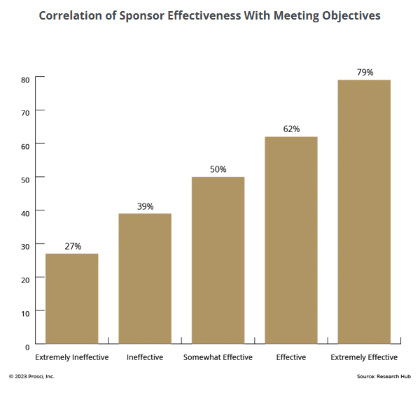
The culture audit findings presentation is the moment to secure that sponsorship. Leadership needs to understand not just what was found, but why it demands their active involvement in the integration process that follows.
How to Build Your Post-Acquisition Cultural Integration Strategy
The culture audit tells you what you’re dealing with. The integration strategy is what you do about it. This is where post-merger integration consulting firms can help turn audit findings into a structured integration plan.
Most organizations make one of two mistakes at this stage: they try to absorb everything too fast, or they acknowledge cultural differences without actually building a plan to address them.
We suggest taking a more deliberate approach. Break the process into clear steps. Focus on what to integrate, how to support your teams, and how to align the systems that reinforce culture.
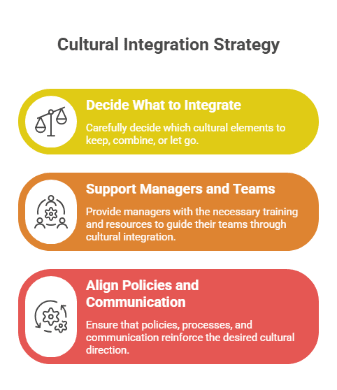
1. Decide What to Integrate, Preserve, and Let Go
Not everything in an acquired company’s culture needs to change. At the same time, not everything in the acquiring company’s culture should automatically win.
This is where careful judgment matters. You need to decide which elements to keep, which to combine, and which to leave behind.
The Haspeslagh and Jemison integration framework identifies three broad models:
- Absorption: the acquired company adopts the acquirer’s culture wholesale
- Preservation: the acquired company maintains its culture with minimal interference
- Symbiosis: both organizations evolve toward something new together
The right choice depends on your deal rationale, the level of cultural difference, and which elements of the acquired company contributed to its value.
Get this wrong, and the cost shows up quickly.
Take Cisco’s acquisition strategy as an example.
Rather than absorbing acquired companies into its existing culture, Cisco evaluated cultural fit as a core part of its pre-acquisition process, prioritizing targets that shared its values around innovation and speed, and built integration plans designed to protect those elements rather than override them.
The company also immediately brought acquired employees into integration teams for subsequent deals, using their firsthand experience as an asset rather than treating them as outsiders.
Now compare that with the Daimler-Chrysler merger.
Instead of addressing cultural differences, leadership pushed for absorption. Daimler-Benz operated with a structured, hierarchical approach, while Chrysler followed a faster, more flexible model.
The mismatch created friction almost immediately. Leadership turnover followed, key talent left, and employee morale declined. The expected synergies never materialized, and the deal eventually unraveled.
These outcomes are not unusual. Research shows that only 14% of M&A deals achieve significant success across strategic, financial, and operational measures.
At the same time, McKinsey's survey shows that companies managing culture effectively in their integration planning are around 50% more likely to meet or exceed synergy targets across both cost and revenue.
From our work with different teams, one pattern stands out. Successful integrations don’t leave culture to chance. They make deliberate decisions early and revisit them as the integration evolves.
When working through this decision for each cultural dimension, ask three questions:
- Does this element drive value in the deal rationale, and would losing it reduce what we paid for?
- Does this element create friction with the combined organization’s goals, and is that friction worth managing?
- Is this element neutral, meaning it can be adapted over time without affecting near-term performance?
2. Support Managers and Teams During Cultural Integration
Culture changes through behavior, and behavior at the team level is driven almost entirely by managers. This makes manager readiness one of the most critical and most underinvested elements of any cultural integration strategy.
What we see is that teams focus on structure and systems, while managers are expected to figure out cultural alignment on their own. This gap creates problems early.
According to Aon Hewitt's Global M&A Survey, 58% of companies admit to having no specific approach for assessing and integrating culture during a deal. The problem runs even deeper at the manager level.
Companies routinely skip any assessment of whether their leadership team has the capability or capacity to manage a cultural integration. This means the people most responsible for setting cultural norms day to day are left to figure it out as they go.
The consequences show up quickly. Firms lose 4 out of 10 managers in the first 24 months post-acquisition, which is three times the normal turnover rate.
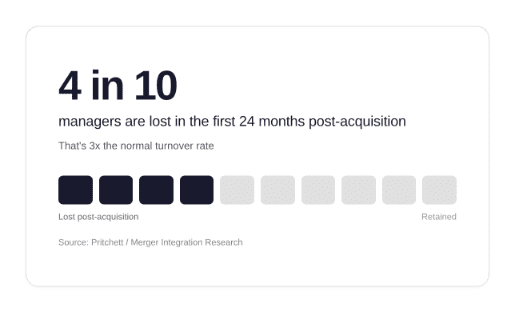
When managers leave, their teams lose their cultural anchor at exactly the moment when stability matters most. Employee morale drops, informal networks fragment, and the behavioral norms that hold team culture together start to dissolve.
To stabilize this, focus on interventions across three levels:
- Manager level: Provide leadership coaching and cross-cultural training so managers can navigate differences and guide their teams effectively
- Team level: Create structured cross-company workgroups and joint initiatives to build shared experience and alignment
- Structural level: Introduce bridging roles and integration task forces that connect both organizations in real decision-making environments
Cross-cultural training is particularly valuable in deals that span different national or regional cultures, where behavioral norms can vary significantly even when the deal looks clean on paper.
3. Align Policies, Processes, and Communication Early
Policies and processes are where culture becomes concrete. Each system either reinforces or contradicts the cultural direction the integration strategy is trying to build.
Communication is the highest-leverage one to get right. Employees fill information vacuums with speculation, and in an M&A context, speculation almost always trends negative.
In our experience, teams underestimate how quickly misalignment in systems can undo cultural progress. Even small inconsistencies send mixed signals about what actually matters.
When aligning policies, prioritize in this order:
- Communication cadence and channels to ensure consistent updates across both organizations
- Performance management alignment to reflect the combined culture in what gets measured
- Decision-making processes to clarify authority and reduce second-guessing
- Onboarding and rituals to introduce new norms through shared experience
Common Challenges in Post-Acquisition Culture Audits
Even with a solid framework, the audit process itself runs into predictable obstacles.
Understanding them in advance is part of running the process well. And in most cases, the audit methodology described above is specifically designed to surface and address each one.
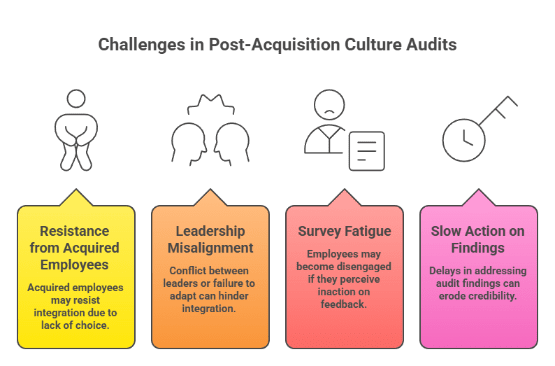
1. Resistance from Acquired Employees
Acquired employees didn’t choose to be acquired. Unlike new hires who go through a mutual selection process, they arrive with no vote in what happened to their organization. The natural response is resistance, withdrawal, or departure.
We’ve seen that this resistance is rarely about compensation or role changes. It usually comes from a loss of identity and uncertainty about where they fit in the new organization.
An MIT Sloan study found that 33% of acquired workers left within the first year, versus 12% of regular hires. The cause was traced to organizational mismatch, not compensation or role changes, but a breakdown in cultural belonging.
The culture audit surfaces these identity gaps early, before they calcify into attrition.
2. Leadership Misalignment Between Both Orgs
Leadership misalignment shows up in two ways. You’ll see visible conflict around direction and decision rights, along with quieter issues where leaders fail to adapt and unintentionally slow down integration.
This is where problems compound quickly. In our experience, leadership teams assume alignment without validating how decisions are actually made across both organizations.
Research consistently shows that around 40% of senior executives fail within the first 18 months of a new position. In an acquisition, most leaders are effectively operating in a new context, even if their title hasn’t changed.
According to McKinsey, lack of cultural fit is the most common reason integrations fall short of value creation expectations. Companies that get culture right are more than 40% more likely to meet cost synergy targets and up to 70% more likely to meet revenue targets.
The culture audit gives leadership a factual map of decision-making style differences, which is the most direct starting point for leadership coaching and organizational alignment work.
3. Survey Fatigue and Audit Overload
Post-acquisition environments are already high-pressure. Adding multiple culture surveys and feedback requests on top of that can quickly overwhelm employees.
What matters here is not volume, but follow-through. When employees don’t see action, participation drops, and trust erodes.
Gartner research found that only one-third of employees believe their organization will act on the feedback they provide. Once that perception sets in, surveys start to feel performative rather than useful.
Survey design also matters. According to InMoment, 74% of respondents are only willing to answer five questions or fewer, and adding a fourth question to a three-question survey drops completion rates by 18%.
Pro tip: A simpler approach works better. Keep your surveys short, space them away from major operational changes, and clearly show what actions were taken based on feedback.
4. Acting on Findings Too Slowly
Culture audit findings have a shelf life. The longer an organization waits to act, the more credibility the process loses.
Employees judge whether leadership is serious about integration based on how fast they see responses to concerns that were raised.
We’ve noticed that delayed responses create a ripple effect across teams. Concerns remain unresolved, informal narratives take over, and momentum fades.
Data support this pattern. Change fatigue causes employees’ intent to stay by up to 42%, while performance can drop by 27%.
To avoid this, treat culture findings with the same urgency as financial targets. Assign clear ownership to each major issue, set a 30-day timeline for high-priority actions, and track progress alongside integration metrics.
Turn Your Post-Acquisition Culture Audit Into Action with Alpha Apex Group
Culture is a core factor in whether a deal succeeds.
A culture audit helps you identify risks early, understand how teams operate, and make better decisions about integration. When used early, it helps protect value and supports a smoother transition.
The difference comes down to how early and how deliberately culture is addressed. Teams that act early avoid many of the issues that slow integration later.
If your organization needs support with culture audits, post-acquisition integration, leadership alignment, or change strategy, Alpha Apex Group can assist. We help you assess what matters, reduce risk, and build a stronger path forward.
Reach out to us today to get started.
Frequently Asked Questions
When should a culture audit happen in an acquisition process?
Ideally, it should begin before or immediately after close, while leadership still has time to shape the integration strategy instead of reacting to problems later. Your article makes the case that culture should be assessed early because it influences decision-making, leadership alignment, retention, and execution from the start.
How long does a post-acquisition culture audit usually take?
The timeline depends on the size and complexity of the deal, but it should move quickly enough to inform early integration decisions. The bigger risk is not speed alone but waiting too long to act on the findings, since employee trust and momentum can fade fast in a high-change environment.
Who should be involved in a culture audit after an acquisition?
It should include senior leadership, managers, and employees from both organizations, because culture rarely looks the same from every level of the business. A strong audit also looks beyond the org chart to identify informal influencers, communication patterns, and the people who shape how work really gets done.
Can a culture audit help prevent employee turnover after an acquisition?
Yes, that is one of its most practical benefits. A culture audit helps identify the friction points that make employees feel uncertain, disconnected, or misaligned, so leadership can address them before they turn into attrition, disengagement, or stalled integration.
Research Appendix
- We analyzed 40,000 M&A deals over 40 years. Here’s why 70–75% fail
- How to Make Organizational Culture Part of M&A Due Diligence
- How culture can unlock M&A performance
- Culture risk in M&A
- The 9 Essential Types of Company Culture
- How culture can create value during M&A integration
- Management Theory of Edgar Schein
- The future of human capital in M&A
- Why Employee Experience Determines M&A Integration Success
- 2025 International Employee Communication Impact Study
- Employee Survey Response Rate: Bias, Benchmarks & Fixes
- 2023 M&A Integration Survey
- Organizational Culture Assessment Instrument (OCAI)
- Culture Amp Platform
- Qualtrics XM Platform
- Perceptyx Platform
- Best Practices in Change Management
- Acquisition Integration Approach Model
- Growth by Acquisition: The Case of Cisco Systems
- Lessons from the DaimlerChrysler Merger
- Five areas of successful M&A integration
- Importance of Cultural Integration in M&A
- Why most cultural integrations in M&A fail
- Employee Retention After an Acquisition
- Why acquired hires leave
- Avoiding leadership missteps in M&A
- Why managing culture is critical for M&A value creation
- Gartner Engagement Research (31% engaged)
- Avoiding Survey Fatigue
- Gartner HR Leaders Survey 2024
.jpg)
.jpg)