40+ HR Manager Interview Questions & Answers
Hiring the right human resources manager directly impacts retention, compliance risk, leadership alignment, and long-term workforce stability. This role now sits at the center of hiring strategy, performance management, and organizational execution, which means a weak hire does not just slow HR; it slows the business.
That challenge is clear in the data: 69% of employers are still struggling to fill full-time roles. At the same time, 48% of HR leaders say skill demands are evolving faster than their current talent structures can support.
That is why interviews must go beyond generic questions. This guide outlines specific, high-signal HR manager interview questions, what strong answers actually sound like, and how to evaluate candidates based on measurable outcomes.
With a structured process and the right partner, such as Alpha Apex Group, hiring becomes more predictable and less reactive.
Why HR Manager Interviews Are Hard
Interviewing an HR manager is uniquely challenging because the role itself has expanded far beyond traditional people administration.
Today’s HR leaders are expected to balance recruitment and workforce planning, HR technology and analytics, compliance and risk, culture and engagement, and strategic partnership with leadership… all at once. That’s a constantly evolving skill set, and it’s difficult to assess properly through informal or conversational interviews alone.
The problem is compounded by the lack of clarity many organizations have around skills in the first place. Only 8% of organizations have reliable data on current workforce skills, which makes it hard to define what “good” really looks like before the interview even begins. Without clear criteria, interviews often default to gut feel or surface-level experience.
This shift from support function to strategic partner is well illustrated in the video below about how HR’s role is evolving:
All of this reinforces the same conclusion: HR manager interviews require structure, predefined evaluation criteria, and business-aligned scorecards. In the sections ahead, we break down exactly how to build that rigor into your process.
How to Build Your HR Manager Interview Playbook
Hiring decisions improve dramatically when interviews are designed as a system rather than as a series of disconnected conversations.
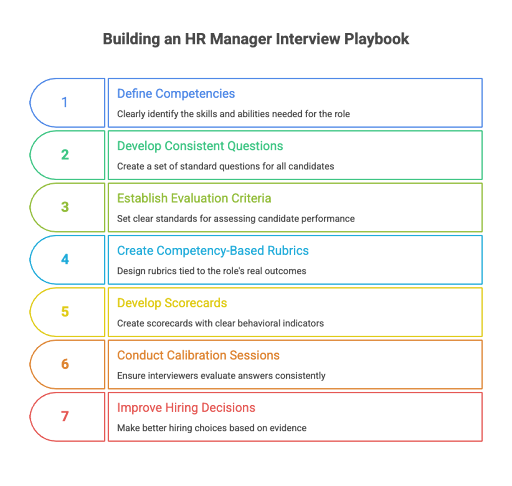
A strong HR manager interview playbook starts with clarity. This means clearly defined competencies, consistent questions, and shared evaluation criteria across interviewers. This is especially important for HR roles, where soft skills like judgment and influence matter just as much as technical knowledge.
The case for structure is well established in research. Research has found that structured interviews are significantly more effective at predicting future job performance than unstructured interviews, with predictive validity coefficients of 0.44 for structured interviews compared to just 0.33 for unstructured formats.
In practice, this means building interviews around:
Competency-based rubrics tied to the role’s real outcomes
Scorecards with clear behavioral indicators
Calibration sessions so interviewers evaluate answers consistently
The goal here is fairness, clarity, and better hiring decisions based on evidence as opposed to guesswork.
As the Harvard Business Review says,
“While unstructured interviews consistently receive the highest ratings for perceived effectiveness from hiring managers, dozens of studies have found them to be among the worst predictors of actual on-the-job performance...”
Key HR Manager Interview Questions & Answers
The questions below are designed to go beyond surface-level experience and uncover how candidates actually think, decide, and operate in real HR scenarios.
For each question, the goal isn’t just to hear what the candidate has done, but how they approach problems, balance competing priorities, and turn HR strategy into execution.
To help you evaluate answers consistently, each question is broken down into:
Why they ask: the capability or risk the question is designed to surface
What to listen for: signals in how the candidate frames their response
Strong answer indicators: traits and examples that point to real impact
Red flags: warning signs that suggest gaps in judgment, experience, or execution
When we use them together, these questions form a practical framework for comparing candidates fairly and identifying HR managers who can deliver results in your organization’s specific context.
Strategy and Leadership Related HR Manager Questions
These questions focus on how candidates think beyond day-to-day HR execution and operate as business leaders. Strong HR managers set priorities, make tradeoffs, and align people strategy with performance goals.
This section helps you assess whether a candidate can connect HR work to real business outcomes, influence senior stakeholders, and lead through change.
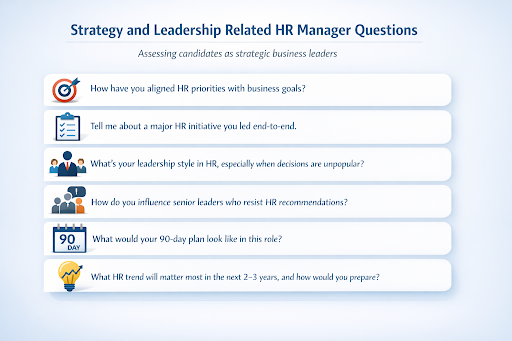
1. How have you aligned HR priorities with business goals?
Look for: Clear examples of translating revenue or growth targets into workforce plans with defined metrics. Strong candidates reference specific KPIs such as retention, time-to-productivity, headcount modeling, or cost-per-hire tied to business outcomes.
They should explain how they aligned leaders around measurable targets, not just “partnered with the business.
Strong answer: A strong candidate starts with a clear business target, such as expanding into two markets or increasing output by 25%, then models hiring volume, ramp time, and attrition risk. They reference concrete outcomes like reducing early attrition from 22% to 11% or cutting ramp time by 15%.
They explain how they aligned leadership around measurable workforce targets tied directly to revenue or productivity.
Red flags: Vague statements about “supporting company growth” without numbers. No connection between HR initiatives and revenue, productivity, or retention metrics. Reactive problem-solving instead of forward workforce planning. No evidence of trade-offs, measurement, or stakeholder calibration.
2. Tell me about a major HR initiative you led end-to-end.
Look for: Clear ownership from problem identification through rollout and post-launch measurement. Strong candidates define the scope, set timelines, secure stakeholder buy-in, manage resistance, and track measurable outcomes such as adoption rates, cost impact, retention shifts, or productivity improvements.
Strong answer: A strong candidate anchors the story in a real business problem, such as 30% first-year attrition or inconsistent performance reviews. They describe scoping the initiative, executing a 60–90 day rollout, and defining success metrics before launch. They cite measurable results like improving completion rates from 68% to 96% or reducing early attrition by 14%, and explain how they corrected early adoption gaps.
Red flags: Describes only the launch without baseline metrics or outcome data. Cannot explain sequencing, decision rationale, or resistance from managers. Attributes success vaguely to leadership or external partners. Avoids discussing missteps, low adoption, or what they would change after seeing results.
3. What’s your leadership style in HR, especially when decisions are unpopular?
Look for: Specific examples of delivering tough decisions like pay freezes, headcount cuts, and policy enforcement, all while maintaining credibility. You want to see clear evidence of structured communication, manager alignment, and follow-through.
Strong answer: A strong candidate describes a real scenario, for example, implementing a compensation freeze during a 12% revenue dip. They explain how they briefed leaders first, provided managers with FAQs and talking points, hosted Q&A sessions, and tracked engagement or attrition after rollout.
They also show how they listened without reversing necessary decisions and monitored downstream impact (for example, regretted attrition stayed below 5%).
Red flags: “I try to avoid conflict.” Blaming leadership for unpopular decisions like layoffs instead of looking for solutions. They might think of HR solely as rule enforcement and overlook areas such as communication strategy and the impact of their decisions.
4. How do you influence senior leaders who resist HR recommendations?
Look for: Concrete examples of influencing executive behavior using data, risk framing, and timing. The candidate should demonstrate persistence while maintaining relationships over time.
Strong answer: A candidate might describe a case where managers resisted structured interviews. They brought data showing a 30% first-year attrition rate, modeled the cost of turnover, piloted structured scorecards in one function, and demonstrated improved quality of hire within 2 quarters.
They tailored messaging differently for finance (cost impact) and operations (productivity risk). They show patience and relationship-building over multiple conversations.
Red flags: “I escalate to the CEO.” Some HR managers lean too heavily on their authority as a leader. When they can't share useful metrics or pilot-test decisions, teams are forced to rely solely on their own opinions.
5. What would your 90-day plan look like in this role?
Look for: A phased 30-60-90 structure with clear sequencing, defined listening activities, HR data review (focusing on attrition, time-to-fill, engagement, and compliance exposure), and prioritization based on business risk.
Strong answer: A strong candidate outlines the first 30 days focused on stakeholder interviews, reviewing HR dashboards, and identifying compliance or turnover risks.
By day 60, they narrow their focus to 2-3 high-impact issues, for example, 22% first-year attrition in a key function, and propose targeted actions like structured onboarding or manager coaching.
And by day 90, they present a 6-12 month HR roadmap tied to measurable KPIs like reducing early attrition by 8% or cutting time-to-fill by 15%.
Red flags: Just saying, “I’d get to know the team first.” Carrying out immediate sweeping changes without diagnosis. No sign of any metrics, no prioritization, and no link to business outcomes.
6. What HR trend will matter most in the next 2–3 years, and how would you prepare?
Look for: A clear connection between the trend and operational changes, including systems, governance, training, budget implications, and timeline. The candidate should explain what would actually change inside the organization.
Strong answer: A candidate might identify skills-based workforce planning and explain how they would map critical capabilities against growth plans, audit internal skill gaps, and adjust hiring and mobility strategies accordingly.
Or they may focus on HR tech consolidation, outlining steps to reduce fragmented systems and improve data accuracy before scaling analytics. They discuss trade-offs, budget constraints, and phased rollout rather than treating trends as abstract ideas.
Red flags: Buzzwords like “AI” or “future of work” without details about how these would actually be implemented. Trends disconnected from company strategy, and no discussion of cost, sequencing, or measurable impact.
Talent Acquisition and Hiring-Related HR Manager Questions
Talent acquisition is one of the most visible and business-critical parts of the HR function. These questions focus on how candidates think about sourcing, selection, onboarding, and partnerships with hiring managers.
The goal is to assess whether the candidate can balance speed, quality, and experience in a competitive market.
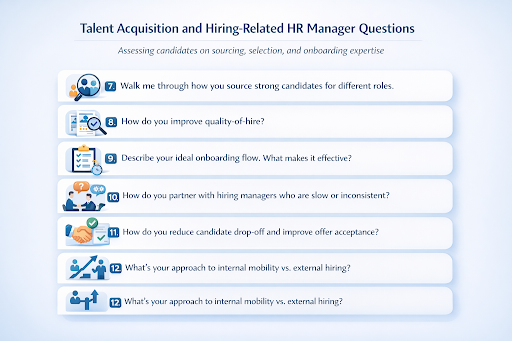
7. Walk me through how you source strong candidates for different roles.
Look for: A clear sourcing strategy tailored by role type, evidence of structured intake meetings before launching a search, defined screening criteria, and tracking of funnel metrics like submission-to-interview ratios and channel performance.
Strong answer: A strong candidate explains how they align with departmental leaders on measurable outcomes before opening a role. For senior hires, they may describe competitor mapping and referral targeting; for high-volume roles, talent pools, and pre-screen filters. They track which channels produce hires who stay beyond 12 months and adjust accordingly.
Red flags: Over-reliance on job boards. Forwarding unvetted resumes without defined screening criteria. No visibility into which sourcing channels produce strong performers.
8. How do you improve quality-of-hire?
Look for: A defined quality-of-hire framework tied to measurable outcomes such as 6-12 month performance ratings, first-year attrition, ramp-to-productivity, and hiring manager satisfaction. Evidence of structured scorecards and interviewer calibration.
Strong answer: A strong candidate explains how they review post-hire performance data quarterly and adjust interview criteria when early attrition or underperformance trends appear. They may describe tightening assessment standards and reducing first-year attrition significantly as a result.
Red flags: Focusing solely on time-to-fill, no post-hire data tracking, or no link between interview design and on-the-job performance.
9. Describe your ideal onboarding flow. What makes it effective?
Look for: A structured 30-60-90 day ramp plan aligned to business outputs, defined manager responsibilities, milestone check-ins, and measurement of early attrition or productivity indicators.
Strong answer: A strong candidate describes structured pre-boarding, defined first-week priorities, and performance milestones tied to real deliverables. They track ramp metrics and early engagement surveys, and adjust if trends show risk.
Red flags: Orientation-focused onboarding, no defined performance milestones, no follow-up check-ins, and no measurement of early retention or productivity.
10. How do you partner with hiring managers who are slow or inconsistent?
Look for: Clear expectations set upfront (for example, feedback SLAs), shared pipeline metrics, structured intake meetings, and direct coaching before escalation. Evidence of using data to change behavior.
Strong answer: A strong candidate should explain how they show managers the impact of delayed feedback on candidate drop-off and enforce response timelines. They coach interviewers and run brief calibration sessions to improve decision quality.
Red flags: Blaming managers, escalating issues immediately without first addressing them directly, or lacking shared accountability metrics.
11. How do you reduce candidate drop-off and improve offer acceptance?
Look for: Funnel-stage tracking, defined communication cadence (for example, we touch base with our candidates once a week), shortened decision cycles, transparent compensation discussions, and pre-close conversations before formal offers.
Strong answer: A strong candidate explains how they analyze where candidates exit the funnel and implement faster feedback loops. They proactively confirm expectations before issuing offers and monitor acceptance rates monthly.
Red flags: Treating drop-off as unavoidable, not tracking stage-by-stage attrition, or failing to review compensation expectations early.
12. What’s your approach to internal mobility vs. external hiring?
Look for: Regular talent reviews, visibility into successor readiness, internal fill-rate tracking, and structured career conversations. The manager should be aware of trade-offs among speed, cost, and long-term capability building.
Strong answer: A strong candidate describes mapping successors for critical roles and tracking promotion outcomes. They balance internal advancement with external hiring when this is needed to fill large skill gaps.
Red flags: Defaulting to external hiring without assessing internal talent or lacking data on internal mobility performance.
HR Operations & HR Technical Questions
Strong HR operations underpin compliance, workforce stability, and scalable growth. These questions assess whether a candidate can run reliable systems and improve them over time.
The focus is not on tool familiarity alone, but on operational judgment, data integrity, process design, and risk control. HR technology only creates value when it drives adoption, accuracy, and measurable business impact.
However, only 24% of HR functions report getting maximum value from their HR technology investments, according to Gartner. That gap highlights the difference between maintaining systems and optimizing them.
The following questions help you evaluate whether candidates can strengthen processes, improve data quality, increase system adoption, and reduce operational risk.
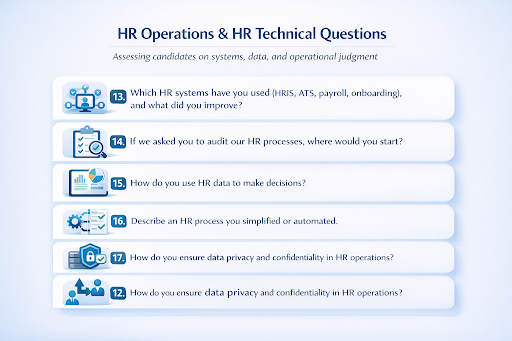
13. Which HR systems have you used (HRIS, ATS, payroll, onboarding), and what did you improve?
Look for: Evidence of system configuration, integration, adoption improvement, or building up reporting that goes beyond just familiarity with the platform. The candidate should explain what wasn’t working and what changed as a result of their intervention.
Strong answer: A strong candidate describes a concrete issue, for example, payroll errors caused by manual data transfers between ATS and HRIS. They explain how they automated data sync, standardized fields, and reduced processing errors by a measurable margin.
They may reference increasing manager adoption of performance modules from 60% to 92% after simplifying workflows and delivering targeted training.
Red flags: Listing software names without describing the impact. Treating systems as purely administrative tools rather than operational levers. No mention of user adoption, reporting quality, or error reduction.
14. If we asked you to audit our HR processes, where would you start?
Look for: A clear, risk-based framework; starting with legal exposure, payroll accuracy, documentation consistency, and access controls before moving to efficiency improvements.
Strong answer: A strong candidate explains they would first review compliance-sensitive areas such as employee classification, payroll accuracy, contract documentation, and termination processes. They might describe running spot-check audits or sampling employee files for gaps.
Once high-risk areas are stabilized, they shift to efficiency; for example, identifying duplicate approvals or bottlenecks in onboarding workflows. They link findings to remediation plans with timelines and ownership.
Red flags: Jumping straight to “optimizing workflows” without assessing compliance risk. No mention of documentation review, control checks, or prioritization logic.
15. How do you use HR data to make decisions?
Look for: Use of defined dashboards, analyzing appropriate trends over time, and connecting metrics to business outcomes rather than just reporting activity.
Strong answer: A strong candidate describes tracking leading indicators such as new-hire ramp time, engagement pulse results, and early attrition rates. They explain how data-triggered action, for example, noticing that one department had 30% higher turnover and discovering it correlated with inconsistent manager onboarding.
They then implemented targeted manager training and monitored turnover over the next two quarters. They also explain how insights were presented to leadership in clear, decision-focused summaries.
Red flags: Generating reports without explaining the decisions that followed, or relying only on annual engagement surveys or lagging turnover data without deeper analysis.
16. Describe an HR process you simplified or automated.
Look for: A clearly defined before-and-after state, including measurable time savings, reduced errors, or improved compliance.
Strong answer: A strong candidate explains that onboarding required manual coordination across five stakeholders, leading to delays and inconsistent documentation. They introduced workflow automation with defined triggers and accountability checkpoints, which reduced onboarding cycle time by several days and improved completion compliance to near 100%.
They describe how they tested the change, gathered feedback, and made adjustments before the full rollout.
Red flags: Automating processes without clarifying the original problem. No measurable improvement. No discussion of user training or adoption challenges.
17. How do you ensure data privacy and confidentiality in HR operations?
Look for: Structured controls including role-based system access, documented policies, training cadence, audit routines, and a clear escalation protocol for breaches.
Strong answer: A strong candidate explains how access is limited by job role, how permissions are reviewed quarterly, and how managers are trained on handling sensitive employee data. They may describe running internal audits to check for inappropriate access or having a documented incident-response plan outlining reporting timelines and legal consultation steps.
Red flags: Vague statements like “we take privacy seriously.” Over-reliance on IT without HR oversight, and no mention of audits, documentation, or incident response procedures.
Compensation, Benefits, and Employee Experience Questions
Compensation and benefits sit at the center of employee retention, morale, and cost control. These questions assess whether candidates can design programs that are competitive, financially sustainable, and aligned with business realities.
The objective is to evaluate how they translate employee feedback into structured policy changes while balancing advocacy with budget discipline.
Employee experience remains a major challenge for organizations. McKinsey’s HR Monitor 2025 found that around 36% of employees report dissatisfaction with their current employer. This shows there’s a persistent gap between what HR teams intend to deliver and how employees actually experience work.
Strong HR managers understand which compensation levers drive retention, how to benchmark effectively, and when to adjust benefits without inflating long-term cost risk.
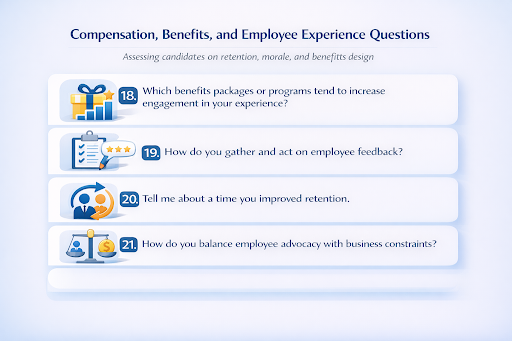
18. Which benefits packages or programs tend to increase engagement in your experience?
Look for: Evidence of segmentation and data-informed design over generic, boilerplate perks. The candidate should explain how benefits differ across workforce segments (e.g., frontline vs. corporate, early-career vs. senior leaders) and how engagement data informed their decisions.
Strong answer: A strong candidate explains how engagement surveys or exit data revealed specific gaps, for example, burnout in mid-level managers or retention risk among working parents.
They may describe introducing flexible scheduling, more generous parental leave, or targeted learning stipends and tracking engagement scores or retention shifts over two review cycles. They show how they measured adoption and adjusted programs based on participation rates.
Red flags: They name trendy perks without linking them to employee feedback or measurable outcomes, or treat benefits as universal rather than role- or life-stage specific.
19. How do you gather and act on employee feedback?
Look for: A structured feedback cycle, with collection, analysis, prioritization, action planning, and visible follow-up, rather than isolated surveys.
Strong answer: A strong candidate describes running annual engagement surveys supported by quarterly pulse checks and targeted focus groups. They explain how themes are prioritized with leadership, action owners are assigned, and progress is reviewed at defined intervals.
They may cite improving engagement in a low-scoring department after manager coaching and structured follow-up sessions. Crucially, they explain how outcomes are communicated back to employees to close the loop.
Red flags: Running surveys without visible action. Not showing any ownership of follow-up, or relying solely on informal feedback channels without structured analysis.
20. Tell me about a time you improved retention.
Look for: Clear root-cause diagnosis, targeted intervention, and measurable improvement over a defined period.
Strong answer: A strong candidate explains how they analyzed turnover data and identified a pattern like high attrition among first-year sales hires. They conducted exit interviews, identified onboarding gaps and unrealistic quotas, and introduced structured ramp plans and manager coaching.
Over the following two quarters, early attrition decreased meaningfully. They explain how results were tracked and sustained.
Red flags: Attributing turnover solely to market conditions with no diagnostic work before intervention and no measurable outcomes or time-bound improvement.
21. How do you balance employee advocacy with business constraints?
Look for: Clear decision frameworks, transparent communication, and willingness to say no while preserving trust.
Strong answer: A strong candidate describes advocating for employees using data, for example, presenting workload or burnout metrics to justify additional headcount, while acknowledging budget realities.
If a proposal is declined, they explain how they communicate trade-offs transparently and explore alternative solutions, such as phased implementation. They focus on maintaining credibility with both employees and leadership.
Red flags: Positioning HR as automatically siding with employees or leadership. A tendency to avoid difficult conversations with no evidence of structured decision-making or expectation management.
Employee Relations and Conflict Management Questions
Employee relations is where HR's credibility is most visibly tested. These situations are usually high-risk and time-sensitive, and they rarely have perfect outcomes.
Strong HR managers follow clear processes, document consistently, and maintain empathy while actually solving the problem at hand. These questions are designed to reveal how candidates think under pressure and whether they can manage sensitive situations in a fair, defensible, and human way.
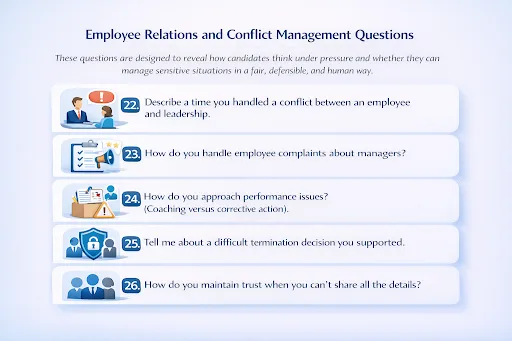
22. Describe a time you handled a conflict between an employee and leadership.
Look for: A structured approach based on fact-finding, documentation, neutral language, and clear resolution steps. The candidate should explain how they gathered perspectives separately before forming conclusions.
Strong answer: A strong candidate describes interviewing both parties independently, reviewing relevant documentation (emails, performance records), and clarifying the core issue, whether it was conduct, communication, or expectations.
They outline how they facilitated a mediated discussion or implemented corrective steps, and how outcomes were documented. They also explain how they monitored the situation afterward to prevent escalation.
Red flags: Taking sides early, relying on verbal summaries without documentation, or framing the resolution as “I told them to work it out.”
23. How do you handle employee complaints about managers?
Look for: A clear intake and investigation framework, defined confidentiality boundaries, documentation standards, and safeguards against retaliation.
Strong answer: A strong candidate explains how complaints are formally logged, how expectations around confidentiality are clarified upfront, and how interviews are conducted with consistency.
They may describe separating fact from perception and documenting findings in writing. They also explain how they follow up after resolution to make sure no retaliation occurs and that behavior changes are sustained.
Red flags: Treating complaints informally, promising absolute confidentiality, or failing to document steps taken and conclusions reached.
24. How do you approach performance issues? (Coaching versus corrective action.)
Look for: A distinction between capability shortcomings and conduct issues, alignment with policy, and consistent documentation before escalation.
Strong answer: A strong candidate explains that capability gaps (around skills, clarity, or workload) are addressed first through coaching, clear expectations, and documented check-ins.
Conduct issues like policy violations and repeated behavior concerns are handled more formally and may require written warnings. They describe setting measurable improvement goals and follow-up timelines, rather than vague expectations.
Red flags: Defaulting immediately to performance improvement plans without prior coaching, or avoiding formal steps altogether out of discomfort with conflict.
25. Tell me about a difficult termination decision you supported.
Look for: Clear documentation trail, legal awareness, preparation, and thoughtful communication.
Strong answer: A strong candidate explains how they made sure performance or conduct documentation was complete, aligned with policy, and reviewed with leadership before the termination meeting.
They describe planning the conversation carefully, treating the employee with dignity, and preparing messaging for the broader team to maintain trust. They also address operational continuity, such as workload redistribution.
Red flags: Casual descriptions of termination, lack of documentation, or no mention of legal review or risk assessment.
26. How do you maintain trust when you can’t share all the details?
Look for: Clear communication boundaries, empathy, and proactive reassurance rather than defensiveness.
Strong answer: A strong candidate explains how they acknowledge concerns directly (by saying, for example, “I understand this feels unclear”), clarify what they can and cannot disclose, and reinforce that decisions follow consistent processes.
They avoid vague references to “policy” and instead explain principles such as fairness or confidentiality. They also describe checking back in with stakeholders to make sure trust remains intact.
Red flags: Over-explaining sensitive information, becoming defensive, or hiding behind policy language without context or empathy.
Compliance, Policy, and Ethics Related Questions
Compliance and ethics are the non-negotiables of the HR function. While much of this work happens behind the scenes, mistakes in this area can carry serious legal, financial, and reputational consequences.
These questions are designed to assess whether candidates approach compliance proactively, apply policies consistently, and exercise sound ethical judgment when situations aren’t black and white.
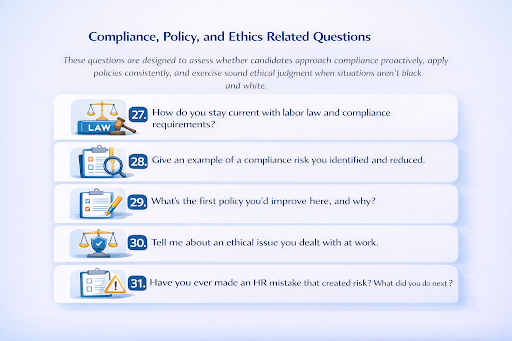
27. How do you stay current with labor law and compliance requirements?
Look for: A structured update process that includes named legal sources, membership in professional bodies, scheduled policy reviews, and regular collaboration with external counsel or internal legal teams.
Strong answer: A strong candidate explains they subscribe to formal legal updates like employment law briefings, attend quarterly compliance reviews, and partner with legal counsel when regulations change.
They describe translating updates into action, such as revising leave policies within 30 days of new legislation and training managers on implications. They may talk about maintaining a compliance calendar with audit checkpoints throughout the year.
Red flags: Saying things like, “I read updates when they come through.” Assuming compliance is solely legal responsibility, and having no structured review cadence or documentation process.
28. Give an example of a compliance risk you identified and reduced.
Look for: Early detection of compliance issues, structured assessment, documented remediation steps, and follow-up monitoring.
Strong answer: A strong candidate might describe identifying inconsistent contractor classification during a payroll audit. They explain reviewing contracts, assessing financial and legal exposure, correcting classifications, and implementing a review checklist to prevent recurrence. They outline how leadership was informed and how future audits were scheduled.
Red flags: Only addressing issues after formal complaints or audits, lacking documentation of corrective steps, and shifting responsibility entirely to finance or legal without HR ownership.
29. What’s the first policy you’d improve here, and why?
Look for: Prioritization based on objective factors like organizational risk, clarity gaps, or inconsistent application rather than personal preference.
Strong answer: A strong candidate might identify performance management or hybrid work policies if they see inconsistency or manager confusion. They explain how they would review usage data, gather stakeholder input, update language for clarity, and roll out changes with manager training sessions. They connect the update to measurable outcomes like improved review completion rates or reduced policy disputes.
Red flags: Suggesting policy changes without context, choosing topics unrelated to business risk, and having no plan for communication, training, or adoption.
30. Tell me about an ethical issue you dealt with at work.
Look for: A calm, step-by-step approach including fact-finding, documentation, appropriate escalation, and fairness across parties.
Strong answer: A strong candidate describes a real scenario, like handling a conflict of interest involving a senior manager. They explain how they gathered facts, consulted legal or executive leadership where required, documented findings, and made sure the process remained consistent with company policy. They balance confidentiality with accountability.
Red flags: Overconfidence or moral grandstanding, sharing excessive confidential details, and failing to escalate appropriately when required.
31. Have you ever made an HR mistake that created risk? What did you do next?
Look for: Ownership of mistakes and oversights, clear evidence of appropriate action to fix the problem, and setting up systemic measures like regular reviews to avoid the same thing happening again.
Strong answer: A strong candidate openly describes a misstep, such as delayed documentation in a termination process, and explains how they corrected the issue immediately. More importantly, they outline how they introduced process changes like checklist requirements or review checkpoints to prevent recurrence. They show learning and accountability rather than defensiveness.
Red flags: Claiming they’ve never made a mistake, blaming others for their own mistakes, or failing to demonstrate a clear change implemented after the incident.
Soft Skills and HR Judgment Related Questions
Technical skills and experience matter, but in HR, how decisions are made is just as important as what decisions are made.
This section focuses on judgment, self-awareness, and interpersonal effectiveness, which are the qualities that determine whether an HR manager can build trust and operate credibly across the organization.
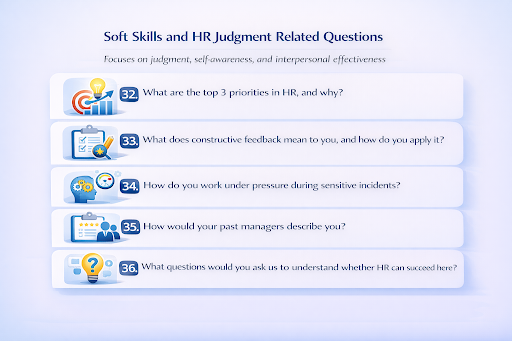
32. What are the top 3 priorities in HR, and why?
Look for: Clear prioritization tied to business stage (e.g., growth, restructuring, or stabilization), workforce risks like attrition, skills gaps, and leadership capability, and company values. The candidate should explain trade-offs and prioritization.
Strong answer: A strong candidate will prioritize workforce planning, manager capability, and retention. They should explain that in a high-growth phase, hiring quality and ramp speed matter more than policy refinement.
They can articulate why certain initiatives come first and what would be deprioritized, and show awareness that priorities will change depending on revenue pressure, regulatory exposure, or cultural health.
Red flags: Generic answers like “culture, engagement, and compliance” with no context, rigid, one-size-fits-all thinking, and no acknowledgment of trade-offs or resource constraints.
33. What does constructive feedback mean to you, and how do you apply it?
Look for: A practical feedback philosophy with examples of both giving and receiving feedback, and evidence of behavior change. The candidate should describe timing, structure, and follow-up as well as intent.
Strong answer: A strong candidate explains that feedback is specific, timely, and tied to observable behavior. They may describe coaching a manager through difficult conversations or adjusting their own approach after upward feedback. They reference structured check-ins or development plans and explain how improvement was measured over time.
Red flags: Framing feedback as criticism or conflict, only describing how they give feedback, not receive it, and not being able to share any examples of changed behavior that came from feedback.
34. How do you work under pressure during sensitive incidents?
Look for: A structured response approach under stress that prioritizes facts, contains risk, clarifies roles, and communicates deliberately rather than reacting emotionally.
Strong answer: A strong candidate describes slowing down before acting, gathering verified facts, and clarifying who needs to be informed. They may reference handling a sensitive complaint or legal risk by creating a response plan, setting communication boundaries, and documenting decisions carefully. They demonstrate steady tone and careful sequencing rather than urgency-driven decisions.
Red flags: Reactive decision-making, emotional language, or vague claims like “I stay calm” without describing what that looks like in terms of concrete actions.
35. How would your past managers describe you?
Look for: Specific strengths tied to outcomes, plus one or two development areas with evidence of improvement. The response should feel reflective rather than rehearsed.
Strong answer: A strong candidate might say they’re known for structured thinking and follow-through, referencing a project delivered on time or improved process adoption. They also acknowledge growth areas, such as previously overcommitting, and explain how they adjusted by prioritizing more deliberately.
Red flags: Overly polished answers with no development areas, generic adjectives like “hardworking” or “passionate” without evidence, and an inability to describe feedback they received in the past.
36. What questions would you ask us to understand whether HR can succeed here?
Look for: Questions about decision rights, leadership alignment, resource allocation, performance expectations, and cultural realities. The candidate should be curious about how HR is positioned within the business.
Strong answer: A strong candidate asks about executive support for HR initiatives, how performance is measured, how conflicts between business leaders and HR are resolved, and what previous HR challenges looked like. They should care about the way the business works rather than focusing solely on benefits or compensation.
Red flags: No meaningful questions, only asking about personal growth or perks, and avoiding deeper inquiry into any challenges in the organization.
Culture and Engagement Related HR Manager Questions
Culture and engagement are a major part of how people work, communicate, and stay (or leave). These questions help you assess whether a candidate understands company culture as something that must be actively measured, shaped, and reinforced over time.
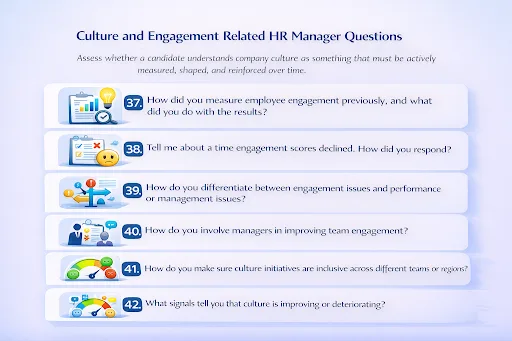
37. How did you measure employee engagement previously, and what did you do with the results?
Look for: A structured measurement approach (featuring an annual survey as well as regular pulse checks), segmentation by department or manager, clear prioritization of themes, and shared accountability with leadership for follow-through.
Strong answer: A strong candidate explains how engagement data was broken down by function, tenure, or manager to identify patterns. They describe prioritizing 2-3 focus areas rather than tackling everything at once, assigning executive sponsors, and tracking progress quarterly.
For example, maybe after low scores on career development, they introduced structured growth conversations and monitored internal mobility rates over the next two review cycles.
Red flags: Running surveys without action plans, treating results as HR-owned rather than leadership-owned, and showing no evidence of tracking improvement over time.
38. Tell me about a time engagement scores declined. How did you respond?
Look for: Root-cause investigation beyond surface explanations, collaboration with managers, and a time-bound recovery plan.
Strong answer: A strong candidate explains how they analyzed engagement data alongside turnover, workload, or leadership changes to isolate likely drivers. For example, a department showing declining scores after rapid growth may have lacked manager support.
They describe targeted interventions like leadership coaching or workload redistribution, and how they monitored trends over subsequent quarters. They show patience and follow-through rather than expecting immediate improvement.
Red flags: Blaming external pressures like market conditions without intervention, and reacting with one-off morale initiatives instead of addressing deeper structural issues like a lack of proper training.
39. How do you differentiate between engagement issues and performance or management issues?
Look for: Analytical discipline where the candidate separates systemic culture patterns from individual leadership gaps using data and observation.
Strong answer: A strong candidate explains how they compare engagement scores across teams and cross-reference them with turnover, absenteeism, or performance outcomes. If one manager’s team consistently underperforms while others remain stable, they investigate leadership behavior rather than labeling it a culture issue. They rely on patterns instead of anecdotes.
Red flags: Treating all dissatisfaction as an engagement issue, avoiding accountability conversations with managers, and no use of comparative data.
40. How do you involve managers in improving team engagement?
Look for: Clear ownership placed on managers, structured action planning, and measurable follow-up expectations.
Strong answer: A strong candidate describes training managers on interpreting engagement data, setting 2-3 team-level commitments, and reviewing progress in quarterly check-ins. They might reference improving engagement scores in a specific function after equipping managers with feedback tools and holding them accountable for action plans.
Red flags: HR designing initiatives without manager involvement, no accountability mechanism, and treating engagement as an HR-only responsibility.
41. How do you make sure culture initiatives are inclusive across different teams or regions?
Look for: Segmented data analysis, sensitivity to local context, and structured feedback loops from diverse employee groups.
Strong answer: A strong candidate explains how global principles are set centrally but adapted locally, for example, adjusting flexible work policies based on operational realities in different regions. They reference reviewing engagement data by demographic group to identify disparities and partnering with regional leaders to implement policies that work for their specific circumstances.
Red flags: Rolling out identical programs everywhere without context, no measurement of inclusion outcomes, and ignoring regional or workforce differences.
42. What signals tell you that culture is improving or deteriorating?
Look for: A defined set of leading and lagging indicators, such as voluntary turnover trends, internal mobility rates, engagement scores, absenteeism, and qualitative exit themes. These should be reviewed over time rather than in isolation.
Strong answer: A strong candidate explains how they monitor trends quarterly, looking for consistent patterns rather than one-off fluctuations. For example, rising regretted attrition or declining internal promotion rates may signal cultural strain. They triangulate survey data with operational metrics before drawing conclusions.
Red flags: Relying solely on anecdotal feedback, overreacting to single survey results, and having no consistent dashboard or review cadence.
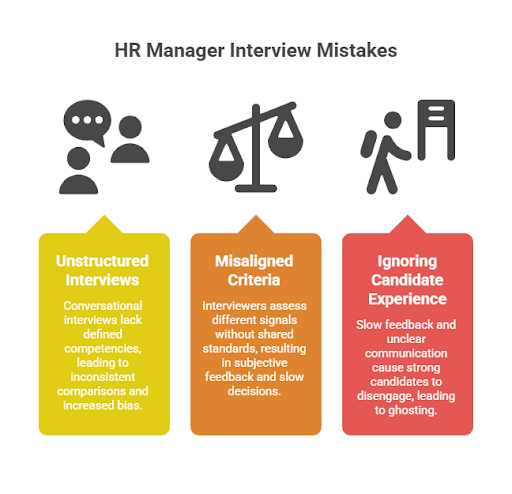
Common HR Manager Interview Mistakes and What to Do Instead
Even experienced hiring teams weaken HR manager interviews through avoidable process errors.
Unstructured, conversational interviews: These feel engaging but vary widely between interviewers. Without defined competencies and scoring criteria, comparisons become inconsistent, bias increases, and confidence in hiring decisions declines.
Misaligned evaluation criteria: When interviewers assess different signals such as leadership presence, culture alignment, or technical depth without shared standards, feedback becomes subjective. Decisions slow down and default to consensus instead of evidence.
Ignoring candidate experience: Slow feedback, unclear next steps, and inconsistent communication can cause strong candidates to disengage. Around 41% of employers report candidates ghosting during the hiring process, signaling breakdowns in communication and process clarity.
What to do instead:
Set up structured interviews with clearly defined competencies, standardized questions, and scorecards. Align interviewers upfront on what a good performance looks like, and hold short calibration or consensus discussions after interviews.
This approach improves decision quality, reduces bias, and creates a clearer, more professional experience for candidates, especially for senior HR roles.
AAG’s HR Interview Checklist
Use this checklist to bring structure and consistency to your HR manager interviews and avoid common pitfalls.
Define success metrics before interviewing. Be explicit about what “good” looks like. This is especially important because so few organizations have reliable data on workforce skills.
Use structured, behavioral, and technical questions tied to real job outcomes, with clear scoring charts
Train interviewers on consistency and bias awareness so candidates are evaluated against the same criteria
Benchmark answers against real organizational KPIs, such as retention, time-to-fill, engagement, or compliance risk
At AAG, this structured, evidence-based approach underpins how we help organizations identify HR leaders who can deliver impact from day one.
Hire Better HR Leaders with AAG
Interviewing HR managers well requires structure, clarity, and consistency.
As this guide shows, data-backed interview frameworks help hiring teams move beyond gut feel and hone in on the skills, judgment, and leadership capability that truly matter.
At Alpha Apex Group, we help you operationalize these best practices, from defining success criteria and building interview scorecards to calibrating interviewers and assessing HR leadership talent with confidence.
If you’re hiring an HR manager and want a more reliable, defensible process, Alpha Apex Group can help you design and run interviews that lead to better hires, faster decisions, and stronger long-term outcomes.
Connect with AAGtodayto strengthen your HR leadership recruitment process and secure the talent that will drive your organization forward.
FAQs
1. What makes employee selection for HR managers different from other roles?
Employee selection for HR managers is more complex because the role spans compliance, culture, leadership, and business strategy. Unlike many recruitment manager roles, HR managers must balance people decisions with risk, data, and long-term impact.
2. Who should be involved in employee selection for an HR or recruitment manager?
Employee selection works best with three to five interviewers who can assess leadership, operations, and the use of HR technology tools. Being in agreement on the criteria matters more than the number of interviewers.
3. What are common red flags in employee selection interviews for HR leaders?
Red flags include vague answers, poor judgment, limited experience with HR technology tools, and an overfocus on speed rather than quality-of-hire, especially in recruitment manager candidates.
4. How does AAG help organizations hire better HR managers?
AAG supports organizations by designing structured, evidence-based interview frameworks for HR leadership roles. This includes defining success metrics, building interview scorecards, training interviewers, and helping teams assess candidates consistently and confidently.
5. Can AAG help standardize interviews across multiple roles or regions?
Yes. AAG works with organizations to create scalable interview frameworks that can be applied across teams, functions, and geographies while still allowing for local context. This helps reduce bias and improve hiring consistency at scale.
6. Does AAG support internal HR promotions as well as external hiring?
Absolutely. AAG’s interview and assessment frameworks are designed for both internal and external candidates. This helps organizations make fair, defensible decisions when promoting HR professionals into management or leadership roles.
7. How can we improve interview quality quickly without overhauling our entire hiring process?
Start by clarifying success criteria, introducing structured questions with scorecards, and aligning interviewers on what “good” looks like. Even small changes, like consistent scoring and post-interview calibration, can significantly improve hiring outcomes.
.jpg)
.jpg)