How To Measure Company Culture in 2026: 8 Effective Methods
You already know company culture matters. You see it in team meetings, hiring outcomes, and how work actually gets done day-to-day.
The harder question comes after that: how do you measure company culture without relying on opinions?
Culture becomes measurable when you connect behaviors, systems, and outcomes instead of looking at them in isolation. When these signals line up, you gain clarity on what is actually shaping the employee experience.
This clarity matters. Research shows that highly engaged teams deliver 21% higher profitability and 59% lower turnover. These figures confirm a direct link between culture measurement and business results.
The guide below breaks down practical methods and metrics you can use to measure organizational culture and turn employee insights into action.
We’ll cover:
What measuring organizational culture really means
Why workplace culture measurement affects employee engagement, retention, and corporate performance
Proven methods to assess culture
Practical culture metrics you can track over time
P.S. Struggling to connect employee feedback with real cultural change? Alpha Apex Group helps you measure, interpret, and improve company culture through structured culture assessments and leadership-aligned action planning. If you want complete clarity, our team can help you move forward with confidence.
What Does “Measuring Company Culture” Really Mean?
When people talk about company culture, they usually describe how work feels. You hear words like supportive, chaotic, fast-paced, or political. That description sounds familiar, but from our experience, it rarely helps you make decisions. Measuring company culture means translating values into things you can actually observe and track.
At a practical level, culture becomes measurable when you connect three elements that most of the time sit apart:
Company values with how people are expected to work
Day-to-day behaviors with how work actually happens
Business outcomes with what employees experience over time
You might believe your workplace culture reflects trust, collaboration, or accountability. But that belief is perception. Evidence looks different and shows up in specific places, such as:
How feedback flows across teams
How decisions move through the organizational structure
How leaders respond under pressure
How employees describe their experiences in surveys and reviews
In our practice, we have seen leadership teams surprised when employee surveys, employee reviews, and people analytics point to patterns that do not match leadership assumptions.
This is why qualitative and quantitative data must work together.
Qualitative data, such as interviews, focus groups, and open employee feedback, help you understand context and meaning. In contrast, quantitative data such as engagement scores, turnover rate, productivity rate, and internal promotions show scale and consistency.
From our point of view, relying on one side creates blind spots. We recommend combining both so you can see patterns clearly and act with confidence. Trust us, culture becomes much easier to understand when stories and numbers reinforce each other.
Why Measuring Company Culture Matters for Business Performance
Company culture shapes how work gets done, whether people stay, and how leadership is perceived. When you measure culture, performance patterns start to make sense instead of feeling random.
As the Forbes Councils Expert Panel puts it,
“A company’s internal culture has a significant impact on how the business performs in a given market. From negative interactions with customers and decreased productivity to high turnover, the wrong kind of company culture can actively harm the organization’s reputation and chances of success.”
From our experience working with different teams, this is where culture measurement delivers real value.
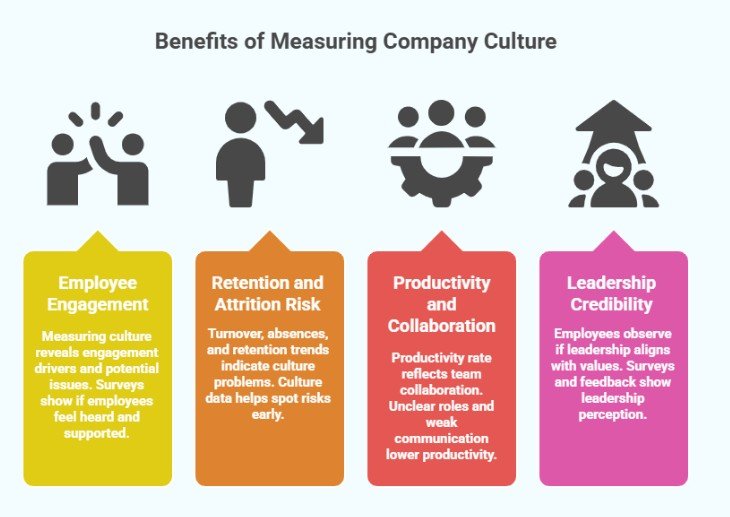
Employee Engagement
When you measure culture, it becomes much easier to see what actually drives employee engagement and where it starts to slip. Employee surveys and pulse surveys reveal whether people feel heard, supported, and clear on expectations.
That connection isn’t theoretical. Research consistently shows that company culture and engagement go hand in hand. Organizations with strong, well-aligned cultures report up to 72% higher employee engagement compared to those with weak or misaligned cultures.
Retention and Attrition Risk
Turnover rate, unscheduled absences, and employee retention trends mostly point to culture issues before exits happen. This matters more than you realize.
In fact, research shows that about 88% of workers consider culture important when choosing where to work, and 61% say they would leave their current role for a better culture. In our work with different companies, we have seen that culture data helps you spot these risks early, before they turn into resignations.
Productivity and Collaboration
Productivity rate helps you determine how well your teams collaborate and coordinate. When teams struggle with unclear roles, weak communication, or constant friction, productivity usually drops first.
From what we have seen across different teams, these drops rarely come from a lack of effort. They mostly point back to culture and how work actually flows.
That connection shows up in the data as well. Gallup has found that highly engaged teams can achieve up to 14% higher productivity than less engaged ones.
Leadership Credibility
Employees notice whether leadership behavior aligns with company values. When you use culture assessment surveys and employee feedback, you gain a clearer view of how senior leaders and managers are actually perceived across your organization.
From our point of view, measuring organizational culture turns performance into something you can understand and influence with confidence.
8 Proven Methods to Measure Company Culture
Now that you understand why culture measurement matters, the next step is knowing how to do it properly. Below are proven methods we recommend using to measure company culture with clarity and consistency.
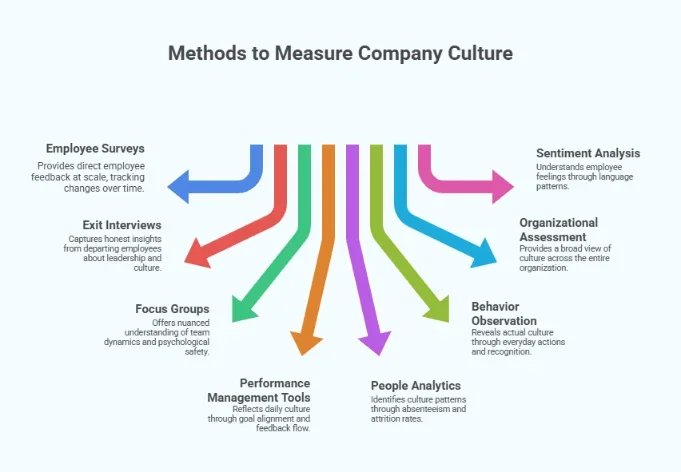
1. Exit Interviews
Exit interviews provide insights that employee surveys do not always capture. Once someone has decided to leave, the conversation usually becomes more direct. We’ve noticed that people speak more freely about leadership gaps, team dynamics, and cultural friction at this stage.
That openness is not anecdotal. Data from SecondTalent shows that 75% of departing employees provide honest feedback. This explains why exit interviews can surface issues that stay hidden during active employment.
What makes exit interviews truly valuable is not a single comment. It is the pattern that forms over time.
We believe the strongest signals appear when you step back and look across multiple exits. This approach aligns with broader trends as well. SecondTalent data also shows that 64% of companies actively use exit data to improve employee retention. This shows why reviewing departures collectively gives teams clearer direction.
Therefore, we always pay close attention to patterns such as:
Repeated mentions of the same manager or leadership behavior
Similar concerns around growth, recognition, or workload
Timing clusters where several exits happen within a short period
Consistent language used across different roles or teams
One departure can reflect a personal decision. Several departures pointing to the same issue usually reflect a culture problem.
We recommend reviewing exit feedback collectively rather than file by file. When you connect these signals, exit interviews become one of the clearest ways to understand what is driving attrition inside your workplace culture.
2. Employee Surveys
Employee surveys give you direct access to employee voice at scale. When used well, they provide early signals about how people experience your workplace culture. From our experience, surveys work best when you treat them as a listening tool rather than a reporting task.
You will typically use pulse surveys or annual surveys.
Pulse surveys help you track changes over time, whileannual surveys offer a deeper view of employee experience. In our day-to-day work with numerous teams, we use both pulse surveys and annual surveys so we can see short-term shifts alongside long-term patterns.
Remember that what you ask matters more than how often you ask. Culture-focused questions should measure:
Alignment with company values
Trust in leadership
Psychological safety within teams
Fairness in recognition and decisions
Whether employees feel heard
We have seen shorter, well-designed surveys deliver clearer insights than long survey templates. Trust us, when questions reflect real behaviors, employee feedback becomes far more actionable.
3. Focus Groups
Focus groups help you hear what lies beneath survey responses. They create space for nuance and show how safe people feel speaking up in front of others. In many cases, the way a conversation unfolds tells you more about culture than the words alone.
What stands out in these sessions is the group dynamic. You notice where people pause, agree quietly, or avoid certain topics. We have watched leadership teams connect the dots in real time when these moments explain survey results that felt unclear on their own.
Focus groups help you identify:
How comfortable teams feel with challenging ideas
Whether psychological safety exists in practice
Unspoken norms that guide behavior
Gaps between stated company values and lived experience
From what we have learned over time, focus groups work best when they are used with a clear purpose. They are particularly useful after survey data raises questions or when leaders need context before making changes in the culture.
They deliver the most value when:
Groups stay small and include mixed perspectives
Sessions feel guided, instead of defensive
Leaders listen without trying to justify past decisions
Feedback leads to visible next steps
Believe us, when people sense that their input will be taken seriously, the insights become far more direct and useful.
4. Performance Management Tools
Performance management tools quietly reflect how culture shows up day to day. Platforms such as Lattice, 15Five, or Workday track goals and reviews, but they also reveal how clearly expectations are set and how accountability works in practice.
In many teams we have supported, early culture signals appeared here before they surfaced anywhere else.
When goals feel disconnected from real work, confusion follows. And when feedback appears only during formal reviews, trust takes a hit. We have noticed that performance data captures these patterns without anyone spelling them out.
Look closely at signals such as:
How goals connect to company values
How feedback flows between managers and teams
How accountability is handled when results slip
How recognition shows up across roles
From our perspective, these tools work best when you read them as indicators. Believe us, performance data already reflects your culture. You just have to pay attention.
5. People Analytics
People analytics helps you see culture through patterns rather than opinions. When you look at absenteeism, attrition, and internal mobility trends together, the story becomes clearer.
From what we have observed across teams, shifts in these numbers usually signal changes in the employee experience long before issues become visible.
Take absenteeism, for example. It’s most of the time an early indicator of stress or disengagement. Research shows that disengaged employees have 37% higher absenteeism than their engaged peers
Attrition patterns highlight where culture may be pushing people out, while internal mobilityshows whether employees see a future inside the organization. We suggest reviewing these trends side by side instead of treating them separately.
What makes people analytics powerful is correlation. When you connect behavior with outcomes, culture stops feeling abstract. This approach has helped us understand why certain teams struggle while others thrive. Trust us, the numbers start making sense when you read them together.
6. Behavior Observation and Recognition
What people do every day tells you more about culture than what is written in policy documents. You may state values like collaboration or accountability, but behavior shows whether those values guide real decisions. From what we have seen, culture becomes visible in small, everyday moments.
Pay close attention to signals such as:
How meetings are run and who gets space to speak
How disagreements are handled under pressure
How decisions are challenged or accepted
Recognition patterns matter just as much. Who gets praised, promoted, or rewarded signals what the organization truly values.
What we have observed is that recognition rarely happens by accident. It reflects priorities, power dynamics, and leadership habits. We suggest reviewing recognition data and everyday behavior together.
Note that when behavior and recognition align with values, culture becomes visible without asking a single survey question.
7. Organizational Assessment Systems
Organizational assessment systems give you a wider lens on culture. Instead of focusing on individual teams or isolated signals, these tools help you understand how culture shows up across the entire organization. In larger or growing companies, this broader view becomes essential.
Maturity models and diagnostics help you place your culture on a continuum. You see what is working, what is inconsistent, and what progress looks like in realistic terms. We have watched leadership teams gain clarity quickly once culture is mapped this way.
These systems help surface insights such as:
How culture differs across departments, regions, or functions
Where leadership behavior stays aligned or starts to drift
Which cultural strengths support execution
Where gaps slow down decisions or create friction
Based on what we have learned working with complex organizations, these assessments work best during growth, restructuring, or leadership change. Believe us, enterprise-level visibility changes how culture decisions get made.
8. Sentiment Analysis and Employee Language Patterns
Sentiment analysis helps you understand how employees actually feel by analyzing the language they use across open-ended responses, reviews, and internal communication channels.
From our experience, this is where culture signals become much clearer. Two teams may report similar engagement scores, yet sentiment analysis reveals very different emotional tones. One team may use neutral or constructive language. Another may show frustration, hesitation, or distrust through repeated word patterns.
Sentiment analysis typically looks at:
Emotional tone in open-ended survey responses
Recurring words and phrases linked to stress, trust, or disengagement
Shifts in employee language over time
Differences in sentiment across teams, roles, or locations
This approach usually uses natural language processing and machine learning to detect patterns at scale. When combined with survey scores and people analytics, sentiment analysis adds depth without relying on assumptions.
We recommend using sentiment analysis to validate what survey scores suggest and to guide where deeper conversations, such as focus groups, are needed. When employee language changes, culture usually has already shifted.
Key Company Culture Metrics to Track Over Time
Once you start measuring culture, numbers give you clarity only when you know how they are calculated. From our experience, teams get far more value when they understand the logic behind each metric instead of treating scores as black boxes.
Below are the core culture metrics we recommend tracking, along with simple formulas you can actually use.
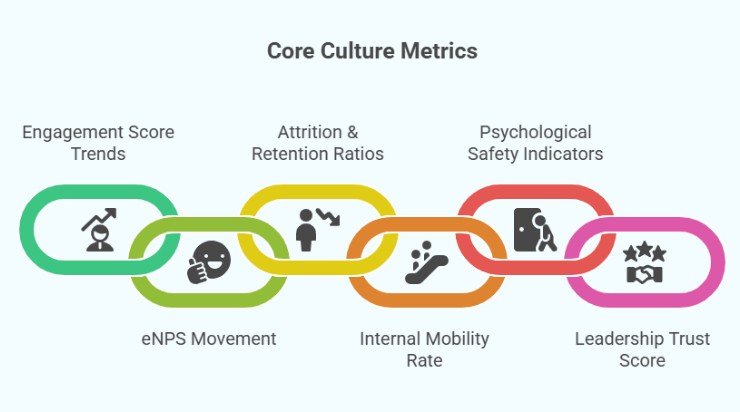
1. Engagement Score Trends
Engagement scores start to matter once you stop treating them as one-time results. The real signal lies in how those scores move over time. We have seen teams worry about a single dip and miss the bigger picture entirely.
How it’s calculated
Engagement score = Total engagement question scores ÷ Number of engagement questions
Keep the questions consistent and compare results across cycles. Small shifts across teams usually tell you more about culture health than a headline score ever will.
2. eNPS Movement
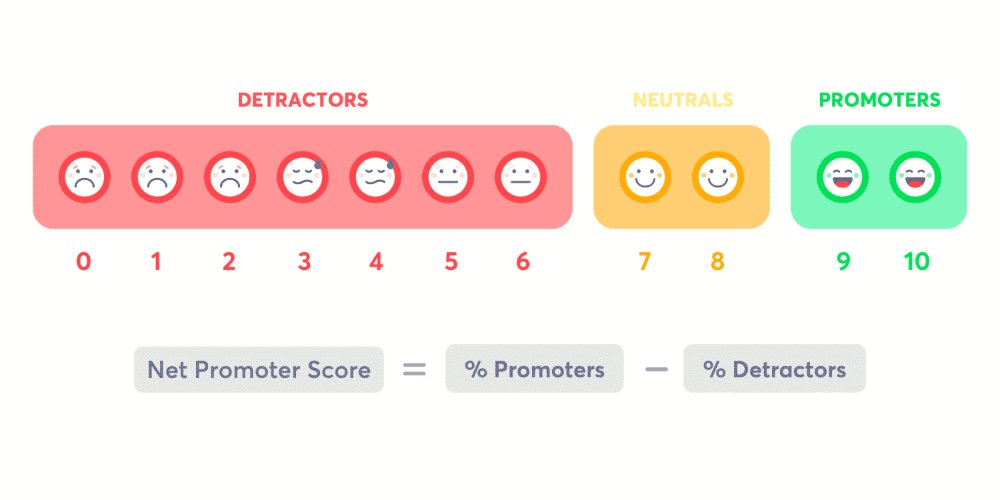
Employee Net Promoter Score (eNPS) tells you how willing employees are to recommend your organization as a place to work. What matters is not the score itself, but how it shifts over time.
We have watched teams focus on a single result and miss early warning signs that showed up months earlier in the trend.
How it’s calculated
eNPS = Percentage of promoters − Percentage of detractors
We suggest reviewing eNPS regularly and comparing it across teams or time periods. Even small changes usually point to real shifts in trust or experience before they surface elsewhere.
Source: Zest
3. Attrition & Retention Ratios
Attrition and retention ratios show you whether people are choosing to stay or quietly preparing to leave. From what we have noticed, these numbers rarely move without a reason. Culture usually sits right behind the shift. When attrition rises or retention softens, something in the employee experience has changed.
How they’re calculated
Attrition rate = (Number of employees who left ÷ Average employee count) × 100
Retention rate = (Number of employees who stayed ÷ Employees at start of period) × 100
We suggest looking at both together rather than in isolation. In our work with different teams, this side-by-side view has helped us understand whether exits reflect growth cycles, leadership gaps, or deeper culture issues that need attention.
4. Internal Mobility Rate
Internal mobility rate shows whether employees see growth inside your organization. Movement into new roles or promotions usually signals trust in leadership and confidence in career paths.
How it’s calculated
Internal mobility rate = (Number of internal moves or promotions ÷ Total employees) × 100
We suggest reviewing this alongside retention data. Low mobility paired with rising attrition usually points to blocked growth or unclear pathways.
5. Psychological Safety Indicators
Psychological safety indicators show whether people feel safe raising concerns, challenging ideas, or admitting mistakes. When that safety fades, employees usually pull back before they disengage. We have watched teams go quiet long before performance numbers changed.
To measure this, you can use a small set of survey questions focused on openness, trust, and speaking up, then track the average over time. Pay attention to subtle movement in these scores. Small declines signal hesitation building under the surface.
6. Leadership Trust Score
The leadership trust score shows whether employees believe leaders act with consistency and follow through on commitments. In our experience, changes in this score explain cultural concerns before they surface elsewhere.
You can track it using a small set of survey questions focused on confidence in leadership decisions, transparency, and follow-through. Review the average score over time rather than treating it as a one-off result.
What we have learned is simple. When this score starts to drift, it deserves attention. Small changes here usually point to bigger conversations ahead.
Build a Measurable, High-Impact Culture with Alpha Apex Group
Measuring company culture gives you clarity on how work actually happens. When you connect behaviors, systems, and outcomes, culture stops feeling abstract. It becomes something you can observe, track, and improve with intention.
From our experience, teams that measure culture consistently make better decisions, spot risks earlier, and build workplaces where performance and employee experience move in the same direction.
Key takeaways
Company culture becomes measurable when values, behaviors, and outcomes are viewed together
Perception alone is not enough; evidence shows what employees actually experience
Surveys, interviews, and analytics work best when used together
Exit interviews reveal patterns that surveys may not surface
People analytics helps link culture signals to real outcomes
Behavior and recognition show what the organization truly values
Culture metrics matter most when tracked consistently over time
Action matters more than scores when building trust
If you are looking to move beyond assumptions and understand what is really shaping your workplace culture, Alpha Apex Groupcan help. Our team supports organizations with structured culture assessments, clear interpretation, and practical action planning.
Contact us to measure, strengthen, and align your company culture with confidence!
FAQs
What are the most effective methods to measure company culture?
The most effective methods approach culture from multiple angles. Culture becomes clearer when you combine employee surveys, focus groups, people analytics, and performance data. Surveys capture perception, behavioral data show reality, and outcomes confirm impact. Relying on one method alone usually leaves gaps you cannot explain.
What tools or techniques are used to evaluate company culture?
You can evaluate company culture using a mix of employee survey tools, pulse surveys, culture assessment surveys, and people analytics platforms. Many teams also use qualitative techniques such as interviews, focus groups, and open-ended feedback analysis. We recommend choosing tools that support continuous listening rather than one-time measurement.
How can qualitative and quantitative methods be combined to measure company culture effectively?
Qualitative and quantitative methods work best when they inform each other. Qualitative inputs help you understand why employees feel a certain way, while quantitative data shows how widespread those patterns are. We suggest using interviews and focus groups to add context to survey results, engagement scores, turnover trends, and productivity metrics. When both sides point in the same direction, your confidence in the findings increases.
What role do focus groups play in assessing company culture?
Focus groups help you uncover nuance that surveys often miss. They give employees space to explain experiences, raise concerns, and describe cultural dynamics in their own words.
How does Alpha Apex Group measure company culture differently from standard surveys?
Our team goes beyond one-time surveys. You get a structured culture assessment that combines employee feedback, behavioral data, and leadership input to uncover patterns that actually affect performance and retention.
Can Alpha Apex Group help turn culture data into real action?
Yes. Measurement is only the starting point. Alpha Apex Group supports action planning, leadership alignment, and follow-through so culture insights lead to visible changes employees can experience.
Does Alpha Apex Group support culture measurement for remote or hybrid teams?
Absolutely. We design culture assessments that account for remote work, flexible arrangements, and distributed teams to ensure feedback reflects real employee experiences across locations.
.jpg)
.jpg)