CEO Succession Planning: Securing Leadership Continuity
Leadership transitions rarely fail because of what happens at the moment of change. They fail because the groundwork was never done.
In 2025, Challenger, Gray & Christmas tracked 2,032 CEO exits across U.S. companies, and public-company CEO turnover reached a record 446 exits. Even with that level of churn, many boards and executives still treat succession like a periodic compliance exercise. Heidrick & Struggles found that only 26% say CEO succession is a top priority and is treated as such.
That lack of planning creates predictable instability.
When a transition becomes urgent, decision-making compresses, confidence erodes, and the organization loses momentum, at the exact moment it needs clarity.
This article lays out a practical approach to preventing more instability and poor decisions. We’ll discuss how to:
Define the CEO profile you actually need
Build internal options early
Govern the process with discipline
Prepare for emergencies
Execute a transition without disruption
Let’s dive in.
The Business Case for Proactive CEO Succession Planning
Most boards treat CEO succession like a fire extinguisher. It's somewhere on the wall, nobody's checked it recently, and the assumption is it'll work when needed. That assumption is expensive.
The Competitive and Financial Cost of Poor CEO Succession Planning
The financial damage from reactive succession is not abstract.
Poorly managed CEO and C-suite transitions destroy close to $1 trillion in market value every year among S&P 1500 companies. That figure accounts for underperformance from ill-suited external hires, the loss of institutional knowledge when internal candidates weren't developed, and the drag of cultural disruption on productivity.
The cost hits individual companies hard too.
Companies forced to fire their CEO forgo an average of $1.8 billion in shareholder value compared to companies that planned ahead. Unexpected departures also trigger a 6.8% decline in market value and a 7.4% decrease in return on equity.
These aren't rounding errors. They're the price of treating succession as something to deal with later.
Performance trends reinforce this.
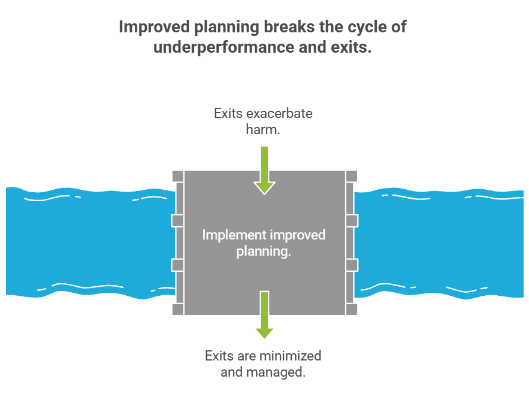
42% of S&P 500 companies that changed CEOs in 2024 had total shareholder returns below the 25th percentile before the exit, up from 30% in 2017. Underperformance precedes exits, exits are often forced, and forced exits compound the damage that triggered them. Better planning interrupts that cycle.
What Proactive CEO Succession Planning Actually Delivers
Firms with formal CEO succession plans:
Experience measurably less profit decline during transitions than firms without them.
Internal candidates selected through structured processes outperform those chosen reactively.
From our experience, the discipline of the process improves the outcome.
Besides, external hires tend to perform worse than internal promotions.
Research tracking U.S. public company CEOs over nearly two decades found internally promoted leaders delivered at least 25.4% greater total financial performance than outside hires. That makes the case for building internal leadership depth rather than defaulting to an external search when the seat opens.
Investor confidence follows the same logic.
In a study of 676 CEO turnover cases, companies that disclosed their succession planning process experienced significantly better stock market reactions than those that didn't. Investors want evidence that a transition was managed with intention, and a board with a visible, credible process sends that signal before a change ever happens.
Remember: Proactive succession planning is not a governance formality. It's a competitive asset that pays off before, during, and after every leadership transition a company faces.
How to Implement CEO Succession Planning: The 3-Step Plan
Now that you know why CEO succession planning is important, let’s see how to implement it in your organization.
Step 1: Define the Right CEO Profile Before You Start Looking
Every other step in succession planning depends on this one. Without a clear picture of the leader your company actually needs, candidate evaluation becomes subjective, development programs aim at the wrong target, and board conversations stall in vague disagreement. Getting the profile right is the foundation.
Map Core Competencies to Your Organization's Needs
The starting point is honest documentation.
What decisions does your CEO need to make well?
What leadership style does your culture respond to?
What values are non-negotiable?
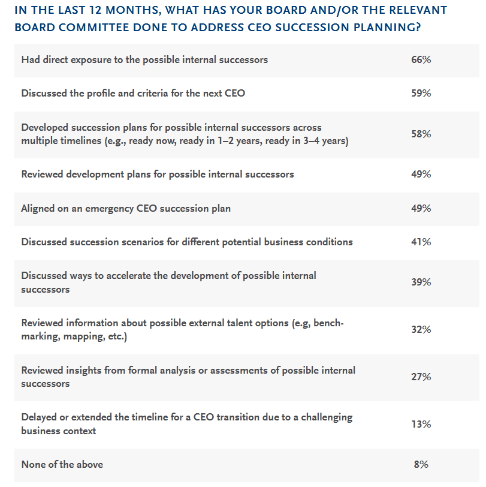
These questions sound straightforward, but most boards haven't answered them rigorously. Only 59% of boards discussed the profile and criteria for their next CEO in the past 12 months, according to a Spencer Stuart report. That means four in ten boards haven't even started the conversation.
Warning: If you’re not doing it either, expect your bottom line to suffer.
A generic list of leadership traits pulled from a consulting template is not a CEO profile. A real profile maps specific competencies to:
Your company's actual operating context
The industry dynamics you're competing in
The organizational culture you've built
The decisions your next leader will face in year one
For that, you’ll need input from the board, the current CEO where appropriate, and sometimes external assessment.
Remember: The output should be specific enough that two directors reading it independently would evaluate the same candidate the same way.
Build a Profile for Where the Company Is Going, Not Where It Is
The most common profiling mistake is backward-looking. Boards describe the traits that made the current CEO successful and call it a profile.
But the next CEO you’ll have in 10 years won't inherit the same company you have today.
In fact, average CEO tenure among departing S&P 500 leaders declined from 10.3 to 8.3 years between 2021 and 2024 alone. Compressed tenures mean the leader you select today needs to be built for where the company is headed over the next decade, not optimized for conditions that may already be shifting.
Our advice is simple:
Stress-test the profile against your five to ten year strategy.
If you're planning a major international expansion, does your profile include experience managing across geographies?
If a technology disruption is coming for your category, does it weigh digital fluency appropriately?
The profile should make your strategic assumptions explicit so the board can pressure-test them openly.
Founder-Led Companies: A Special Case
Founder transitions carry a different set of complications. The company's identity, culture, and often its investor relationships are built around one person.
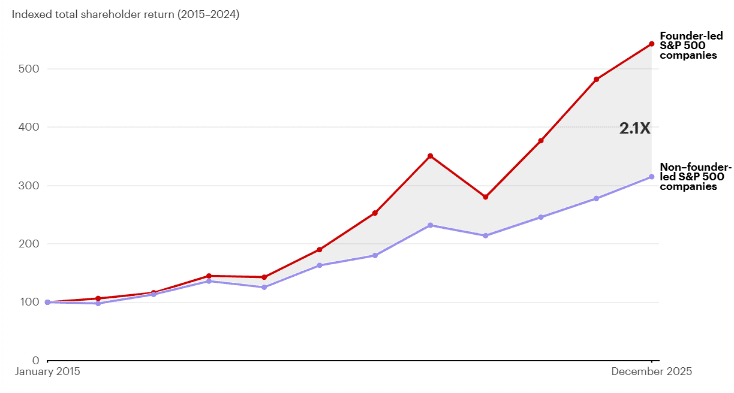
Side note: Speaking of investor relationships, founder-led S&P 500 companies have outperformed non-founder-led peers by 2.1x in total shareholder returns since 2015, which makes the stakes of getting the transition wrong that much higher.
The emotional dimension is real and should be planned for directly.
Here’s the main problem:
Founders often struggle to define what they want in a successor separate from what they want for themselves.
To solve that, the board has to own the profile process with enough independence to ensure it reflects the company's future needs, not the founder's self-image. That means:
Structured conversations, sometimes with outside facilitation
Clear agreement on who has final authority over the criteria before candidate evaluation begins
Step 2: Build and Develop an Internal Leadership Pipeline
Identifying your next CEO is only half the job. The other half is building the conditions that make great internal candidates possible in the first place. That means starting earlier than feels necessary, investing in development that goes beyond performance management, and treating the pipeline as a strategic asset that requires active maintenance.
Identify High-Potential Candidates Early
Most organizations don't have a rigorous process for this. Only 57% of companies have a formal standard and discussion process to identify high-potential leaders, and on average, organizations consider just 15% of their leadership population to be high-potential.
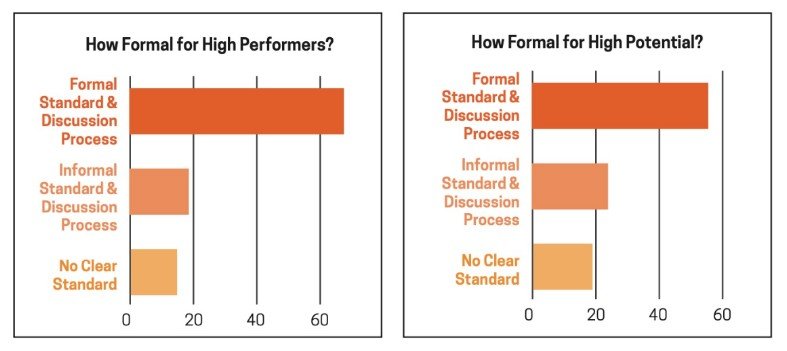
That's a thin pool to draw a CEO from, and it gets thinner when the identification process is informal or inconsistent.
The fix is a structured framework that operates separately from annual performance reviews. After all:
Performance tells you who's delivering in their current role.
Potential tells you who can grow into a significantly larger one.
Those are different questions, and conflating them is one of the most common pipeline mistakes.
Boards and CHROs should:
Agree on explicit criteria for what "CEO-ready potential" looks like at your company, then:
Track candidates against those criteria with consistent cadence.
The urgency of getting this right is growing.
In 2025, internal S&P 500 CEO successions dropped to 67% as external hires nearly doubled to 33%, the highest external hire rate in eight years. When internal pipelines run dry, boards reach outside. That's a signal worth paying attention to.
Create Meaningful Development Experiences
Identifying candidates is the start. Next you need to invest in their development.
In our practice, we’ve learned that the experiences that build CEO-level judgment include:
Stretch assignments that put candidates in charge of something consequential
Cross-functional rotations that build enterprise-wide perspective
Direct P&L responsibility that forces real accountability
Doing this will increase your bottom line, and Korn Ferry's longitudinal research across hundreds of publicly traded companies proves it.
CEOs who scored high on leadership assessments achieved 162% higher annual market cap growth and 105% higher annual revenue growth over their first four years compared to those who scored low.
Pro tip: If you want to increase your chances of success, make sure your development plans are specific to each candidate's readiness gaps:
If someone has strong operational instincts but limited experience with investors or boards, build that in deliberately.
If another candidate has enterprise vision but hasn't managed through a downturn, find a way to create that exposure before the succession decision arrives.
Executive Coaching and Sponsorship Programs
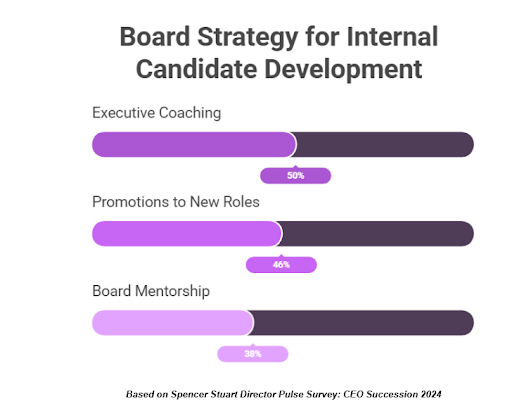
Structured coaching is now the single most common tool boards use to accelerate successor readiness. According to the Spencer Stuart report cited above 50% of boards report using executive coaching to develop internal candidates, ahead of promotions to new roles (46%) and board mentorship (38%).
The returns justify the investment.
The average ROI of executive coaching is 7x the cost of the engagement, and 86% of organizations that use coaching report a positive return.
Beyond the financial case, coaching accelerates development by surfacing blind spots that internal feedback rarely reaches. A candidate can be high-performing and still carry leadership patterns that would limit them at the CEO level. Good coaching closes those gaps before they become a board problem.
Sponsorship programs add a different layer.
Where coaching develops capability, sponsorship builds visibility. A senior executive who actively advocates for a candidate, connects them to key relationships, and creates exposure to the board helps close the gap between being ready and being recognized as ready. Both matter in a succession process.
Step 3: Implement The Board and Governance Framework for Succession
A strong leadership pipeline and a well-defined CEO profile won't deliver results without a governance structure to hold the process accountable. This section is about who owns succession, how it stays on the agenda, and where the lines of authority need to be drawn clearly.
Make Succession a Year-Round Board Priority
The most common governance failure is treating succession as an annual agenda item rather than a continuous one.
AAG insider tip: A board that reviews the succession plan once a year, checks a box, and moves on is not managing succession. It's documenting the absence of a crisis.
The data suggests this is still the norm.
In a recent Korn Ferry survey, fewer than 40% of directors discussed succession quarterly or more.

Yet 34% of U.S. public company directors identified CEO and C-suite succession as their top company priority for 2025, ranking it ahead of AI adoption, workforce planning, and cybersecurity.
There's a gap between stated priority and actual governance cadence, and that gap is where succession plans go stale.
The fix requires structural commitment:
Succession should have a designated home on the board, typically the nominating and governance committee, with defined review frequency, clear deliverables at each session, and accountability for follow-through.
Candidate updates, profile reviews, and pipeline assessments should rotate into board discussions regularly, not only when a transition feels imminent.
Balance the Incumbent CEO's Role in the Process
This is one of the most delicate dynamics in succession governance, and boards that handle it poorly tend to end up with either too much CEO influence or too little.
Remember: The sitting CEO has genuine value to contribute.
They understand the strategic demands of the role better than anyone on the board.
They have direct visibility into which internal candidates are performing under pressure.
Cutting them out entirely wastes that knowledge.
At the same time, no CEO is fully objective about their own succession. The natural human tendency is to:
Favor candidates who reflect their own style.
Prolong timelines that feel personally uncomfortable.
Underestimate someone who challenges their thinking.
The board's job is to use the CEO's input while retaining clear ownership of the final decision. That means defining in advance what role the CEO plays, advising, nominating, or neither, and making sure that role is understood and respected by everyone involved.
The board selects the next CEO.
The current CEO informs that process.
Keeping those lanes distinct prevents the most common governance breakdowns.
Align the Board, HR, and Senior Leadership
Succession planning fails when ownership is unclear.
Boards assume HR is managing candidate development. HR assumes the board has defined the profile. Senior leaders assume someone else is tracking pipeline readiness. The result is a process that exists on paper and nowhere else.
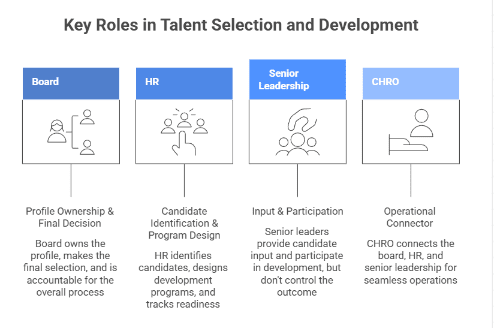
Effective governance assigns explicit roles.
The board owns the profile, the final selection decision, and overall process accountability.
HR owns candidate identification frameworks, development program design, and readiness tracking.
Senior leadership provides input on candidates and participates in development where appropriate, but doesn't control the outcome.
The CHRO serves as the operational connector between all three.
Getting these lanes documented and agreed upon early prevents the confusion that derails succession processes at the worst possible moment. A transition is not the time to negotiate who decides what.
Emergency Succession Planning: Preparing for the Unexpected
Everything covered so far assumes time. Emergency succession planning assumes you don't have any.
The sudden incapacitation, death, resignation, or termination of a CEO creates a different kind of challenge, one where the quality of your preparation becomes visible immediately, to employees, investors, clients, and the board itself.
And from our experience, most companies aren't ready.
The steps below will help you tackle this issue.
Interim Leadership Protocols and Day-One Decision-Making
The first 24 to 48 hours after an unexpected CEO departure set the tone for everything that follows.
Who speaks for the company?
Who has authority to make operating decisions?
Who calls the board into session?
If those questions require debate in the moment, you've already lost ground.
An effective emergency succession plan answers all of them in advance.
It names a specific interim leader, not a committee, not "to be determined," but a named individual with defined authority.
It outlines exactly what that person can and cannot decide unilaterally during the interim period.
It includes a communication protocol that sequences announcements to the board, senior leadership, employees, and external stakeholders in a defined order with pre-approved messaging frameworks ready to adapt.
Pro tip: The interim leader doesn't have to be the long-term successor.
In many cases they shouldn't be. Their job is stability and continuity while the board runs a deliberate selection process. Conflating the interim role with the permanent succession decision adds pressure that distorts both.
Keeping Emergency Plans Current
An emergency succession plan written three years ago and filed away is not a plan. It's a document. The two are only the same thing if someone is actively maintaining them. After all:
Personnel changes make plans obsolete faster than most boards realize.
The named interim leader may have left the company.
The communication contacts listed may be outdated.
The authority structure described may no longer reflect the actual org chart.
Any one of these gaps can create real confusion when speed matters most.
A significant organizational restructuring should prompt a review. A senior leadership departure should prompt a review.
Remember: Regardless of triggering events, the plan should be reviewed at least annually as a standing governance commitment.
The standard for an emergency plan is simple.
If the CEO became unavailable tonight, could your board execute it confidently tomorrow morning?
If the answer is anything other than yes, the plan needs work.
How to Integrate Succession Planning into Your Corporate Strategy
Succession planning belongs in the same conversation as your five-year strategy. Most companies haven't made that connection yet, and the gap shows.
Connecting Leadership Continuity to Long-Term Strategic Planning
61% of organizations have a formal CEO succession plan in place. That means nearly two out of five companies are making long-term strategic commitments without accounting for whether they'll have the right leader to execute them.
Here’s the problem:
Most strategic plans operate on a five to ten year horizon. If your succession planning doesn't match that horizon, you're selecting leaders for a company that may look nothing like the one they'll actually run.
The fix is structural.
Succession planning should be reviewed as part of the annual strategic planning cycle, with explicit checkpoints that ask whether your current pipeline would produce a leader equipped to execute the strategy as it evolves.
This kind of ongoing calibration keeps leadership continuity and strategic direction aligned.
When External Candidates Deserve Serious Consideration
Internal candidates are the right default. The performance data supports that clearly, and the organizational continuity benefits are real.
But defaulting to internal candidates without honest external benchmarking isn't always productive.
The external hire rate is rising for a reason.
According to Russel Reynolds, 73% of incoming CEOs globally came from within their organizations in 2024, an all-time high at the largest companies.
But among mid-cap companies, external appointments reached 58% that same year (as per Spencer Stuart), signaling that internal pipelines at smaller firms are struggling to keep pace with strategic complexity.
External candidates deserve serious consideration when:
The company is entering a strategic phase that no internal candidate has navigated before
A turnaround requires credibility that can't be built internally on a compressed timeline
Honest assessment reveals that internal candidates would be stretching beyond their actual readiness
Rigorous, assessment-driven evaluation of both pools is what separates a sound decision from a comfortable one.
Remember: The goal is not loyalty to insiders or novelty from outsiders. It's getting the right leader for where the company is actually going.
How to Execute the CEO Transition Successfully
Selection is just the beginning. Everything that happens in the months before and after a new CEO takes the role determines whether all the planning that preceded it actually pays off.
At Alpha Apex Group, we’ve seen many companies underinvest here, and the failure rates reflect it.
Structured Onboarding and Knowledge Transfer
Between a third and half of new CEOs are considered to be failing within 18 months of taking the role, and more than 90% of those leaders say they wish they had managed their transition differently. That's not a talent problem. It's a process problem.
The root cause is almost always the same:
Companies invest heavily in selecting the right person and almost nothing in setting them up to succeed.
Institutional knowledge walks out the door with the outgoing CEO.
Key relationships go unintroduced.
Strategic context that lived in one person's head never gets transferred.
The new CEO spends months reconstructing information they should have had on day one.
A formal onboarding plan fixes this.
It maps the relationships the incoming CEO needs to build, in what order, and with what framing.
It documents the strategic decisions in flight, the organizational dynamics worth knowing early, and the cultural context that doesn't appear in any report.
It also identifies early wins, visible, achievable actions in the first 90 days that build credibility with the organization before the harder work begins.
The results speak for themselves.
Well-planned leadership transitions correlate to 90% of newly hired or promoted teams meeting their performance goals over the following three years.
Ad hoc transitions don't come close to that number.
Only 30% of global executives are satisfied with their onboarding experience, and 32% rate it as poor or below average. For a CEO, that gap is not just a personal frustration. It's an organizational risk.
Communicating the Transition to Stakeholders
How a transition is announced shapes how it's received. The sequencing matters, the framing matters, and the consistency of the message across audiences matters.
The internal announcement should come first, before anything reaches the market or the press.
Employees who hear about their new CEO from a news alert rather than their own leadership team start the relationship with a trust deficit that takes time to recover.
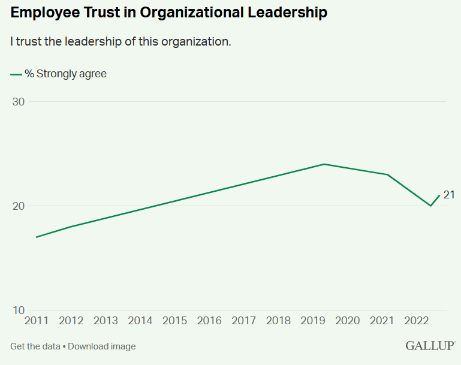
Side note: Only 21% of U.S. employees strongly agree they trust their organization's leadership, a number that has declined steadily since 2019. A poorly sequenced transition announcement accelerates that erosion.
External communications require equal care.
Investors want continuity of strategy, not just a name.
Customers and partners want assurance that service and relationships won't change.
Each audience needs a version of the message calibrated to what they care about most, delivered through the right channels, at the right time.
Pro tip: The outgoing and incoming CEO appearing together where possible, with aligned messaging, signals stability in a way that a press release alone cannot.
Post-Transition Support and Performance Integration
The board's job doesn't end at the announcement. 30% of CEOs don't make it past the first three years, but the odds of a long, successful tenure rise significantly once a leader clears that window.
The first 90 to 180 days are where the board can most directly influence that outcome.
That means:
Structured check-ins with real candor.
Giving the new CEO a clear channel to raise concerns about what they're discovering without it being interpreted as weakness.
The board is actively calibrating its support to the context.
McKinsey research analyzing nearly 600 S&P 500 CEO transitions found that bold early moves, including reshuffling leadership teams, produced significantly better results at underperforming companies than at well-performing ones, where the same moves often destroyed value.
The right level of board support depends on where the company is, not just who the new CEO is.
Succession Planning Is Never Really Finished
The companies that handle CEO transitions well share one trait.
They treat CEO succession planning as a continuous discipline, one that runs through every strategic planning cycle, every board meeting, and every leadership development conversation the organization has.
The path forward isn't complicated, but it requires consistency.
Define a CEO profile built for where your company is going.
Develop internal candidates with experiences that build real judgment.
Keep succession on the board agenda year-round.
Maintain an emergency plan that's current and executable.
And invest in the transition itself, not just the selection.
If you want to turn succession planning into a repeatable, board-ready process, Alpha Apex Group can help. We partner with founders, CEOs, and boards to define the future CEO profile, assess internal talent, build readiness plans, and design governance that stands up under pressure.
Whether a transition is imminent or still on the horizon, connect with Alpha Apex Group today to start a confidential conversation and secure leadership continuity with confidence.
Frequently Asked Questions
What should a CEO succession plan include?
A strong succession plan covers four core areas: a defined CEO profile built around your company's future strategy, a pipeline of candidates being actively developed, an emergency succession plan for unexpected departures, and a governance structure that keeps the board of directors accountable year-round. Without all four, the process tends to collapse when it's needed most.
How do boards choose between internal candidates and external candidates?
Internal candidates typically outperform external candidates on long-term financial metrics and tend to have longer CEO tenures, but they're only the right choice if the pipeline has been built deliberately through leadership development and real stretch experiences. When CEO turnover data signals pipeline gaps, or when a company is entering a strategic phase no one internally has managed, external candidates deserve serious consideration backed by rigorous executive assessment.
How often should the CEO succession planning process be reviewed?
Strategic succession planning works best as a continuous discipline, not an annual checkbox. Board members should be reviewing the candidate pool, succession plan timeline, and CEO profile at least quarterly, with formal updates tied to the company's strategic planning cycle. Most boards fall well short of this cadence, which is why leadership change so often triggers unnecessary disruption.
What role does the board chair play in CEO succession?
The board chair typically owns accountability for the CEO succession process, ensuring it stays on the governance agenda and that the sitting CEO's involvement stays appropriately balanced. This includes aligning the board of directors, HR, and senior leadership teams on candidate selection criteria and who has final decision-making authority.
Why do so many new CEOs struggle in their first year?
The most common failure point isn't a talent gap, it's a support gap. Many organizations invest heavily in the CEO search and almost nothing in structured onboarding or post-transition board check-ins, leaving C-suite successors to reconstruct institutional context on their own. Executive coaching, clearly defined early priorities, and regular feedback loops in the first 90 to 180 days are among the most effective tools for protecting both CEO tenure and stakeholder confidence through the succession cycle.
Research Appendix
- 2025 CEO Turnover Report: CEO Exits Fall From 2024; Public CEO Exits Break Record
- Route to the Top 2025 | The Ascent Redefined: Charting More Effective Routes to the Summit
- The High Cost of Poor Succession Planning
- The Impact of Unplanned CEO Succession on Organizational Performance
- CEO Succession: Low-Performing CEOs Have Less Leeway as Turnover and Tenure Trends Shift
- Why Do So Many Firms Lack CEO Succession Plans?
- Outside and Inside Hired CEOs: A Performance Surprise (SSRN)
- CEO Succession Planning and Market Reactions to CEO Turnover Announcements (ScienceDirect)
- Spencer Stuart Director Pulse Survey: CEO Succession 2024
- CEO Transitions: How to Avoid a Bumpy Exit (PDF)
- The Magic of Founder-led Companies (Bain Snap Chart)
- 2024 High Performer & High Potential Development Report
- Report: CEO Departures Are Rising, Even at Strong-Performing Firms
- Unlocking CEO Success (Korn Ferry Institute)
- Coaching Statistics: The ROI of Coaching in 2024 (ICF)
- CEO Succession Planning: Best Practices for Boards (Korn Ferry)
- What Directors Think: Boards Focusing on Succession Planning in 2025
- The Role of the CEO in Succession Planning (Deloitte)
- Record Number of CEOs Left Their Roles in 2024 (Russell Reynolds Associates)
- Four Steps to Success for New CEOs (McKinsey)
- Conducting Leadership Transitions for Long-Term Success (Wowledge)
- Executive Onboarding and Transition Roadmap: Timeline, Toolkit, Plans, and Templates (Avenue Leadership)
- Why Trust in Leaders Is Faltering and How to Gain It Back (Gallup)
- McKinsey Studied the Most Successful Fortune 500 CEOs and Found They Share One Similar Trait (Fortune)
- How New CEOs Can Boost Their Odds of Success (McKinsey)
- Why 40 Percent of New Exec Hires Fail in 18 Months—And How to Fix It (QSR Magazine)
.jpg)

.jpg)