Organizational Design Consulting: Structuring Teams for Post-Acquisition Success
Every acquisition looks promising on paper. However, the execution structure is where most of them fall apart.
The financials get scrutinized for months. Lawyers review every clause. Bankers model every synergy. And then, after the deal closes, two companies with different structures, different hierarchies, and different ways of making decisions are expected to operate as one.
That's where 70 to 75% of acquisitions fail, according to a rigorous analysis of 40,000 deals over four decades. The culprit isn't the deal itself. It's the structural and human integration that follows.
That's the gap organizational design consulting is built to close.
By treating M&A integration as an organization design problem, companies can build structures that actually support their post-acquisition business strategy.
You’re on the right page to solve that problem.
This article covers:
What organizational design consulting involves
Why acquisitions demand a specialized approach to it
How a well-run engagement translates into measurable, lasting organizational effectiveness
Let’s dive in.
What Is Organizational Design Consulting?
Organizational design is one of the most misunderstood disciplines in business. People assume it means redrawing org charts or flattening hierarchies.
It's actually much more than that.
Organizational design consulting is the practice of aligning a company's structure, governance, business processes, people, and culture so that all of them work together to support a defined business strategy.
When any one of those elements is out of sync with the others, the whole system underperforms.
Consultants working in this space examine:
How decisions get made
Who holds authority
Where reporting relationships create friction
Whether roles and responsibilities are distributed in a way that actually drives results
Firms should treat structure, decision rights, behavioral norms, and workforce strategy as interconnected design variables. Don’t view them as separate HR or management issues.
That framing is what separates organizational design from broader management consulting or general HR advisory work:
General management consulting tends to focus on strategy, competitive positioning, or operational efficiency.
HR consulting typically centers on talent, compensation, and people programs.
Organizational design consulting sits at the intersection of both.
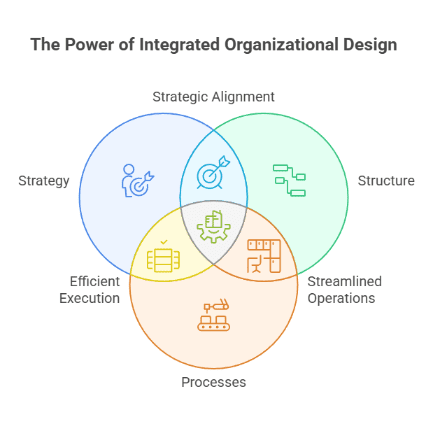
It's concerned with how the organization is wired to execute, and it treats structure as a lever for performance rather than an administrative artifact. That distinction matters enormously in post-acquisition contexts, where both the strategy and the operating model are in flux at the same time.
The discipline has also grown significantly more sophisticated, so it produces better results.
Just look at what the numbers show:
A 2025 McKinsey survey of 2,000 executives across 16 sectors found that 63% of operating model redesigns now meet most of their objectives and improve performance, up from just 21% a decade ago. That improvement reflects the growing maturity of organizational design as a structured, data-driven practice.
Why Structure Must Follow Strategy
In our experience, there's a recurring mistake companies make when they feel organizational pressure: they redesign the structure before they've locked in the strategy. The result is a design built for a plan that may shift, and when the strategy changes, the whole structure has to be rebuilt from scratch.
Structure should be derived from strategy, not the other way around.
Research shows that even high-performing companies carry a 30% gap between their strategy's full potential and what is actually delivered, attributable to shortcomings in their operating models. That gap exists not because the strategy was wrong, but because the structure wasn't built to execute it.
In an acquisition context, where the combined entity's strategy is still being defined, building the org chart before the strategic need is clear is exactly how that gap gets baked in from day one.
Why Post-Acquisition Integration Is an Organizational Design Problem
The moment a deal closes, the real work begins. Two companies with different histories, different management systems, and different ways of making decisions have to start functioning as one.
That's not only a financial problem. It's an organizational design problem, and (from what we’ve seen) it's one most acquirers are underprepared for.
The pressures that hit immediately after close are specific and predictable:
Functions get duplicated across both entities, creating confusion about who owns what.
Reporting relationships that made sense inside each company stop making sense in the combined one.
Culture collision sets in as employees on both sides watch for signals about whose behavioral norms will win out.
Key talent, especially from the acquired company, starts evaluating options.
These aren't soft, secondary concerns. They're the structural conditions that determine whether the combined organization can execute at all.
Generic playbooks are built around cost reduction, headcount rationalization, and systems consolidation.
Those matter, sure.
But they don't address the underlying organization strategy questions that determine whether the new entity can actually execute its business goals:
What decision paths will govern the combined business?
How do reporting relationships reflect the new operating model?
Where does accountability live?
A headcount spreadsheet doesn't answer those questions. A deliberate design process does.
What makes M&A integration uniquely difficult is that it has to happen fast, under scrutiny, while the business keeps running. And you’re probably dealing with other problems, too:
Employee engagement is fragile.
Every structural ambiguity generates anxiety.
Leaders are making real-time decisions about roles and responsibilities without a complete picture of what the new organization needs to look like.
Applying a generic restructuring approach to that context is not lucrative at all.
By comparison, organizations with the right integration capabilities are 1.6x more likely to exceed their cost synergy targets and 1.7x more likely to exceed revenue synergy targets than those without them. That gap is what professional organizational design consulting is built to close.
The Real Cost of Structural Misalignment
When the organizational structure isn't designed deliberately after a deal, the financial consequences are direct and measurable. Synergies that looked clean in the deal model get eroded by duplicated roles, unclear accountability, and decision-making friction.
An analysis of 160 mergers found that nearly 70% failed to achieve expected revenue synergies, with overestimation and poor post-merger execution as the primary culprits. Here are just two of the worse consequences:
Workforce productivity drops when people don't know their roles or reporting lines.
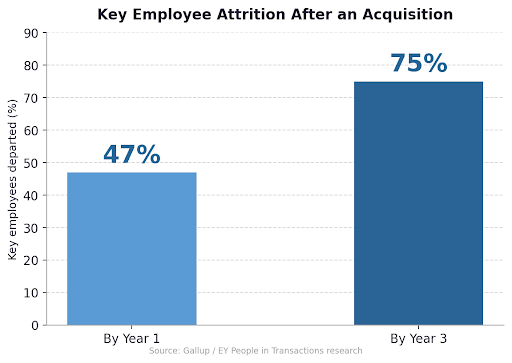
Acquired talent, often the core reason the deal was done in the first place, walks when leadership clarity is absent. In fact, according to Gallup, 47% of key employees leave within the first year after a transaction, and 75% are gone within three years.
That's not a retention problem. That's a structural design failure with a direct line to value destruction.
Core Components of Post-Acquisition Organizational Design
Organizational design after an acquisition isn't a single workstream. It's four interconnected systems that have to be designed at the same time, because changing one changes the others. If you treat them separately, your design will fail.
So, here’s what you need to consider.
1. Organizational Structure and Reporting Lines
Structure is the most visible element of any organizational design, and in an acquisition context, it's also the most politically charged. Two legacy organizations each bring their own org charts, their own organizational hierarchy, and their own assumptions about how authority should flow.
Reconciling those into a single, functional structure means making real decisions:
How centralized or decentralized should the combined entity be?
How many layers of management are appropriate?
What spans of control can leaders realistically handle?
Where do reporting relationships create clarity versus confusion?
Remember: The choice between centralized and decentralized models follows from your business model and the strategy.
In our experience, job architecture and role sizing determine whether the resulting structure can actually carry the work it's being asked to carry.
In a post-acquisition context, disciplined role design is what separates a structure built to perform from one built to satisfy internal politics.
2. Decision Rights and Governance
Structure tells people where they sit. Decision rights tell them what they're actually empowered to do.
In a newly combined organization, this distinction matters enormously.
Two companies merging means two sets of decision-making processes, two sets of escalation norms, and often two very different assumptions about who has authority to move on what. Without a clear governance design, those assumptions collide constantly and slow everything down.
At Alpha Apex Group, we’ve seen how concrete the cost of getting this wrong is.
And data proves it.
McKinsey-cited research found that 80% of organizations report struggling with decision-making. Meanwhile, separate analysis shows that organizations with high decision velocity and quality generate:
2.5x higher growth
Twice the profit
30% higher return on invested capital than peers
Side note: In post-acquisition integration, where decision paths are undefined and authority is ambiguous by default, establishing a clear RACI framework and governance architecture is one of the highest-leverage design decisions the integration team will make.
3. Workforce Strategy and Role Rationalization
Once the structure and governance model take shape, the workforce strategy question becomes unavoidable: who does what in the new organization?
This is where talent mapping and role rationalization happen, and where a lot of integration efforts lose discipline.
There’s another problem we see quite frequently:
Companies default to preserving existing roles from both entities, layering them together rather than designing from first principles. The result is a bloated structure with duplicated accountability and unclear ownership.
Instead, we teach our clients that a rigorous workforce strategy starts with the business goals and the capability requirements they imply, then maps existing talent against those needs:
Roles that are genuinely redundant get rationalized.
Capability gaps that the combined entity needs but neither organization currently has get identified early, so they can be filled through development or hiring before they become execution problems.
Talent systems and performance metrics shift to reflect the new organizational model rather than the legacy ones from either company.
The talent strategy isn't a downstream HR activity. It's a core component of the design itself, and it shapes the structure just as much as the reporting lines do.
4. Culture as a Design Input
Culture is the element most organizations acknowledge and fewest actually design for.
A big mistake is to treat it as an outcome of integration rather than an input to it. In our experience, that’s exactly how culture becomes a source of failure instead of what it should be, aka your source of strength.
In organizational design consulting, culture is treated as a structural variable. Consider:
Behavioral norms
Decision-making styles
How people handle ambiguity
How quickly problems escalate
What they consider normal collaboration
All this affects whether the designed structure will function as intended when real people operate inside it.
The data on culture's stakes in M&A integration is unambiguous.
Consequences of getting it wrong: According to Financier Worldwide, drawing on research across multiple major M&A surveys, between 50% and 75% of all post-merger integrations fail to meet original objectives due to culture clashes.
The upside of getting it right: companies that manage culture effectively in their integration planning are around 50% more likely to meet or exceed their synergy targets across both cost and revenue synergies.
Remember: A culture shift doesn't happen by accident. It has to be designed in from the start, alongside the org chart, the governance model, and the workforce strategy.
The Organizational Design Consulting Process
Reactive, piecemeal restructuring is how post-acquisition integration fails quietly. A function gets reorganized here, a reporting line gets fixed there, and six months later the organization still doesn't have a coherent structure because no one ever designed it as a whole.
A well-run organizational design engagement prevents that by following a phased model that moves from diagnosis to design to implementation to sustained performance, with each phase building on the last. The sequence matters as much as the content.
Here's a preview of the 4 phases of the consulting process:
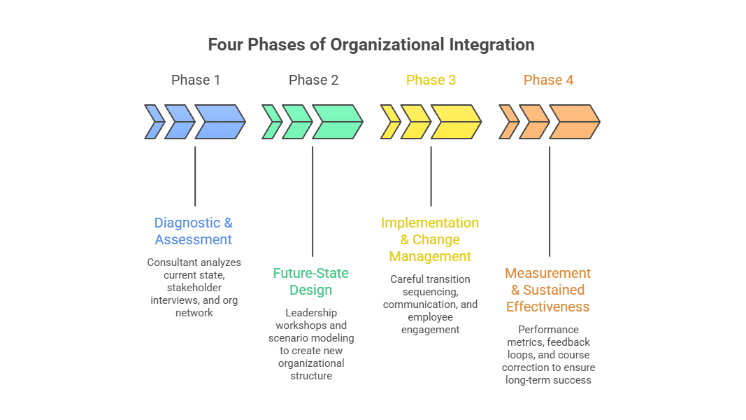
Phase 1: Diagnostic and Current-State Assessment
Before any design work begins, the consultant's job is to understand what actually exists, not what the org charts say exists. Those are very different things in many cases.
That’s why you need a diagnostic phase that involves:
Structured data analysis of both organizations
Stakeholder interviews across levels
Org network analysis to map how information and decisions actually flow through the combined entity
This phase surfaces structural pain points that wouldn't show up in a headcount report:
Where decision-making is bottlenecked
Which reporting relationships create friction
Where capability gaps live
Which informal networks are carrying work that the formal structure doesn't account for
The diagnostic phase also sets the foundation for leadership alignment.
When senior leaders from both entities participate in the diagnostic, they develop a shared picture of the current state before anyone starts advocating for a particular design outcome. That shared baseline is what makes co-creation possible in the next phase. Without it, future-state design conversations become turf battles.
Pro tip: In our experience, getting the diagnostic right is an investment that pays back many times over in the phases that follow.
Phase 2: Future-State Design and Co-Creation
With a clear current-state picture in hand, you can move to designing the future-state organization.
This phase establishes the strategic criteria that every design decision will be tested against. Those principles are derived from the organization strategy and business goals of the combined entity, not from the legacy preferences of either side.
From there, leadership workshops and scenario modeling allow the design team to pressure-test different structural configurations before committing to any of them.
Co-creation is the operative word here. Designs imposed top-down without involving the leaders who will operate inside them tend to fail at implementation. Bringing the right voices into the design process produces better outcomes and significantly reduces resistance downstream:
Mid-level leaders who understand how work actually gets done should have a seat at the table.
The output should be a future-state design with clear rationale.
Every design decision should be traceable back to a strategic principle agreed upon at the outset.
Phase 3: Implementation and Change Management
A well-designed structure that is poorly implemented produces the same outcome as a bad design.
This is where many organizations underinvest, and where the data is unambiguous about the consequences.
Prosci's Best Practices in Change Management research, surveying over 2,600 change practitioners, found that 88% of projects with excellent change management met or exceeded their objectives, compared to only 13% with poor change management.
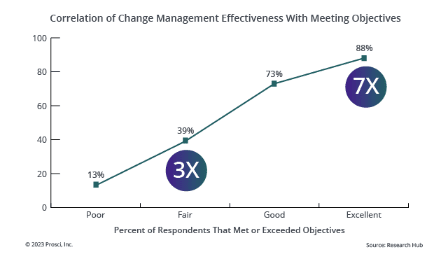
Side note: That's a 7x difference in success rate. Projects with excellent change management were also nearly 5x more likely to stay on or ahead of schedule. Implementation and change management aren't a phase to be resourced at whatever's left in the budget. They're the phase that determines whether everything before it was worth doing.
In practice, this means:
Careful transition sequencing, so that structural changes are rolled out in an order that preserves business continuity.
Communication planning that keeps employees at all levels informed about what's changing, why, and what it means for them personally.
Managing the human side of organizational change with the same rigor applied to the structural side because employee engagement during the transition directly affects whether the new design takes hold or quietly reverts to old patterns.
Phase 4: Measurement and Sustained Effectiveness
The integration doesn't end when the new structure is announced. That's actually when the real test begins.
Research on organizational transformations found that fewer than 30% of organizational transformations succeed at both improving performance and sustaining those improvements over time. The companies that beat those odds are consistent in one respect: they build measurement and accountability into the process from the start, rather than treating it as a post-implementation task.
In phase 4, you need to:
Establish performance metrics tied directly to integration goals.
Create feedback loops that surface problems early.
Build in course correction mechanisms before small misalignments compound into larger failures.
The first 18 months are particularly critical. McKinsey's analysis of 248 large deals found that:
79% of deals that outperformed their index in the first 18 months were still outperforming three years after close. Early execution predicts long-term outcomes.
60% of acquirers expressed regret about not dedicating more resources to culture and change management during integration. The measurement phase ensures those regrets don't accumulate silently until it's too late to act on them.
The Role of Leadership in Post-Acquisition Organizational Design
A well-designed structure can still fail if the leadership surrounding it is misaligned, underprepared, or pulling in different directions.
Pro tip: From our experience with clients, this is one of the most consistent findings across post-acquisition research, and one of the most consistently underestimated risks in practice.
Here’s the main problem we frequently encounter:
Companies invest heavily in structural design and then staff the leadership layer with whoever was senior before the deal closed, without asking whether those people are equipped to lead the new, combined organization. The result is a sound design operating under ineffective or fragmented leadership, which produces the same outcome as a poor design.
Remember: Leadership isn't just a variable that affects how a structure performs. It's a design element in its own right.
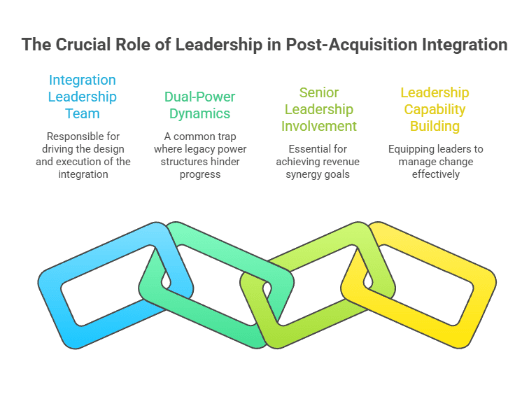
As such, you have to deliberately configure leadership alongside the org chart, the governance model, and the workforce strategy.
Two questions drive this:
Who leads the integration effort itself?
How do leaders at every level get equipped to operate effectively inside the structure being built around them?
Establish the Integration Leadership Team
The integration leadership team, often formalized as an Integration Management Office, is the organizational unit responsible for driving the design process and translating it into execution. Getting this right requires deliberate choices about authority, accountability, and composition.
Warning: The IMO leader needs real decision-making power.
Without clear authority, the IMO becomes a reporting function that produces updates but can't resolve the conflicts that arise when business units resist structural changes that affect their turf.
Dual-power dynamics are one of the most common structural traps in post-acquisition integration.
When the acquiring and acquired organizations both retain informal authority centers:
Decisions stall.
Accountability diffuses.
The design process becomes a negotiation between legacy power structures.
Preventing that requires an unambiguous leadership structure at the top from day one, who owns the integration and can make the required decisions.
If you ensure that, it will pay off:
According to McKinsey, 70 to 80% of M&A transactions that achieved or exceeded their revenue synergy goals had strong senior leadership involvement, from CEO to functional leadership.
Side note: Staffing the IMO with top talent is both a retention and a development investment. IMO roles are among the most career-accelerating assignments in any organization.
Build Leadership Capability for the New Structure
Structural design creates clarity on paper. Leadership capability is what makes that clarity real inside the organization. Leaders from both entities are being asked to manage ambiguity at the same moment their teams are experiencing it most acutely.
Without deliberate investment in building their capability to lead through that, even well-intentioned leaders default to familiar patterns from their legacy organizations, which undermines the new structure from the inside.
Building leadership capability for the integration means three things:
Equipping leaders to model the behavioral norms the new organization is trying to establish, not just communicate them.
Giving leaders the tools to manage teams through organizational change rather than around it.
Addressing the talent retention dimension directly because the leadership layer is exactly where attrition is most damaging post-acquisition.
Building leadership capability isn't a development program layered on top of integration. It's a structural protection against the value destruction that follows when leaders disengage or leave.
How to Select the Right Organizational Design Consulting Partner
The quality of the organizational design work is inseparable from the quality of the firm delivering it. Two engagements built on the same methodology can produce dramatically different outcomes depending on the experience, integration of capabilities, and outcome orientation of the partner doing the work.
In post-acquisition contexts, where the stakes are high and the window to get the design right is narrow, the partner selection decision deserves at least as much rigor as the design process itself.
Unfortunately, we know that most companies don't apply that rigor.
They default to relationships, rely on brand recognition, or select whoever is already on a preferred vendor list.
Warning: Those shortcuts are expensive.
PwC's 2023 M&A Integration Survey of Fortune 1000 executives found that only 14% of respondents achieved significant success across strategic, financial, and operational dimensions of integration.
The firms that beat those odds are working with more experienced partners who bring institutional knowledge that cannot be improvised.
M&A Experience and Sector Depth
Post-acquisition organizational design requires a specific understanding of
How M&A integration timelines create pressure on design decisions
How to sequence structural changes without disrupting ongoing operations
How the dynamics between acquiring and acquired organizations affect what will and won't work in practice.
A firm that has redesigned organizations in stable environments is not automatically equipped to do it well under acquisition conditions.
Sector depth matters for the same reason. The right spans of control, the appropriate governance model, the realistic pace of workforce transformation, and the likely capability gaps all vary significantly by industry.
A firm that brings deep experience in your sector can distinguish between structural problems that are acquisition-specific and those that are endemic to the business model. That distinction shapes the entire design.
Remember: Experience doesn't guarantee success, but its absence is one of the most reliable predictors of failure.
Change Management Integration
Structural design and change management are not two separate services to be procured from different vendors and coordinated after the fact.
Firms that treat them as distinct workstreams create an implementation risk that no amount of coordination can fully resolve. By the time the change management team engages, design decisions have already been made without accounting for how people will actually respond to them. The structural logic may be sound, but the human reality hasn't been built into it.
Remember: A consulting partner that embeds change management thinking into the design process from phase one is structurally more likely to deliver those outcomes.
When evaluating firms, the question isn't whether they offer change management. It's whether their design methodology and their change capability are genuinely integrated or just co-branded.
Find Post Acquisition Success with Confidence
Post-acquisition integration is where strategy either becomes reality or breaks down in day-to-day execution. To succeed, you must treat integration as an organizational design challenge.
When structure, governance, roles, and culture are designed to work together, leaders reduce ambiguity, teams move faster, and the combined company operates as one with clear accountability and sustained momentum.
If you want to integrate with confidence and build an operating model that truly supports your post-deal strategy, partner with Alpha Apex Group today. Connect with our team to launch an organizational design engagement that delivers clarity, alignment, and lasting performance from day one.
Frequently Asked Questions
What does an organizational design consultant actually do?
An organizational design consultant conducts organizational diagnostics and operating-model assessments to understand how a company's structures, decision rights, people, and processes are wired and where they're creating friction. From there, they design future-state organizational structures and governance models aligned to the company's strategy, then support implementation through change management and performance tracking.
What is the difference between an organizational chart and organizational design?
An organizational chart is a static picture of reporting relationships showing who sits where in the hierarchy. Organizational design is the broader discipline of aligning everything that determines how work actually gets done: organizational structures, decision rights, leadership roles, talent systems, culture, and governance. A well-designed organization may produce a clear org chart as an output, but the chart itself is never the design.
How does organizational design support a growth plan after an acquisition?
A people and process-oriented growth plan only works if the organization is structured to execute it. Organizational design aligns leadership roles, reporting lines, and decision rights to the combined entity's growth plan, ensuring the new structure is built for where the business is going. Without that alignment, growth initiatives stall because planning and accountability are unclear.
How does digital transformation factor into post-acquisition organizational design?
Digital transformation decisions made during integration, around digital organization capabilities, Technology and Data infrastructure, and where automation will absorb work, have a long tail. Role definitions that don't account for digital opportunities will need to be redesigned again as technology continues to reshape operations. Building a digital transformation lens into the organizational design process from the start is far less disruptive than retrofitting it into a structure that has already hardened.
How do you measure whether an organizational redesign is working?
Effective measurement ties directly to the integration thesis: synergy capture rates, talent retention, decision velocity, and workforce productivity tracked against pre-integration baselines. A strong performance system also monitors employee experience and customer experience, since structural friction shows up in both before it appears in financial results. Job evaluation frameworks and org network analysis can be used on an ongoing basis to detect where the design is drifting from its intended architecture.
Appendix: Research Sources
- Fortune: We Analyzed 40,000 Mergers and Acquisitions
- Korn Ferry: Organization Design
- McKinsey: The New Rules for Getting Your Operating Model Redesign Right
- McKinsey: A New Operating Model for a New World
- McKinsey: Equipping Leaders for Merger Integration Success
- McKinsey: Where Mergers Go Wrong
- Gallup: Stop Losing Talent When You Merge or Acquire
- McKinsey: The Limits of RACI and a Better Way to Make Decisions
- McKinsey: Keys to Unlocking Great Decision Making
- Financier Worldwide: Culture Clashes in M&A – New Perspectives
- McKinsey: The Importance of Cultural Integration in M&A
- Prosci: The Correlation Between Change Management and Project Success
- McKinsey: Successful Transformations
- McKinsey: Post-Close Excellence in Large-Deal M&A
- McKinsey: Merge to Grow — Realizing the Full Commercial Potential of Your Merger
- McKinsey: Merger Management Compendium
- M&A Community: Employee Retention After Acquisition
- PwC: M&A Integration Survey
- PwC: Five Areas of Integration That Successful M&A Organizations Get Right
- Deloitte: 2025 Global Human Capital Trends Report
- McKinsey: Enterprise Agility — Buzz or Business Impact
- McKinsey: The Impact of Agility — How to Shape Your Organization to Compete
- World Economic Forum: Future of Jobs Report 2025
- McKinsey: Organizational Health Is Still the Key to Long-Term Performance
- Bain: Looking Back at M&A in 2024
.jpg)