HR Target Operating Model: Framework & Examples
Despite decades of investment in HR transformation, most HR functions still struggle to balance efficiency with business impact.
In fact, Gartner found that only 9% of HR functions are both highly efficient and highly aligned to organizational needs. This points to a structural issue rather than a talent issue.
An HR target operating model gives you a clear blueprint for how HR should deliver value, support business priorities, and work with leaders across the organization.
At Alpha Apex Group, we help organizations redesign HR operating models so they can support growth, transformation, workforce planning, and technology change more effectively.
In this guide, we’ll break down what an HR target operating model is, the main frameworks companies use, real-world examples, and the mistakes that cause many redesigns to fall short.
What Is an HR Target Operating Model?
An operating model is the blueprint for how a function delivers value. It defines how people, processes, technology, governance, and data work together to achieve a specific outcome.
The word “target” refers to the desired future state. Instead of describing how HR works today, a target operating model translates business strategy into a practical design for how HR should work next.
It answers a practical question: if the organization wants to achieve a particular goal, how should HR be structured, staffed, governed, and supported to make that happen?
An HR Target Operating Model applies this concept to the HR function. It defines how HR will organize its teams, services, technology, capabilities, and decision-making to deliver the organization's people strategy and support broader business objectives.
Most HR TOMs include:
- Organizational structure and reporting lines
- Roles and responsibilities
- Service delivery model
- HR technology and automation
- Governance and decision rights
- Data, analytics, and reporting
- Capability and workforce requirements
Remember: an HR strategy and an HR target operating model are closely connected, but they are not the same. The strategy defines what HR is trying to achieve, while the TOM defines how HR will be organized to achieve it.
This is where many organizations struggle. They may have a clear people strategy, but HR teams still work through unclear ownership, fragmented systems, slow service delivery, or weak workforce planning.
According to Deloitte, only 20% of business executives believe HR is adequately planning for future talent needs, while just 28% consider HR highly efficient.
As Dave Ulrich, one of the most influential thinkers in modern HR, argues:
"HR is about creating value in the marketplace, not just strategic value internally, but value for customers, investors, and communities. It's about the value that the HR services bring to the stakeholders of the company."
A well-designed HR Target Operating Model provides the structure that turns that ambition into a repeatable way of working.
Want to see how an HR target operating model comes together? This video breaks it down:
What Makes a Good HR Target Operating Model?
There is no universally correct HR Target Operating Model. The right design depends on the organization's strategy, operating model, and workforce demands. However, the most effective HR functions share a handful of characteristics.
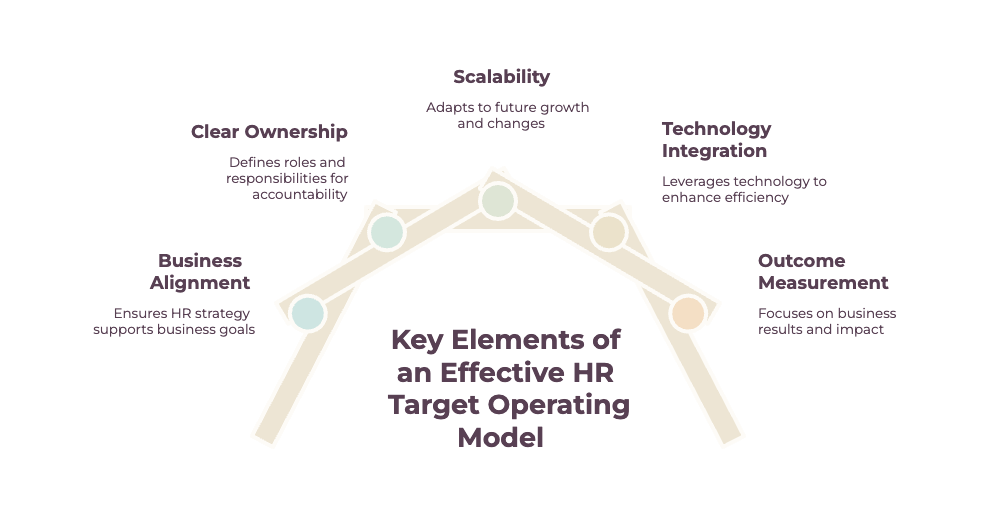
1. Fits the Business You're Actually Running
An HR Target Operating Model should be designed around how the business creates value.
This is where many redesigns fail. Organizations adopt a sophisticated structure only to discover it doesn't match their size or decision-making culture. A multinational operating across dozens of markets needs a different HR model than a 500-person scale-up.
The HR TOM should reflect business realities like growth plans, operating structure, workforce composition, and strategic priorities.
2. Everyone Knows Who Owns What
Most HR operating model problems are ownership problems.
Business leaders need to know who to contact, HR teams need clarity on decision rights, and specialists need clear routes into the business. Without defined responsibilities, work gets duplicated, and accountability becomes blurred, which slows down delivery.
The HR business partner and center of excellence relationship is a common example. According to Talent Strategy Group’s 2023 HR Operating Model Report, HRBPs own the relationship with business leaders in 75% of organizations, while only 18% of CoEs have direct access.
3. Supports Growth Without Constant Redesign
The best operating models are designed to look beyond the current state, at the organization's future.
Growth, acquisitions, new geographies, and changing workforce needs all place pressure on HR structures. A model that only works at today's scale will eventually become a constraint.
Rather than creating rigid reporting lines, effective TOMs establish flexible decision rights, service delivery principles, and governance mechanisms that can adapt as your business becomes more complex.
4. Uses Technology Where it Creates the Most Value
Technology should support the operating model as opposed to dictating it.
A well-designed HR TOM deliberately identifies where automation and self-service create value and where human expertise is still essential. Updating personal details, booking leave, and accessing policies are obvious candidates for digital self-service. Workforce planning, leadership development, and organizational design are not.
Right now, many organizations still struggle to translate HR technology investments into business value. Gartner found that only 35% of HR leaders are confident their current HR technology approach is helping achieve business objectives, while two-thirds believe inaction will reduce HR effectiveness.
5. Measures Success Through Business Outcomes
A good HR operating model is accountable for outcomes.
Metrics such as training hours, ticket volumes, or HR headcount don’t tell you much about whether the model is working.
More meaningful measures include:
- Time-to-fill
- Internal mobility rates
- Manager effectiveness scores
- Workforce productivity
- Employee retention
The strongest HR functions assign ownership for these outcomes and use them to evaluate whether the operating model is delivering the results the business actually cares about.
HR Target Operating Model Frameworks with Examples
HR teams are moving toward more defined operating model archetypes.
McKinsey research cited by CIPD found that HR leaders most commonly adopt either the Ulrich+ archetype at 48% or the employee experience-driven archetype at 47%.
AI is adding another layer to this decision. Gartner found that adapting the HR operating model to AI has a greater predicted impact on AI productivity gains at 29% than AI skills, adoption, or knowledge sharing alone.
Below are six emerging HR target operating model frameworks, where each one works best, and how organizations apply them in practice.
1. The Business Partner Model (Ulrich / Ulrich+)
The framework: Dave Ulrich introduced the three-pillar HR model in Human Resource Champions (1997). It separates HR into three core functions:
- HR business partners (HRBPs): Embedded within business units to align HR with business priorities.
- Centers of excellence (CoEs): Provide specialist expertise in areas such as talent, rewards, and learning.
- Shared services: Handle high-volume administrative and transactional HR activities.
As we saw, this remains the most widely adopted model globally. McKinsey's "Ulrich+" archetype is an evolved version that adds more sophisticated analytics capability and a stronger strategic mandate for HRBPs without changing the fundamental three-pillar structure.
Best for: Large, complex organizations with multiple business units and mature HR functions that want to balance efficiency with strategic input.
Core limitation: The model was built for stability rather than speed. The fixed structure struggles with agility and speed in fast-changing environments, and the HRBP-CoE interface can slow things down.
Real-world example
Peabody, a UK housing association with 4,000+ employees, refined rather than abandoned its three-pillar structure following its 2022 merger with Catalyst.
HRBPs were repositioned as Strategic Partners with employee relations responsibilities removed, L&D became an internal academy, and analytics capability was built up. This kept the Ulrich+ architecture intact while sharpening role definitions and showed that the model can be modernized without being replaced.
2. The Functional Model
The framework: HR is organized by function, such as recruitment, learning and development, compensation and benefits, and employee relations. Each team acts as a centralized center of expertise for its area.
In this model, there is no HRBP layer. Business leaders work directly with functional HR teams when they need support.
Best for: Small to mid-sized organizations that do not need a full Ulrich structure yet, or companies where HR headcount is limited, and generalist coverage is more practical than deep specialization.
Core limitation: As the organization grows, functions start to optimize for their own metrics rather than shared business outcomes. This means delivery becomes siloed, handoffs between teams create friction, and HR struggles to present a coherent, joined-up service to the business.
3. The Employee Experience (EX)-Driven Model
The framework: HR is organized around key moments in the employee lifecycle like joining, developing, performing, and exiting, rather than functional specialisms or business unit alignment.
Teams are accountable for the quality of specific employee experiences end-to-end, which cuts across what would previously have been separate CoE or HRBP responsibilities.
Best for: Organizations where talent experience is a strategic differentiator, businesses competing in high-demand labor markets, and organizations with a strong consumer-facing culture that want to extend that thinking to employees.
Real-world example
Tesco, a retail, distribution, banking, and mobile communications group with around 330,000 employees, redesigned its people function to create a more consistent colleague experience across different markets.
The company moved toward a four-pillar model covering strategic partnering, practices of expertise, people change, and people services. This gave HR clearer ownership across strategic priorities, specialist knowledge, change capability, and day-to-day service delivery, while supporting more digital self-service and stronger local market input.
4. The Agile HR Model
The framework: HR is structured around cross-functional squads or a fluid pool of problem-solvers rather than fixed hierarchies. Resources are dynamically allocated to the organization's highest priorities rather than permanently assigned to business units or functions.
Gartner's future HR operating model is built around a "problem-solver pool" using agile methods. This is favored by CHROs who believe HR needs to match the execution pace of the business.
Best for: Fast-growing organizations, technology companies, and businesses undergoing significant transformation where the list of HR priorities changes often.
Real-world example
In 2015, ING Netherlands restructured its 3,500-person headquarters into self-organizing agile squads and tribes inspired by Spotify.
HR followed a similar direction by reorganizing work around HR products and services instead of functional silos. This helped multidisciplinary teams move faster on programs and policy changes while reducing slow departmental handoffs.
5. The Leader-Led/Federated Model
The framework: HR capability is distributed to line managers and business leaders, with a lean central HR function providing frameworks, tools, and guardrails rather than owning delivery.
HR acts as architect and enabler while the business owns execution. In federated models, individual business units may operate largely independent HR functions with shared technology infrastructure but minimal central oversight.
Best for: Highly decentralized organizations, companies where manager empowerment is a deep cultural priority, and businesses where speed of local decision-making matters more than standardization.
Key consideration: This model places significant demands on manager capability. Gartner (2024) found that 74% of managers are not equipped to lead change, which makes this model fragile without sustained investment in manager development.
McKinsey describes this model through CHRO interviews rather than a named case, so treat it as a design philosophy rather than a fully documented case study.
6. The Machine-Powered / AI-Enabled Model
The framework: HR delivery is increasingly automated through integrated people analytics, AI-powered service tools, and machine-driven decision support. Human HR professionals concentrate almost entirely on complex, judgement-heavy, and strategic work.
McKinsey identifies this as the most advanced of its five archetypes. Rather than a fixed structural blueprint, it represents the direction all operating models are being pulled toward as AI matures.
What changes structurally: Transactional HR work like query handling, scheduling, document generation, and policy lookup moves to AI-powered self-service, which means far less justification for large shared services teams.
CoEs are redesigned around analytical and interpretive capability rather than subject-matter expertise alone. The HRBP role changes from information broker to strategic adviser, and AI handles a lot of the data synthesis that previously consumed HRBP time.
Best for: Organizations with mature HR technology infrastructure and strong data governance, large enterprises with high volumes of routine HR transactions, and organizations where the CHRO has a mandate to reduce HR operational costs.
Real-world example
IBM’s AskHR platform, powered by watsonx Orchestrate, handled more than 11.5 million employee interactions in 2024 with a 94% containment rate for common questions. IBM says AskHR also contributed to a 40% reduction in HR operational costs over four years.
The example shows what a hybrid HR operating model can look like at scale. Digital labor handles routine transactions, while human HR teams focus on complex cases, judgment-heavy decisions, and strategic advisory work.
Which HR Operating Model Is Right for Your Organization?
The right HR operating model depends less on HR preference and more on business context. Size matters, but it is not the only factor. Workforce complexity, growth speed, geographic spread, manager capability, and technology maturity all shape the answer.
We have learned that most organizations do not fit one pure archetype. A company might use an Ulrich-style structure at the enterprise level, an employee experience model for onboarding and internal mobility, and AI-enabled shared services for high-volume employee requests.
The question is not, "Which model is best?" It is, "Which parts of each model solve the business problems we actually have?"
A functional model might work well until headcount, geography, or complexity creates too many handoffs. An Ulrich model may work until the HRBP layer becomes a bottleneck.
An employee experience model may become attractive when fragmented HR services begin to damage retention or manager trust. Agile HR often makes sense when transformation priorities change faster than fixed HR teams can respond.
In practice, the strongest HR Target Operating Models are hybrids. They combine enough structure to create consistency with enough flexibility to adapt as the business changes.
Common Mistakes When Designing an HR Target Operating Model
Most HR operating model failures happen because of the way the model is designed or implemented.
In our daily practice, we have noticed that these mistakes appear repeatedly across HR transformations, regardless of which operating model an organization adopts.
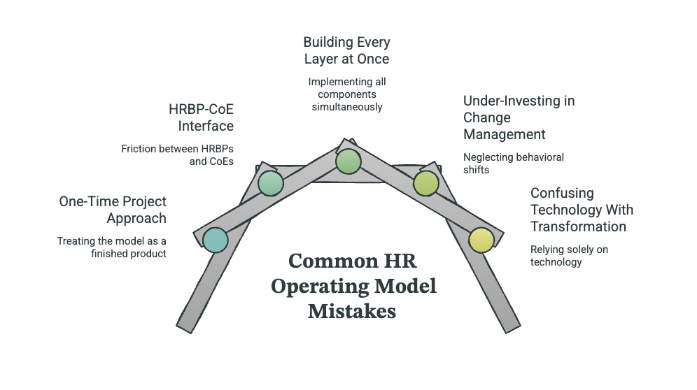
1. Treating the TOM as a One-Time Project
Many operating model redesigns are treated like implementation projects. You launch the new structure, update the org chart, and move on.
The reality is that business models evolve continuously. New technologies emerge, workforce needs change, acquisitions happen, and growth creates new organizational pressures. An HR operating model that works today may become a constraint three years from now.
NatWest's transformation is a useful example here. Rather than describing its redesign as complete, NatWest frames it as an ongoing experiment that continues to evolve alongside business needs.
2. Ignoring the HRBP-CoE Interface Problem
Few HR operating model issues create more friction than the handoff between HR business partners and centers of excellence.
HRBPs usually sit closer to business leaders, so they understand local priorities, manager concerns, and urgent workforce issues. CoEs bring deeper expertise in areas such as talent, rewards, learning, and organizational design.
Problems start when the model does not clearly define who owns decisions, who advises, and who delivers.
Without clear rules of engagement, HRBPs may feel specialists are too far removed from business realities, while specialists may see HRBPs as creating unnecessary bottlenecks. Business leaders then receive slower support, mixed guidance, or solutions that do not fully match their needs.
3. Building Every Layer at Once
Many organizations attempt to implement the finished version of their HR operating model immediately. HRBPs, Centers of Excellence, shared services, analytics teams, governance forums, and new technologies are all introduced at the same time.
The problem is that business challenges rarely arrive all at once. A 300-person company ends up managing an HR structure designed for a 3,000-person enterprise. More layers create more handoffs, more meetings, and more decision points before they create more value.
The strongest HR operating models evolve in stages. Rather than building every capability upfront, they introduce new layers only when business needs justify them. This keeps the function lean while creating a clear path for future growth.
4. Under-Investing in Change Management
A lot of operating model redesigns focus heavily on structure and surprisingly little on behavior.
New reporting lines do not automatically create new ways of working. HRBPs need different skills, managers may inherit new responsibilities, and specialists may need to engage with stakeholders differently. In some cases, you’ll need to build entirely new capabilities.
This challenge is becoming more pronounced. Gartner, in the report we shared earlier, found that 73% of HR leaders report employee change fatigue. Without a deliberate change management strategy, even well-designed operating models can fail.
5. Confusing Technology With Transformation
Implementing a new HRIS is not the same thing as redesigning an HR operating model.
This mistake is particularly common during digital transformation initiatives. Organizations invest heavily in technology, automate existing processes, and expect operating model problems to disappear. In reality, technology often amplifies poor design rather than fixing it.
The evidence supports this. Gartner found that 46% of HR leaders believe their current technology solutions hinder rather than improve the employee experience, while 55% say existing systems do not adequately support current or future business needs.
Design the operating model first, then select, configure, and govern technology to support it.
How Alpha Apex Group Helps Organizations Redesign HR Operating Models
An HR Target Operating Model is only effective if it reflects how your organization creates value, manages talent, and plans to grow. The right design for a global enterprise may be completely wrong for a fast-growing scale-up or a decentralized business unit structure.
At Alpha Apex Group, we help you assess your current HR operating model, define a future-state design, and align people, processes, technology, and governance around business objectives.
Request an HR operating model assessment now to find where your current structure is slowing the business down and what needs to change next.
FAQs
How long does it typically take to implement an HR Target Operating Model?
Most organizations can design a target operating model within three to six months, but full implementation often takes six to eighteen months once organizational changes, governance updates, technology changes, and capability building are included. The timeline depends less on the design itself and more on the scale of change required.
What's the difference between an HR operating model and an HR strategy?
An HR strategy defines priorities such as improving retention, strengthening leadership capability, or closing skills gaps. The HR operating model determines how the HR function is structured to deliver those priorities, including the roles of HRBPs, Centers of Excellence, shared services, technology, and managers.
When should an organization redesign its HR Target Operating Model?
A redesign is usually needed when the business has outgrown its current HR structure. Common triggers include rapid growth, mergers and acquisitions, international expansion, AI adoption, declining service quality, or situations where HR teams spend most of their time on transactions rather than strategic workforce issues.
How does Alpha Apex Group support organizations redesigning their HR Target Operating Model?
Our experts at Alpha Apex Group help you evaluate your current HR operating model, identify structural bottlenecks, define a future-state design, and develop a practical implementation roadmap. This includes organizational design, governance, HR technology alignment, service delivery redesign, and workforce planning support.
When should an organization bring in an external HR consulting firm versus redesigning its operating model internally?
Internal teams understand the business best, but external advisors can provide specialized expertise, benchmarking data, and an objective perspective that is difficult to replicate internally. This is particularly valuable for large-scale transformations, post-merger integration, HR technology modernization, or first-time operating model redesigns.
What role does AI play in the modern HR Target Operating Model?
AI is changing how HR work is allocated across shared services, specialists, managers, and business partners. As routine employee inquiries, reporting, and administrative tasks become automated, HR teams can spend more time on workforce planning, leadership development, and strategic decision support.
.jpg)