Data Center Staffing Models: When to Use Contractors, Full-Time Employees, or Managed Services
Getting the staffing mix wrong in your data centre can have implications that go far beyond overtime pay.
Poor resourcing decisions can jeopardize uptime, slow disaster recovery, and leave critical systems like power and cooling systems, uninterruptible power supplies, and server racks vulnerable when you need them most.
According to the Uptime Institute Global Data Center Survey 2025, nearly two‑thirds of operators report difficulty both retaining staff and finding qualified candidates.
This shows how acute the workforce crunch has become for essential roles like security personnel and data center technicians.
In this article, we’ll break down when to use contractors, full‑time employees, or managed services so you can balance cost, expertise, and reliability across your IT load, cooling solutions, and day‑to‑day operations.
For additional context, the following video outlines some of the staffing challenges data centers are facing today.
P.S. Finding qualified data center talent remains one of the biggest operational challenges today. Alpha Apex Group supports you by supplying vetted professionals aligned to workload demands and critical environment requirements.
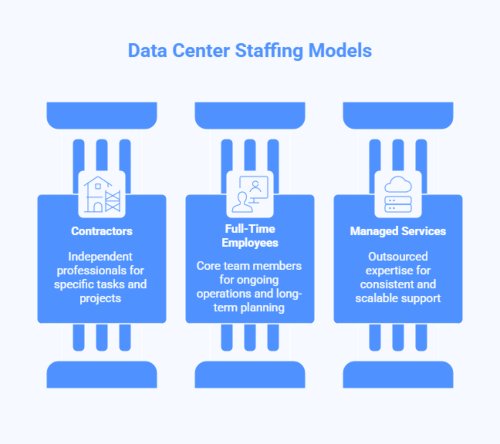
Overview of the Three Primary Data Center Staffing Models
Staffing in data center operations is a key driver of uptime, cost control, and responsiveness. Whether you’re scaling for edge computing, handling IT load spikes, or supporting mission-critical servers, choosing the right staffing model matters.
Industry data shows that many data centers are actively expanding their teams, with 35% reporting more hires in 2024 compared with the year before.
Most teams rely on a mix of three:contractors, full-time employees, and managed services. Let’s explore how each one works and when to use them.
1. Contractors
Contractors are independent professionals or third‑party specialists brought in for defined tasks, projects, or specific periods. Unlike full‑time employees, they’re typically engaged on an hourly or project basis, without long‑term benefits or commitments.
This makes them a flexible option when you need to scale support quickly. For example, when handling spikes in IT load or deploying upgrades on power and cooling systems.
Common contractor roles in data centers include:
Network engineers for system upgrades or migrations
Critical Environment Technicians for maintenance peaks
Specialized security personnel for compliance work
Cooling or power delivery experts during infrastructure work
Incident response or disaster recovery specialists
2. Full-Time Employees
Full-time employees (FTEs) form the backbone of most data center teams. These are your go-to people for ongoing operations, long-term planning, and owning core systems like power and cooling, storage systems, and hyperconverged infrastructure.
Unlike contractors, FTEs are deeply embedded in the organization, which means they’re invested in its goals, company culture, and long-term success.
Their value really shows in areas where continuity, accountability, and deep system knowledge matter. FTEs help reduce risks tied to staff turnover, since they accumulate knowledge over time and often develop a strong feel for the nuances of your infrastructure.
3. Managed Services
Managed services involve outsourcing specific data center functions, and sometimes even entire layers of operations, to a third-party provider.
These partners typically handle tasks like 24/7 monitoring, incident response, routine maintenance, backup and recovery, and even support for cloud services or edge computing environments.
What makes managed services different is the structure of responsibility. Rather than hiring individual people, you’re partnering with a provider who’s contractually accountable for outcomes, typically defined by SLAs (service-level agreements). This means they’re on the hook for uptime, performance, and meeting clearly defined metrics.
It’s all about choosing where your team adds the most value and letting trusted partners handle the rest.
Read Next: How to Build a Data Center Workforce for 24/7 Operations: A Hiring Playbook
When Contractor Staffing Is the Right Choice
Contractor staffing shines when you’re facing specialized, short‑term, or high‑intensity work that doesn’t justify a permanent hire.
In our experience working with data center teams, contractors consistently deliver the most value when speed, flexibility, or niche expertise matters more than long-term continuity.
Whether it’s handling a complex migration, ramping up for a power and cooling systems upgrade, or responding to a sudden IT load surge, contractors give you flexibility without a long‑term commitment.
According to the U.S. Bureau of Labor Statistics, independent contractors accounted for about 7.4 % of total employment in 2023. This shows how many organizations rely on contingent talent for project‑based and variable work.
Ideal scenarios for using contractors
Based on what we’ve observed across different environments, contractors are best suited for:
Bringing in experts for systems transitions like cloud computing or edge computing
Supporting periods of high business demand
Targeted needs like security personnel for audits, compliance reviews, or incident response
Key advantages of data center contractors
Organizations turn to contractors because they offer:
The flexibility to scale up or down as workloads fluctuate
Quicker onboarding compared to full‑time hiring
Targeted expertise to access niche skills without long‑term payroll
Trade‑offs to consider
Remember that contractor models come with risks if they’re not managed carefully:
There’s a continuity risk since knowledge may walk out the door when the contract ends
Even short engagements need clear context and expectations, which can add to onboarding time
Limited long‑term ownership because contractors may not drive ongoing initiatives
How to Reduce Risk Associated With Data Center Contractors
From our experience working alongside data center teams, we have learned that contractor risk is best managed through structure, ownership, and partner quality.
Clear statements of work help align expectations around scope, timelines, and accountability from day one and reduce ambiguity as projects evolve.
We recommend pairing contractors with internal champions so critical knowledge stays embedded within the organization rather than leaving at the end of an engagement.
In addition, working with vetted talent pools and trusted staffing partners helps reduce hiring friction and quality risk. This helps you ensure contractors arrive prepared to contribute in high-stakes environments.
This is where a staffing partner like Alpha Apex Group adds serious value. We help you connect with pre‑vetted professionals who match your data center’s needs, so you get quality, reliability, and speed without the guesswork.
When Full-Time Employees Make the Most Sense
Full‑time employees are beneficial for long‑term stability in a data centre environment. They are ideal for core operations, governance, and leadership roles.
Full-time teams typically own the long-term roadmap, including fault tolerance, disaster recovery, and major technology shifts such as cloud, AI, and edge computing.
Uptime’s research found that a majority of data center operators ranked the lack of qualified staff as one of their top operational concerns. This reality explains why many organizations continue to invest in full-time hiring as a way to stabilize operations and build durable expertise over time.
Benefits of full-time data center employees
The following are some of the key benefits of full-time data center employees:
FTEs give you reliable and experienced stewardship of your most critical systems, like power and cooling systems, and uninterruptible power supplies
Over time, full‑timers accumulate deep institutional knowledge about your configuration, performance quirks, and business priorities, which leads to better uptime and fewer surprises
Permanent staff mostly own governance, compliance, and process improvement, which supports broader goals like customer satisfaction and risk mitigation
Where full-time hiring delivers the strongest ROI
Full-time hiring delivers the strongest return on investment in environments that require constant availability and operational consistency.
This includes 24/7 operations and mission-critical systems where reliability cannot depend on short-term staffing. Full-time teams are also well-positioned to lead long-term strategy and internal capability development.
Roles that depend on detailed system familiarity and operational history benefit most from permanent ownership, since this knowledge directly reduces risk and improves performance.
Cost and scalability considerations
We have seen that full-time hiring can introduce real cost and flexibility constraints. Salaries, benefits, and ongoing training require sustained investment, and scaling a permanent team quickly during an unexpected IT load increase or a major infrastructure rollout can prove challenging.
These limitations make it important to deploy full-time roles where long-term value clearly outweighs short-term flexibility.
When to Choose Managed Services
Managed services make the most sense when organizations want to shift day-to-day operational responsibility without adding full-time headcount. In our experience, this model works best for functions that require predictable performance, consistent coverage, and specialized expertise delivered at scale.
Typical use cases of managed services include:
24/7 operations where round‑the‑clock monitoring and immediate responsiveness are required
Continuous system health checks and performance optimization across power and cooling systems, mission‑critical servers, and storage systems
Routine maintenance (patching, updates, backups) that frees internal teams to focus on strategic work
Standardized environments where predictable, documented procedures help reduce risk
The market reflects this shift. The global managed data center services market reached an estimated US$413.39 billion in 2024 and is expected to grow $880.17 billion in 2029 as more and more organizations outsource complex infrastructure management to expert providers.
This growth is driven by digital transformation, increased cloud and hybrid adoption, and the need for scalable operational support as environments grow more complex.
From what we have observed, adoption is also rising because managed services help relieve pressure on internal teams facing skill shortages and turnover.
Providers typically bring mature tools, standardized processes, and experience across cloud, hybrid, and edge environments. This helps you keep pace with expanding IT loads and evolving technical requirements.
What benefits will you see?
Organizations that adopt managed services typically gain:
More predictable operating costs, since fixed or subscription pricing replaces variable in‑house staffing expenses
24/7 monitoring and maintenance, even during nights, weekends, or peak demand
Access to provider experience in areas such as security, compliance, and performance optimization
Key considerations before choosing a partner
Managed services can reduce operational burden, but success depends heavily on how the relationship is structured.
Clear governance is essential so service providers operate in line with business priorities rather than purely contractual outcomes.
Well-defined service-level agreements should set measurable expectations for uptime, response times, escalation paths, and accountability.
It is also critical to assess whether a provider can operate within your regulatory, security, and compliance requirements.
From what we have seen, misalignment on reporting standards, access controls, or change management processes often creates risk rather than reducing it.
Evaluating provider maturity, transparency, and integration with internal teams is just as important as technical capability when selecting a managed services partner.
Data Center Staffing Models: Contractors vs. Full-Time Employees vs. Managed Services
By now, you’ve seen how each staffing model serves a different purpose depending on your goals, timelines, and internal capacity. But when it comes time to decide what to use (and when) it helps to see the trade-offs in one place.
Here’s a quick comparison of contractors, full-time employees, and managed services to guide your staffing strategy:
| Model | Best For | Key Benefits | Considerations |
|---|---|---|---|
| Contractors | Short-term projects, upgrades, specialized expertise | Flexibility, fast deployment, niche skill access | Knowledge transfer risk, limited long-term ownership |
| Full-Time Employees | Core operations, leadership, and long-term planning | Continuity, accountability, and institutional knowledge | Higher cost, tough to scale quickly |
| Managed Services | 24/7 ops, standardized tasks, predictable performance | SLA-based outcomes, reduced internal burden, expert teams | Requires vendor oversight, less direct control |
Choosing the right mix usually means combining these models to balance flexibility, cost, and expertise.
How to Choose the Right Staffing Model for Your Data Center
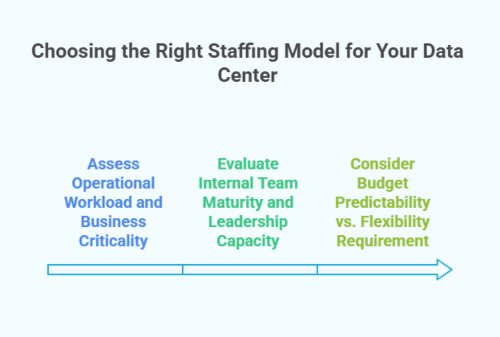
If you want to pick the right mix of contractors, full-time employees, and managed services, you first need to figure out how your data center operates, what your team is built to handle, and how you want to balance cost, flexibility, and control.
1. Assess Operational Workload and Business Criticality
Start with your day-to-day demands. Are you supporting 24/7 operations, handling frequent incident response, or running high-density server racks that support mission-critical services?
The more critical the workload, the more you’ll benefit from stable, experienced support, whether that’s a full-time team or a managed service provider with SLA-backed coverage.
Projects or temporary spikes, on the other hand, are contractor territory.
2. Evaluate Internal Team Maturity and Leadership Capacity
Assess whether your internal team has the experience and leadership depth required to run complex operations.
This might include optimizing power and cooling systems or deploying advanced infrastructure such as machine learning platforms.
From what we have seen, teams with strong in-house capability usually benefit from investing in full-time roles that provide long-term ownership and direction.
Where internal expertise is limited, managed services or specialized contractors can help close gaps without increasing long-term risk. This approach allows organizations to maintain operational stability while internal teams build skills and capacity over time.
3. Consider Budget Predictability vs. Flexibility Requirement
If budget predictability is key, managed services and full-time roles can offer stability. If your business sees seasonal shifts or unpredictable demand, contractors offer the speed and flexibility to keep pace without overcommitting.
The pressure to get the right balance continues to grow. According to AFCOM’s State of the Data Center report, 85% of data center leaders say talent shortages are actively impacting operations. This makes staffing one of the most time-sensitive and consequential infrastructure decisions organizations face today.
Why Hybrid Staffing Models Mostly Deliver the Best Results
In reality, few data centers rely on just one staffing model, and for good reason.
A hybrid approach combines the strengths of contractors, full-time employees, and managed services to meet fluctuating business needs without piling work onto your internal team.
You might use contractors to roll out a liquid cooling retrofit, rely on managed services for 24/7 monitoring, and lean on your in-house staff for governance, long-term planning, and critical decision-making.
This mix gives you:
Agility during periods of rapid change
Stability where consistency and compliance matter
Efficiency by putting the right resources in the right places
A well-structured hybrid model reduces gaps, prevents burnout, and allows your data center to scale with demand. This is becoming more important as tech gets more complicated with AI, cloud computing, and edge deployments.
How Alpha Apex Group Helps Design Smarter Staffing Strategies
At Alpha Apex Group, we help you architect a staffing strategy that matches your goals. Whether you’re running lean, scaling fast, or modernizing aging infrastructure, we help you:
Identify the right mix of contractors, FTEs, and managed services
Build flexible teams that can handle today’s needs and tomorrow’s growth
Tap into trusted, pre-vetted talent pools so you can move fast with confidence
We understand that every data center is unique. That’s why our approach is always tailored to your team structure, budget, and the mission-critical nature of your environment.
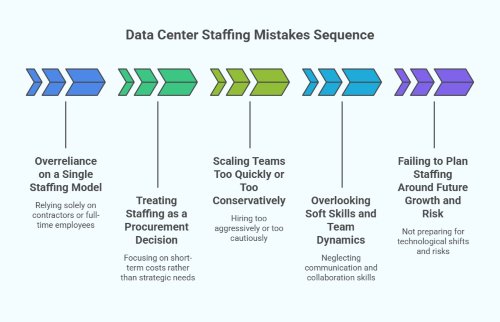
Common Data Center Staffing Mistakes to Avoid
Even the most advanced data centre can struggle if its staffing strategy isn’t built to support both current operations and future growth.
Below are some common pitfalls to watch out for.
1. Overreliance on a Single Staffing Model
Relying only on contractors or only on full-time employees can make it harder to adapt as workloads, technologies, and business needs change.
In our experience, a single-model approach mostly creates gaps, either in continuity or in flexibility, which surface during periods of growth, transformation, or unexpected demand.
2. Treating Staffing as a Procurement Decision Instead of a Strategic One
Staffing decisions that focus mainly on short-term cost or vendor selection typically miss the bigger picture. From what we have observed, hiring works best when it is tied to operational resilience, incident response, and long-term capability, rather than treated as a transactional purchase.
3. Scaling Teams Too Quickly, or Too Conservatively
Hiring too aggressively can drive up costs before demand is proven, while hiring too cautiously can leave critical gaps during migrations, capacity planning, or new service rollouts.
Remember that staffing plans work best when they scale in step with workload growth and project timelines rather than reacting late to operational pressure.
4. Overlooking Soft Skills and Team Dynamics
Strong technical skills are essential, but they are not enough on their own. Communication, collaboration, and adaptability play a major role in how well teams perform, particularly in environments that blend contractors, managed service providers, and internal staff.
When these dynamics are overlooked, even technically capable teams can struggle to execute effectively.
5. Failing to Plan Staffing Around Future Growth and Risk
Staffing decisions that focus only on current needs often fall short as technology and risk profiles evolve.
We have noticed that teams that do not plan ahead for shifts such as cloud adoption, AI workloads, or edge computing struggle to keep pace with performance, resilience, and staffing requirements.
Aligning staffing plans with future growth and risk helps you stay prepared rather than reacting under pressure.
Here’s another reason why this really matters. According to industry research, replacing a departing employee can cost an organization roughly 40 % to 200 % of that employee’s annual salary, with particularly high costs when hiring leaders. And that’s just the financial side, before lost productivity and institutional knowledge are factored in.
Read Next: Avoiding Downtime: The Hiring Mistakes That Put Data Centers at Risk
Build a Smarter Data Center Team with Alpha Apex Group
The right staffing model can make or break your data center’s performance, particularly as infrastructure becomes more complex, uptime expectations grow, and workloads shift with trends like AI, cloud computing, and edge deployments.
Whether you’re optimizing power and cooling systems, scaling to meet demand, or simply trying to build a more resilient team, understanding when to use contractors, full-time employees, or managed services is essential.
A hybrid approach usually delivers the best results by giving you the flexibility, stability, and expertise you need to keep your operation running smoothly.
At Alpha Apex Group, we help data center leaders design staffing strategies that align with their goals. From sourcing top-tier critical environment technicians to building custom hybrid models, we’re here to make sure you’ve got the right people in the right roles at the right time.
Let’s talk about your data center staffing model and how we can help you build a smarter, more scalable team from day one.
FAQs
What is a data center staffing model?
A data center staffing model is the strategy used to build and manage the team responsible for maintaining operations. It’s typically a mix of full-time employees, contractors, and managed services depending on the workload, budget, and business goals.
How do I decide between contractors, full-time staff, or managed services?
It depends on your needs: use contractors for short-term or specialized work, full-time staff for core operations and continuity, and managed services for standardized tasks or 24/7 support that benefits from SLA-backed accountability.
What are the biggest challenges in data center staffing?
The biggest challenges include talent shortages, high turnover, rising costs, and matching the right people to increasingly complex workloads involving AI, cloud, and edge infrastructure.
What’s the most cost-effective data center staffing strategy?
A hybrid approach usually delivers the best value by blending full-time employees for stability, contractors for flexibility, and managed services for predictable, scalable support.
What makes Alpha Apex Group different when it comes to data center staffing?
AAG stands out by taking a strategic approach. We help organizations design staffing models and provide access to deeply vetted talent that’s ready to perform.
How does AAG vet contractors and managed service providers?
We use a rigorous screening process that includes technical assessments, reference checks, and industry-specific vetting to make sure every contractor or partner we recommend meets your operational, compliance, and cultural standards.
Can AAG help build a custom hybrid staffing model for my data center?
Yes, AAG specializes in helping data centers create right-sized, hybrid staffing strategies that balance flexibility, cost, and long-term reliability. We tailor every plan to your goals, infrastructure, and in-house capabilities.