Leadership Pipeline Framework: Building Your Bench
Only 20% of HR leaders say they have leaders ready to fill their most critical roles, according to DDI’s Global Leadership Forecast 2025. This gap shows up fast when a key leader resigns, retires, or burns out. Teams slow down, decisions pile up, and the search for a replacement becomes reactive.
At Alpha Apex Group, we often see organizations with succession charts that still struggle because names on a chart do not always mean people are ready to lead.
A leadership pipeline framework gives you a stronger system. It helps you spot future leaders early, prepare them for larger roles, and build real leadership depth before the next vacancy appears.
In this guide, we’ll break down how the framework works and how to build a stronger bench across every level of your organization.
What Is a Leadership Pipeline Framework?
A leadership pipeline framework is a structured, ongoing process for preparing employees to step into leadership roles before those roles become vacant.
The idea goes back to Walter R. Mahler’s work at General Electric in the 1970s. It was later formalized by Ram Charan, Stephen Drotter, and James Noel in The Leadership Pipeline: How to Build the Leadership Powered Company.
Their core idea was simple. Leaders need different skills as they move from managing themselves to managing teams, managers, functions, and business units. A strong pipeline should help you prepare people for those shifts instead of sending everyone through the same generic training.
This matters because leadership benches are thin. DDI’s Global Leadership Forecast 2023 found that only 12% of companies report confidence in their leadership bench, while only 40% of leaders say their company has high-quality leaders.
The Six Leadership Passages
The leadership pipeline model identifies six major transitions that leaders move through as their responsibilities expand:
- Managing self to managing others
- Managing others to managing managers
- Managing managers to a functional manager
- Functional manager to business manager
- Business manager to group manager
- Group manager to enterprise manager
Each transition point calls for a different set of role-based skills, priorities, and decision-making responsibilities. Leaders must rethink how they spend their time, what they focus on, and how they define success.
This is why leadership pipelines matter. Stepping into a larger role without preparation often creates performance gaps for both the individual and the team. A pipeline framework helps organizations develop leadership readiness and capability before those transitions take place, so they can be confident that people are ready when opportunities arise.
Why Building a Leadership Pipeline Matters
Organizations invest in leadership pipelines because the cost of weak succession planning shows up quickly. Vacant roles slow decisions, stretch teams, and force companies into reactive hiring.
1. The Leadership Skills Gap Is Getting Worse
Leadership development has been the top priority for HR leaders for three consecutive years, according to Gartner. And yet, many organizations continue to struggle because too few leaders are prepared for the roles they are expected to fill.
The issue comes down to a lack of transition readiness. Managers are being asked to lead larger teams and operate in more complex, changing environments than their predecessors.
The same Gartner survey found that 75% of HR leaders believe managers are overwhelmed by expanding responsibilities, while 69% say leaders are not equipped to lead change.
Instead of fixating on competencies in isolation, the leadership pipeline framework focuses on preparing people for specific leadership passages, so development connects directly to the next role they may need to step into.
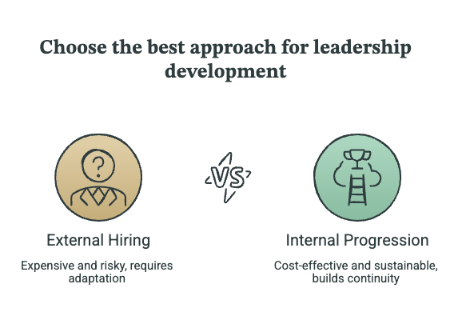
2. External Hiring Is Expensive and Risky
External hiring will always have a place, particularly when organizations need new capabilities or perspectives. The problem arises when external recruitment becomes the primary solution to every leadership gap.
Deloitte's analysis of 45 S&P 500 CEO transitions found that 76% of appointments were internal promotions. The study also showed that internally promoted CEOs earned 84 cents for every dollar paid to the outgoing CEO.
In addition, the analysis showed that external hires came with higher upfront costs. One-time award amounts granted to internally promoted CEOs were 80% lower than those received by external CEOs.
Compensation is only part of the issue. External leaders need time to learn the company culture, build internal relationships, establish credibility, and understand how decisions get made. Even highly qualified executives usually require months before they’re fully effective.
3. Internal Progression Improves Retention and Continuity
A leadership pipeline gives employees a clearer view of how they can grow inside the organization. When people see a realistic path to greater responsibility, they are more likely to stay engaged and invest in their future with the company.
It also protects continuity. Teams do not have to reset every time a role changes hands because future leaders have already been exposed to the expectations, relationships, and decisions tied to the next level.
Strong pipelines compound over time. Every prepared leader can become a mentor, coach, and talent developer for the next layer of the organization. This creates leadership capacity beyond one individual role.
4. Succession Planning Fails Without Development
A succession chart can show who might replace a leader, but it doesn’t prove that the person is ready.
A leadership pipeline closes that gap by developing potential replacements before they are needed. This becomes critical during unexpected departures, rapid growth, acquisitions, and restructuring.
DDI’s Global Leadership Forecast found that organizations with strong leadership benches are 10 times more likely to have highly rated leaders and 5 times more likely to prevent employee burnout.
The common factor is sustained leadership development before a vacancy appears.
As Tacy M. Byham, Ph.D., CEO of DDI, puts it:
“Why would we put the company’s most valuable assets in the hands of the least prepared leaders? This starts with their first leadership job and comes from a focus on leadership as a life-long pursuit.”
How to Build a Leadership Pipeline Framework: Step-by-Step Guide
The strongest leadership pipelines work as ongoing systems. They help you identify talent early, develop leadership capability, and prepare people for larger roles before pressure hits.
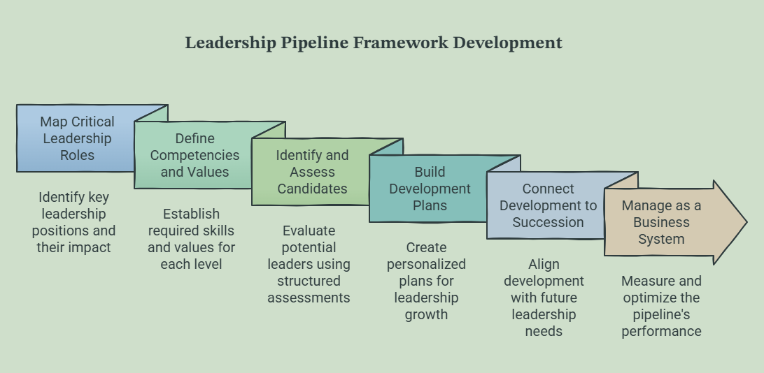
Step 1: Map Your Critical Leadership Roles
Start by identifying the positions that have the biggest impact on your organization.
Focus on leadership multiplier roles. These are critical positions that shape the performance of entire teams, functions, or business units.
Then define success in terms of measurable outputs. For example, a sales director might be responsible for revenue growth, but the real output could be building a management team capable of scaling performance across multiple regions.
Next, identify vacancy risk. Roles held by near-retirement leaders, individuals with highly specialized expertise, or long-tenured incumbents often represent the greatest succession exposure.
Step 2: Define the Competencies and Values Required at Each Level
Use the leadership passages framework to define what success looks like at every transition.
For each passage, document three things:
- Skills required to succeed
- How time should be allocated
- Work values that drive effective decisions
The most valuable exercise is identifying behaviors leaders must leave behind.
Let’s take an example. A functional leader who remains focused on technical expertise can struggle when broader business challenges and trade-offs become their primary responsibility. The habits that helped them excel in their original role can hold them back as a leader.
Leadership transitions succeed when people adopt new priorities and new ways of creating value throughout the leadership journey.
Step 3: Identify and Assess High-Potential Candidates
High performance and high potential are related, but they are not the same.
A top salesperson may excel through individual execution, but a future sales leader must demonstrate coaching ability, judgment, influence, and the capacity to succeed through others.
Structured assessments improve the quality of pipeline decisions. Assessment centers, leadership simulations, 360-degree feedback, and behavioral interviews give you a broader view than manager recommendations alone.
We suggest starting early. Many organizations discover leadership potential years before employees enter management roles. The stronger approach is to identify talent across a wider segment of the workforce and develop people before a role opens.
Step 4: Build Individualized Development Plans Around the Next Transition
Professional development plans should prepare individuals for their next leadership passage.
Leadership learning programs should specify:
- What the individual needs to learn
- What they need to practice
- What behaviors do they need to leave behind
The best leadership training plans combine real work with guided support. Stretch assignments, cross-functional projects, mentoring, coaching, and structured feedback help future leaders build capability in context.
For example, someone preparing to manage managers may need practice setting expectations through others, showing emotional intelligence, reviewing team performance through direct reports, and coaching managers instead of stepping in to solve every issue themselves.
Step 5: Connect Development to Succession Decisions
Pipeline development becomes far more powerful when tied directly to future leadership needs.
Map internal candidates to specific positions and assess readiness using categories such as:
- Ready now
- Ready in 1-2 years
- Ready in 3-5 years
This gives you visibility into future gaps while helping leaders prioritize development investments.
Pipeline reviews should occur every 6 months, with senior leaders actively involved. Organizations that consistently build leadership depth treat talent development as a leadership responsibility.
Step 6: Manage the Pipeline as a Business System
Leadership pipelines perform best when measured like any other strategic business process.
Key metrics include:
- Internal fill rate for leadership positions
- Time-to-fill for leadership vacancies
- Performance of internally promoted leaders
- Retention of high-potential employees
- Success rates across leadership transitions
The opportunity remains substantial. LinkedIn's Workplace Learning Report found that only 33% of organizations have formal internal mobility programs, while only one in five employees feel confident about making an internal move.
Regular pipeline reviews help leadership teams find bottlenecks and adjust development priorities so they can better understand future leadership capacity.
Do this right, and you’ll gain a significant advantage over the many businesses that aren’t there yet. Gartner research shows only 38% of CHROs are confident in their succession management capabilities.
What to Avoid When Building a Leadership Pipeline
Even well-designed leadership pipelines can break down when development becomes inconsistent or succession planning turns into a compliance exercise.
Here’s what to avoid when building your leadership pipeline.
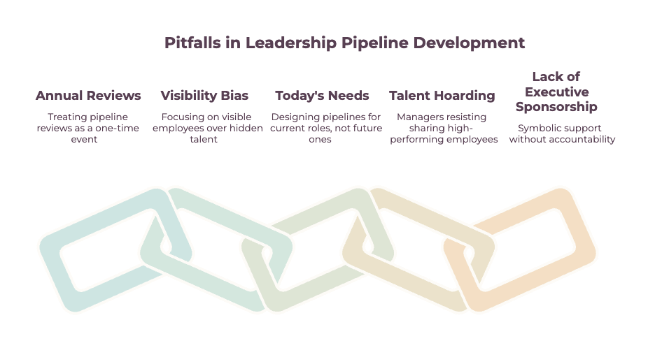
1. Treating the Pipeline Review as a Once-a-Year Event
Many organizations invest significant effort into annual talent reviews, then spend the next eleven months focused on other priorities.
The result is predictable. Readiness assessments become outdated, development plans stall, and leadership discussions turn into historical snapshots rather than forward-looking decisions.
Strong pipelines depend on ongoing talent conversations. Regular development check-ins, updated readiness assessments, and deliberate stretch opportunities help leadership teams keep pace with changing business demands and strategic goals throughout the year.
2. Confusing Visibility with Potential
Pipeline candidates emerge from the same places, like high-profile projects and teams that interact frequently with senior leadership.
This creates a visibility bias. Highly visible employees become easier to nominate, while equally capable talent in field operations, regional offices, technical functions, or support roles receives far less attention.
Organizations that consistently build strong leadership benches widen their search for potential. They use structured criteria, multiple assessors, and talent data to spot people who may be ready for larger roles, even when they are not already known to senior leaders.
3. Designing the Pipeline Around Today's Needs
We have noticed that leadership pipelines are typically built around current roles and reporting structures.
The problem here is that organizations evolve faster than succession maps. New business models emerge, technology reshapes decision-making, and leadership responsibilities shift over time.
Remember: strong pipelines prepare leaders for future requirements. Review pipeline criteria regularly, pressure-test role assumptions, and look for people who can adapt across functions, markets, and changing business priorities.
4. Letting Managers Hoard Top Talent
High-performing employees frequently become indispensable to their managers. When development opportunities arise, some managers resist sharing those individuals because losing them means short-term disruption for their own team.
Talent hoarding is one of the most persistent barriers to internal mobility. It keeps future leaders stuck in place and weakens the broader leadership bench.
We recommend making talent movement part of every manager’s performance expectations. Leaders should be recognized for developing people who grow beyond their immediate team. Internal movement should count as a leadership success, not a loss.
5. Building the Pipeline Without Executive Ownership
Leadership pipelines gain momentum when senior executives actively own outcomes. They stall when sponsorship stays symbolic.
Many executive teams support leadership development in principle, but fewer connect pipeline outcomes to leadership performance evaluations, succession metrics, or business reviews.
According to the Gartner source we mentioned earlier, even though 75% of organizations have made significant updates to their leadership development programs and more than half have increased spending on leader development, they still report not seeing results.
Senior leaders must be accountable for talent pipeline outcomes in their own performance reviews.
Strengthen your leadership bench with Alpha Apex Group
A strong leadership pipeline takes time, structured development, and steady attention from senior leadership. The organizations that invest early are better prepared for growth, turnover, restructuring, and critical role changes.
At Alpha Apex Group, we help you strengthen leadership continuity through executive search, succession planning, leadership assessment, interim leadership solutions, and leadership alignment consulting. If you are building a pipeline from scratch, assessing gaps in your current bench, or helping senior leaders align around succession priorities, our team can help.
Contact Alpha Apex Group to discuss how your organization can build the leadership depth needed to support long-term growth.
FAQs
What's the difference between succession planning and a leadership pipeline framework?
Succession planning usually names potential replacements for key roles. A leadership pipeline framework prepares those people for the next level through targeted development, role exposure, feedback, and readiness tracking. It turns succession from a list of names into an active development system.
How long does it realistically take to build a functional leadership pipeline?
Most organizations need 12 to 24 months to build a functional leadership pipeline. Early visibility can improve within a few months, but real readiness takes longer because future leaders need assessment, development, feedback, and role exposure.
At what company size does a leadership pipeline framework become necessary?
Leadership pipelines become valuable as soon as leadership responsibilities begin extending beyond a founder or small executive team. Many organizations start formalizing the process between 50 and 200 employees.
Can Alpha Apex Group help us identify and place leaders to fill gaps in an existing pipeline?
Yes. We help organizations assess leadership gaps, strengthen succession strategies, and identify executive talent that aligns with their long-term leadership goals. We can also support critical leadership placements while internal successors continue to develop.
Can Alpha Apex Group help us build a leadership pipeline from scratch?
Yes. We work with organizations at every stage, from companies formalizing leadership development for the first time to enterprises refining mature succession and talent strategies.
Can Alpha Apex Group provide interim leadership support?
Yes. We can provide interim executives and leadership talent to maintain continuity while internal successors continue to develop and prepare for larger roles.
.jpg)

.jpg)