Top 10 Data Center Roles in High Demand in 2026
The race to hire the right talent in data centers is no longer a future problem; it’s a right now challenge, driven by a growing data center talent shortage.
The global data center sector is projected to grow around 14% per year through 2030 as cloud computing, AI workloads, and digital services boom. However, the supply of skilled professionals still can’t keep pace with demand.
This growth is all about powering increasingly complex electrical infrastructure, cooling systems, and mission‑critical systems that underpin nearly every industry.
For HR teams and operational leaders, this means that data center roles in high demand, from power systems engineers to IT operations specialists, are now core to keeping facilities running 24/7.
This article breaks down the top data center roles in high demand for 2026, who’s hiring, why these jobs matter, and what it means for staffing leaders in the data center industry.
P.S. The data center talent shortage isn’t slowing down as demand accelerates. That’s why specialist partners like Alpha Apex Group are increasingly critical to keeping mission-critical facilities fully staffed and future-ready.
What’s Driving Data Center Job Growth in 2026
At Alpha Apex Group, we’ve seen a massive uptick in requests for niche talent across cloud computing, AI infrastructure specialists, and data center construction roles as providers scramble to staff up for 2026.
Whether you're looking to hire top talent or find your next role, feel free to contact us.
Behind the scenes, an explosion of digital demand, power‑hungry AI workloads, and booming infrastructure projects is creating sustained hiring pressure across teams.
According to the Uptime Institute’s 2024 Capacity Trends and Cloud Survey, 86% of data center operators reported plans to increase capacity, and over half said AI workloads are now directly driving that growth. In contrast, only 14% of respondents said they had no plans to increase capacity.
Here are the key forces propelling this growth:
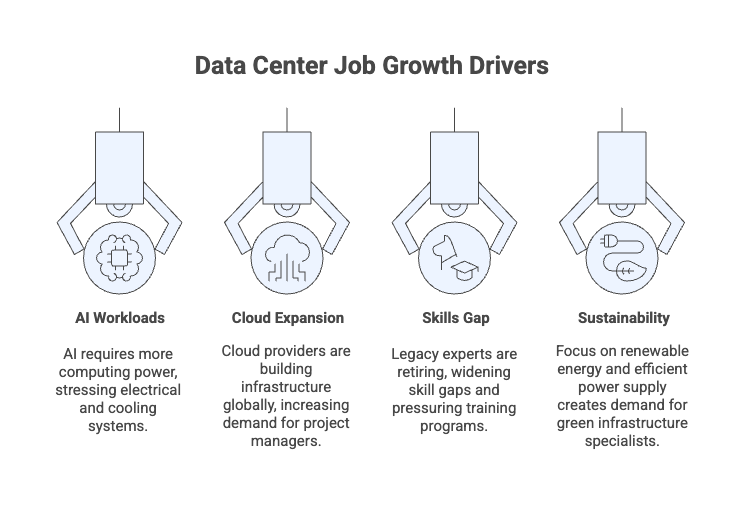
- AI, machine learning, and high‑density computing: AI workloads need far more computing power and advanced electrical systems and cooling systems. This puts pressure on teams that can engineer, operate, and optimize high‑density facilities.
- Cloud service provider expansion: Hyperscale cloud providers and cloud providers are building out infrastructure globally. This drives demand for project managers, commissioning specialists, and structured cable techs as part of resilient digital infrastructure.
- Aging workforce and skills gap: Many legacy experts in power systems, backup generators, and HVAC technicians are nearing retirement, which is widening skill gaps and putting hiring pressure on training and apprenticeship programs
- Regulatory and sustainability pressures: Renewed focus on compliance, renewable energy, and efficient uninterruptible power supply deployment means specialists in green infrastructure and sustainability are now must‑have roles
In the following YouTube video, you can learn more about how AI, in particular, is driving data center growth:
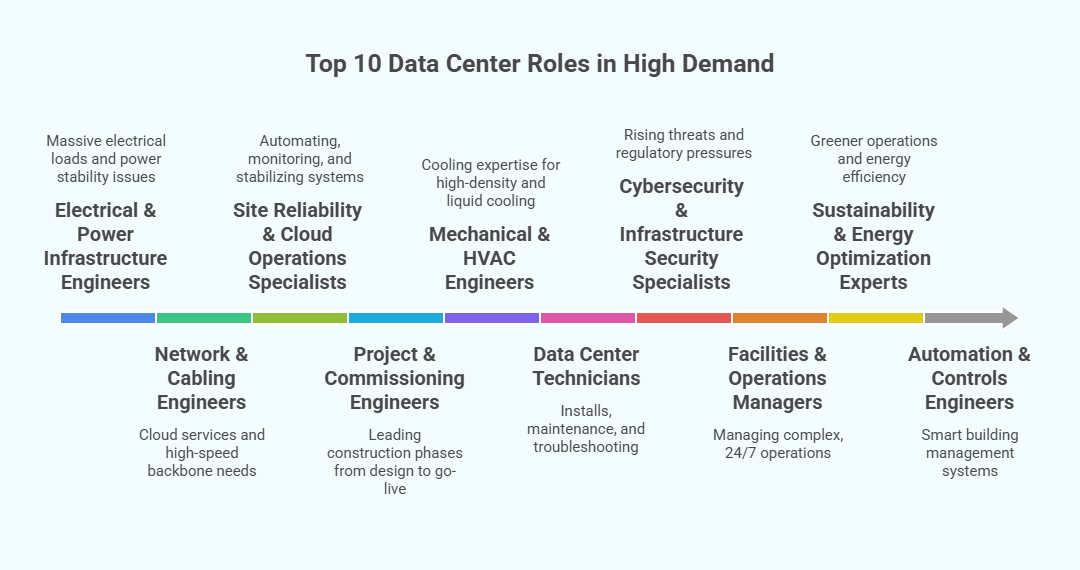
Top 10 Data Center Roles in High Demand (2026)
Here’s a closer look at the roles seeing the most demand across the data center industry in 2026, what they do, why they matter, and how they’re shaping hiring strategies.
1. Electrical and Power Infrastructure Engineers
These engineers design and maintain the systems that power data centers, from grid connections and backup generators to UPS systems and on-site energy like microgrids.
Their work is critical to keeping operations stable, especially as facilities become more power-dense.
Why the spike in demand? Global data center electricity use is projected to grow by 16% in 2025 alone and could double by 2030, thanks to the expansion of AI and cloud services.
For staffing teams, this means high competition for engineers who understand complex power systems, renewable energy, and high-voltage design.
At AAG, we’re seeing particularly strong demand for talent experienced in hyperscale facilities and sustainable energy integration.
2. Network and Cabling Engineers
As cloud traffic and digital services scale up, these engineers are key to building and maintaining the high-speed backbone of modern data centers. They handle everything from fiber optics and structured cabling to routing and hybrid networking environments.
Why the demand? The global data center wire and cable market is projected to hit $32.9 billion by 2031, fueled by cloud growth, AI workloads, and rising bandwidth needs.
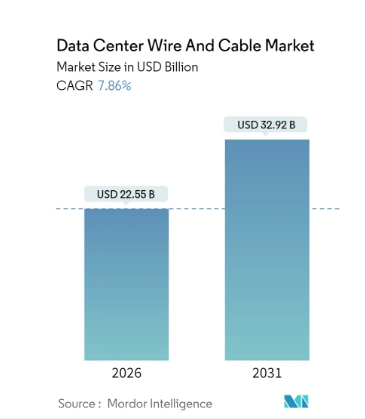
For hiring teams, it means serious competition for engineers who can design and maintain high-speed, scalable, and highly reliable connectivity across mission-critical facilities.
3. Site Reliability and Cloud Operations Specialists
These specialists make sure data centers and cloud environments stay up and running 24/7. This is increasingly complex as systems scale across on-prem, cloud, and hybrid platforms. Uptime is no longer optional.
Their focus areas include automation, monitoring, incident response, and proactive reliability practices. These efforts reduce manual workloads and keep services stable under heavy load.
Why are they in demand? The shift to cloud‑native infrastructure and AI workloads means manual ops just can’t keep pace. Organizations that lean into Site Reliability Engineering (SRE) practices can achieve stronger uptime and performance.
For staffing teams, the takeaway is clear: professionals who blend software‑oriented automation skills with traditional IT operations knowledge are rare and prized.
At AAG, we have seen strong demand for candidates who can bridge the gap between engineering, automation, and cloud platform reliability.
4. Project and Commissioning Engineers
These engineers oversee the full lifecycle of data center builds, from early design and planning all the way through construction, testing, and final commissioning.
They coordinate across teams to make sure everything runs on time, on budget, and to spec, especially when it comes to mission-critical systems, electrical infrastructure, and cooling systems.
Why the demand? As of 2025, more than 10 gigawatts of new data center capacity had entered development globally, supported by roughly $170 billion in construction and expansion projects.
At the same time, global data center electricity demand is projected to nearly double by 2030, driven largely by AI workloads and cloud growth.
For hiring teams, the takeaway is clear. Organizations need project and commissioning engineers with hands-on build experience, strong construction management skills, and deep knowledge of electrical and mechanical systems.
These capabilities are becoming essential as data center projects grow larger, faster, and more complex.
5. Mechanical and HVAC Engineers
These engineers keep data centers cool, stable, and running. They design, install, and optimize cooling infrastructure and thermal systems (including advanced air‑ and liquid‑based solutions) to manage heat from high‑density racks and AI workloads.
Without effective cooling, equipment can overheat, uptime drops, and costs skyrocket.
Why this role is booming: the data center cooling market, driven by cloud computing and AI demand, is rapidly expanding. In 2025, it was valued at about $20.8 billion and is projected to grow steeply to $49.9 billion by 2034 as facilities adopt more sophisticated thermal solutions.
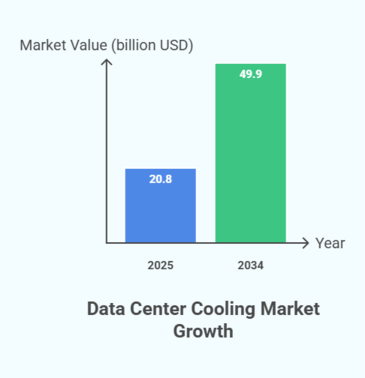
For staffing teams, that means fierce competition for candidates with hands‑on experience in HVAC systems, high‑density cooling, and environmental control design.
6. Data Center Technicians
These hands‑on pros are the backbone of daily operations. It’s their job to install hardware, maintain servers and storage, monitor equipment, and troubleshoot issues to keep systems running smoothly around the clock.
Their work directly supports cloud computing, digital services, and core IT operations that power businesses of every size. Without skilled technicians, data centers can’t maintain uptime, meet SLAs, or respond quickly when something breaks.
We’re seeing demand for data center technicians rise sharply. As data centers scale to support more cloud providers, AI workloads, and edge sites, operators need technicians who can handle both routine maintenance and rapid response work.
For hiring teams, the focus is clear. Build strong entry‑level talent pipelines and retain experienced techs who understand physical infrastructure, cooling systems, power delivery, and network hardware.
Read Next: The Complete Guide to Data Center Technician Staffing
7. Cybersecurity and Infrastructure Security Specialists
Cybersecurity and Infrastructure Security Specialists protect the heart of modern digital infrastructure, data centers, from increasingly sophisticated threats.
These roles cover everything from securing networks and systems against external attacks to building resilient defenses for critical electrical infrastructure, AI workloads, and hybrid environments that blend cloud and on‑prem systems.
They also bridge cybersecurity with physical risk management to safeguard everything from access control to security devices and compliance frameworks.
Here’s why they’re in demand: The global cybersecurity industry is expanding rapidly as threats grow in volume and sophistication.
According to ISACA’s State of Cybersecurity 2025 report, 70% of security professionals expect demand for technical cybersecurity roles to increase in the coming year, and more than half of teams remain understaffed.
This surge reflects rising threat levels, regulatory pressures, increased use of digital services, and the need to secure complex, distributed systems, particularly in hyperscale data center and cloud provider environments.
8. Facilities and Operations Managers
These leaders are the ones who keep complex, 24/7 data center operations running smoothly. This means balancing uptime, staffing, compliance, sustainability goals, and everyday chaos.
They coordinate across teams that manage power systems, cooling infrastructure, security devices, and environmental controls to make sure that mission‑critical systems perform as expected around the clock.
We consistently see this role under pressure. As digital services, cloud platforms, and AI workloads expand, operators are expected to deliver near-perfect availability.
Teams usually target “Five 9s” (99.999 %) uptime, which leaves just about 5.26 minutes of downtime per year.
Effective facility management and operations leadership are essential to deliver on that standard while navigating energy, security, and regulatory challenges.
For hiring teams, this translates into strong demand for professionals with deep experience in technical operations as well as people management.
The ideal candidate understands not just IT operations and resilience planning, but also how to lead cross‑disciplinary teams that support renewable energy initiatives, sustainability targets, and compliance frameworks.
9. Sustainability and Energy Optimization Experts
These specialists help data centers run greener and smarter by optimizing energy use, reducing waste, improving Power Usage Effectiveness (PUE), and integrating renewable energy into infrastructure.
They’re the go‑to experts for balancing performance with environmental goals like refining cooling systems, supporting liquid cooling for high‑density AI workloads, and advising on grid decarbonization strategies.
Why they’re in demand?
Data centers now consume a meaningful share of global electricity. Estimates suggest they account for around 2% of worldwide power use, pushing energy efficiency and sustainability higher on the executive agenda. Improving metrics like PUE helps operators control costs while reducing environmental impact.
As a result, demand is growing for professionals with expertise in energy-efficient design, sustainability frameworks, and renewable energy integration.
These roles are becoming central to both operational resilience and long-term strategy.
10. Automation and Controls Engineers
These engineers are critical as data centers embrace smarter Building Management Systems (BMS) and advanced automation to run more efficiently.
They design, integrate, and maintain automated control systems, like energy and cooling controls and predictive maintenance platforms. These help facilities monitor conditions, reduce manual intervention, and respond rapidly to changing loads.
BMS and automation tools increasingly tie into power, HVAC, and security systems to provide real‑time operational insights and automated responses.
They’re in demand because modern data centers are moving beyond manual operations toward condition‑based monitoring and proactive automation.
Technologies that support predictive maintenance, particularly those that use AI and sensor data to foresee system issues before they escalate, can reduce unexpected failures and cut operational costs.
At AAG, we’re seeing strong interest in engineers who understand BMS, SCADA, and automated predictive systems.
Read Next: How to Build a Data Center Workforce for 24/7 Operations: A Hiring Playbook
What This Means for Staffing Leaders
The surge in demand for specialized data center talent is creating real pressure on hiring teams. Here’s how it’s playing out on the ground:
- Longer time-to-hire: Critical roles, especially in AI infrastructure, electrical systems, and security, are taking longer to fill. Delays mean missed project milestones and potential downtime.
- More poaching and turnover: Top candidates are getting snatched up quickly, often by competitors offering better pay or flexibility. Retention is becoming just as hard as recruitment.
- Rising costs: Salaries for in-demand data center roles are climbing rapidly as competition intensifies. Contractor rates are also increasing, with more operators relying on short-term staffing to cover urgent skill gaps and project deadlines.
- Burnout risk: Understaffed facilities place extra strain on existing teams. Over time, this increases the risk of burnout, mistakes, and unplanned attrition.
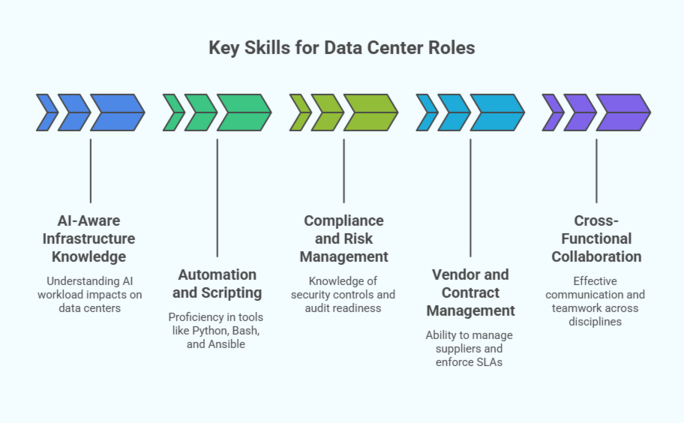
Key Skills Employers Look for in 2026 Data Center Roles
As data centers evolve to support more complex workloads and infrastructure, the bar for talent is rising. This means having the right mix of skills to operate in high-pressure, high-stakes environments.
Here’s what hiring managers are prioritizing nowadays:
AI-aware infrastructure knowledge
Employers are looking for professionals who understand how AI workloads affect data center operations. This includes higher power density, advanced cooling requirements, and new approaches to capacity planning. Candidates who can anticipate these impacts are better equipped to support long-term scalability.
Automation and scripting
Automation is no longer optional. Familiarity with tools such as Python, Bash, and Ansible is becoming standard across many roles. Teams value engineers who can automate routine tasks, streamline deployments, and reduce manual intervention, particularly as environments grow in size and complexity.
Compliance and risk management
Regulatory scrutiny continues to increase. Employers want professionals who understand security controls, documentation requirements, and audit readiness. Experience navigating compliance frameworks helps reduce risk and protect mission-critical operations.
Vendor and contract management
From structured cabling to cooling systems and construction partners, vendor coordination plays a major role in data center performance. Hiring managers favor candidates who can manage suppliers, enforce service-level agreements, and hold partners accountable for quality and timelines.
Cross-functional collaboration
Modern data centers rely on close coordination between IT, facilities, security, and engineering teams. Candidates who communicate clearly and work effectively across disciplines are especially valuable as hybrid and edge environments blur traditional boundaries.
We consistently see demand for professionals who combine these technical capabilities with strong communication and leadership skills.
At Alpha Apex Group, this blended skill set is a key focus when helping clients build teams that are not just qualified for today’s needs but also prepared for what’s coming next.
Smart Strategies for Attracting and Retaining Data Center Roles
With so many data center roles in high demand, the hiring industry has shifted.
It’s no longer enough to post a job and wait; you need to take a smarter, more proactive approach to stand out and keep your best people.
It starts with strong employer branding. Candidates want to know who they’re working for and what the company stands for.
Highlighting your company culture, sustainability initiatives, and the impact your team makes can set you apart.
Flexibility also matters more than ever. While most data center roles require on-site presence, offering flexible scheduling, location-based incentives, or thoughtful on-call rotations can go a long way.
Training is another big piece of the puzzle. When you build clear pipelines for growth, including apprenticeship programs and ongoing upskilling, it helps close the talent gap while improving retention. This is more true than ever as experienced professionals leave the industry.
One of the most effective moves we’ve seen is partnering with firms that specialize in data center hiring. Generalist recruiters mostly miss the nuances of these environments, which leads to mismatches and delays.
At Alpha Apex Group, we’ve built a deep network of pre-vetted talent across every layer of the data center ecosystem, from HVAC and power systems to automation, cloud ops, and AI infrastructure.
We’ve helped clients fill critical roles 37% faster than the industry average, and we stay involved through every step of the process to ensure a great fit.
Hire the Best Data Center Talent With Alpha Apex Group
As this article shows, the rise of AI, hyperscale development, sustainability requirements, and increasingly complex infrastructure has put unprecedented pressure on data centers to secure the right talent.
The challenge is that skilled professionals are in short supply, and the competition for top talent is fierce. Time-to-hire is stretching, salaries are climbing and the cost of falling behind, whether in uptime, compliance, or project delivery, is higher than ever.
But with every challenge comes opportunity. Companies that invest in smarter hiring strategies and stronger partnerships are pulling ahead and building future-ready teams that can adapt, scale, and lead.
If you're looking to build a resilient, future-ready data center team, Alpha Apex Group is here to help. Let’s talk.
FAQs
What makes a data center role “high demand” in 2026?
Roles become high demand when they’re essential to uptime, security, or expansion, particularly in areas like AI infrastructure, power systems, and automation, where talent is scarce, and infrastructure is scaling fast.
Which certifications are most valuable for data center roles?
Certs like BICSI, CDCP, CDCS, CompTIA Server+, AWS, and Cisco (CCNA/CCNP) are widely respected, along with vendor-specific training for power, cooling, and security systems.
How long does it typically take to hire top talent for these roles?
It can take anywhere from 4 to 12 weeks, depending on the role complexity and location. Niche technical roles often take longer due to tight candidate pools.
Are hybrid or remote roles common in data centers?
Most roles are on-site due to the physical nature of the work, though some engineering, project management, and cybersecurity positions offer hybrid flexibility.
How is AI changing the skill sets needed in data centers?
AI workloads are increasing power density and system complexity, driving demand for skills in high-efficiency cooling, power planning, automation, and AI-aware infrastructure design.
How does Alpha Apex Group specialize in data center recruitment?
We focus exclusively on mission-critical hiring, from construction and commissioning to operations and security, with a deep talent network built for the unique demands of data centers.
What’s AAG’s process for finding and vetting candidates?
We combine industry-specific sourcing with technical screening, behavioral assessments, and hands-on support to make sure every candidate is qualified, reliable, and ready to perform.
Can AAG help with both full-time hires and contract staffing?
Absolutely. We support both permanent placements and contract roles, which gives our clients the flexibility to scale teams as needed without sacrificing quality.
.jpg)
.jpg)