COO Salary & Compensation Guide 2026
.jpg)
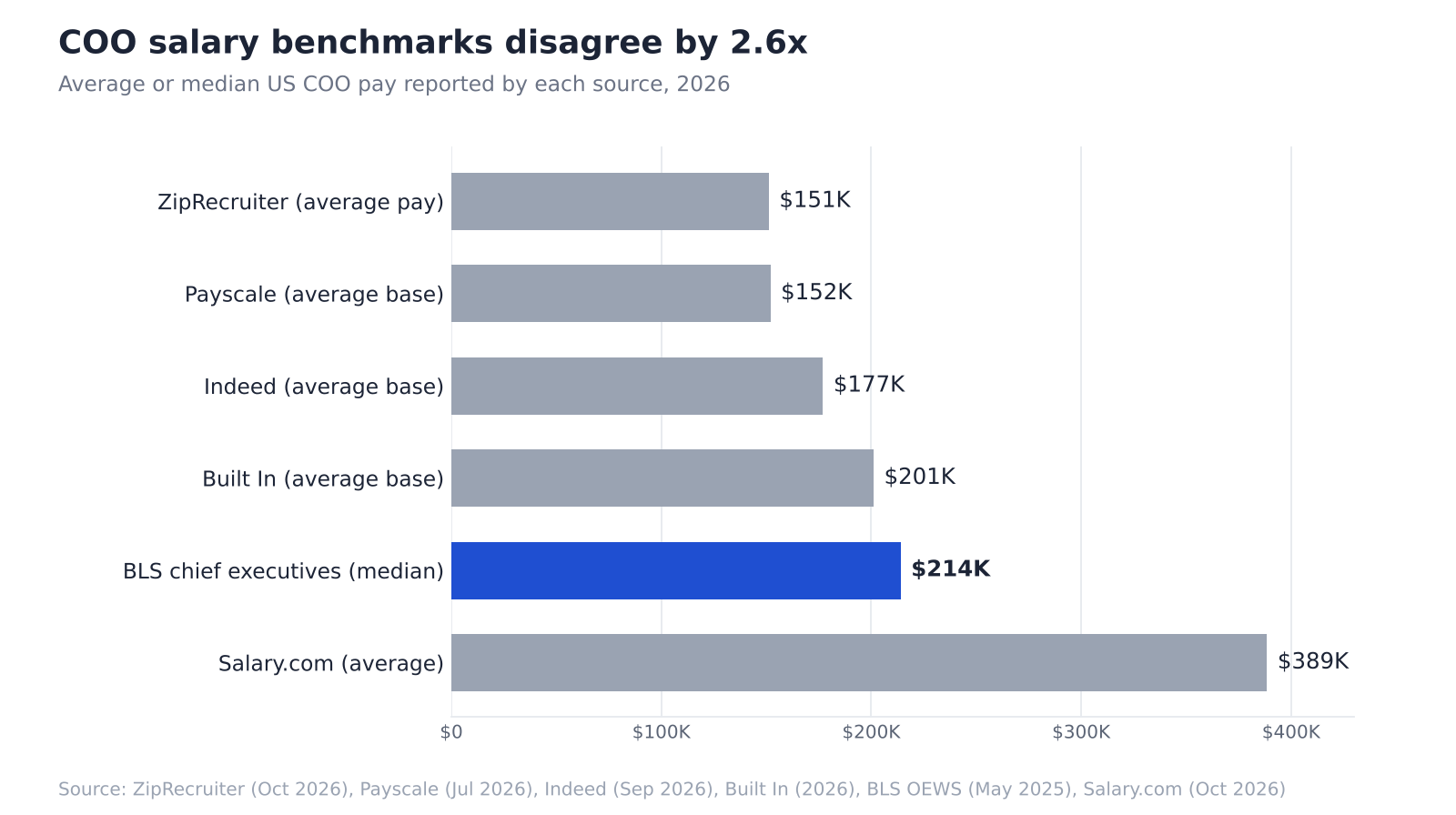
The average COO salary in the US runs from about $151,000 to $389,000 a year, depending on which salary database you trust. A gap that wide makes any single benchmark misleading on its own.
A single "average COO salary" blends five different markets: startups, founder-led companies, mid-market firms, PE-backed portfolio companies, and public companies.
Total pay runs from about $200,000 at an early-stage startup to more than $27 million at Apple (both sourced in the sections below), and at the largest public companies, stock makes up most of the COO's pay.
So we price the COO role by its scope first: P&L ownership, revenue responsibility, and whether the hire is a CEO successor. The title comes second. Sources are linked throughout, and if you're hiring for the seat, our executive search team benchmarks offers against the same data.
How Much Does a COO Make in 2026?
A COO in the US makes between $151,203 and $388,536 a year on average in 2026. The BLS median for chief executives, the federal category that includes COOs, is $213,990. Which number applies to you depends on how each source defines pay and which companies it samples.
The table below lines up the main benchmarks side by side. "Base" means salary only. "Total cash" adds bonus and other cash, and "total compensation" also counts equity where a source reports it.
Why COO Salary Sources Disagree by 2.6x
COO salary sources disagree because they measure different things across different companies. The highest figure is about 2.6 times the lowest, and four factors explain most of the gap:
- Base pay and total pay get mixed together. Payscale and Indeed report base salary. Built In reports base and total cash separately, and its total cash runs $75,678 higher.
- Job postings capture only employers that publish pay. That pool tends to tilt toward small and mid-size firms, which pulls posting-based averages down.
- Each source samples a different mix of companies. Salary.com's 10th percentile ($324,725) sits above every other source's average, which may reflect a different mix of employers or job levels.
- The BLS has no COO category. COOs are counted inside "chief executives" (11-1011), alongside CEOs and the heads of public-sector organizations.
The practical move is to pick sources that match your company type. A 40-person startup should give less weight to the Salary.com range, and a $400 million manufacturer less weight to ZipRecruiter's. Prioritize sources that cover comparable roles.
COO Salary Range by Percentile
The COO salary range runs from about $75,700 at the 10th percentile to $507,730 at the 90th, based on BLS May 2025 data cited above for chief executives.
The BLS band is wider because it covers every organization with a chief executive, from small towns to Fortune 500 companies. For a COO with full P&L ownership at a company above $75 million in revenue, we recommend starting from the upper half of this band and checking it against a segment-specific source. That is our guidance, not a BLS finding.
Average COO Salary by Company Size and Revenue
Average COO base salary more than doubles between a founder-led company and a public small or mid-cap company, and total compensation grows much faster because equity takes over.
Source: a 2026 executive search salary analysis. Startup, PE-backed, and large-cap public company pay each have their own section below.
Headcount data adds a wrinkle. Built In's data (cited above) shows COOs at companies with 501 to 1,000 employees earning the highest average pay of any size band, at $251,783.
COO Salary at a Small Company or $10 Million Business
A COO at a small company or a $10 million business typically earns $180K to $300K in base salary, according to the founder-led band above.
At that size, check the scope before you post the role. A $10 million company often needs someone to run fulfillment, vendors, and day-to-day operations while the founder owns strategy and the P&L. That job often fits a VP of Operations, which we compare with the COO seat further down.
Hire a COO at this stage when the person will:
- Own a P&L or the company's full operating budget
- Manage other department heads directly
- Act as the founder's second in command, with authority to make decisions in their absence
COO Salary at a $100 Million Company
A COO at a $100 million company sits in the mid-market band, with $275,000 to $425,000 in base and $375,000 to $700,000 in total compensation.
The top of that range goes to COOs who carry real P&L ownership, run multi-site or multi-country operations, or lead an integration after an acquisition. A COO who manages internal operations under a CEO who keeps the commercial side belongs closer to the bottom.
COO Compensation Package: Base Salary, Annual Bonus, Equity, and Benefits
A COO compensation package has four parts: base salary, annual bonus, long-term incentives, and benefits. Base salary makes up a smaller share of pay as the company grows.
1. COO Base Salary
Base salary is the anchor for the rest of the package. Bonus targets are set as a percentage of it, and severance is often expressed as a multiple of it.
At private mid-market companies, base is most of what a COO takes home. At large public companies, it becomes a small slice of the total.
2. COO Annual Bonus Targets
COO annual bonus targets range from about 20% to 75% of base salary, depending on the sector and ownership:
Tie the COO bonus to two or three operating metrics the COO controls, such as EBITDA or operating margin, a cost or efficiency target, and one execution goal like on-time delivery or a system rollout.
3. COO Long-Term Incentives and Equity
Long-term incentives take a different form at each type of company. Public companies grant restricted stock and performance shares, startups grant stock options, and PE-backed companies carve out a management equity pool. Each has its own section below with the actual numbers.
4. Benefits, Severance Packages, and Change-of-Control Terms
COO benefits can include executive health coverage, a 401(k) match, life and disability insurance, and sometimes relocation support or a car allowance.
The terms that matter more are the severance package and the change-of-control clause. Proxy advisor ISS flags new executive agreements with severance or change-of-control payments above three times base salary plus bonus, which acts as a practical ceiling for many public companies.
When you negotiate these terms, three questions decide their value:
- Trigger: Does equity accelerate on a sale alone (single trigger), or only if the COO is also let go (double trigger)?
- Multiple: How many years of base, or base plus bonus, does severance pay?
- Scope: Does a sale or a reorganization that shrinks the role count as "good reason" to leave?
If you need a second view on a COO package before it goes out, our compensation and benefits consulting team benchmarks executive pay structures.
How Much Do Public Company COOs Make?
In four 2026 proxy filings from large public companies, COOs reported $8.7 million to $118.1 million in total compensation for fiscal 2025, and stock made up 75% to 86% of it.
Public companies disclose this in the Summary Compensation Table of their annual proxy statement (SEC Form DEF 14A). Here are four 2026 filings:
Totals include "all other compensation" (security, retirement contributions, insurance). Meta's stock share is lower partly because Olivan's other compensation totals about $2.2 million, mostly personal security and related tax payments.
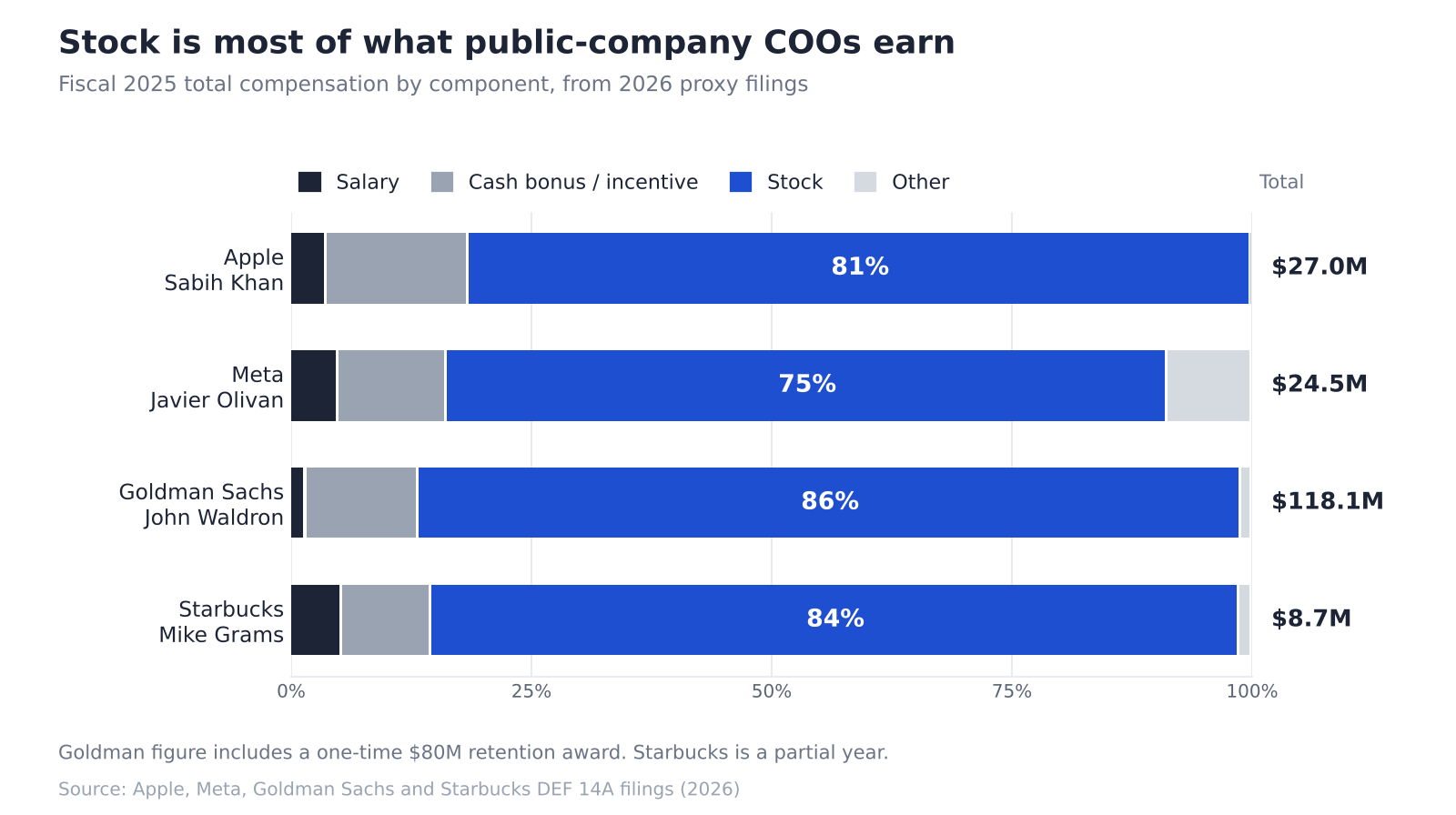
Three of these numbers need context before anyone uses them as a benchmark, based on the same proxy filings linked in the table:
- Goldman Sachs granted Waldron and CEO David Solomon a one-time retention award worth $80,000,099 that cliff-vests in January 2030. Without it, Waldron's 2025 pay was about $38.1 million, up from $30,971,548 in 2024. Excluding the award, stock was about 55% of his pay.
- Starbucks hired Grams in February 2025 and named him COO in June 2025, so his figure is a partial year. The $500,000 in his bonus column is a sign-on payment.
- Apple paid every named executive officer the maximum cash incentive for fiscal 2025 because performance exceeded its maximum goals.
Mega-cap COO pay is an outlier. The typical public-company COO earns a fairly consistent share of CEO pay, which the next section covers.
COO vs CEO vs CFO Salary: Who Gets Paid More?
A COO earns about 42% of what the CEO earns at a typical Russell 3000 company, and a CFO earns 37% to 39%, according to the Conference Board. On average, that makes the COO the second-best-paid seat in the public-company C-suite.
Source: Conference Board and ESGAUGE analysis of 2024 proxy data.
To turn those shares into dollars: the Conference Board puts median CEO pay at $6.7 million in the Russell 3000 and $16.5 million in the S&P 500. As rough arithmetic only, applying the ratios to those medians gives about $2.8 million and $6.3 million. These are illustrations, not observed COO pay benchmarks.
The ratio shifts by sector, according to the same Conference Board analysis. COOs earn 48% of CEO pay in health care, 46% in financials, and 43% in materials.
One likely reason for the COO's premium over the CFO is succession: the COO or president role was the previous job for 43.9% of sitting large-company CEOs, according to a 2025 C-suite turnover study. That succession link is worth weighing alongside CEO succession planning when you set COO pay.
Sector matters for CFOs too: in communication services, CFOs earn 50% of CEO pay in the same Conference Board data, above the all-sector COO average.
COO vs VP of Operations Salary
A COO ranks above a VP of Operations and earns more. A VP of Operations makes an average base of $147,958 (Payscale, July 2026), with total pay between $92,000 and $253,000.
The Payscale averages sit close together, likely because many small companies give the COO title to a role scoped like a VP. If the role fails the three tests in the small-company section above, the VP title fits better, and the salary band will follow.
Startup COO Salary and Equity by Funding Stage
A startup COO typically takes $150,000 to $250,000 in base salary and $200,000 to $400,000 in total compensation, according to venture firm CRV's 2026 hiring guide. CRV describes these as directional ranges. Equity is the bigger lever: roughly 1% of fully diluted shares at Series A or B in both the US and Europe, per Index Ventures.
SaaS and venture-backed teams hiring their first operator can also see how SaaS executive recruiters approach these searches.
Cofounder COOs trade cash for ownership. In the same Sifted data, cofounder COOs earned about £71,000 at seed, well below the £94,500 paid to hired COOs.
For a hired startup COO, the stock options terms deserve as much attention as the grant size:
- Vesting: Confirm the vesting schedule, the cliff, and whether any vesting accelerates on a sale.
- Exercise window: Ask how long the COO has to exercise options after leaving. A longer window is worth real money.
- Refresh grants: Ask whether the company tops up equity after later rounds dilute the original grant.
How Much Do PE-Backed COOs Make in Salary and Equity?
A PE-backed COO earns $300,000 to $475,000 in base salary, per the executive search salary analysis cited above, and receives about 1.7% of the company's equity on average, from a management pool that averages 8.9%, according to a 2025 survey of PE portfolio-company equity plans.
Sponsors filling these seats across a portfolio can use our private equity executive search practice.
The same survey shows how that pool usually splits across the top team:
The COO average hides two groups. Awards cluster around 0.75% and around 2%, and COOs without revenue responsibility receive awards about 40% smaller. Only about half of portfolio companies have a COO at all.
The equity is also less certain than it looks. In that survey, 54% of plans require a 3x to 4x return, or the equivalent IRR, before management equity fully vests, and 41% of executives who reached a sale were paid less than three-quarters of the value projected in their base case.
Before accepting or making a PE-backed COO offer, model the payout at a 2x, 3x, and 4x return, and confirm what happens to unvested equity if the COO leaves before the exit.
COO Salary by Industry: Which Industries Pay COOs the Most?
Technology pays COOs the most, with a median total pay of $408,599, according to Glassdoor's October 2026 data. Manufacturing follows at $324,072.
Source: Glassdoor, top five paying industries for COOs, October 2026.
Manufacturers hiring an operations leader can compare approaches in our review of supply chain executive search firms.
Hospital and Health System COO Salary
A hospital COO's pay scales with the size of the health system, from $250,000 to $350,000 in base at systems with $25 million to $100 million in revenue to $625,000 to $850,000 at systems above $5 billion, which the source labels large-cap public, per one healthcare executive recruiter's 2026 benchmarks cited above. Total direct compensation in that over-$5 billion, large-cap public band runs from $3.8 million to $9.5 million. The recruiter presents all of these as directional ranges.
Public and academic systems show up among the highest-paying COO employers in Indeed's data cited above, including University of Vermont Health Network at $467,640 and Cook County Health at $449,604.
Nonprofit COO Salary
Nonprofit COO pay ranges from under $150,000 at small regional charities to more than $8 million at the largest health systems. Form 990 tax filings on ProPublica's Nonprofit Explorer show the range:
Totals combine reportable compensation and other compensation from Part VII of each Form 990.
Organization size drives much of the difference. Girl Scouts Heart of the Hudson reported about $7 million in revenue, while Feeding America reported about $5 billion, according to the same Form 990 filings. Nonprofit boards can pull comparable organizations' 990s from ProPublica for free, which makes nonprofit COO pay one of the easiest to benchmark.
Financial Services and Family Office COO Salary
A COO at an investment-focused family office earns a median base salary of $367,500 and a median total cash package of $525,000, according to the Morgan Stanley family office report cited above. Assets under management drive the gap:
- Under $1 billion in assets: $270,000 median base, $420,000 median total direct compensation
- $1 billion or more: $500,000 median base, $1.2 million median total direct compensation
COO Salary by Location: US States, Metros, and International
Chief executives in the New York metro area earn a mean of $392,410, the highest of the four large metros below in BLS May 2025 data. Dallas-Fort Worth has the highest median of the four at $320,060.
BLS figures cover all chief executives (11-1011). Private-market figures come from the executive search salary analysis cited above.
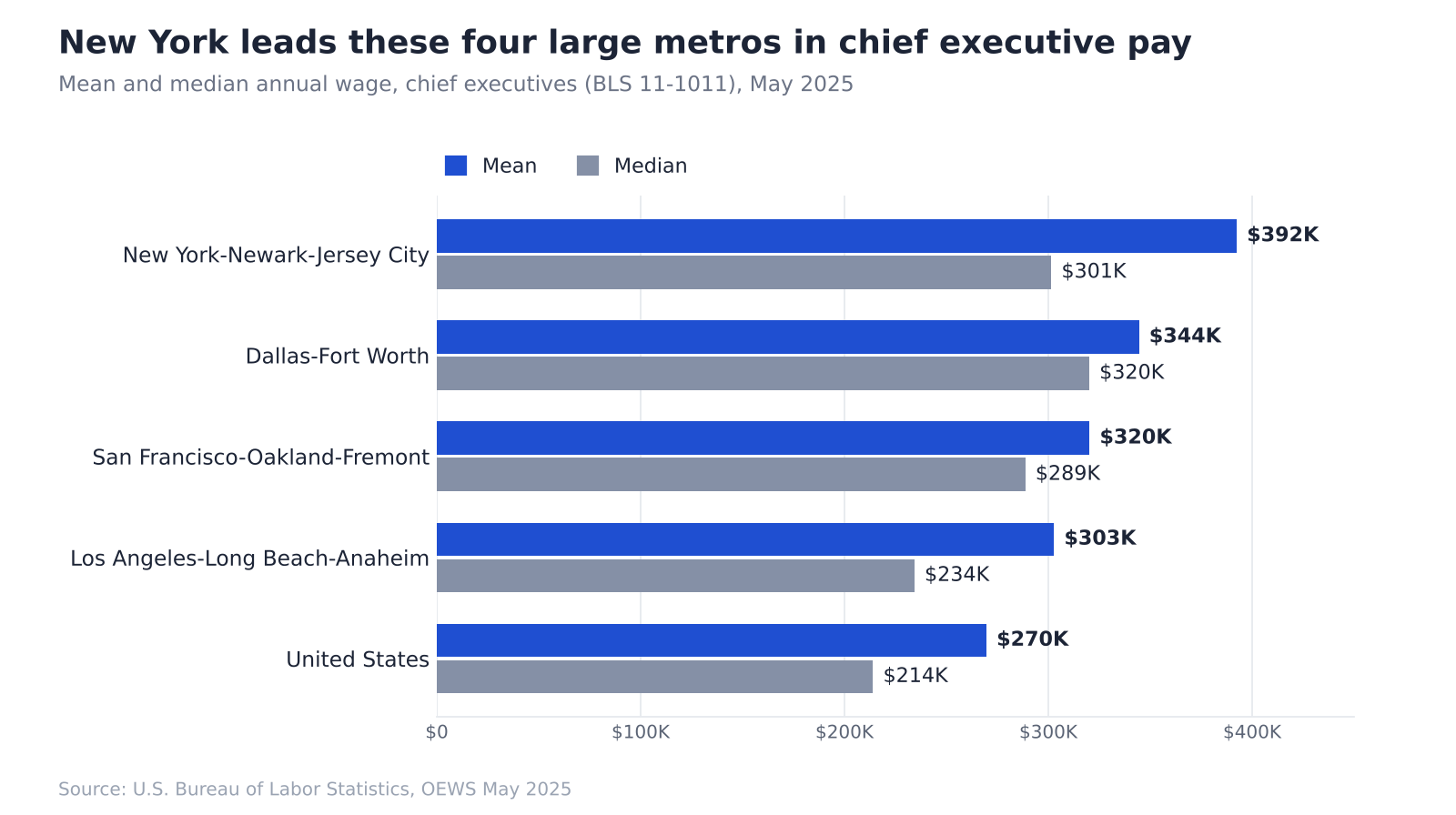
The two columns tell different stories about the Bay Area. BLS data puts San Francisco below Dallas, while private-market COO data puts it at the top. A likely reason is sample mix: venture-backed and tech companies pay COOs heavily and make up a bigger share of private-market searches than of the BLS survey.
Among the states in the same BLS May 2025 data, these have the highest chief executive means:
- Oregon: $403,380
- Connecticut: $376,840
- New Jersey: $372,910
- Washington: $360,290
- New York: $351,160
Texas ($310,660) out-earns California ($272,920) on the mean, and the gap holds at the median ($257,850 against $218,600).
International COO Salary: UK and Canada
UK COOs in London earn £150,000 to £350,000 or more in base salary, and total packages can exceed £500,000 at large or PE-backed companies, according to a UK executive recruitment salary guide. Hedge fund and private markets COOs can earn up to £550,000 or more.
In Canada, the government's Job Bank reports a median of C$96.15 an hour for senior managers in financial, communications, and other business services (NOC 00012), or about C$200,000 a year at full time.
How Much Does a Fractional COO Cost?
A fractional COO costs $175 to $400 an hour, or $6,000 to $15,000 a month on retainer, based on 2026 fractional COO pricing data.
Most engagements fall in that range, and price depends on how many hours the work covers. The hourly rate is for project or advisory work. Retainers are priced by monthly hours, so a small advisory retainer can work out to a higher effective hourly rate. The same pricing data breaks retainers down by engagement level:
Rates vary by provider. Venture firm CRV's hiring guide, cited above, puts typical fractional COO retainers at $8,400 to $11,300 a month for about 14 hours a week.
At the top of the embedded tier, a fractional COO costs about $180,000 a year. That's close to a founder-led company's full-time base salary, without the bonus, equity, or benefits.
A fractional COO fits best when:
- The business is still small enough that operating work doesn't fill a full-time week
- The company is pre-Series B and wants to preserve equity for a later full-time hire
- A post-acquisition integration needs senior operating attention for six to twelve months
An interim COO can also hold the seat while a permanent search runs. We cover both models in our breakdown of fractional and interim executive search firms.
How to Build a Competitive COO Offer in 2026
A competitive COO offer comes from defining the role's scope first, then pricing each part of the package against the right peer group. Follow these steps in order:
- Define which COO you are hiring. Name the archetype: an integrator who runs the business for a visionary founder, a scale-up operator, a turnaround leader, a CEO successor, or a PE value-creation lead. Each one pays differently.
- Pick three benchmark sources that match your segment. Use BLS and one employer-reported source for a broad view, then a segment-specific source such as proxy filings, Form 990s, or a PE equity survey.
- Set the base band between the 50th and 75th percentile of that segment. Consider going higher for a CEO-successor hire or a turnaround.
- Set the bonus target and the two or three metrics it pays on. Use the ranges and metrics in the annual bonus section above.
- Size the equity against stage or pool norms. Write the vesting schedule, any return hurdle, severance, and change-of-control terms into the offer letter.
- Post a compliant pay range where state law requires it. Several states now require a good-faith range in the job posting.
- Test the package with candidates in the market before the formal offer. Ask shortlisted candidates what their current equity is worth and when it vests, so the offer can cover what they would give up.
Use this checklist to test a draft offer before it goes out:
Mismatched cash and equity expectations can derail an executive offer late in the process, a theme in our list of hard truths about hiring an executive.
COO Compensation Trends for 2026
Two trends shape COO pay in 2026: large companies are keeping the COO seat, and overall salary budgets have stayed flat.
COO Prevalence Among Large US Companies
38.1% of Fortune 500 and S&P 500 companies had a COO in 2025, according to the same C-suite turnover study cited above. That's up from 33.6% in 2015, though slightly below the decade's high of 39.6% in 2022, so the role is holding its place in large companies.
Salary Increase Budgets for 2026 and 2027
US employers gave average salary increases of 3.5% in 2026 and budgeted 3.4% for 2027, according to a July 2026 survey of 1,650 US employers. A separate 2026 salary planning survey put the average merit increase at 3.2%.
Those budgets cover all employees, so treat them as a reference point for a COO raise. Larger increases usually come with a change in scope, a promotion to president, or a move to a new company.
Hire the Right COO at the Right Price With Alpha Apex Group
The right COO salary depends on the job you're hiring for. A $10 million founder-led company, a PE-backed platform, and a public company are three separate markets, and an offer priced against the wrong one either loses the candidate or overpays for the role.
Alpha Apex Group helps companies scope the COO seat, benchmark the package against the right peer set, and find the operator who fits. We've completed more than 2,000 placements, deliver a first shortlist in 72 hours, and back placements with a 90-day guarantee.
Ready to hire? Talk to our COO executive search team about your search.
FAQs
What does a COO do?
A COO runs the company's day-to-day operations and turns the CEO's strategy into execution. The scope varies by company: some COOs own the full P&L and every operating department, while others focus on supply chain, delivery, or internal processes, while the CEO keeps the commercial side.
Is COO a stressful job?
Yes, the COO role carries heavy pressure because it owns execution across the whole business. The COO answers for missed targets in every operating function, and in many companies also acts as the CEO's stand-in.
Do COOs get a signing bonus?
Yes, COOs can negotiate a signing bonus, often to replace a bonus or equity they give up by leaving. Starbucks' 2026 proxy, cited above, shows sign-on bonuses of $10 million for its CEO and $2.5 million for its CFO, alongside the COO payment covered above.
How much does it cost to hire a COO through an executive search firm?
Retained executive search fees run 25% to 35% of the COO's first-year cash compensation, based on the fee ranges in our guide to fractional and interim executive search firms cited above. For a COO with $400,000 in base and bonus, that means a fee of $100,000 to $140,000.
How long does it take to hire a COO?
Hiring an executive takes about a month and a half at the median, according to SHRM's 2025 data. That's measured from requisition to accepted offer, and it rises to about 60 days at organizations with more than 5,000 employees. Alpha Apex Group's average time-to-fill is 43 days, as reported on our COO executive search page linked above.

.jpg)
.jpg)
.jpg)