Petroleum Engineer Salary: A Detailed Guide

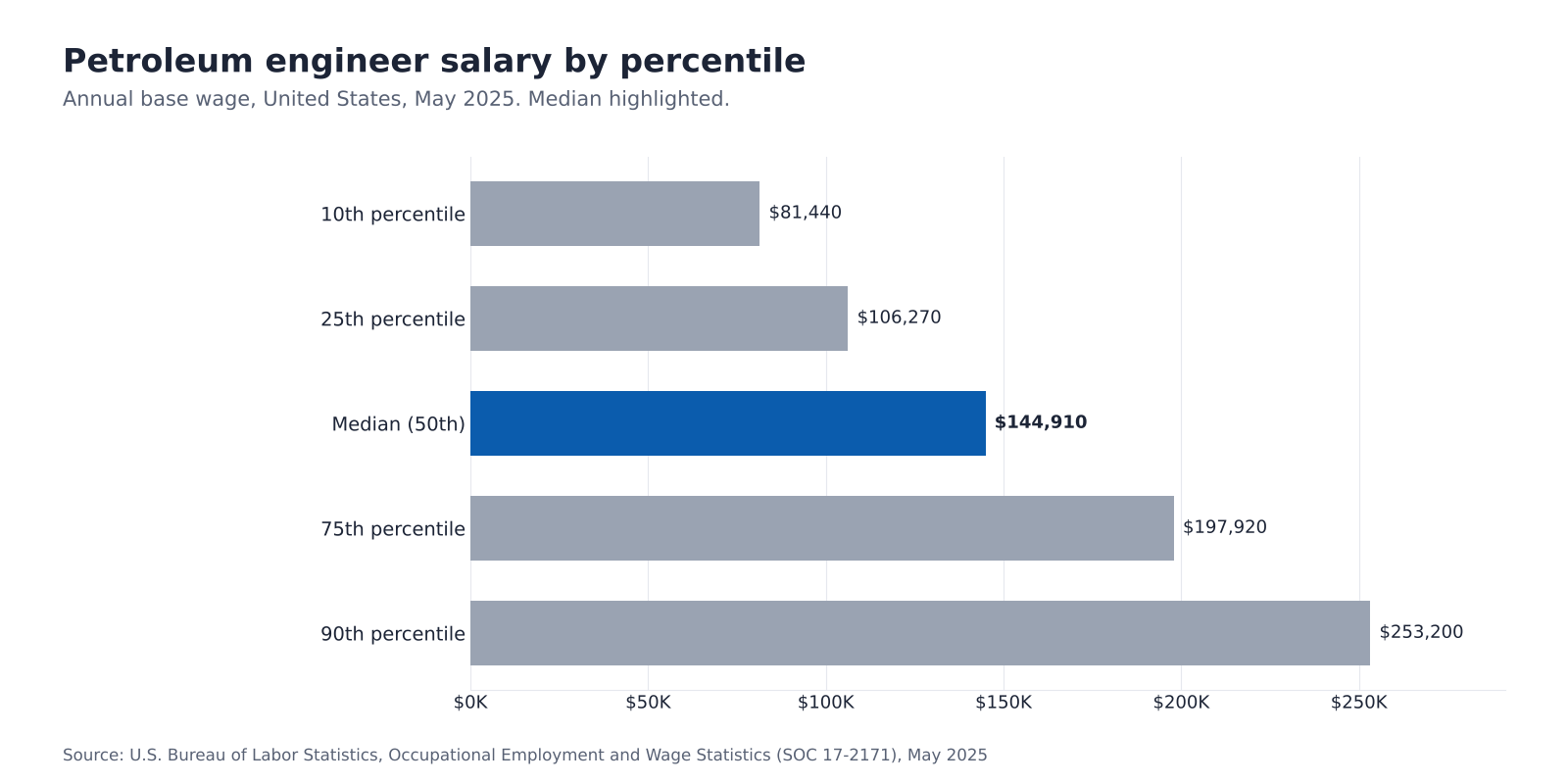
Search for “petroleum engineer salary” or “petroleum engineering salary,” and you will find estimates that differ by more than $40,000. One posting-aggregator estimate puts average pay at $102,400, while a self-reported pay survey reports $122,650. The Bureau of Labor Statistics puts the median at $144,910 as of May 2025.
Why such a wide gap? This guide breaks down petroleum engineer pay by experience, state, industry, specialty, employer, and country, and explains why different salary sources produce different numbers.
As per our experience placing petroleum engineers with employers, we know the headline salary is only the starting point. The final offer usually depends on three factors it does not show: the total compensation package, whether the employer is an operator or service company, and the oil-market conditions when the position opens.
Understanding these variables gives candidates a stronger basis for negotiation and helps employers avoid losing strong hires over compensation.
TL;DR
- The median petroleum engineer salary is $144,910, and the mean is $157,150 (BLS, May 2025).
- New graduates are projected to start around $100,750, the highest of any engineering major (NACE, 2026).
- Alaska pays the highest state average ($199,700); Texas employs about half of all petroleum engineers (BLS, May 2025).
- Engineers at oil and gas producers average $193,990, about $65,600 more than at oilfield service firms (BLS, May 2025).
- BLS pay data predates the 2026 oil price recovery, which can shift hiring budgets and offer negotiations.
How Much Does a Petroleum Engineer Make?
A petroleum engineer in the U.S. earns a median salary of $144,910 a year, or $69.67 an hour, according to the BLS Occupational Outlook Handbook cited above. The mean annual wage is higher, at $157,150, because a group of very high earners pulls the average up.
That median is about 2.8 times the $50,980 median for all U.S. occupations. It has also kept climbing through a rough patch for the industry:
The top of the range moved faster than the middle. In the BLS releases cited above, the 90th percentile rose from $225,920 in 2023 to $253,200 in 2025, a 12% jump, while the median rose about 7%. That pattern suggests the highest-paid roles saw the biggest gains.
Source: BLS Occupational Employment and Wage Statistics, May 2025. BLS reports straight-time gross wages: they include production bonuses and hazardous-duty pay but exclude overtime and nonproduction bonuses.
Why Petroleum Engineer Salary Data Varies by Source
Petroleum engineer salary figures differ because each source surveys a different group of people and counts a different slice of pay. BLS asks employers for actual payroll records. Salary websites use job postings or numbers that workers type in themselves.
Four differences explain almost all of the gap:
- Who answers. Self-reported surveys over-represent early-career engineers, who are more likely to look up and share their pay.
- What counts as pay. Some sources report base salary only; others blend in bonus and profit sharing.
- Sample size. A few hundred profiles can swing several thousand dollars with one outlier.
- Data age. Posting-based tools average listings from the past one to three years.
The takeaway is that aggregator figures skew low because they lean toward junior and self-reported pay. For a full-career benchmark, BLS is the most reliable number. For a first job offer, the new-graduate surveys are closer to reality.
What Is the Salary of a Petroleum Engineer at Different Experience Levels?
BLS doesn't publish wages by years of experience, so the experience-level pay below comes from two salary surveys. Both lean toward self-reported and early-career pay, so their figures run below BLS numbers.
Starting Petroleum Engineer Salary
The average petroleum engineering graduate is projected to start at $100,750, according to the NACE Winter 2026 Salary Survey cited above. That's the highest of any engineering major and about $19,500 more than the $81,198 average for all engineering graduates.
University placement reports land in the same range:
- University of Texas at Austin: petroleum and geosystems engineering graduates averaged $104,539 in its 2025 report.
- University of Houston: petroleum engineering bachelor's graduates averaged $96,900 in May 2026.
- Internships: $35 an hour at Houston and $4,871 a month at UT Austin, per the same university reports.
NACE figures are projected base salaries and exclude sign-on bonuses. The self-reported pay survey cited above puts average total pay at $100,569 for engineers with under one year of experience and $101,513 for those with 1 to 4 years.
Mid-Career Petroleum Engineer Salary (5-9 Years)
Mid-career petroleum engineers with 5 to 9 years of experience earn about 3% below the $122,650 average in the self-reported pay survey cited above, and those with 10 to 19 years earn about 18% above it. The posting-aggregator estimate cited above shows $93,400 for 4 to 9 years and $135,200 for 10 to 20 years.
Senior and Principal Petroleum Engineer Salary
Engineers with 20 or more years of experience earn about 65% above the self-reported survey's average, and the posting-aggregator estimate shows $156,100 for the same group.
Principal engineers, technical advisors, and asset managers at large operators rarely post their compensation on salary websites, and most of these roles are filled through a confidential executive recruitment process, with little public pay data left behind.
Petroleum Engineer Salary by State and City
Alaska pays petroleum engineers the highest average salary of any state, at $199,700, according to the BLS OEWS data cited above. Texas employs the most by far, with 9,140 of the roughly 18,060 petroleum engineers in the country.
Source: BLS OEWS, May 2025. "Not published" means BLS didn't release an estimate for that cell.
At the metro level, the gaps get sharper:
Source: BLS OEWS, May 2025 (cited above).
New Mexico's low average is worth a note. A likely reason: much of New Mexico's Permian Basin activity is managed from Midland and Houston offices, so many of the engineers running those assets are counted in Texas wage data.
Petroleum Engineer Salary in Texas: Houston and Midland
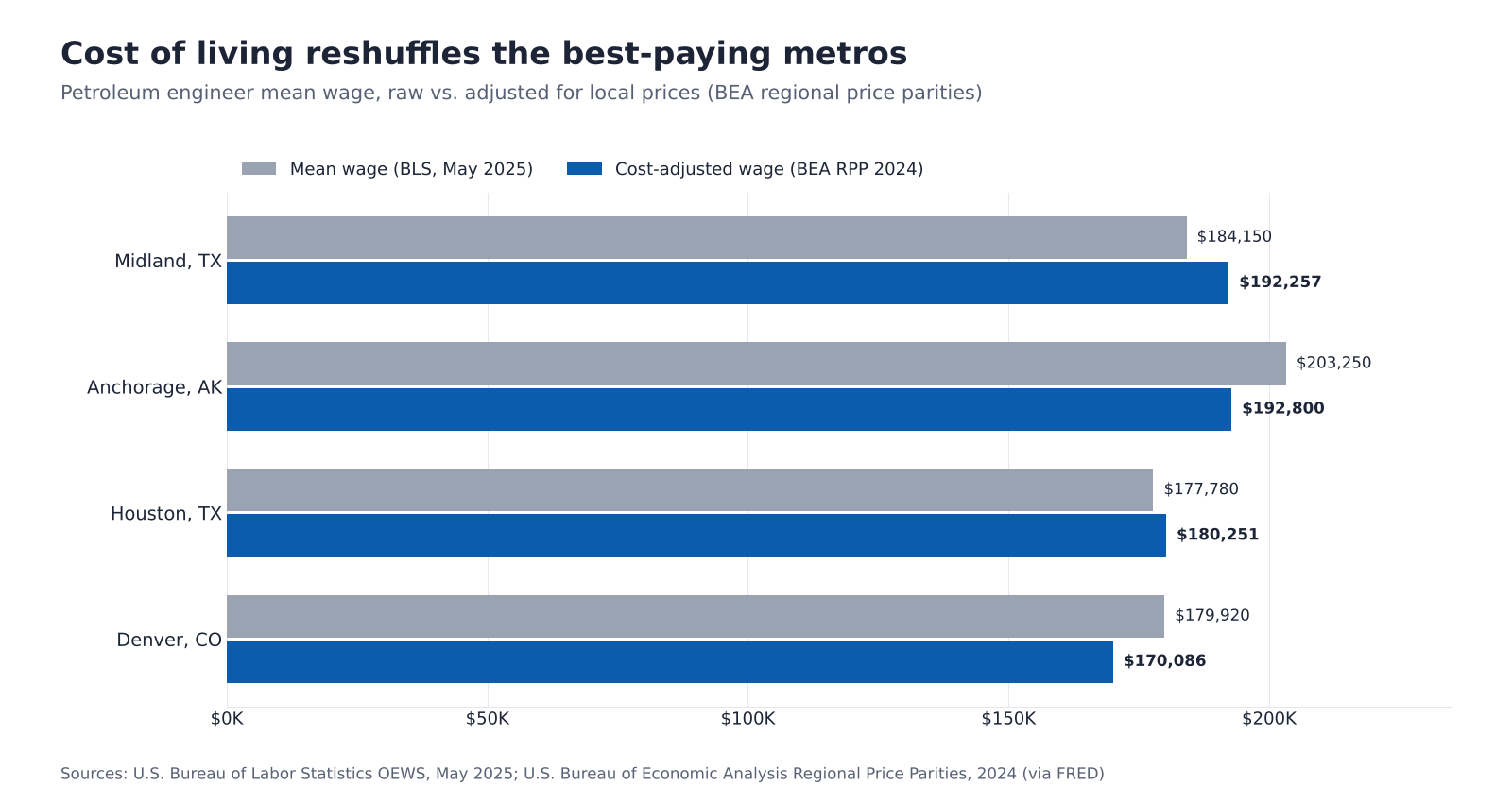
The median petroleum engineer salary in Texas is $164,860, about $20,000 above the national median, per the same BLS OEWS data. Within the state, Midland pays a mean of $184,150, and Houston pays $177,780.
Cost of living widens that gap. Using the Bureau of Economic Analysis regional price parities for 2024, the same salaries adjust to:
Source: BLS OEWS mean wages; BEA regional price parities via FRED for Midland (linked above), Houston, Denver, and Anchorage.
After adjustment, Midland pays almost exactly what Anchorage does, and Denver drops below Houston. The cost-adjusted metro averages for Midland and Denver differ by about $22,000. At the same base, a Midland offer buys about 10% more than a Denver one: on a $150,000 base, that's roughly $14,800 in purchasing power.
Petroleum Engineer Salary by Industry and Employer Type
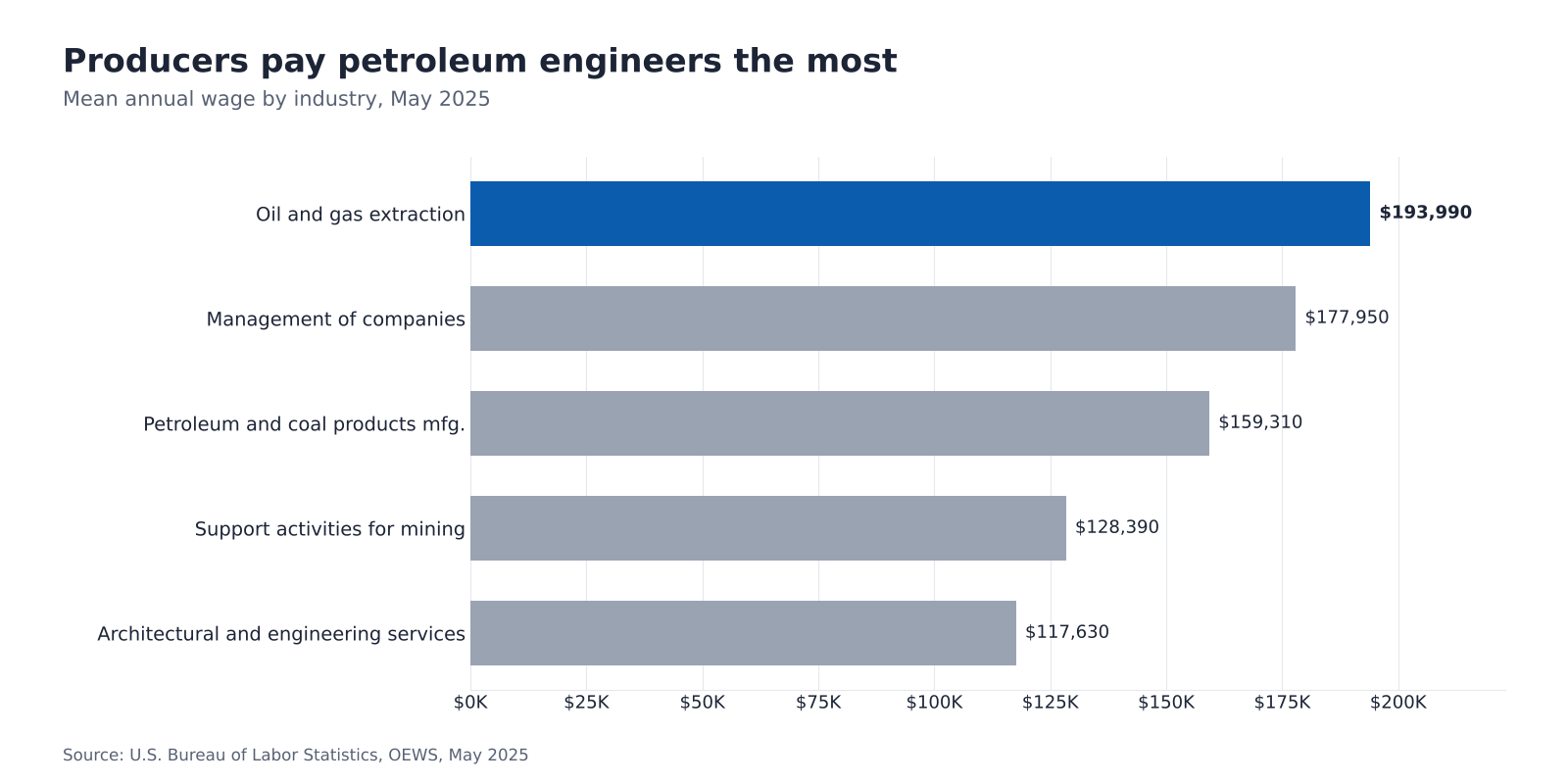
Petroleum engineers working for oil and gas producers earn an average of $193,990, approximately $65,600 more than those at oilfield service companies ($128,390). Employer type is a major factor influencing salary, alongside experience and seniority.
Source: BLS OEWS, May 2025.
The reason is economics. Operators own the reservoir and capture the value of every barrel an engineer helps recover, so they pay for judgment that moves production.
Service firms sell engineering hours and equipment to operators, which caps what they can pay in base salary. They close part of the gap with field allowances and overtime, covered in the total compensation section below.
The operator premium has also widened. In 2023, the extraction industry mean was $163,170 in the May 2023 BLS release cited above. Two years later it's $193,990, an increase of almost 19%.
Petroleum Engineer Salary by Specialization
Drilling engineers earn the highest average base salary of the main petroleum engineering specialties, followed by reservoir and completions engineers.
Specialty pay data is thinner than BLS data because BLS groups every specialty under one occupation code, so all four figures below come from one self-reported pay survey and should be read with their sample sizes in mind.
Drilling Engineer Salary
Drilling engineers average $149,036 in base pay. The premium reflects cost exposure: a single offshore or extended-reach well can cost tens of millions of dollars, and drilling engineers carry that budget.
Reservoir Engineer Salary
Reservoir engineers average $136,375, with a 90th percentile of $214,000.
Completions Engineer Salary
Completions engineers average $130,128, but that figure rests on only 12 profiles. Treat it as directional. Demand for completions engineers tracks shale activity closely, so pay swings faster with rig counts than in other specialties.
Production Engineer Salary
There's no reliable public salary dataset for oil and gas production engineers. Salary sites list "production engineer" pay, but those pages mix in manufacturing production roles, which pull the average far below what an upstream production engineer earns. For this specialty, use the BLS petroleum engineer percentiles and adjust for employer type.
What Oil and Gas Companies Pay Petroleum Engineers
U.S. Department of Labor H-1B filings show 2025 petroleum engineer salaries ranging from $98,072 to $170,000, with a median of $129,210. These are employer-filed wage commitments, not proof of a hire or of pay received, but they are one of the few public records of what employers say they will pay.
Source: DOL Labor Condition Application data compiled by the public LCA database cited above, 2025 filings for the job title "Petroleum Engineer" (9 records).
An H-1B Labor Condition Application lists the wage an employer commits to pay a sponsored worker, which must be at least the higher of the actual wage paid to similar workers and the prevailing wage. That makes LCA data a useful public proxy for offer levels. It has limits: the samples are small, and the figures exclude bonus and stock.
Large operators pay well above those bases once you add everything else:
- ExxonMobil: petroleum engineer total compensation commonly falls between $263,000 and $312,000, based on submissions to a compensation-sharing platform. The sample is small, and these are mostly experienced engineers.
- ConocoPhillips: a job-postings salary tracker estimates an average of $167,011, based on just 11 postings.
In our experience, the spread between majors and independents narrows in base salary and widens in bonus and long-term incentives. Two offers with the same base can differ sharply in year-one total compensation.
Petroleum Engineer Total Compensation: Bonus, Profit Sharing, and Field Pay
Base salary is only part of a petroleum engineer's pay: bonus, profit sharing, stock, and field allowances can add tens of thousands of dollars a year. The self-reported pay survey cited above shows annual bonuses from $4,000 to $59,000, profit sharing of up to $65,000, and total pay ranging from $75,000 to $241,000.
For field roles, the extras can matter even more. An industry hiring report estimates that per diem, overtime, and housing allowances add 20% to 40% to base pay for service-company field engineers, who typically work rotations such as 14 days on and 14 off, or 21 on and 7 off.
Do petroleum engineers get paid more offshore? Usually yes, through rotation pay and allowances more than base salary. No public dataset isolates offshore petroleum engineer pay, so compare offshore offers on total annual cash, including days-on premiums, and on the hours you'll actually work.
Employers designing these packages often bring in outside help. Our roundup of total rewards consulting firms covers who does this work well.
Petroleum Engineer Salary Outside the US
Engineers in petroleum, mining, and metallurgy in Norway's private sector average NOK 1,086,360 a year, and Canadian petroleum engineers earn a median of CAD $64.90 an hour.
Gulf-region figures look high in headline terms but are less reliable and often exclude housing and schooling allowances.
A few notes on reading this table:
- In Norway, engineers in that group with a master's degree average NOK 1,205,880.
- Canada's hourly median works out to roughly CAD $135,000 a year at a 40-hour week, or about CAD $11,250 per month.
- We couldn't find a verified source for Qatar, so it's left out.
Headline figures understate Gulf packages. Expat contracts in Saudi Arabia, the UAE, and Qatar usually add housing, schooling, flights, and tax-free income, which can be worth more than the salary difference itself.
Companies hiring petroleum engineers across borders without a local entity usually use an employer of record service to handle payroll and compliance.
How Do Oil Prices and Layoffs Affect Petroleum Engineer Salaries?
Oil prices, mergers, and corporate restructuring can influence petroleum engineering jobs and salary negotiations. In 2025, several major oil and gas producers announced substantial workforce reductions.
According to a Reuters factbox:
- ConocoPhillips announced plans to cut 20% to 25% of its workforce.
- Chevron announced plans to reduce its global workforce by 15% to 20%.
- BP announced in January 2025 that it would cut about 4,700 employee jobs and 3,000 contractor roles.
Oil prices have since risen considerably. Brent crude averaged $69 per barrel in 2025, while the U.S. Energy Information Administration's October 2026 Short-Term Energy Outlook forecasts an average of $96 in 2026 and $105 in the fourth quarter. It also projects U.S. crude oil production of 13.9 million barrels per day in 2026.
These changes matter because oil-market conditions can influence exploration budgets, engineering hiring, and compensation negotiations. However, higher oil prices do not automatically translate into higher petroleum engineer salaries.
How Petroleum Engineer Salary Compares to Other Engineering Jobs
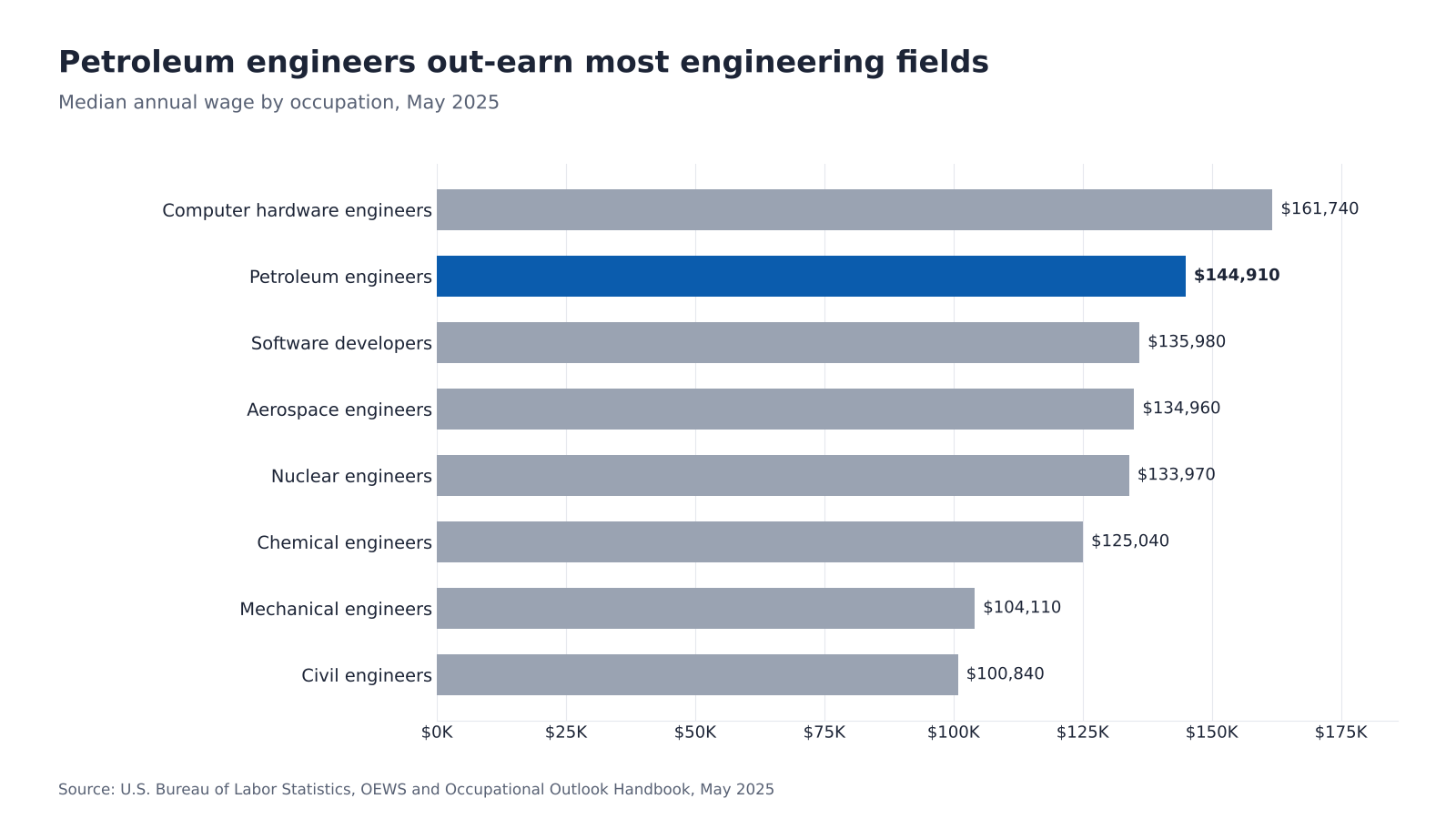
Petroleum engineers earn more than almost every other engineering occupation. Among the major engineering jobs BLS tracks, only computer hardware engineers ($161,740) out-earn them at the median.
Source: BLS OEWS national estimates cited above, May 2025.
The trade-off is volatility. Chemical and mechanical engineers have broader employer bases across many industries, so their pay and employment move less when oil prices fall.
Petroleum engineers are paid a premium partly for carrying that cycle risk, which is also why companies hiring across disciplines benchmark each one separately in their engineering recruitment plans.
Engineer Offers
Employers should benchmark petroleum engineer offers against the BLS mean for their own industry and metro, then price bonus and field pay on top. Benchmarking against the national median alone is the most common reason operator offers come in low and service-company offers come in high, and it's the first thing we fix in a compensation benchmarking review.
Then run a short benchmarking process before the requisition opens:
- Set the level, using years of experience and scope (single well, field, or asset).
- Pick the comparison set: your industry, your metro, and three to five direct competitors.
- Price the full package, including bonus target, long-term incentives, and field or rotation pay.
- Check the posted range against pay transparency laws in every state where the role is advertised. Colorado, California, and Washington all require ranges in postings.
- Set a counteroffer ceiling in advance so the hiring manager can respond the same day.
Cash isn't the only lever. Rotation schedules, remote reservoir-modeling days, and a clear path to a principal title all count for experienced engineers. Engineers coming off 14/14 field rotations often weigh a predictable schedule as heavily as base salary, and operators that offer one tend to win those candidates at a smaller premium.
When the cash gap is a few thousand dollars, those benefits often close it, as long as they're written into a clear employee value proposition.
Hire Petroleum Engineers with Alpha Apex Group
Petroleum engineer salaries vary by experience, employer type, location, and oil-market conditions. Setting a competitive offer requires understanding these differences and what qualified candidates expect.
Alpha Apex Group helps energy companies identify and recruit experienced engineering talent. Our energy recruitment team develops tailored search strategies, draws on industry networks, and evaluates candidates for technical expertise and fit with the hiring organization's needs.
If you're hiring petroleum engineers this year, talk to our energy executive search team about a benchmarked search.
FAQs
What does a petroleum engineer do?
A petroleum engineer designs and manages the methods used to extract oil and gas from underground reservoirs. Most specialize in one of four areas: drilling engineering, reservoir engineering, completions engineering, or production engineering. They work for oil and gas producers, oilfield service companies, refiners, and engineering consultancies, splitting time between offices and well sites.
Who earns more, a lawyer or a petroleum engineer?
Lawyers earn more at the median: $159,670 a year vs. $144,910 for petroleum engineers, according to BLS May 2025 data. Petroleum engineers, though, get close to that pay with a four-year bachelor's degree, while lawyers need a bachelor's degree plus three years of law school.
How long does it take to become a petroleum engineer?
It takes about four years, the length of a bachelor's degree in petroleum engineering. The BLS handbook cited above lists a bachelor's degree as the typical entry requirement, with no prior work experience needed. Earning the Professional Engineer license takes at least four more years of supervised engineering experience.
What is the lowest salary for a petroleum engineer?
There is no fixed minimum salary for petroleum engineers. According to BLS May 2025 data, the lowest-paid 10% earned less than $81,440 annually. That figure marks the lower end of the national wage distribution; it does not represent a guaranteed starting salary. Pay varies by employer, location, experience, and responsibilities.
.jpg)
.jpg)

.jpg)
.jpg)