CFO Job Description Template: Responsibilities, KPIs & Reporting Lines
.jpg)
CFO turnover at America's largest companies was projected to reach 18.3% by the end of 2026, above the 16% ten-year average. And 64% of CFOs appointed in the first half of 2026 at companies in leading global public stock indices were stepping into the seat for the first time.
This puts more weight on the CFO job description.
Most templates list duties and stop. This template covers the core CFO responsibilities, KPIs, reporting lines, decision rights, and variations by company stage. It also includes a downloadable version you can adapt to your hiring process.
At Alpha Apex Group, we treat the CFO job description as the first version of the scorecard that will eventually be used to evaluate the hire. Our CFO executive search team typically delivers qualified candidates within 72 hours.
The strongest CFO job descriptions are built around the company’s next financial event, whether that is a capital raise, exit, audit, turnaround, or another major transition. That future mandate should shape the role more than the previous CFO’s résumé.
Key Takeaways
- A complete CFO job description has eight parts: role summary, company context, reporting lines, responsibilities, first-year success measures, qualifications, compensation, and application details.
- The CFO reports to the CEO and has an independent line to the audit committee; finance leaders report to the CFO.
- The most useful CFO KPIs measure close speed, forecast accuracy, liquidity and control quality, plus a couple of company outcomes.
- Stage matters more than title. A startup CFO, a PE-backed CFO and a public company CFO share a job title and very little else.
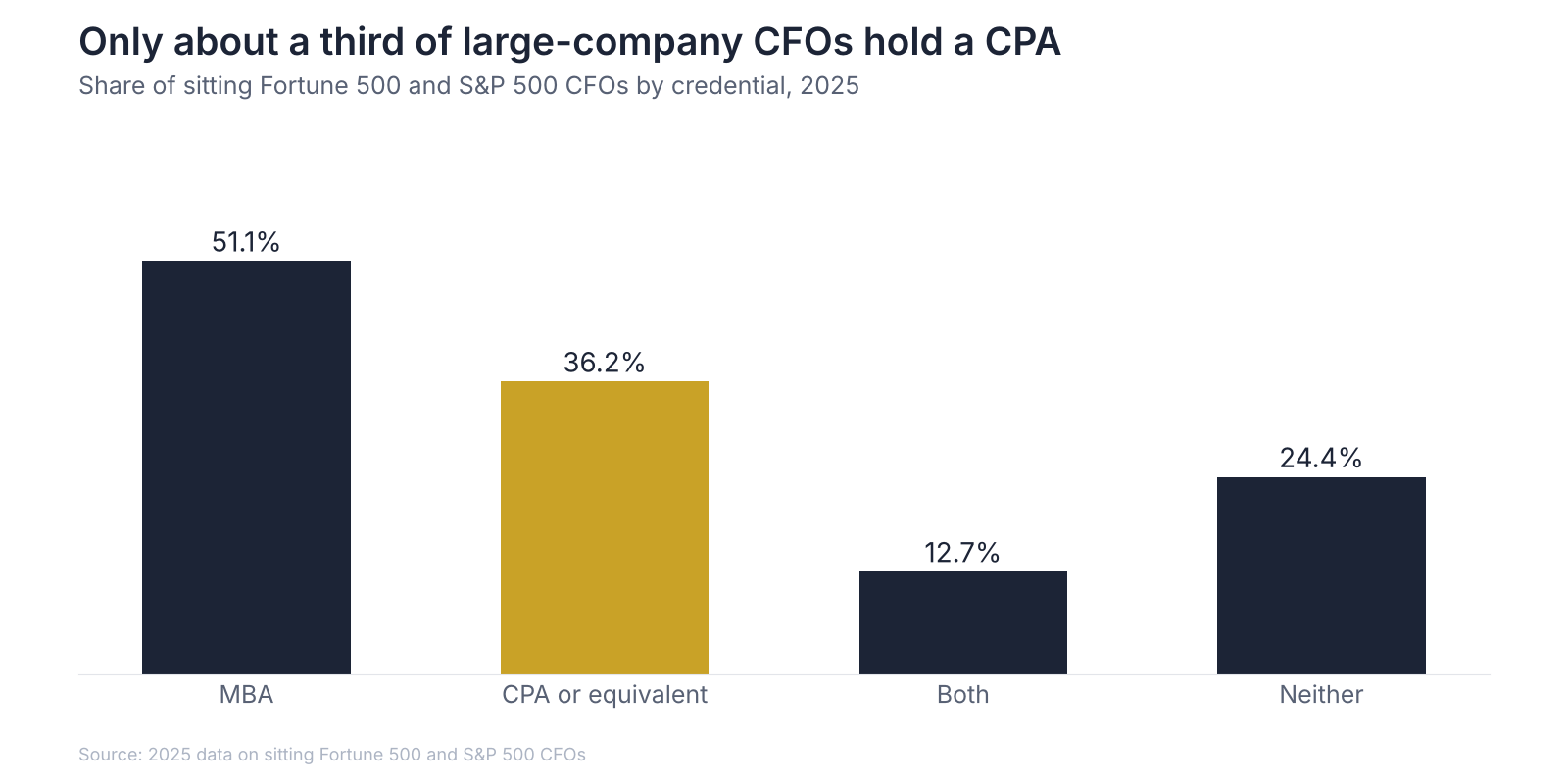
- 36.2% of large-company CFOs hold a CPA or equivalent accounting designation, so list credentials as preferred and require SEC reporting experience only where the role needs it.
What Does a Chief Financial Officer (CFO) Do?
A chief financial officer is the senior executive accountable for an organization's financial strategy, reporting, capital and risk. The CFO typically reports to the CEO and presents to the board.
In practice, the role carries three hats:
- Steward: Accurate books, clean audits, sound internal controls.
- Operator: A fast close, reliable forecasts, efficient finance processes and systems.
- Strategist: Capital allocation, fundraising, M&A, and a voice in every major business decision.
The weight on each hat has shifted over time. The scope keeps widening, which is why the reporting lines section below matters as much as the duties list.
CFO Job Description Template (Free to Download)
Copy or download the template below, replace every bracketed field, and delete any line that doesn't fit your company.

Job Title and Role Summary
Job title: Chief Financial Officer (CFO)
Location: [City, State / Hybrid / Remote]
Role summary: [Company name] is hiring a Chief Financial Officer to lead finance, accounting and capital strategy as we [next financial event: raise our Series C / prepare for a 2028 exit / complete our first external audit].
The CFO will own financial planning, reporting, treasury and risk for a [$ revenue] business with [number] employees. This is a hands-on executive role reporting to the CEO, with a standing seat at board meetings.
About the Company
[Two to three sentences: what the company does, its ownership (founder-led, venture-backed, PE-backed, public, nonprofit), headcount, revenue range, and the financial event ahead in the next 12 to 36 months.]
Reporting Lines
- Reports to: Chief Executive Officer
- Board access: Attends board meetings; independent access to the [audit committee/finance committee] chair
- Direct reports: [Controller], [VP or Director of FP&A], [Treasurer], [Tax Director], [IT/procurement lead, if applicable]
- Decision authority: Approves spend up to [$ amount]; owns finance hiring; signs [bank/lender/auditor] engagements
Key Responsibilities
- Build and run the annual budget, rolling forecasts and long-range financial plan
- Lead a monthly close of [target] business days and produce accurate financial statements under [GAAP / IFRS]
- Manage cash, banking relationships, debt and covenant compliance
- Maintain internal controls, tax compliance and enterprise risk management
- Prepare board materials and manage relationships with investors, lenders and auditors
- Lead fundraising, M&A analysis and capital allocation decisions
- Own the finance systems roadmap, including ERP, FP&A tools and automation
- Hire, develop and retain a high-performing finance team
Success Measures for the First 12 Months
- Monthly close completed in [X] business days by month [6]
- Forecast variance within [±X%] of actuals for [revenue / EBITDA]
- [X] months of cash runway maintained, or [financing event] closed by [date]
- Clean audit opinion with zero material weaknesses
- [Finance system / ERP] implementation live by [quarter]
- Finance team succession plan in place for [controller / FP&A lead]
Required and Preferred Qualifications
Required:
- Bachelor's degree in finance, accounting or economics
- [12+] years of progressive finance experience, including [5+] years leading a finance function
- Experience with [the company's next financial event: fundraising/exit/audit / ERP rollout]
- Track record presenting to a board, investors or lenders
Preferred:
- CPA, CMA or MBA
- Prior CFO or VP Finance experience at a [stage/industry] company
- Experience with [NetSuite / SAP / Workday / other ERP] and modern FP&A tools
Compensation and Benefits
- Base salary: [$X to $Y] (required in states and cities with pay transparency laws)
- Annual bonus: [X%] of base, tied to the success measures above
- Equity: [Stock options / RSUs / profits interest / LTIP], [vesting schedule]
- Benefits: [Health, retirement, PTO, other]
How to Apply and EEO Statement
[How to apply, who manages the search, expected timeline.] [Company name] is an equal opportunity employer and considers all qualified applicants without regard to race, color, religion, sex, sexual orientation, gender identity, national origin, disability or veteran status.
What Are the Main CFO Duties and Responsibilities?
CFO duties and responsibilities fall into eight areas: planning, accounting, treasury, risk, stakeholder relations, capital allocation, systems, and team leadership. The template above gives one line for each.
Here's what each area covers in practice and how to tailor that line.
1. Financial Strategy, Planning and FP&A
The CFO owns the budget, rolling forecasts and scenario plans that guide spending and hiring. Tailor this line by naming the planning horizon your board expects, such as a three-year model for a PE-backed company. Weak models are a common source of bad decisions, and we cover the usual traps in our guide to financial modeling mistakes.
2. Accounting, Monthly Close and Financial Reporting
The CFO is accountable for accurate balance sheets, income statements and cash flow statements, delivered on a predictable close calendar. A larger company delegates the daily work to a controller. Tailor this line by stating your reporting standard (GAAP or IFRS) and the close target you expect.
3. Cash, Treasury and Capital Structure
The CFO manages liquidity, cash flow planning, banking relationships, debt and covenants.
For a venture-backed company, this means runway. And for a leveraged company, it means covenant headroom. Name whichever one keeps your board up at night.
4. Risk Management, Internal Controls and Compliance
The CFO designs the internal controls that keep financial reporting reliable and owns tax compliance and enterprise risk. At public companies, the stakes are personal: under SEC rules implementing SOX Section 302, the principal executive and financial officers each certify every quarterly and annual report. If you're pre-IPO, add "build SOX-ready controls" to this line.
5. Board, Investor and Lender Relations
The CFO prepares board materials, runs the audit relationship and manages investors and lenders. Specify which audiences matter: a PE sponsor, a lender group, public shareholders or a nonprofit board finance committee.
6. M&A, Fundraising and Capital Allocation
The CFO decides where capital goes, raises it when needed, and leads deal analysis and diligence. Interest in acquisitions is growing: 63% of North American CFOs reported more interest in M&A than in 2024, in Deloitte’s Q4 2025 CFO Signals survey of 200 North American CFOs at companies with at least $1 billion in annual revenue. If acquisitions are part of the plan, say so and ask for integration experience.
7. Finance Systems, Data and AI
The CFO owns the finance tech stack, from the ERP to FP&A software and automation, and increasingly the data analysis that runs on it. In the same Q4 2025 Deloitte survey, 87% of CFOs said AI would be extremely or very important to finance operations.
8. Finance Team Leadership
The CFO builds the finance team and its bench. Tailor this line with the size of the team and any immediate hires, such as a first controller.
Which KPIs Should a CFO Be Measured On?
The right CFO KPIs measure how fast, accurate, liquid and controlled the finance function is, plus one or two company outcomes the CFO directly influences. Eight metrics cover most companies.
Set First-Year CFO Targets With the CEO and Audit Chair
Agree on first-year targets before the offer is signed, then revisit them once the CFO has seen the real numbers.
- Choose three finance-function KPIs and two company KPIs from the table.
- Ask the new CFO to baseline each one in the first 30 days.
- Set 12-month targets with the CEO and the audit committee chair.
- Review progress quarterly in the board finance session.
- Tie the annual bonus to the same five measures.
At six months, a good CFO has a reliable close and a forecast the board trusts. At twelve months, the finance team should be answering strategic questions faster than the business asks them.
CFO Reporting Lines: Who the CFO Reports To and Who Reports to the CFO
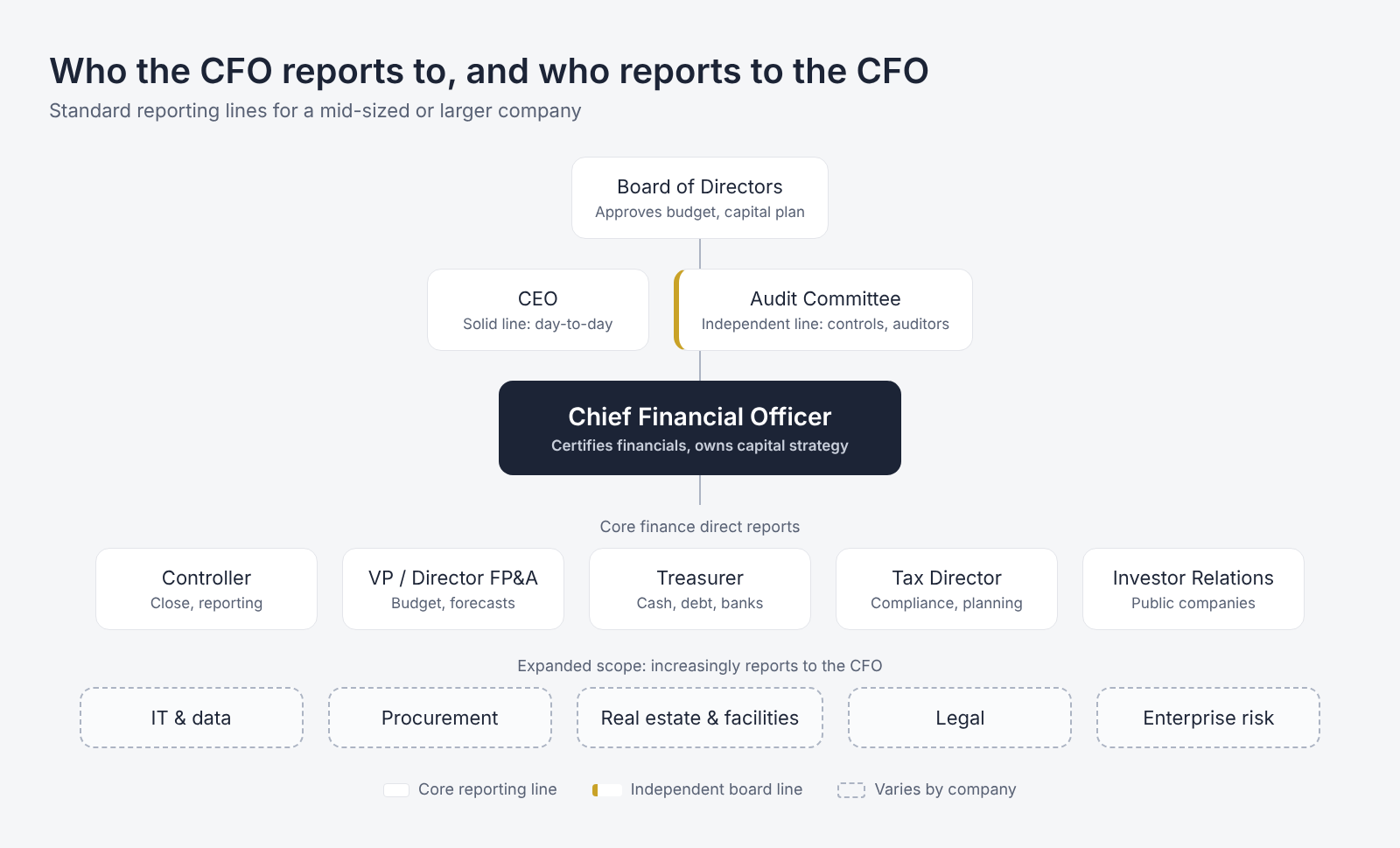
In most companies, the CFO ranks below the CEO and reports to them, with an independent line to the board's audit committee. The controller, FP&A, treasury and tax leaders report to the CFO.
Upward Reporting: CEO, Board and Audit Committee
The CEO oversees the CFO's executive responsibilities, while the board provides governance and financial oversight. At public companies, Sarbanes-Oxley certification requirements also require the CFO to disclose significant deficiencies and material weaknesses in internal controls to the external auditors and audit committee.
The CFO job description should specify the reporting relationship, board presentation responsibilities and decisions requiring board approval.
Downward Reporting: The CFO's Direct Reports
A typical CFO oversees the controller, head of financial planning and analysis (FP&A), treasurer and tax director. At public companies, investor relations may also report to the CFO.
The role can extend beyond finance. Gartner's research identifies enterprise data and analytics, risk management, corporate strategy, procurement, IT and AI among the responsibilities CFOs increasingly own or share.
Before adding these functions to the job description, companies should distinguish direct reports from shared responsibilities and confirm that the CFO has sufficient capacity to oversee them.
What Decision Authority Should a CFO Job Description Include?
A CFO job description should state decision authority as clearly as it states reporting lines. Write down three things:
- Spending authority: The dollar amount the CFO approves without the CEO.
- Hiring authority: Whether the CFO hires their own team directly.
- Board access: Whether the CFO meets the audit chair without the CEO present.
Experienced candidates ask about all three. A job description that answers them up front attracts candidates who want the actual job on offer.
How Does a CFO Job Description Change by Company Stage?
The CFO's priorities depend on the company's ownership and stage more than on its industry. You can use this table to adjust the template, then read the notes for each stage.
Startup and Venture-Backed CFO
A startup CFO's first job is runway: knowing exactly how many months of cash remain and closing the next round before that number gets uncomfortable.
The job description should ask for fundraising experience and for someone who will build the first real close process themselves. Many early companies start with part-time help, which the role comparison below covers.
Small and Mid-Sized Business CFO
A small business CFO often partners directly with an owner who has run finance informally for years. Ask for experience with bank lending, a first ERP or systems upgrade, and the patience to formalize processes without slowing the business.
Private Equity-Backed CFO
A PE-backed CFO works to the sponsor's value creation plan and an exit date. The job description should name the hold period and ask for lender reporting, 100-day plan experience and at least one completed exit. We cover the wider dynamics in executive search for PE-backed companies.
Pre-IPO and Public Company CFO
A public company CFO certifies the company's required annual and quarterly reports, runs earnings guidance and leads investor relations. This is the stage where demonstrated SEC reporting, SOX or IPO experience belongs in the required list. Pre-IPO JDs should ask for SOX readiness and S-1 experience.
Nonprofit and Hospital CFO
A nonprofit CFO manages restricted funds, grant compliance and the single audit required for organizations spending large amounts of federal money. Reporting usually runs to the executive director, with a strong line to the board's finance committee. Hospital CFOs add payer mix and reimbursement to the list.
What Qualifications Does a CFO Need?
A CFO typically needs a bachelor's degree in finance or accounting and at least 10 years of finance experience, including five or more in management, according to a national recruiter salary guide.
The U.S. Bureau of Labor Statistics sets the floor for financial managers at a bachelor's degree and 5 or more years in a related role, and CFO roles sit well above that floor. Certifications matter less than most templates suggest.
Among sitting Fortune 500 and S&P 500 CFOs in 2025:
- 51.1% hold an MBA.
- 36.2% hold a CPA or equivalent accounting designation (such as a CA or CMA).
- 24.4% hold neither.
Prior CFO experience is also less common than you'd expect. 65% of CFOs hired in 2025 were internal promotions, and fewer than a quarter of sitting CFOs came directly from another CFO seat. That's a strong argument for a leadership pipeline framework inside finance.
So keep CPA, CMA or MBA and a prior CFO title under Preferred in the template. For public and pre-IPO roles, require demonstrated SEC reporting, SOX or IPO experience, and decide separately whether a specific credential is required.
A prior CFO title requirement can exclude candidates ready to step up from senior finance roles.
What Salary Range Should a CFO Job Posting Include?
A CFO job posting should include a base salary range, a bonus target and the equity type. For larger companies, equity and long-term incentives carry most of the package, and if you're designing one from scratch, our total rewards consulting team can benchmark it against your peers.
Benchmarks vary widely by company size:
The average salary figures quoted on job boards often mix these populations, which is why they conflict. Post a range that matches your size and stage, and check local rules: several states and cities require a range in the posting under pay transparency laws.
CFO vs Controller vs VP of Finance vs Fractional CFO: Which Role to Hire
A controller runs accounting, a VP of Finance runs planning and reporting, a CFO owns financial strategy and capital, and a fractional CFO provides that strategic layer part time.
Pick the role before you write the job description. If the answer is a controller or VP of Finance, our accounting and finance executive search team covers those roles too.
Signs you need a full-time CFO:
- Lenders or a board expect monthly reporting packages.
- You run multiple entities, currencies or a first external audit.
- Finance decisions are waiting on the CEO's calendar.
A fractional CFO job description should list deliverables (a board pack, a financing model, a 13-week cash forecast) and the number of days per month.
Our recommendation: consider converting to a full-time hire when the workload, reporting complexity or need for day-to-day leadership outgrows a part-time arrangement. In our experience, that happens once the fractional CFO is working more than about two days a week, or the company is within a year of a major financing event. Our interim and fractional executive search team places both.
How to Use This CFO Job Description in the Hiring Process
Turn the finished job description into your hiring tool with five steps:
- Define the three-year mandate. State the CFO's primary objective in one sentence, such as “Prepare the company for a planned exit in 2029 by improving financial reporting, profitability, and transaction readiness.”
- Get CEO and board approval. Agree on reporting lines, decision authority, compensation, and first-year priorities before opening the search.
- Build an interview scorecard. Convert first-year KPIs into measurable evaluation criteria. Ask candidates for examples of achieving similar outcomes.
- Brief your search partner and finalists. Share the approved job description, expected outcomes, and evaluation criteria so everyone understands the role.
- Set the 90-day review. Use the first-year priorities to establish initial milestones and assess the new CFO's progress after joining.
Leadership IQ's older, widely cited study of more than 20,000 new hires across all job levels found that 46% of new hires failed within 18 months, and attitude accounted for 89% of those failures. The study isn't CFO-specific, but it points to the same lesson for executive hires: assess how candidates work with others as carefully as their technical record.
A clear job description helps establish performance expectations, while structured interviews and reference checks help evaluate how candidates work with others.
CFO Interview Questions Mapped to the Job Description
Hire Your Next CFO with Alpha Apex Group
A strong CFO job description makes the search faster, and the right search partner makes the job description work harder. Alpha Apex Group has made more than 2,000 placements worldwide, and our CFO searches assess candidates on financial judgment, leadership and fit with your company's next financial event.
We start every search by pressure-testing the job description with you: the mandate, the reporting lines, the decision authority and the first-year success measures in this template. From there, we present candidates against those measures, so interviews compare like with like.
Ready to start? Contact our CFO search team for a call that covers your mandate, the market for your profile, and a realistic timeline.
FAQs
Should a CFO job description name specific ERP or FP&A tools?
Yes, if the company is committed to its stack, because hands-on experience shortens the ramp. If a system change is planned, describe the decision ahead and ask for selection and implementation experience. Listing too many tools narrows the pool without improving it.
How should the job description change when the new CFO replaces a founder who ran finance?
Spell out which decisions move to the CFO and which stay with the founder, starting with spending authority and banking relationships. Ask for experience formalizing processes in a founder-led company. Candidates will probe this hand-off in interviews, so settle it in writing first.
Should the CFO job description mention the CFO's role in CEO succession?
Only if the board actually sees the CFO as a potential successor, and then carefully, as a development path. Promising a CEO track that isn't real damages trust within a year. Boards working through this question can start with our guide to CEO succession planning.
Can a first-time CFO lead a company through an IPO or exit?
Yes, with support. At large public companies, most new CFOs are first-timers, so the realistic question is whether the candidate has run a process like it from the number-two seat. Pair a first-time CFO with experienced advisors, a strong controller and an audit committee chair with deal experience.
How often should a CFO job description be rewritten?
Rewrite it whenever the company's next financial event changes, and review it at least every two years. A job description written for a Series B raise is the wrong document for a company preparing for a sale. Updating the success measures each year also keeps the CFO's bonus plan honest.
.jpg)


.jpg)
.jpg)