What Is a PE Operating Partner? Role, Comp & How to Hire One
Private equity used to make its money on leverage and timing. That playbook has worn thin. Buyout funds now hold companies for around seven years at exit, up from five to six years between 2010 and 2021, so returns have to come from running businesses better.
That shift is why the operating partner has moved from a nice-to-have to a core seat at most firms. It's also why the title gets misused. This guide covers what an operating partner in private equity actually does, the five models firms use, what the role pays by fund size, and a seven-step process for hiring one.
P.S. If you're scoping an operating partner search now, our private equity executive search team can help you scope the mandate.
TL;DR
- What it is: A senior operator employed or retained by a PE firm to improve portfolio company performance during the hold.
- Five models: Full-time generalist, functional specialist, senior advisor, fractional or interim, and a dedicated portfolio operations group.
- Pay: Mean cash compensation of roughly $385K to $1.14M depending on fund size, plus modeled carry of about $2M to $7M in most fund-size bands (2024 industry compensation survey).
- Hiring: AAG's planning estimate for a retained, partner-level operating search is three to six months.
- Measurement: Judge an operating partner on value creation plan delivery and leadership stability. Activity counts tell you very little.
The title "operating partner" now covers at least five different jobs, which means the job description is the strategy. Firms that start a search with "we need a former CEO" tend to hire a résumé. Firms that start with one value creation lever and one operating model hire someone who can move it.
The market already reflects this. Former CEOs make up a shrinking share of operating partners, while people who have done the job inside another PE firm make up a growing one. In our view, the stronger predictor of success is credibility with portfolio company management combined with a track record of delivering a specific lever under sponsor ownership.
What Is an Operating Partner in Private Equity?
An operating partner is a senior executive at a private equity firm who improves portfolio company performance during the holding period. Most are employed by the firm, and some are exclusively retained.
Deal partners make the investment calls. The operating partner works on what happens in between: cost, growth, talent, technology, and the execution of the value creation plan.
Most operating partners have run something before, usually a P&L, a function, or a turnaround. They sit at the general partner level at many firms, attend portfolio company board meetings, and work directly with CEOs and CFOs.
Advent, for example, named Patricia Cross an operating partner for Australia and New Zealand in May 2026 to support its regional portfolio.
The operating partner meaning shifts slightly in venture capital. A VC operating partner usually runs platform support across many early-stage companies, such as recruiting, go-to-market advice, and founder coaching.
A PE operating partner works on fewer, larger companies and is judged on EBITDA growth and value creation plan delivery. This guide focuses on the private equity version.
What Does a PE Operating Partner Do Across the Deal Lifecycle?
An operating partner's job changes by deal stage, from testing the investment thesis before close to proving the equity story before exit.
The table below summarizes the role at each stage, and the sections that follow explain what good looks like.
Due Diligence: Test the Operating Thesis Before Close
In diligence, the operating partner checks whether the improvements baked into the price are realistic. That means walking the operations, assessing the management team, and narrowing the plan to the two or three levers that justify the valuation. Many firms pair this with people and culture diligence so leadership gaps surface before signing.
First 100 Days: Build the Value Creation Plan
The value creation plan is the document that turns the investment thesis into named initiatives, owners, milestones, and KPIs. The operating partner usually drafts it with the CEO and CFO, sets the KPI baseline, and flags leadership changes early, including CEO succession.
These changes are common: 65% of PE firms report CEO turnover during the holding period, according to a 2026 PE leadership survey.
Hold Period: Run Initiatives and Portfolio-Wide Playbooks
During the hold, the operating partner runs the value creation strategies the plan calls for.
Typical work includes:
- Cost management and procurement savings across portfolio companies
- Pricing and commercial excellence programs
- Monthly KPI reviews with management
- Board preparation and governance cadence
- Shared playbooks for talent, finance, and technology
Pro tip: Keep a short, ranked list of initiatives per company and cut anything that isn't moving EBITDA by an agreed review point.
Exit Preparation: Prove the Equity Story to Buyers
Twelve to eighteen months before a sale, the operating partner shifts to making results provable. This means clean KPI history, a credible forward plan, and a management team buyers want to keep. A buyer pays for performance it can verify, and the operating partner owns that evidence.
Why PE Firms Are Adding Operating Partners Now
Firms are adding operating partners because operational improvement now drives a larger share of returns than financial engineering.
A study by the Institute for Private Capital, cited in a 2023 industry analysis, found operations accounted for about 47% of PE value creation since 2010, up from 18% in the 1980s, while financial engineering fell from 51% to 25%.
Market conditions push in the same direction:
- Exits are slow. The industry is sitting on roughly 32,000 unsold companies worth $3.8 trillion, and distributions as a share of NAV have stayed below 15% for four years running.
- Operating teams are mainstream. In Paul Weiss's 2024 fundraising survey, nearly half (47%) of the roughly 50 large, top-of-market funds reviewed had a dedicated operating partner group.
- LPs expect it. An LP interviewed for a 2012 study of operating partner models said it would be hard to invest in a firm without an operating partner model, and warned against "phantom operating partners" listed for show.
Longer holds also mean more leadership decisions per company. Our guide to executive search for PE-backed companies covers how those hires tie back to the value creation plan.
What Are the Five Private Equity Operating Partner Models?
Most firms use one of five private equity operating partner models, and the model decides the profile you need, how many companies the person covers, and who pays for the role.
1. Full-Time Generalist Operating Partner
A full-time generalist operating partner sits at partner level and covers several portfolio companies across functions. How many depends on portfolio complexity and the mandate. This is the classic model at mid-market firms. It works when the firm's thesis depends on broad operational upgrades and the partner has enough authority to push management and the deal team.
2. Functional Specialist Operating Partner
A functional specialist operating partner owns one discipline across the portfolio, such as finance, pricing, technology, or talent. PwC notes that firms increasingly want specialists who can deliver a specific lever, and a 2024 operating professional survey reports growing interest in finance specialists in particular. AI is the newest specialty, covered in its own section below.
3. Senior Advisor or Executive Advisor
A senior advisor is a part-time role that typically takes 5% to 50% of the individual's time, according to a 2024 operating professional compensation survey. Advisors are often former industry CEOs who add sector credibility in diligence and sit on portfolio company boards.
4. Fractional or Interim Operating Partner
A fractional operating partner works on a defined mandate, mostly at a single portfolio company or for a set period. Lower middle market funds use this model to test the role before committing to a full-time hire, and larger firms use it to cover a leadership gap. If you're comparing providers, see our roundup of fractional and interim executive search firms.
5. Dedicated Portfolio Operations Group
The largest firms build in-house operating groups that work like an internal consulting arm. KKR Capstone began as a small team in 2000 and now has about 100 full-time operating professionals. Bain Capital's Portfolio Group lists more than 115 operating professionals.
Operating Partner vs. Deal Partner, Managing Partner, Consultant, and Portfolio CEO
The operating partner owns how value gets created, while the deal partner owns whether to buy and when to sell. The confusion with other roles usually comes from overlapping titles, so the table below separates them by accountability.
Two related titles also come up. A venture partner usually sources and supports deals part time, and an entrepreneur-in-residence is often a future founder or CEO being incubated by the firm.
Here's a quick test for whether a firm really has an operating partner: look at the calendar. If most of the person's week goes to investment committee and LP meetings, the firm has a deal partner with a different title.
How Much Does a PE Operating Partner Make?
Operating partners earned mean cash compensation of roughly $385K to $1.14M in 2023, depending on fund size. That's according to a 2024 North American operating professional compensation survey of 251 North American operating professionals.
Carry is the larger prize. Modeled carry at work runs about $2M to $7M in most fund-size bands, assuming a net 2x return in a fund charging a 20% performance fee. It's an expected value across a person's carry participation, not a realized or guaranteed payout.
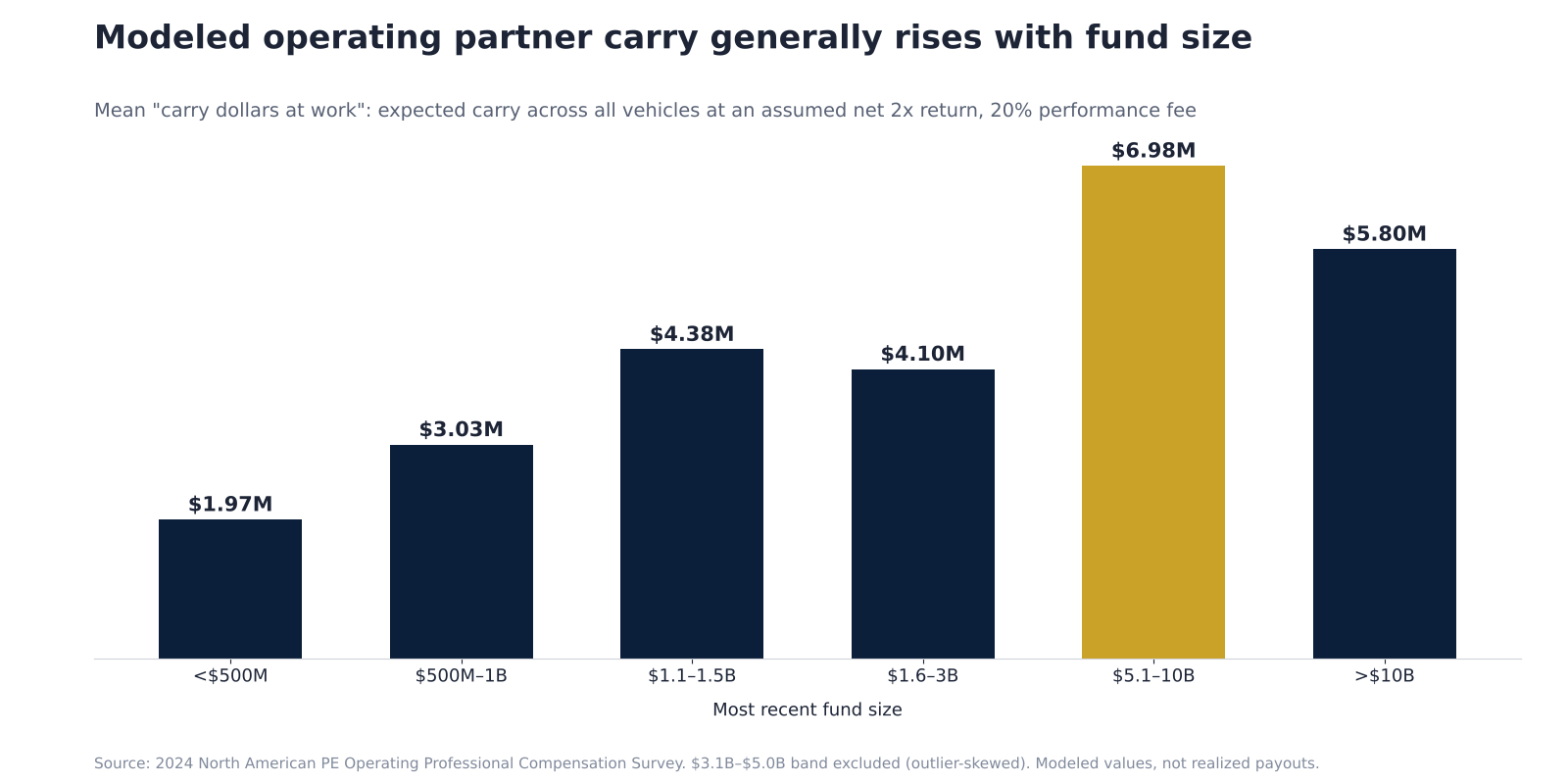
Operating Partner Salary and Bonus by Fund Size
Cash pay rises with fund size, from about $385K at funds under $500M to about $1.1M at funds above $3B. Sample sizes are small, so treat each band as directional.
Mean total cash is reported separately by the survey and won't always equal base plus bonus, because response counts differ by question. Carry at work is a modeled expected value (net 2x return, 20% performance fee) across the person's carry participation. It isn't realized or paid out each year.
Bonuses are becoming more structured. In the same survey, among respondents with discretionary bonus plans, 52% said their bonus was entirely discretionary, down from 67% in 2022.
Carried Interest and Co-Invest
Most full-time operating partners get carry, though usually a smaller share than deal partners. In a 2024 portfolio operations compensation study, 83% to 92% of operating partners were eligible for carry depending on fund size, and 67% to 75% could co-invest.
When structuring carry, settle three things up front:
- The points in the current fund and whether they extend to future funds
- The vesting schedule and what happens if the operating partner leaves mid-fund
- Whether carry comes from the firm-wide pool or a portfolio-specific pool
Fractional and Advisory Fee Structures
Fractional and advisory operating partners are usually paid through a monthly retainer, a per-company fee, or a mix of cash and equity in the portfolio company they support. There's no reliable public benchmark for day rates, so price these against the scope, the time commitment, and the cost of a full-time hire for the same mandate.
Who Pays: Fund Expenses vs. Portfolio Company Fees
Who pays for the operating partner depends on the fund documents. In the Paul Weiss survey, 88% of funds with an operating partner group permitted operating partner expenses to be charged to the fund under their fund terms.
LPs increasingly scrutinize these charges and fee offsets, so align the structure with your LPA before you make an offer. If you're designing a package for the first time, our compensation and benefits consulting team can benchmark it.
How to Hire a PE Operating Partner: A 7-Step Process
Hiring a PE operating partner starts with the value creation mandate. The candidate profile comes second. By AAG's planning estimate, a retained search for a partner-level operating role runs three to six months. The steps below follow that sequence.
By AAG's published benchmarks, new candidates reach the hiring manager within 72 hours, and full-time searches average 43 days to fill.
Step 1: Define the Value Creation Mandate and Operating Model
Write down the one or two levers this person must deliver, such as margin expansion, pricing, digital transformation, M&A integration, or talent. Then pick the operating model from the section above that fits the mandate.
Finally, set the scope: how many portfolio companies, which sectors, and whether the role covers diligence on new deals. If you're weighing outside help for the search itself, our ranking of private equity executive search firms compares the main options.
Step 2: Write the Operating Partner Job Description and Scorecard
A strong operating partner job description covers:
- The mandate
- Portfolio scope
- Reporting line
- Board seats
- Success metrics at 6, 12, and 24 months
Pair it with a scorecard built on the skills and competencies that predict success. One widely cited assessment model frames these as three abilities: creating value, influencing the deal partner, and influencing the portfolio company CEO. The table below is an illustrative scorecard; adjust the weights to the mandate.
Step 3: Set the Compensation Structure Before Outreach
Agree on the base and bonus band, carry points, co-invest rights, and whether the fund or the portfolio companies pay before the first candidate call. Strong candidates ask about carry early, and a firm that can't answer loses them. Use the pay data in the compensation section above as your starting benchmark.
Step 4: Source Beyond Former CEOs
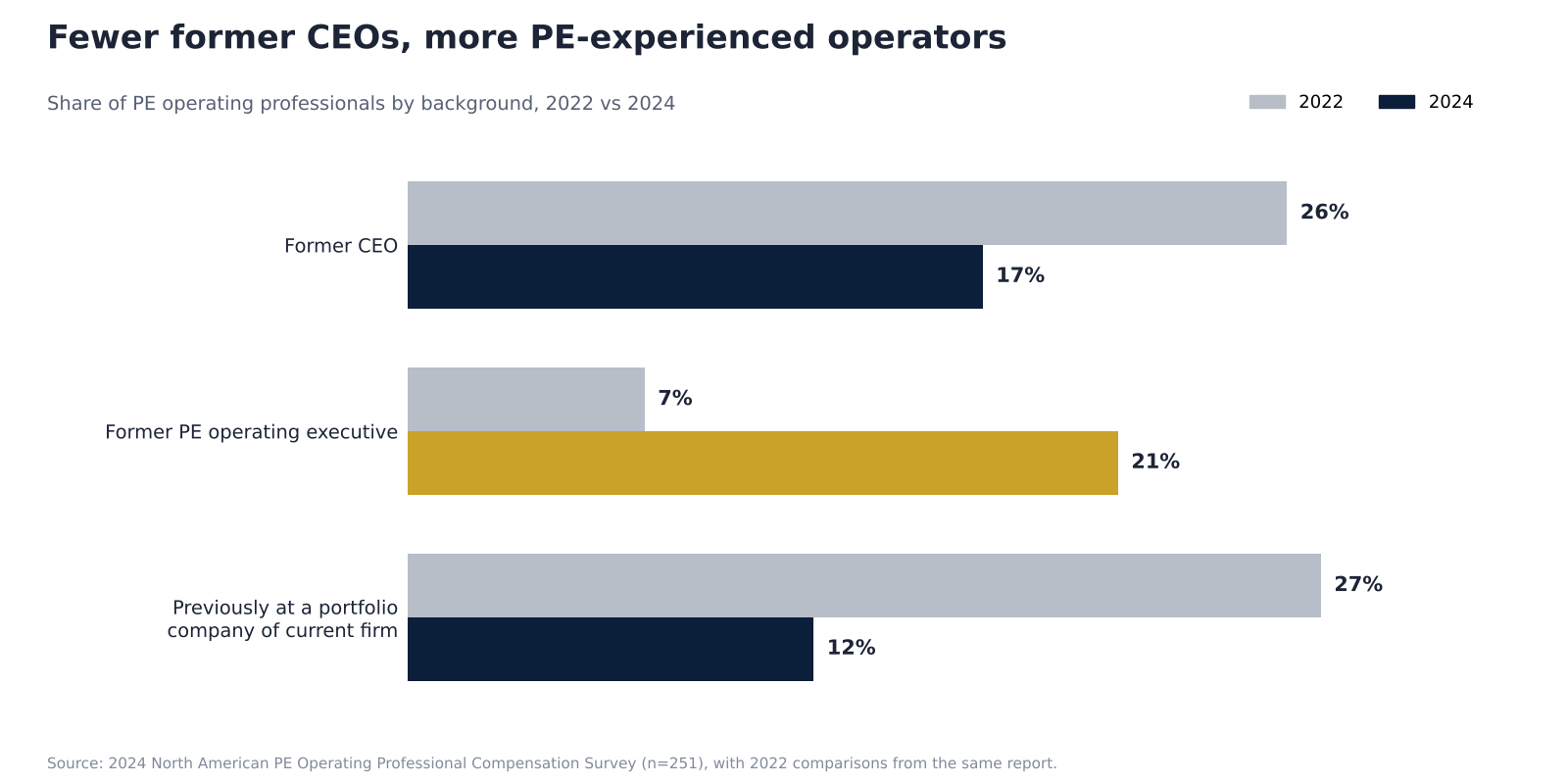
Former CEOs are a smaller share of the pool than most firms assume. In the 2024 compensation survey cited above, only 17% of operating professionals had been a CEO in their prior role, down from 26% in 2022, while 27% came from management consulting and 21% had been PE operating executives, up from 7%.
Just 12% had worked at a portfolio company of their current firm, down from a high of 60% in 2014.
Widen the search to:
- Operating executives at other PE firms
- Functional leaders who delivered your target lever at PE-backed companies
- Consulting partners with hands-on implementation experience
- Executives you've developed through your own leadership pipeline
Most of these candidates aren't looking, so plan for direct outreach.
Step 5: Assess with Scenario-Based Interviews
Test candidates on a real portfolio company. Give them a short data pack and ask for their top three constraints and how they'd rank them by return.
- How do you identify and prioritize constraints in a company you don't know yet?
- How do you build trust with management without being seen as the fund's spy?
- How do you document a playbook so executives own the execution after you step back?
Step 6: Reference-Check with Portfolio CEOs and Deal Partners
Talk off-list to the CEOs and CFOs the candidate worked alongside, in addition to the sponsors who hired them. Ask each reference to confirm the results the candidate claimed and who actually owned them. Then probe for "going native," the failure mode where an operating partner sides with management against the firm.
Step 7: Onboard with a 30/60/90-Day Plan
The operating partner's own onboarding is separate from a portfolio company's first 100 days. Plan it in three stages:
- Days 1 to 30: Visit every portfolio company in scope, meet each CEO, and review the current value creation plans.
- Days 31 to 60: Take ownership of specific initiatives and attend the first board meetings.
- Days 61 to 90: Present a ranked initiative list with targets to the investment team.
Our employee onboarding checklist covers the logistics side.
What Are the Red Flags When Hiring an Operating Partner?
Most operating partner mis-hires show warning signs in the interview process. Watch for these:
Many of these mirror broader executive hiring mistakes, but they carry a higher price in PE, where a lost year can be a big slice of a hold.
How to Measure Operating Partner Performance
Measure an operating partner on value creation plan delivery, contribution to the EBITDA bridge, and leadership stability. Hours logged and initiative counts tell you how busy someone is and very little about results.
The common challenges in measuring operating partners are attribution and conflicting loyalties. PwC points out that it's hard to tie a portfolio company's results to the operating partner, and the role answers to both the deal team and management.
Agree on which initiatives the operating partner owns before the hold starts, and review those, so credit and accountability stay clear.
How AI Is Changing the Operating Partner Role
AI is compressing the analytical part of the operating partner's job and expanding the change-management part. Benchmarking, diligence analysis, and KPI reporting take less time with AI tools. Redesigning workflows and teams around those tools takes more.
The pressure is already visible. 41% of companies with significant PE investment expect AI to cut more than 10% of jobs within five years, according to that 2026 PE leadership survey, which puts workforce redesign on the operating partner's desk.
For hiring, point back to the AI and data fluency row in the Step 2 scorecard and ask for a deployed result with a measured KPI. Our guide to AI executive search firms covers how to find leaders with that track record.
Hire Your Next Operating Partner with Alpha Apex Group
The right operating partner is defined by the mandate first and the pedigree second. This means agreeing on the lever, the model, and the comp structure before outreach, then testing candidates on real portfolio problems and checking references with the CEOs they worked alongside.
Alpha Apex Group runs operating partner and portfolio leadership searches for private equity firms, from full-time partners to fractional and interim mandates. With more than 2,000 placements worldwide and advisory support after the hire, we help sponsors land operators who deliver the plan.
Ready to scope your search? Contact our team to talk through the mandate, the market for candidates, and a realistic timeline.
FAQs
Should an operating partner sit on the investment committee?
It depends on the firm, since participation and voting rights vary. A non-voting seat is one option: it lets the operating partner challenge operating assumptions before a deal is approved without blurring accountability for the investment decision.
Should an operating partner's bonus track individual portfolio companies or the whole fund?
A blend usually works best. Tie part of the bonus to the companies the operating partner owns initiatives at, so accountability is real, and part to fund performance, so they share learnings across the portfolio. Carry already rewards fund performance, so many firms weight the cash bonus toward company-level results.
What happens when an operating partner and a portfolio CEO disagree?
The company's agreed governance decides it, through the board and the decision rights set at the deal. Operating partners advise and influence. They don't run the company.
When disagreements become constant, it's often a sign that either the CEO is the wrong fit or the operating partner has drifted into managing the business directly.
Can the firm's existing operating partner step in as interim CEO?
Yes, and it happens when a CEO leaves suddenly. It works best as a short bridge with a permanent search running in parallel, or with an interim executive brought in so the operating partner can step back, since the operating partner's other companies lose coverage while they're in the seat. Set a clear end date and a handover plan before they step in.
Is hiring a former portfolio company CEO as an operating partner a conflict?
It can be managed, but it needs guardrails. The main risks are loyalty to their former management team and access to information about a company they once ran. Keep them off decisions about that company for a set period and disclose the relationship to the board.
Can Alpha Apex Group Provide a Fractional Operating Partner?
Yes. Alpha Apex Group offers fractional executive services for organizations that need experienced leadership without immediately committing to a full-time hire. This can be useful when a PE firm or portfolio company needs specialized operational expertise during a transition, transformation initiative, or leadership gap.
Can Alpha Apex Group Recruit Operating Partners for Specific Industries?
Alpha Apex Group can tailor an executive search around the requirements of the investment strategy and portfolio. That includes prioritizing candidates with relevant sector knowledge, functional expertise, operating experience, and a track record that aligns with the PE firm's value creation priorities.
.jpg)
.jpg)