Top 10 Supply Chain Management ERP Software Solutions
Companies continue to invest in software that connects planning, procurement, inventory, manufacturing, and logistics. Still, selecting the right platform remains difficult.
In fact, PwC found that 92% of operations and supply chain leaders said their technology investments had not fully delivered the expected results.
The best supply chain management ERP software depends on how your operations work. A manufacturer managing production schedules has different requirements from a retailer coordinating stores, warehouses, ecommerce orders, and suppliers.
This guide compares leading solutions based on where they fit best. It also explains how enterprise resource planning software differs from dedicated supply chain tools, helping you choose the right approach for your operations.
Read Next: Top 6 ERP Selection Criteria for Choosing the Best System
TL;DR: Top 5 Supply Chain ERPs
- WinMan ERP: Best for manufacturers and distributors seeking an all-in-one ERP with strong MRP, supplier management, and inventory control to streamline production and purchasing.
- Oracle Fusion Cloud SCM: Best for large global enterprises that need a comprehensive cloud suite connecting planning, manufacturing, procurement, logistics, and analytics across complex operations.
- ERPNext: Best for organizations that need a flexible, open-source ERP that delivers robust inventory, procurement, fulfillment, and supplier management without vendor lock-in.
- LeanDNA: Best for discrete manufacturers that want to improve supply planning, inventory execution, and supplier collaboration by maximizing data from their existing ERP.
- SAP Supply Chain Management: Best for global enterprises that need end-to-end supply chain planning, manufacturing, procurement, and logistics within a unified SAP ecosystem.
Supply Chain ERP Fit by Operating Model
The right supply chain management ERP software depends on how closely its capabilities match your operating model.
Manufacturers, distributors, 3PL providers, and omnichannel retailers manage different workflows, inventory risks, and fulfillment requirements. A platform that works well for one may create unnecessary complexity for another.
You can use this matrix as an initial filter. Once you know which capabilities matter most, you can compare platforms based on how deeply they support those workflows.
For a closer look at how ERP strengths differ across use cases, watch Best ERPs by Use Case: Finance, Manufacturing, Supply Chain & More.
10 Best Supply Chain Management ERP Solutions for Different Business Needs
Each platform on this list supports a different mix of planning, procurement, inventory, manufacturing, and logistics needs. The right choice depends on your operating model, company size, existing systems, and the level of supply chain complexity you manage.
1. WinMan ERP
- Supply chain strength: Manufacturing and distribution companies that need purchasing, MRP, supplier management, inventory visibility, warehouse, finance, CRM, and production data in one ERP system.
- Customer proof: Westin Design increased productivity by over 100% after implementing WinMan. The company also reported improvements in supplier relationship management, production scheduling, product configuration, capacity planning, and MRP-driven inventory reduction.
WinMan stands out as a supply chain ERP for manufacturers and distributors that want lean, operational control as opposed to a broad enterprise platform. Its supply chain tools help you manage purchasing and delivery receipts against demand, flag inventory shortages before they become issues, use MRP to suggest orders based on supplier lead times and minimum quantities, and factor in supplier shutdown calendars.
It’s a good option if supplier reliability, stock accuracy, and multi-site purchasing are major ERP pain points. WinMan also supports supplier returns, supplier performance reports, supplier contract records, container planning for international suppliers, currency rates, landed costs, and actual batch costing.
2. Oracle Fusion Cloud SCM
Supply chain strength: Large, global companies that need planning, inventory, manufacturing, maintenance, order management, logistics, procurement, analytics, and sustainability tools in one cloud suite.
Customer proof: Unilever Prestige improved forecast bias from ±20 to ±10 after using Oracle Fusion Cloud Demand Management and Supply Planning. The company also reduced inventory waste and maintained better in stock rates.
Oracle stands out for breadth. Instead of focusing on one supply chain function, Oracle Fusion Cloud SCM connects planning, materials management, mixed-mode manufacturing, logistics, procurement, product lifecycle management, analytics, and sustainability in the same suite.
It’s a good option if your supply chain ERP needs span multiple countries, business units, and operating models. Oracle says nearly 10,000 leading corporations worldwide use Oracle to run mission-critical business functions. Its SCM customer stories include companies such as Bissell, Cisco, Cohu, DP World, FedEx, Honda, Land O’Lakes, TaylorMade, Thermo Fisher, Toyota, and Titan.
3. ERPNext
Supply chain strength: Companies that want an open-source ERP for inventory, procurement, supplier management, shipments, fulfillment, batch tracking, serial-number tracking, RFQs, supplier portals, and stock replenishment.
Customer proof: AVH Polychem used ERPNext to give sales teams real-time stock visibility across 3 warehouses. The company reported revenue growth of almost 60% after improving credit limits, delivery tracking, and sales predictability.
ERPNext is a flexible, open-source alternative to proprietary supply chain ERP systems. Its supply chain tools cover inventory tracking, procurement, supplier quotations, supplier portals, shipment management, order fulfillment, item variants, serial numbers, batch management, and automatic stock replenishment.
It’s a good option if you want a supply chain ERP that can be customized without being locked into a closed vendor ecosystem. ERPNext is built on the Frappe Framework, and Frappe’s customer-story library includes supply-chain-heavy examples across trading, distribution, manufacturing, ecommerce, and process manufacturing.
4. LeanDNA
Supply chain strength: Discrete manufacturers that want to improve supply planning and inventory execution using data from their existing ERP rather than replacing it.
Customer proof: E-ONE reduced inventory shortages by 39% in 7 months after using LeanDNA to move from manual reporting toward prioritized supply-chain actions.
LeanDNA is different from the full-suite ERP systems in this list because it sits on top of ERP data rather than acting as the core transaction system. Its supply chain software focuses on AI supply planning, inventory optimization, shortage reduction, buyer workflows, supplier collaboration, and cross-site visibility for discrete manufacturers.
It’s a good option if your ERP already holds the data but planners and buyers still rely on spreadsheets, manual reports, or disconnected site-level processes to decide what to expedite, buy, defer, or transfer. LeanDNA says its APEX platform turns ERP data into prioritized actions for shortage resolution, inventory optimization, supplier management, and factory-level execution.
5. SAP Supply Chain Management
Supply chain strength: Large enterprises that need supply chain planning, procurement, manufacturing, logistics, asset management, business network, and product lifecycle management connected across one SAP environment.
Customer proof: SLB used SAP supply chain orchestration to generate more than $700 million in savings over three years. SAP’s supply chain customer-story page also highlights a Microsoft example that reduced manual planning processes by 50%.
SAP stands out for supply chain breadth and enterprise orchestration. Its SCM suite covers planning, procurement, product lifecycle management, manufacturing, logistics, enterprise asset management, and SAP Business Network, with AI assistants for planning, logistics, manufacturing, product design, and asset service workflows.
It’s a good option if your supply chain spans multiple countries, suppliers, plants, warehouses, and business units and you need real-time visibility across planning, procurement, logistics, and execution. SAP reports supply chain results, including a 4x increase in data visibility, an 80% reduction in hours spent on supply chain operations, and a 30% reduction in Days Inventory Outstanding across cited customer examples.
6. Microsoft Dynamics 365
Supply chain strength: Large and mid-market companies that want supply chain management connected with finance, commerce, field service, sales, analytics, Microsoft Teams, Power Platform, and Copilot.
Customer proof: Orkla Food Ingredients’ KåKå business increased warehouse line-picking from 38 lines per hour to 56, a 44% improvement, and made its inbound process three times faster after using Dynamics 365 Finance and Supply Chain Management.
Microsoft Dynamics 365 is for companies that want supply chain ERP inside the broader Microsoft ecosystem. Dynamics 365 Supply Chain Management covers planning, procurement and sourcing, shop floor management, order management, warehouse management, asset management, AI-assisted demand planning, and real-time inventory visibility.
It’s a good option if your team already works heavily in Microsoft tools and wants ERP data connected to collaboration, reporting, automation, and AI workflows. Microsoft offers Copilot and AI agents for demand planning, procurement, warehouse management, fulfillment, and supply chain visibility, along with 5,000+ developer extensibility points for adapting standardized processes.
7. NetSuite
Supply chain strength: Growing companies that need supply chain planning, procurement, inventory, production, warehouse, order, and financial data in one cloud ERP system.
Customer proof: Baja Box increased manufacturing efficiency by 40% after implementing NetSuite. The company also improved customer service productivity by 25% and reported 30% sales growth after centralizing its operations.
NetSuite stands out for companies that want supply chain management built into the same system as finance, orders, inventory, production, and reporting. Its SCM software records and updates production data, financial reports, inventory, and outstanding orders in real time, so procurement, planning, and production teams work from the same data.
NetSuite reports that more than 43,000 customers use its platform worldwide. It’s a good option if disconnected planning, purchasing, inventory, and finance data are creating delays or excess stock. NetSuite’s supply chain tools include demand planning, inventory management, predictive analytics, work orders, routing, procurement, warehouse and fulfillment, and supplier management.
Note: For companies that need support with NetSuite implementation, customization, integration, or ongoing system improvements, Alpha Apex Group offers tailored NetSuite consulting services.
8. Sage
Supply chain strength: Small and mid-sized manufacturers, distributors, and product-based brands that need ERP-connected supply chain tools for inventory, purchasing, demand planning, warehouse management, logistics, and supplier coordination.
Customer proof: Trendhim saved 780 admin hours annually, increased on-time order delivery by 24%, and handled a 62% increase in order volume without expanding the team after adopting Sage Supply Chain Intelligence.
Sage works for supply chain teams that want deeper visibility without replacing every core system at once. Sage Supply Chain Intelligence integrates with Sage 100 and Sage X3 to provide real-time purchase order and shipment tracking, automated supplier workflows, and better visibility from purchase order creation through delivery.
It’s a good option if supplier follow-up, stockouts, shipment delays, or disconnected procurement workflows are the main supply chain bottlenecks. Sage says its supply chain tools support forecasting, demand planning, procurement, supplier management, automated order management, logistics, transportation, warehouse management, inventory management, and multi-location inventory tracking.
9. IFS Cloud
Supply chain strength: Asset-heavy manufacturers and industrial businesses that need supply chain planning connected with ERP, EAM, manufacturing, service, warehouse management, sustainability, and industrial AI.
Customer proof: All American Poly moved from 14-day delivery windows to confirmed delivery dates at order placement, reduced finished-goods inventory shrink by 200%, reduced raw-material inventory shrink by 100%, and reported $5M/year in savings after implementing IFS Cloud.
IFS works well for companies where supply chain performance depends on assets, production, service commitments, and data working together. IFS Cloud spans ERP, EAM, SCM, and FSM, which makes it a stronger fit for industrial companies than for businesses looking for a standalone purchasing or inventory tool.
It’s a strong option if your supply chain challenges include disruption planning, warehouse execution, sustainability reporting, and real-time visibility across operations. IFS says its SCM software uses Industrial AI for predictive insights, real-time supply chain visibility, integrated sustainability metrics, and AI-enabled warehouse management through IFS Softeon.
10. Priority Software
Supply chain strength: Manufacturers, distributors, and multi-company businesses that need supply chain, warehouse, inventory, purchasing, production, finance, and customer-order workflows in one ERP system.
Customer proof: BioThane reduced inventory costs by 40% and shipping errors by 95% after implementing Priority ERP. The company used MRP, barcode scanning, real-time inventory data, and integrated workflows across production, shipping, sales, and finance.
Priority Software is for companies that need a flexible ERP across supply chain execution, manufacturing, warehouse management, and business operations rather than a standalone planning tool. Its SCM ERP covers raw materials, inventory management, quality control, shipping, last-mile delivery, supplier management, contract management, purchase orders, and MRP.
It’s a good option if your supply chain issues come from planning on spreadsheets, poor demand visibility, or disconnected purchasing and warehouse processes. Priority also supports supplier shutdown calendars, lead-time and minimum-quantity planning, landed costs, container planning, batch costing, supplier returns, and supplier performance reporting.
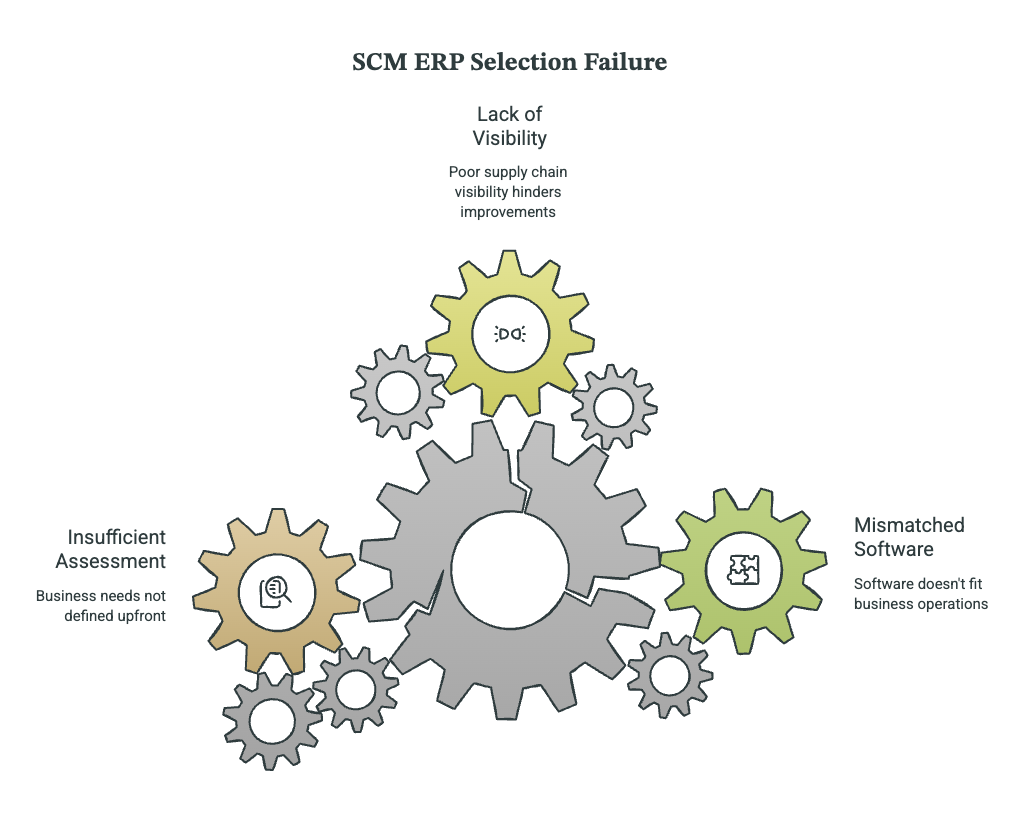
The Real Cost of Getting SCM ERP Selection Wrong
The wrong supply chain management ERP software can create problems long after implementation begins. When the platform does not match your operating model, teams may need extensive customization, additional applications, revised project scopes, and delayed go-lives.
These problems can increase implementation costs and leave the business with another disconnected system. Teams may still rely on spreadsheets, manual data transfers, and separate tools because the ERP cannot support core planning, purchasing, inventory, or fulfillment workflows.
The opportunity cost can also be high. McKinsey shared several examples of companies that redesigned supply chain processes and supported them with connected data and technology:
- A global consumer goods company reduced stockouts by 30% and lowered emergency logistics costs by 20%.
- A leading aerospace supplier increased shipments by 8% to 20% while reducing expedited-service costs by 30% to 50% after centralizing supply chain data.
These gains did not come from ERP software alone. They show what companies can achieve when their processes, data, and technology work together. A poor software fit can make those improvements much harder to reach.
Therefore, we always recommend assessing your operations before comparing vendors. Define your current workflows, recurring pain points, integration requirements, and future plans first. This helps you remove platforms that perform well in demonstrations but cannot support your long-term supply chain needs.
Choose the Right Supply Chain Management ERP Software with Alpha Apex Group
ERP selection is both a business and technology decision. The platform you choose should match your operating model, support future growth, and limit the need for costly customizations after implementation.
Alpha Apex Group provides independent, vendor-neutral ERP strategy and implementation consulting to help you assess business requirements, evaluate vendors, build objective shortlists, manage RFPs, and develop implementation roadmaps.
Whether you're comparing platforms like SAP S/4HANA, Oracle SCM Cloud, Dynamics 365 Supply Chain Management, or other leading solutions, our consultants help you make a confident, data-driven decision based on your unique needs.
Ready to find the right ERP for your business? Contact Alpha Apex Group to discuss your requirements and build an ERP selection strategy that supports your supply chain today and as your business grows.
FAQs
How is supply chain management ERP software different from a standalone SCM or TMS platform?
Supply chain management ERP software connects purchasing, inventory, manufacturing, finance, and order management in a single system. Standalone SCM or Transportation Management System (TMS) platforms focus on specific functions, such as planning, transportation, or warehouse optimization, and integrate with your ERP rather than replacing it.
What size company typically needs a full ERP with built-in SCM versus a best-of-breed supply chain tool bolted onto existing systems?
It depends more on your challenges than on the size of your company. Businesses with multiple sites, warehouses, or legal entities often benefit from an integrated ERP, while organizations with a solid ERP but one weak area can often add a specialized SCM solution instead of replacing the entire platform.
Can a company run cloud-based SCM modules while keeping other ERP modules on-premises?
Yes. Many organizations use a hybrid model, adding cloud-based SCM capabilities while keeping core ERP modules on-premises. Success depends on strong integrations, clean data, and clear ownership of business processes.
How long does a mid-market supply chain ERP implementation typically take from contract signing to go-live?
Most projects take 6 to 12 months, depending on process complexity, data migration, integrations, and the number of locations involved. Good planning before implementation often has a bigger impact on timelines than software selection.
What does Alpha Apex Group's evaluation process look for specifically in a supply chain-heavy ERP RFP?
We evaluate how each platform supports your end-to-end operations. This includes planning, procurement, inventory, warehouse management, logistics, integration requirements, implementation risk, and long-term scalability.
Does Alpha Apex Group help negotiate SCM module pricing and licensing terms with vendors like SAP or Oracle?
Yes. We help clients compare licensing models, identify unnecessary modules, evaluate implementation assumptions, and understand the total cost of ownership before signing an agreement.
How does Alpha Apex Group determine whether a client needs new ERP software versus a business process fix first?
We start with the business rather than the software. By reviewing workflows, data quality, and operational bottlenecks, we determine whether the issue is a technology gap or a process problem that can be solved without replacing the ERP.
.webp)
.jpg)
.jpg)