What is AI Enablement? Everything You Need to Know in 2026
.webp)
AI enablement is the difference between giving employees AI tools and building a business that can use them well. Access alone does not inherently create business value, and companies still need the right workflows, training, data infrastructure, governance, and leadership to turn artificial intelligence into results.
Right now, only 34% of organizations say AI has meaningfully transformed how they operate, even as access to sanctioned AI tools keeps rising. This guide breaks down what AI enablement means, why it matters, and how to build it effectively in 2026.
What Is AI Enablement?
AI enablement is the work required to make artificial intelligence useful across a business.
Buying AI tools, switching on generative AI features, or launching an AI pilot can increase access, but that is only the starting point. Real enablement connects technology with the people, workflows, data infrastructure, training, and governance frameworks needed to produce repeatable business value.
That can mean redesigning a workflow around an AI platform, improving data quality and information access, creating role-based access and security permissions, training employees, or establishing clear rules for how enterprise AI systems can use company data.
The gap between deployment and enablement is already showing, BCG found that only about half of companies have progressed from simply deploying AI into redesigning workflows around it. Meanwhile, LinkedIn’s Workplace Learning Report found that companies with strong career-development programs are 42% more likely to be AI-adoption leaders and 32% more likely to provide formal AI training.
In other words, the companies getting further with AI are not simply buying better tools. They are building the support system around them.
For a broader look at the firms helping companies make that shift, see our guide to the top AI consulting firms for business transformation.
And for a plain-English companion explanation, watch this video:
Why You Should Care About AI Enablement
AI spend is justified only if it changes how the business performs. Without strong AI enablement, companies can end up paying for licenses, pilots, and infrastructure without seeing meaningful gains in productivity, revenue, or decision-making.
The bigger risk is that employees may already be moving faster than leadership realizes. McKinsey found that 13% of employees already use generative AI for at least 30% of their daily tasks, while leaders estimate that figure at just 4%.
That disconnect creates several problems at once:
- Employees turn to unsanctioned AI tools because approved options are too limited
- Sensitive data can move through systems without proper secure access controls
- Promising use cases stay stuck as proof of concepts instead of becoming enterprise applications
- Teams duplicate work because there is no shared AI platform, knowledge base, or governance model
- Leaders make AI implementation decisions based on assumptions rather than actual usage
Skills are another major constraint. The World Economic Forum reports that 63% of employers see skills gaps as the biggest barrier to business transformation driven by technologies such as AI.
That makes enablement a business issue as much as an IT project. Companies need leadership that can connect AI tools, workforce capabilities, data quality, governance, and measurable business value.
Steps to Implement AI Enablement: A Practical Roadmap
A strong AI enablement roadmap starts with how work gets done.
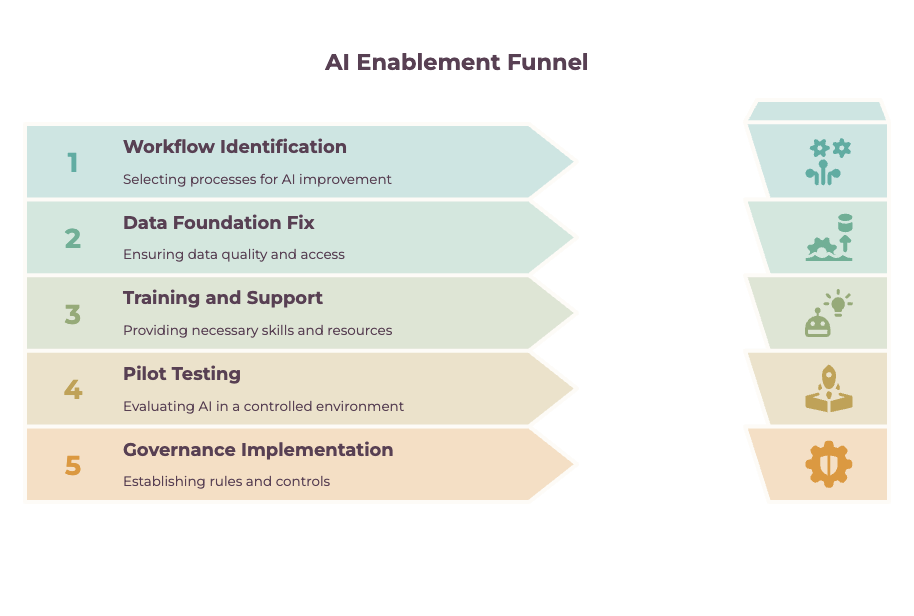
1. Audit Current AI Usage
Find out how your employees already use generative AI, machine learning, AI search engines, or other AI tools. Include sanctioned systems and shadow AI.
Look at:
- Which teams use AI most often
- What tasks they use it for
- Which tools access company data
- Where sensitive information may be exposed
- Which use cases already show measurable business value
This gives you a real baseline instead of relying on leadership assumptions.
2. Choose Workflows Before Tools
Identify specific processes where AI can improve speed, cost, quality, or decision-making. That could include content creation, conversation intelligence, fraud detection, predictive analytics, regulatory monitoring, or analysis of customer behavior data.
Then define the outcome you want before selecting an AI platform. A narrow workflow with a clear metric is far more useful than an enterprise-wide AI implementation with no defined success criteria.
3. Fix The Data Foundation
AI performance depends heavily on data quality and access to data.
Before scaling, address data preparation, metadata tagging, data collection, cloud storage, system connectivity, and information access. Depending on the use case, teams may also need a centralized knowledge base, call data, model registries, or controlled connections to enterprise applications.
The goal is not perfect data. It is reliable, governed data that the right AI systems can access when needed.
4. Build Training And Support Around The Tools
McKinsey found that 48% of employees see formal training as the best way to increase AI use, yet only 29% feel fully supported by their organization.
Provide role-specific training, hands-on coaching, documented use cases, and internal AI champions.
Teams working with foundation models, open source models, natural language processing, or agentic AI systems may also need deeper technical support around prompt management, inference serving, and model evaluation.
5. Run A Bounded AI Pilot
Test one workflow before attempting broad digital transformation.
Define the user group, data sources, success metrics, security permissions, and expected outcome. Treat early proof of concepts as learning exercises rather than automatic candidates for company-wide deployment.
Only 25% of organizations have moved at least 40% of their AI pilots into production, according to Deloitte. That makes disciplined testing and scaling more realistic than a big-bang rollout.
6. Measure, Learn, And Expand
AI enablement is not a one-time implementation.
Track adoption depth, time saved, output quality, employee sentiment, error rates, revenue impact, and other workflow-specific outcomes. Use that feedback to refine training, replace weak tools, improve data infrastructure, and expand only the use cases that are working.
Companies that need clear executive ownership of this process can use interim or fractional Chief AI Officer consulting to lead the roadmap, coordinate stakeholders, and move AI pilots into repeatable business operations.
Real-World Examples of AI Enablement in Action
The clearest examples of AI enablement go beyond giving employees access to generative AI. They change the workflow around it.
Let’s take a look at some real-world cases.
Morgan Stanley: Rebuilding information access for advisors
Morgan Stanley embedded AI into how its wealth management teams find information and prepare for client conversations.
Its AI @ Morgan Stanley Assistant connects advisors with an internal knowledge base, while its Debrief tool converts approved meeting recordings into notes, action items, and draft follow-ups that feed into existing systems. The company also built evaluation frameworks, human review, and data controls around the tools rather than treating them as standalone software.
The result: more than 98% of advisor teams now use its AI tools, while access to relevant internal documents reportedly increased from 20% to 80%.
That is AI enablement at the workflow level: better information access, system connectivity, governance, and automation built around a specific job.
Moderna: Making AI part of how the company operates
Moderna took a broader approach. It paired ChatGPT Enterprise with training, executive sponsorship, internal generative AI champions, office hours, and structured change management.
Within two months, employees had created 750 custom GPTs, and 40% of weekly active users were building their own. Moderna has since applied AI to contract review, internal policy search, content creation, clinical data analysis, and product-development workflows.
This is what enterprise AI looks like when enablement reaches the strategic level. The company is not simply adopting another AI platform, but redesigning how multiple functions work around the technology.
The same pattern can apply in specialized environments, from clinical operations and patient workflows supported by healthcare AI consultants to sales organizations using AI for conversation intelligence, account research, forecasting, and customer behavior data.
And the scope is widening. Deloitte reports that 58% of companies are already using physical AI, while nearly three-quarters expect to deploy agentic AI within two years.
More and more, successful AI implementation is about redesigning the business around useful AI capabilities.
Common Challenges in AI Enablement
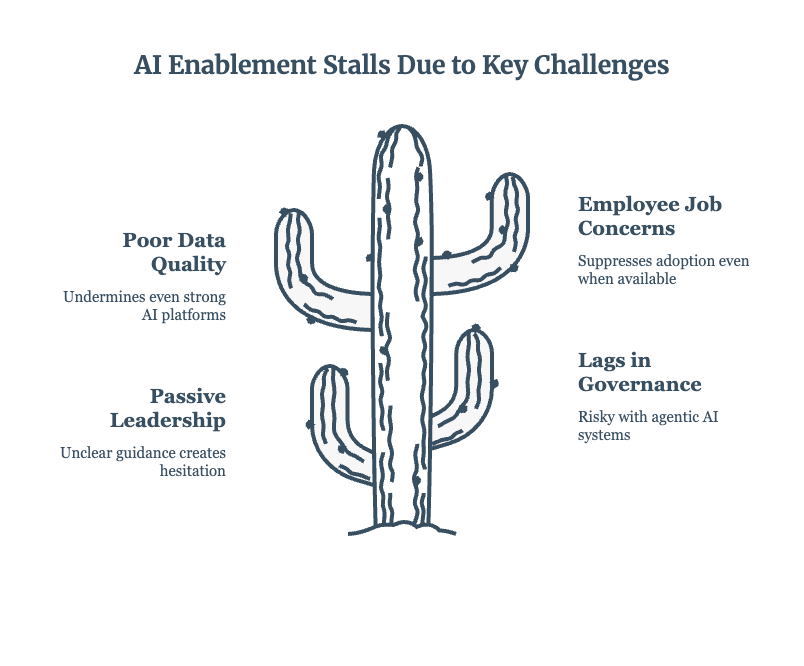
Most AI enablement programs do not fail because the technology is unusable. They stall because leadership, governance, data, and employee support do not keep pace with deployment.
Leadership Support is Too Passive
Employees need clear guidance on where AI fits, what good usage looks like, and how it affects their roles. Yet BCG found that only about one-quarter of frontline employees receive strong leadership support for AI use.
Unclear leadership creates hesitation at one end and uncontrolled experimentation at the other.
Governance Lags Behind Adoption
This becomes especially risky with agentic AI systems that can take actions rather than simply generate recommendations.
Deloitte reports that just 21% of organizations have mature governance models for AI agents, even as adoption accelerates.
Companies need governance frameworks that define:
- What data AI tools can access
- Role-based access and security permissions
- Where human approval is required
- Acceptable use of foundation models and open-source models
- Regulatory monitoring and regulatory risk controls
- Responsibility when an AI-generated decision causes an error
Higher-risk environments may also require an AI ethics committee or another formal review structure.
Poor Data Slows Everything Down
Weak data quality can undermine even a strong AI platform.
More advanced use cases such as predictive analytics, fraud detection, natural language processing, and AI search become especially dependent on reliable data infrastructure.
Data preparation therefore needs to happen alongside AI implementation.
Employees Worry About What AI Means For Their Jobs
Job security concerns can suppress adoption even when AI tools are available. BCG found that concerns about job security range from 34% to 46%, depending on how extensively AI has been implemented.
Companies need to explain what is changing, which tasks are being redesigned, what skills employees will need, and where human judgment still matters. Avoiding the conversation usually increases uncertainty.
These challenges cut across HR, IT, risk, operations, and leadership. That is why AI enablement often needs a broader operating-model lens rather than being treated as a software rollout. Our guide to business operations consulting firms covers the type of cross-functional process work that often sits behind successful implementation.
AI Enablement vs. AI Adoption: What an AI Enablement Strategy Adds
AI adoption tells you whether people are using AI, while AI enablement tells you whether that usage is useful, secure, and repeatable.
A company can have high adoption without a real AI enablement strategy. Employees may already be using generative AI for research, content creation, analysis, or customer communication through personal accounts and unsanctioned AI tools.
That activity shows demand, but it doesn’t prove the company has built the infrastructure to support it.
| AI adoption | AI enablement |
|---|---|
| Measures usage | Builds capability |
| Can happen organically | Requires deliberate investment |
| Focuses on tools and users | Covers people, process, data, and governance |
| May include shadow AI | Creates approved workflows and secure access |
| Tracks whether AI is used | Measures whether AI creates business value |
| Can grow without leadership involvement | Requires clear ownership and accountability |
The gap is likely to widen. McKinsey, in the report we looked at earlier, found that 47% of employees expect to use generative AI for at least 30% of their work within a year, while only 20% of leaders expect adoption at that level across their organizations.
An AI enablement strategy brings structure to that demand. It can include:
- Approved AI enablement platforms and enterprise applications
- Role-specific training and experimentation
- Data preparation and reliable system connectivity
- Secure access controls and role-based access
- Prompt management and model governance
- Sandbox environments for testing proof of concepts
- Clear metrics for moving an AI pilot into production
The strongest programs also give employees room to experiment safely. PwC reports that leading companies are 1.5 times more likely to provide AI sandbox environments, while employees in high-trust organizations are 2.1 times more likely to act on AI-generated insights.
So adoption is not the finish line. Rather, it is often the sign that enablement needs to catch up.
If you’re working through the technology, training, and workforce sides of that transition, you can also compare the top HR technology consulting firms and advisors.
How to Prepare Your Business and People for AI Enablement
AI implementation changes workflows, roles, decision rights, and the skills employees need to do their jobs well.
That means preparation should start before a broad rollout.
Map How Roles And Skills Will Change
Start by identifying which tasks can be automated, accelerated, or augmented by generative AI, machine learning, or agentic AI. Then map the skills employees will need as those workflows change.
This is becoming urgent. The World Economic Forum estimates that 59 out of every 100 workers will need reskilling or upskilling by 2030, while 77% of employers plan to upskill employees specifically in response to AI.
A strong workforce transformation strategy helps connect those capability shifts to hiring, training, role design, and workforce planning.
Make Leadership Visible
Employees take cues from what leaders actually do, not just what they announce.
BCG, in the same source we looked at earlier, found that employee positivity toward generative AI rises from 15% to 55% when leadership support is strong and visible.
Executives should use the tools themselves, talk openly about where AI fits, explain what will and will not change, and give teams room to experiment safely.
Build Learning Into The Rollout
Employees need ongoing practice, real use cases, feedback, and access to people who can help when workflows break down. LinkedIn reports that 91% of learning and development professionals see continuous learning as critical to career success.
As Microsoft CEO Satya Nadella put it:
"You can offload a task, or even a job, but you can never offload your learning."
That principle matters even more as foundation models, open source models, natural language processing, and agentic AI systems evolve quickly.
Protect Institutional Knowledge
AI tools should improve information access, and they shouldn’t become the only place institutional knowledge lives.
Keep critical process documentation, decision logic, customer context, and subject-matter expertise inside systems the company controls. That may mean improving a knowledge base, data collection practices, metadata tagging, or access to data before scaling AI across enterprise applications.
Prepare The Culture For Experimentation
Employees need to know they can test new workflows without being punished for every imperfect result.
That requires clear guardrails, psychological safety, and honest communication about job impact. Companies that skip this groundwork often end up with either low adoption or uncontrolled shadow AI.
Our guide to the top company culture consultants covers firms that specialize in company culture, leadership alignment, and workforce change.
How to Measure the Success of AI Enablement
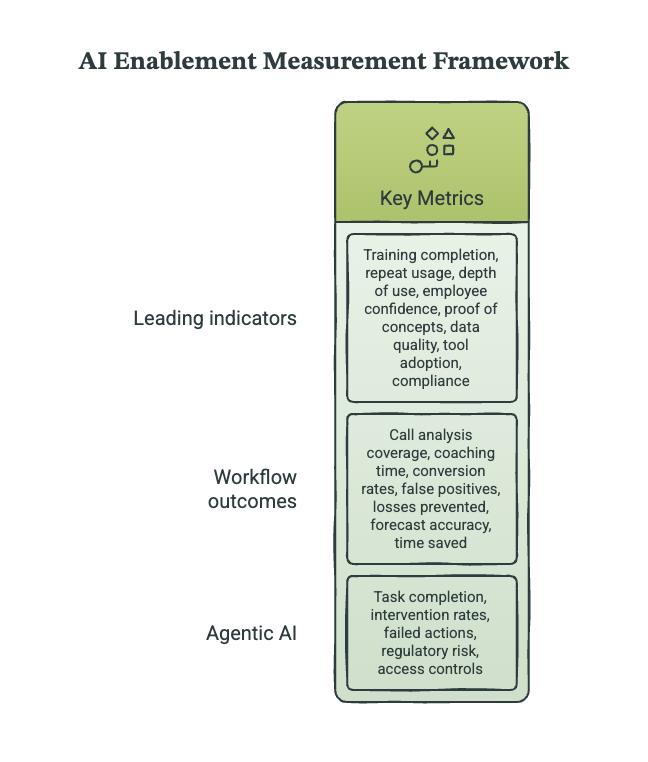
When you measure the success of your AI enablement efforts, the most important question is whether AI is changing how work gets done and creating measurable business value.
Track Leading Indicators First
Early in an AI implementation, financial ROI may be too slow to tell you much. Start with indicators that show whether the foundation is working:
- Training completion and repeat usage
- Depth of AI use within target workflows
- Employee confidence and sentiment
- Number of useful proof of concepts moving into production
- Data quality and information access improvements
- Adoption of approved AI tools versus shadow AI
- Compliance with governance frameworks and security permissions
These measures show whether the organization is becoming more capable before revenue or cost savings fully appear.
Measure Outcomes At The Workflow Level
Avoid one generic ROI target for every AI pilot.
A conversation intelligence rollout might be measured by call analysis coverage, coaching time, or conversion rates. Fraud detection may focus on false positives and losses prevented. Predictive analytics could be measured by forecast accuracy, while an AI search engine may be judged by time saved finding information.
Tie each use case to a specific operational result.
Separate Generative AI From Agentic AI
Generative AI typically helps people produce, summarize, analyze, or retrieve information. Agentic AI systems can take actions across enterprise applications with less direct human involvement.
Those two models need different measurement frameworks.
For agentic AI, track metrics such as task completion, intervention rates, failed actions, regulatory risk, and whether secure access controls and role-based access are working as intended.
Give ROI Enough Time
AI often takes longer to pay back than traditional software investments.
Deloitte reports that most organizations see satisfactory AI ROI within two to four years, compared with the seven-to-12-month payback companies often expected from earlier technology investments.
That does not mean waiting years to judge progress. It means using short-term operational metrics (like the ones we looked at above) alongside longer-term revenue, cost, productivity, and growth measures.
Keep Measuring After Rollout
Market trends, foundation models, open source models, AI enablement platforms, and enterprise AI capabilities are changing too quickly for a fixed measurement framework.
Review metrics regularly. Retire use cases that are not delivering value, improve weak data infrastructure, and expand the workflows that are.
Companies that need outside support building that measurement discipline can compare the top AI consulting firms for business transformation for help moving from experimentation to measurable AI performance.
Build AI Enablement That Changes Your Business with Alpha Apex Group
Alpha Apex Group helps companies turn AI strategy into a practical operating model.
Our AI consulting services cover the work that often gets missed after tool selection. That means use-case prioritization, workflow redesign, governance, workforce readiness, implementation planning, and executive ownership.
Through our Fractional Chief AI Officer Services, we can lead the AI enablement roadmap, coordinate cross-functional teams, and move high-value pilots into production.
Our Workforce Transformation HR Consulting services support the people side, including role design, skills planning, training, and change management.
We can help you build an AI enablement program that moves beyond experimentation and delivers measurable business value. Get in touch to learn more.
FAQs: What is AI Enablement?
Who should own AI enablement inside a company?
One leader should have clear accountability, even if execution spans IT, HR, data, security, and business teams. In larger programs, that is often a Chief AI Officer or equivalent executive who can set priorities, resolve ownership gaps, and connect AI implementation to business outcomes.
How is AI enablement different from an AI strategy or roadmap?
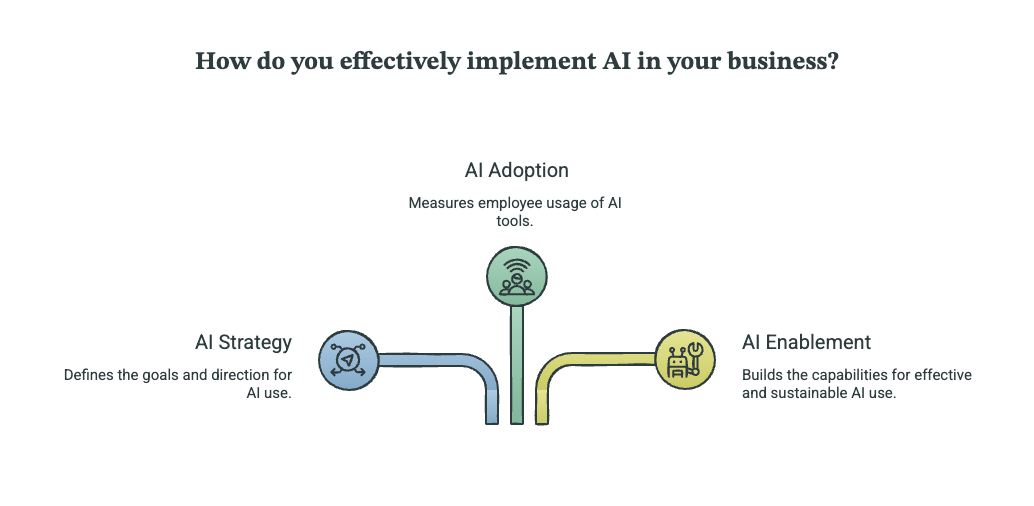
An AI strategy defines where the company wants to go, while a roadmap sequences the work. AI enablement builds the capabilities needed to execute both, including training, workflow redesign, data infrastructure, governance, and ongoing support.
Can smaller companies run AI enablement without a full-time Chief AI Officer?
Yes, smaller companies can run AI enablement without a full-time Chief AI Officer. A fractional or interim CAIO can provide executive ownership without the cost or commitment of a permanent hire. This works particularly well when a company needs to prioritize use cases, establish governance, and move an initial AI pilot into production.
What are early signs an AI enablement program is failing?
Watch for low repeat usage, growing shadow AI, pilots that never reach production, unclear ownership, poor data quality, and employees who cannot explain approved use cases. These problems usually appear well before financial ROI starts falling short.
Does Alpha Apex Group provide AI enablement training?
Alpha Apex Group takes a broader consulting approach, helping companies connect AI strategy, governance, workforce readiness, workflow redesign, and implementation. Training and capability-building can be incorporated into the wider enablement program rather than treated as a standalone exercise.
Can Alpha Apex Group's fractional or interim CAIO lead an AI rollout?
Yes. A fractional or interim CAIO can take ownership of the roadmap, prioritize use cases, coordinate business and technical teams, establish governance frameworks, and help move successful proof of concepts into production.
Which industries can Alpha Apex Group support with AI enablement?
Alpha Apex Group supports AI transformation across functions and industries where companies need stronger strategy, implementation, governance, or workforce readiness. Engagements can be shaped around specific environments such as healthcare, sales, operations, and other enterprise AI use cases.
Appendix of Links
- Deloitte — State of AI Report 2026
- PwC — ROI From AI
- BCG — AI at Work: Momentum Builds, but Gaps Remain
- LinkedIn — Workplace Learning Report
- YouTube — AI Resource
- Alpha Apex Group — Top AI Consulting Firms
- McKinsey & Company — Superagency in the Workplace: Empowering People to Unlock AI's Full Potential at Work
- World Economic Forum — Future of Jobs Report 2025
- Alpha Apex Group — Fractional Chief AI Officer Services
- Alpha Apex Group — Interim & Fractional Chief AI Officer Consulting
- Alpha Apex Group — Healthcare AI Consultants
- Alpha Apex Group — AI Sales Consulting
- Alpha Apex Group — Top Business Operations Consulting Firms
- Alpha Apex Group — Top HR Technology Consulting Firms
- Satya Nadella — X Post
- Alpha Apex Group — Workforce Transformation Solutions
- Alpha Apex Group — Company Culture Consultants
- Deloitte — AI ROI: The Paradox of Rising Investment and Elusive Returns
- OpenAI — Morgan Stanley Case Study
- OpenAI — Moderna Case Study
- Alpha Apex Group — Homepage
- Alpha Apex Group — Contact Us
.jpg)
![Top 10 AI Executive Search Firms & Recruiters [2026 Update]](https://cdn.prod.website-files.com/6a1ef6de349095f1fcc34ccb/6a26d0533a7c25762c14664a_Top%2BAI%2BExecutive%2BSearch%2BFirms%2B_26%2BRecruiters%2B_282_29.jpeg)
.jpg)