Top 10 HR Technology Consulting Firms & Advisors
HR technology decisions carry significant financial and operational consequences. The wrong platform, or the wrong advisor, can lead to poor adoption, costly integrations, weak data, and HR processes that fail to support the business.
As organizations continue investing in modern HR systems, selecting the right technology partner has become more important.
According to Fortune Business Insights data, the global HR technology market is projected to grow from $47.32 billion in 2026 to $95.95 billion by 2034, while North America already accounts for 45.9% of the global market.
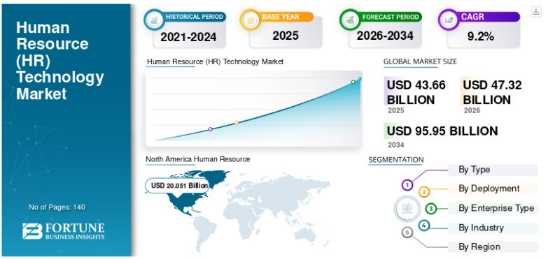
This guide compares leading HR technology consulting firms and explains how to evaluate their independence, expertise, delivery model, and track record.
TL;DR: 5 Top HR Technology Consulting Firms & Advisors
- Alpha Apex Group: Best for organizations that need platform-neutral HR technology guidance across HRIS selection, implementation planning, systems integration, data migration, change management, and workforce transformation.
- HR Tech Solutions: Best for brokers and employers that need hands-on benefits administration, HRIS support, carrier integrations, training, and ongoing platform troubleshooting across a wide range of BenAdmin, payroll, and HR systems.
- PredictiveHR: Best for organizations already using UKG or Paylocity that need specialist help with implementation, optimisation, data quality, analytics, managed services, and post-go-live support.
- The Human Resource Consulting Group: Best for employers that want an ongoing isolved-based partner to manage payroll, benefits, time tracking, compliance, HR analytics, and recurring HR administration.
- HRchitect: Best for companies that want end-to-end HCM technology consulting across selection, implementation, integrations, change management, optimisation, and managed support.
How to Evaluate HR Technology Consulting Firms
The right HR technology consulting partner should match your initiative and the level of support your internal team needs. Before comparing individual firms, you can use the following criteria to assess their capabilities and delivery model.
Best 10 HR Technology Consulting Firms & Advisors to Strengthen Your HR Systems
The firms below bring different strengths across HR technology strategy, platform selection, implementation, integration, and ongoing advisory support. You can compare their expertise, delivery models, platform relationships, and industry experience to find the best fit for your initiative.
1. Alpha Apex Group
- Specific HR tech focus: HRIS selection, implementation, configuration, systems integration, data migration, user training, and post-launch optimization.
- Best suited for: Companies with manual HR workflows, disconnected employee data, low system adoption, or platforms that no longer support growth.
Alpha Apex Group is a strong fit for companies that need HR technology support tied closely to wider workforce operations. We help you review existing HR processes, identify system gaps, select suitable platforms, and support implementation across areas such as employee data, recruitment, performance management, learning, and reporting.
Our main strength is the combination of HRIS consulting, workforce transformation, outsourced HR support, and change management. This allows us to address the technology, process, and people issues that affect adoption.
2. HR Tech Solutions
- Specific HR tech focus: HR Tech Solutions is strongest in benefits administration and broker-facing HR technology support, including system builds, carrier connections, BenAdmin platform support, HRIS consulting, training, and ongoing support.
- Real-world result: MacQueen Insurance Group says HR Tech Solutions helped it deliver benefit administration, consolidated billing, and COBRA solutions, while also supporting employee education during open enrollment and increasing participation in ancillary and worksite benefits by over 65%.
HR Tech Solutions is more specialized than a general HR transformation consultancy. Its niche is helping brokers and employers make benefits administration and HRIS platforms work in practice, including carrier integrations, 834 EDI/API connections, client onboarding, renewals, training, and day-to-day platform troubleshooting.
The firm is a good option when your goal is not choosing a major enterprise HCM suite, but making multiple HR, payroll, benefits, and carrier systems function cleanly for brokers, HR departments, and employer clients. HR Tech Solutions says it is certified by 40 top BenAdmin, HRIS, and payroll platforms, including ADP Workforce Now, BambooHR, Dayforce, Ease, Employee Navigator, Gusto, HiBob, Paychex, Paycom, Paycor, Paylocity, Rippling, SAP SuccessFactors, TriNet Zenefits, and UKG.
3. PredictiveHR
- Specific HR tech lane: PredictiveHR is focused on UKG and Paylocity consulting, including implementation, optimization, post-live support, managed services, data integrity, and people analytics.
- Real-world result: PredictiveHR supported Timken’s UKG Pro WFM migration across 9,000 employees, complex union contracts, and 77 integrated interfaces.
PredictiveHR’s differentiator is platform depth rather than broad HR transformation. The firm specifically positions itself around UKG and Paylocity. This makes it more relevant for companies that already know their HCM ecosystem and need a specialist to improve configuration, reporting, adoption, and post-go-live support.
The firm is a better fit when vendor support is not enough. PredictiveHR positions its consulting model around how a client's HR, payroll, and workforce processes operate in practice, while standard HCM vendor support is primarily focused on supporting the software.
4. The Human Resource Consulting Group
- Specific HR tech focus: HRCG is strongest for employers that want isolved-based HR, payroll, benefits, time and attendance, onboarding, performance, learning, and HR analytics support from a high-touch regional provider.
- Real-world result: KAMCO Supply Corporate New England says its transition to HRCG’s HR, benefits, and payroll services was easy, helping the company manage 300+ employees, multiple New England locations, 1.5M+ square feet of inventory space, and 100,000+ building products more efficiently.
HRCG is less of a project-based HR technology consultant and more of an ongoing HR operations partner. Its model is built around keeping the HR system, payroll process, benefits administration, time tracking, compliance updates, employee records, and reporting workflows running together after implementation.
This makes HRCG a strong option for employers that want one provider to manage both the HCM platform and the recurring administrative work around it. The firm may be particularly relevant when your internal HR team wants to reduce its involvement in payroll processing, benefits administration, compliance updates, and day-to-day system management.
5. HRchitect
- Specific HR tech focus: HRchitect focuses exclusively on HCM technology, with consulting across evaluation and selection, implementation, integrations, optimization, managed support, change management, and client-side subject matter expertise.
- Real-world result: HRchitect helped L.A. Care Health Plan implement a new workforce management system and automate 90% of its payroll and time-and-attendance processes.
HRchitect is more specialized than a broad HR advisory firm because it works only in HCM technology. This narrow focus shows up in its partner ecosystem and service depth, as the firm lists dedicated consulting services for platforms including Dayforce, iCIMS, UKG, WorkForce Software, SAP SuccessFactors, and Oracle.
The firm is a strong option for companies that want outside expertise across the full HCM system lifecycle. HRchitect reports working with more than 4,000 clients worldwide across industries such as healthcare, manufacturing, public sector, retail, hospitality, and professional services.
6. Boston Consulting Group
- Specific HR tech focus: BCG is strongest when digital HR work is part of a broader people strategy, operating model, employee experience, workforce planning, analytics, or AI transformation agenda.
- Real-world result: BCG reports helping a pharmaceutical company increase employee engagement by more than 50% after developing a more inclusive way of working.
BCG’s digital HR work is about connecting HR technology decisions to the design of the HR function itself, including governance, processes, capabilities, systems, employee journeys, and people analytics.
This makes BCG more relevant for large organizations trying to modernize HR at the operating-model level. It may be a strong fit when the initiative includes AI adoption, skills planning, cloud HRIS readiness, employee experience redesign, or workforce analytics.
7. Marsh McLennan Agency
- Specific HR tech focus: MMA’s HR technology consulting is built around HRIS, payroll, benefits administration, and time/attendance technology, with a six-step process covering discovery, RFP support, vendor selection, contract negotiation, vendor monitoring, and ongoing optimization.
- Real-world result: MMA reports helping one employer find a cost-effective standalone benefits administration platform for 300 plan members. It also helped an employer with 1,100 plan members move to a carrier-sponsored platform and automate evidence-of-insurability processing within weeks.
MMA differs from a dedicated HRIS implementation firm because its technology consulting sits within a wider employee benefits and brokerage advisory model. This makes it a good choice when a system decision involves benefits administration, carrier relationships, payroll integrations, enrollment, employee communications, and vendor pricing.
The firm is a strong fit for employers that need help selecting and managing a connected mix of HR and benefits technology. MMA can also negotiate pricing and contract terms, monitor vendor performance, support employee adoption, and provide guidance after implementation.
8. Gallagher
- Specific HR tech focus: Gallagher is strongest where HR technology decisions are tied to benefits administration, payroll, compliance reporting, enrollment, private exchanges, COBRA, leave, learning, and employee experience.
- Real-world result: An aerospace employer with 90,000 employees used Gallagher’s proprietary data platform to identify costly PTO balance patterns, including average accrued PTO balances of 171.6 hours among Baby Boomer and Gen X employees.
Gallagher’s HR technology work is shaped by its benefits and workforce consulting background that goes beyond software implementation. This makes the firm useful when the technology choice affects benefits enrollment, payroll processing, compliance reporting, employee communications, carrier relationships, and the broader employee experience.
Its biggest differentiator is market access. Gallagher says its HR and Benefits Technology Consulting team uses proprietary market scans of 800+ service providers to help employers compare vendors, manage RFPs, assess pricing, support implementation, and optimize existing HR technology investments.
9. OneDigital
- Specific HR tech focus: OneDigital advises on HRIS and HCM selection, payroll, benefits administration, time tracking, compliance, employee experience, and vendor selection. Its services include RFP support, implementation readiness, data conversion, testing, system health checks, and ongoing HRIS administration.
- Real-world result: OneDigital does not publicly publish a client case study focused specifically on HR technology implementation consulting. However, it outlines a vendor-agnostic delivery process covering discovery, system selection, data conversion, user acceptance testing, go-live support, system health checks, and ongoing HRIS administration.
OneDigital’s consulting sits inside a broader benefits, payroll, HR, and workforce advisory business. This matters for employers whose technology problems are tied to carrier feeds, benefits administration, payroll accuracy, compliance reporting, enrollment workflows, and employee adoption.
The firm is well-suited for organizations with messy HR systems or limited internal HRIS capacity. OneDigital says it supports vendor-agnostic system selection across platforms including ADP, Dayforce, Oracle, Paylocity, SAP SuccessFactors, UKG Ready, UKG Pro, and Workday, while also offering AMS-style support for configuration changes, report writing, version migration, troubleshooting, and system maintenance.
10. ISG
- Specific HR tech focus: ISG advises enterprise HR teams on HR technology, HCM SaaS, outsourcing partners, service delivery models, benchmarking, provider contracts, and long-term HR operating-model changes.
- Real-world result: In a global financial company case study, ISG identified a business case for $30M+ in annual run-rate savings, optimized the client’s top 10 Workday HCM processes, rationalized the HR technology stack, and improved employee and manager self-service.
ISG differs from a typical HRIS implementation firm because it sits closer to the sourcing, benchmarking, and operating-model side of HR transformation. Its HR advisory team helps enterprises assess current HR delivery, compare costs and performance against market data, evaluate HCM and outsourcing providers, negotiate contracts, and build a roadmap for technology and service delivery changes.
The firm is a strong fit for large organizations reconsidering how HR services should be structured and delivered. Its work can address technical architecture, data security, HR processes, user expectations, emerging technology, outsourcing strategy, and provider relationship management.
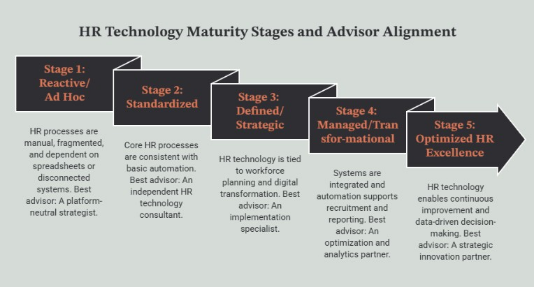
The HR Technology Maturity Model and Which Advisor Fits Each Stage
The right HR technology consulting partner depends on how mature your HR systems and processes already are.
Brandon Hall Group's AI Progression Model found that 21% of organizations remain in the Reactive/Ad Hoc stage, while only 16% have reached Optimized HR Excellence.
Separate research from Phenom found that 83% of nearly 500 organizations fall into the two lowest maturity tiers for AI and automation in HR.
Together, these findings suggest many organizations are still building the foundations needed to support more advanced HR technology.
Now let’s explore what each maturity stage means and the type of HR technology advisor that fits best.
Stage 1: Reactive/Ad Hoc
HR processes are largely manual, fragmented, and dependent on spreadsheets or disconnected systems.
Best advisor: A platform-neutral strategist who can assess current processes, define business requirements, redesign workflows, and build an HR technology roadmap before software selection begins.
Stage 2: Standardized
Core HR processes have become more consistent, and basic automation is in place, but integrations, reporting, and employee experience still need improvement.
Best advisor: An independent HR technology consultant who can compare HRIS platforms, assess total cost of ownership, manage vendor evaluations, and recommend the best-fit solution.
Stage 3: Defined/Strategic
HR technology is tied to broader workforce planning, talent management, and digital transformation goals.
Best advisor: An implementation specialist with expertise in data migration, integrations, change management, testing, and global rollouts.
Stage 4: Managed/Transformational
Systems are integrated, analytics are improving, and automation supports recruitment, reporting, and employee service delivery.
Best advisor: An optimization and analytics partner that can improve user adoption, strengthen data governance, expand automation, and introduce AI capabilities where appropriate.
Stage 5: Optimized HR Excellence
HR technology enables continuous improvement, data-driven decision-making, and ongoing innovation across the enterprise.
Best advisor: A strategic innovation partner that can guide AI governance, organizational design, operating model evolution, and ongoing optimization.
Remember, your current level of HR technology maturity should determine the advisor you choose. The right partner helps solve today's challenges while preparing your organization for the next stage of growth.
Make a More Confident HR Technology Decision With Alpha Apex Group
Alpha Apex Group provides independent, platform-neutral HR technology consulting for organizations managing HRIS selection, implementation, and transformation risk.
Unlike vendor-tied resellers, which steer you towards a specific platform, we evaluate HR systems based on your business requirements, operating model, workforce needs, and long-term HR strategy.
Our team supports requirements gathering, vendor evaluation, implementation oversight, data migration, system integration, and change management. Each stage remains focused on improving adoption, reducing implementation risk, and creating measurable value for your organization.
Contact us today to build an HR technology roadmap that supports your people, processes, and future growth.
FAQs
Should you hire an HR technology consultant before choosing a platform?
In most cases, yes. An independent consultant can assess your current processes, define system requirements, and create evaluation criteria before vendor demonstrations and sales priorities influence the decision.
What qualifications should an HR technology consultant have?
Look for experience with similar HRIS projects, strong process-mapping skills, and practical expertise in system integrations, data migration, change management, testing, compliance, and HR analytics.
Is Alpha Apex Group’s HR technology consulting platform-agnostic?
Yes. Our team at Alpha Apex Group evaluates HR systems against each client’s goals, workflows, budget, workforce needs, and existing technology environment rather than promoting a preferred platform.
Does Alpha Apex Group provide both HR technology strategy and implementation support?
Yes. Alpha Apex Group can support requirements gathering, platform evaluation, implementation planning, data migration, integrations, user training, change management, and post-launch optimization.
.jpg)