Manufacturing Labor Shortage 2026: What It Means for Leadership Hiring
.jpg)
For three years, most manufacturers have treated hiring as a volume problem: more applicants, faster offers, bigger sign-on bonuses.
The data points to something deeper. In ManpowerGroup's 2026 Talent Shortage Survey of more than 39,000 employers across 41 countries, 72% of manufacturing employers reported difficulty filling roles.
The manufacturing labor shortage also reaches the people who run the floor. Supervisors, maintenance leads, and plant managers are retiring, and the roles replacing them now call for automation, data, and change-management skills that few candidates have.
This guide covers the 2026 data, the skills gap in manufacturing, the leadership roles that are hardest to fill, and a hiring process built for this market.
P.S. If a plant or operations leadership seat is open right now, our manufacturing executive search team can put a vetted shortlist in front of you within 72 hours.
TL;DR
- The manufacturing labor shortage is still large in 2026, with more than half a million open jobs, and retirements drive most future openings.
- The skills gap in manufacturing is moving up the org chart. Leadership, digital, and change-management skills are now as scarce as technical ones.
- Frontline supervisors and plant leaders decide whether new hires stay, which makes them the highest-return hires in a tight market.
- Most supervisors are still promoted for tenure and output, and the research shows that choice costs engagement.
- Hire leaders for the plant you're becoming, widen the pool to adjacent industries, and decide early whether to promote, search, or bring in interim help.
What Is the Manufacturing Labor Shortage in 2026?
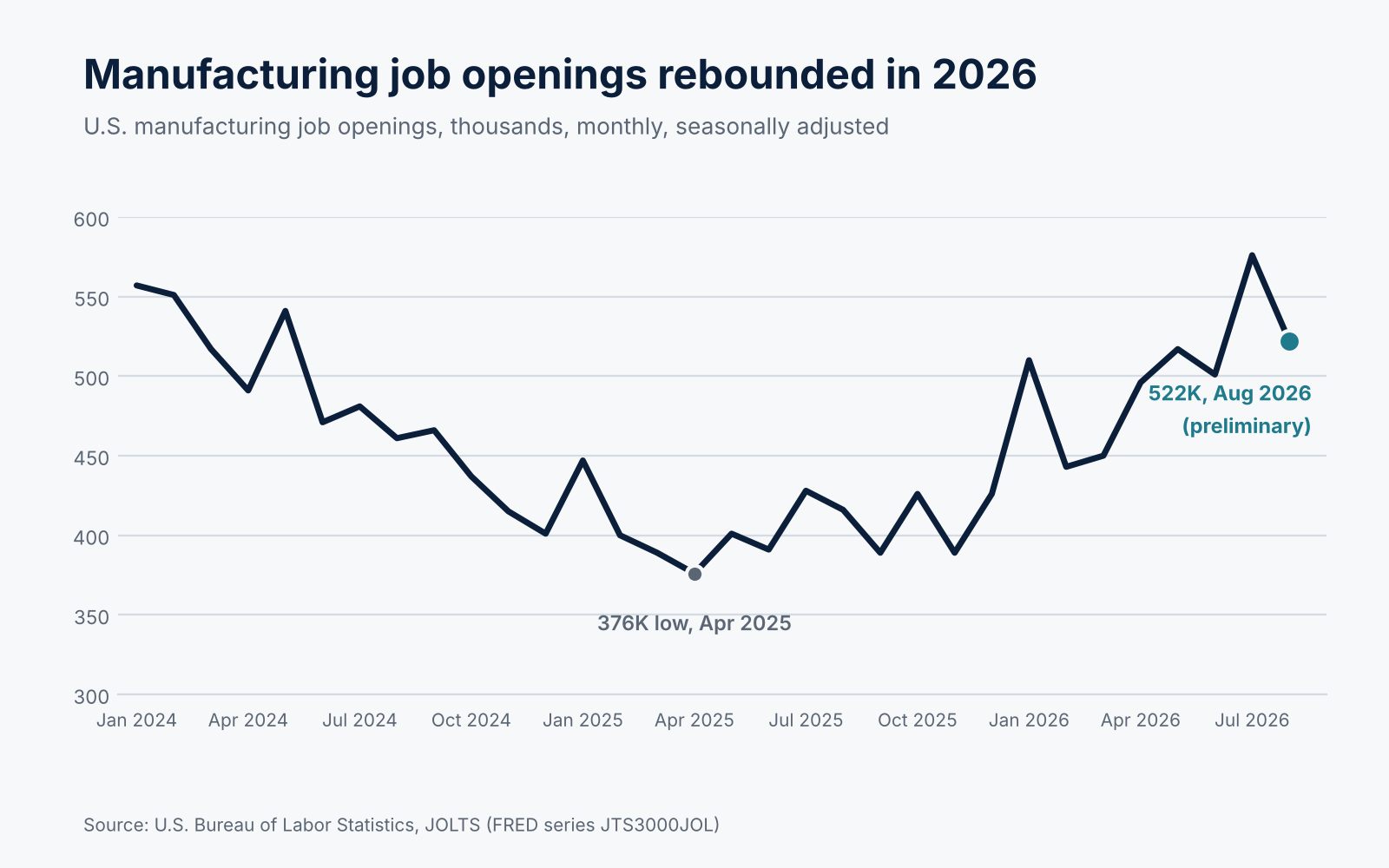
The manufacturing labor shortage is the gap between open manufacturing jobs and the qualified people available to fill them. U.S. manufacturers had 522,000 open jobs in August 2026, according to the Bureau of Labor Statistics' JOLTS survey.
Hiring hasn't stalled. Payrolls are growing again, but the national labor force participation rate held at 61.8% in September 2026, so the manufacturing sector is competing harder for a pool of workers that isn't growing. Most of the pressure sits in durable goods manufacturing, where complex equipment makes every open seat harder to fill.
The table below shows the five numbers that frame the market.
The urgency has shifted, though. In early 2024, more than 65% of manufacturers named attracting and retaining workers their top challenge.
By Q4 2025, that share was 51.68%, behind trade uncertainty, and by Q3 2026 raw material costs led the list. With fewer competitors prioritizing talent, companies that keep hiring leaders now face less competition for the best ones.
Why Is There a Labor Shortage in Manufacturing?
Manufacturing faces a labor shortage mainly because experienced workers are retiring faster than new ones arrive; nearly 75% of the projected employment gap is tied to retirements, according to CFR data. Two other forces add to it: the job mix is shifting toward technical roles, and reshoring is adding demand.
1. Retirements Drive Most Manufacturing Job Openings
Baby boomers are leaving manufacturing jobs faster than younger workers replace them. In 2025, 25.2% of manufacturing workers were 55 or older, and the industry's median age was 43.9, against 42.1 for all workers.
The concentration is sharper at the firm level. Census data show the share of manufacturing employment at firms where at least a quarter of workers are over 55 rose from 14% in 2000 to more than 40% in 2022. For those employers, the retirement wave is already in this year's staffing plan.
2. Production Roles Shrink While Technician Roles Grow
The jobs being created look different from the ones being vacated. The jobs manufacturers need are changing as well. Production occupations accounted for 48.7% of manufacturing employment in 2024, down from 51.9% in 2003. Meanwhile, manufacturing technician employment could grow six times faster than production occupations between 2025 and 2030
Traditional production work still represents a huge part of the labor market. Miscellaneous assemblers and fabricators alone accounted for about 1.48 million U.S. jobs in May 2024. At the same time, manufacturers increasingly need technicians who can maintain, troubleshoot, and work with automated equipment.
3. Reshoring and New Plants Add Demand for Experienced Operators
Reshoring and foreign investment announced 244,000 U.S. manufacturing jobs in 2024, as companies respond to supply chain disruptions and tariff pressure.
New sites need experienced operators and leaders on day one, and shortfalls show up fast. CFR report that we shared above noted that TSMC delayed production at its Arizona semiconductor plant partly because of a shortage of specialized workers.
The pace is uneven. Manufacturing construction spending fell 21.7% year over year to $167.8 billion in July 2026, so new project starts are slowing even as earlier ones come online. We cover how tariff swings change hiring plans in our guide to manufacturing recruiting during a trade war.
What Is the Skills Gap in Manufacturing?
The skills gap in manufacturing is the mismatch between the skills open roles require and the skills available candidates have. A labor shortage means too few people. A skills gap means the people available can't yet do the work, and most plants face both at once.
The World Economic Forum (WEF) expects 39% of workers' core skills to change by 2030. In manufacturing, the gap shows up in three layers.
Technical Skills Gap in Manufacturing
The technical gap centers on maintenance, controls, and machining. Plants need skilled trades workers who can troubleshoot programmable logic controllers, keep automated lines running, and set up CNC equipment, which is the technician work growing fastest.
One unfilled maintenance technician role can idle a line. A shortage of five can stall an automation project for a quarter.
Digital and AI Skills Gap in Manufacturing
The digital gap is about using data, connected equipment, and AI on the floor. The same WEF report ranks AI and big data as the fastest-growing skills through 2030.
Plants now run on IoT devices, manufacturing execution systems, and real-time production data. Operators and leaders who can read that data and act on it within a shift are scarce. If you're modernizing, our manufacturing execution systems guide explains what these platforms ask of the people who run them.
Leadership Skills Gap in Manufacturing
The leadership gap gets the least attention and costs the most. WEF reports that leadership and social influence gained 22 percentage points as a core skill since 2023, the largest jump of any skill.
DDI's Global Leadership Forecast 2025 found that setting strategy and managing change are leaders' top skill gaps, yet only 22% of HR teams prioritize developing them. Frontline managers were also three times more likely than senior leaders to have concerns about AI, and they're the layer expected to roll it out.
What Does the Manufacturing Labor Shortage Mean for Leadership Hiring?
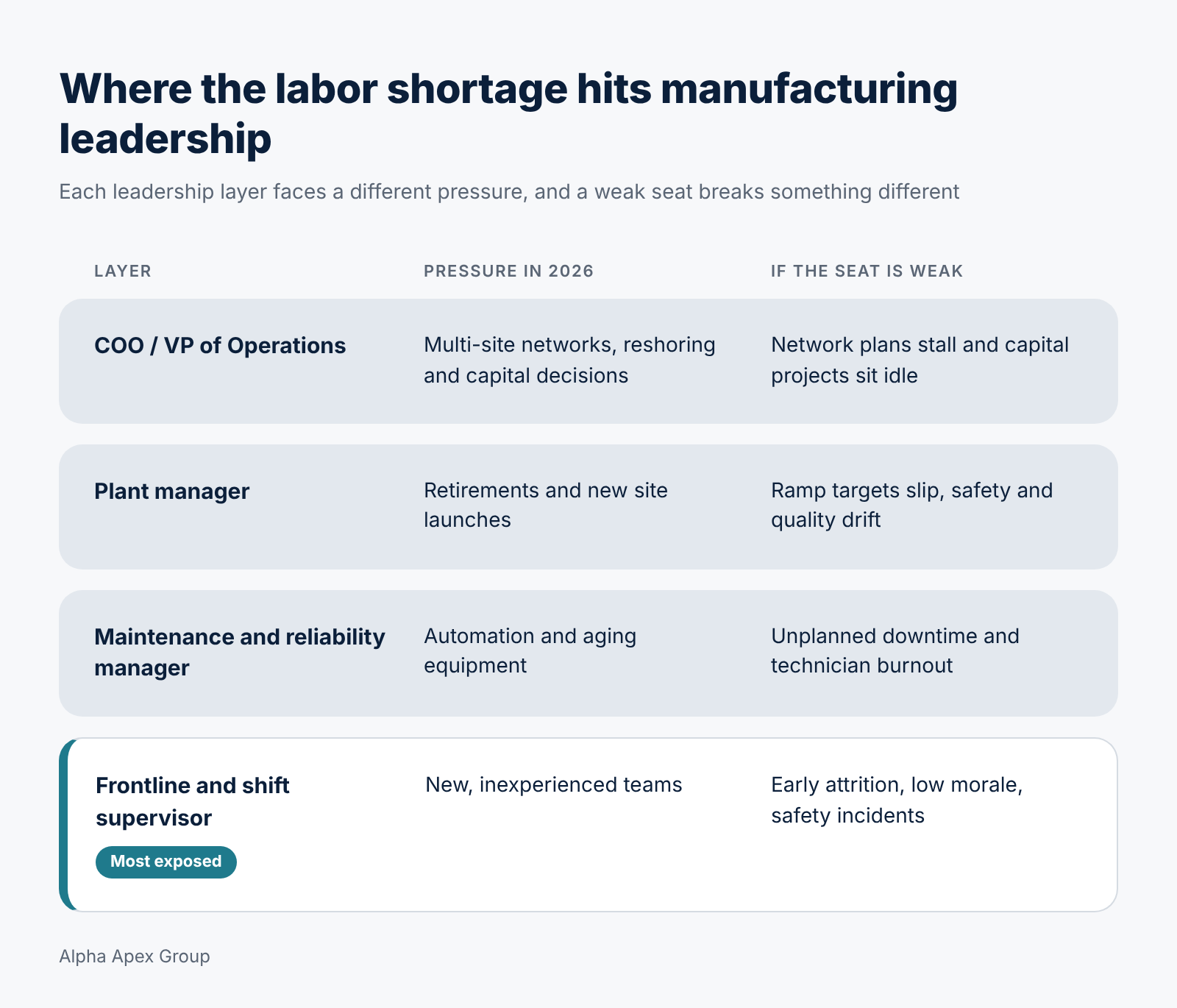
For leadership hiring, the manufacturing labor shortage means supervisors and plant leaders now decide whether new hires stay and whether new technology gets used. Manufacturing leaders who can't retain or train people turn every recruiting win into a short-term fix.
1. Frontline Supervisors Decide Whether New Hires Stay
Managers account for 70% of the variance in team engagement, according to Gallup. On a plant floor, that shows up as worker morale, safety habits, and whether a new operator comes back for week two.
The upside is measurable. Gallup also found that managers who completed strengths-based development programs had teams with 21% to 28% lower employee turnover.
Track 90-day retention by supervisor. A supervisor with repeatedly high early attrition is a coaching or hiring priority, whatever their output numbers say.
2. Retirements Thin the Manufacturing Leadership Bench
The retirement wave hitting the line also hits the people who run it, because supervisors and plant managers usually come from long-tenured staff.
Public data on leadership-level retirements in manufacturing is limited. In DDI’s cross-industry research, organizations reported that, on average, 49% of critical business leadership roles could be filled immediately by internal candidates. This is not a manufacturing-specific figure, but it reinforces the value of assessing your own succession readiness.
Three succession steps are worth starting now:
- Flag every plant leadership role whose incumbent is within five years of retirement eligibility.
- Capture process knowledge, such as changeover tricks, supplier history, and equipment quirks, in writing and video before the exit date.
- Budget for a 60- to 90-day overlap when an outside hire replaces a retiring leader.
For the top seat, our guide to CEO succession planning applies the same logic at the executive level.
3. Automation and Plant Launches Raise the Bar for Plant Leaders
Advanced manufacturing raises the leadership bar in two ways. First, automation projects stall without a leader who can sequence the rollout, retrain operators, and hold output steady during the change. In an Endeavor Business Intelligence survey of more than 110 executives, 36% named automation and technology their top investment priority for 2027, while 18% named workforce training.
Second, new and reshored plants need a launch leader who can hire a workforce, qualify equipment, and hit ramp targets at the same time. Add automation ownership and launch experience to plant leadership scorecards before the search opens.
Which Manufacturing Leadership Roles Are Hardest to Fill in 2026?
The hardest manufacturing leadership roles to fill in 2026 are frontline supervisors, maintenance and reliability managers, plant managers, and automation leaders. Each one pairs scarce technical depth with people leadership.
ManpowerGroup's survey cited earlier ranks manufacturing and production skills as the fifth-hardest to find worldwide, cited by 17% of employers.
VP of Operations and COO searches run longest because the candidate pool is relatively small. Most strong candidates are well paid and well retained, and they weigh ownership stability and capital plans before they move.
Maintenance and reliability managers are the most underrated hard-to-fill role. They sit between the technical skills gap and the leadership gap, and a weak one shows up quickly as unplanned downtime, deferred maintenance, and burned-out technicians. Many of the best candidates work outside manufacturing, in utilities, energy, and data centers, where equipment uptime is just as critical.
Automation leaders are the tightest pool of all. They mostly come from robotics integrators and equipment makers, and our list of robotics recruiters covers firms that specialize in that market. Expect to sell these candidates on the scope of the program, since many have never worked inside a plant.
How to Hire Manufacturing Leaders During a Labor Shortage
To hire manufacturing leaders during a labor shortage, start with the roles that carry the most retention and output risk, then rebuild the scorecard before opening a search.
The six steps below work for a single plant manager search or a full supervisor bench.
- Map the leadership roles with the most retention and output risk. List every supervisor, manager, and director role, then rank each by team attrition, output tied to the role, and incumbent retirement timing. Start searches and development at the top of that list. Our leadership pipeline framework walks through the mapping in detail.
- Build a scorecard for the plant you're becoming. Write it around the operation three years out: the automation you'll add, the products you'll launch, and the team size the leader will run. Use the scorecard table below in every interview loop.
- Hire supervisors for supervisory skill alongside tenure. In the same Gallup research, 65% of U.S. frontline supervisors got the role through performance or years of experience, and only 30% through supervisory skills or experience. Supervisors selected for skill were more engaged, 42% against 31%. Test both with a structured interview and a shift-scenario exercise: a no-show, a quality hold, and a conflict between two operators, all in one hour.
- Recruit leaders from adjacent industries. The Manufacturing Institute and Deloitte count nearly 2 million technicians in adjacent industries whose skills could transfer to manufacturing. The same logic applies to leaders: a data center operations manager or an energy maintenance lead already runs around-the-clock, safety-critical, equipment-heavy work. Screen for how they run systems and teams, and teach the product.
- Compress time-to-offer. Strong manufacturing leaders usually hold more than one offer. Set interview loops in advance, cap them at three rounds, and get compensation approval before the final interview. At Alpha Apex Group, we put candidates in front of hiring managers within 72 hours and average 43 days to fill full-time roles, and most of that speed comes from preparation.
- Measure the first 180 days. Judge a new leader on team retention, safety incidents, OEE, and on-time delivery against the baseline they inherited. Worker turnover rates under a new leader are the earliest signal of fit and are often visible within one quarter.
Pro tip: In reference checks for plant leaders, ask to speak with a former direct report who was promoted while working for them. Leaders who build people leave a trail of promotions behind them.
Should Manufacturers Promote, Hire Externally, or Use an Interim Leader?
Promote internally when a ready-now successor exists, and the role isn't changing. Hire externally when the role needs skills your plant has never needed, and use interim leaders to cover the gap while either path plays out.
With only about half of critical roles backed by a ready internal successor, most manufacturers will use all three options at some point. When you go external, our review of manufacturing executive search firms lists what to check, from niche track record to compensation knowledge in your labor market.
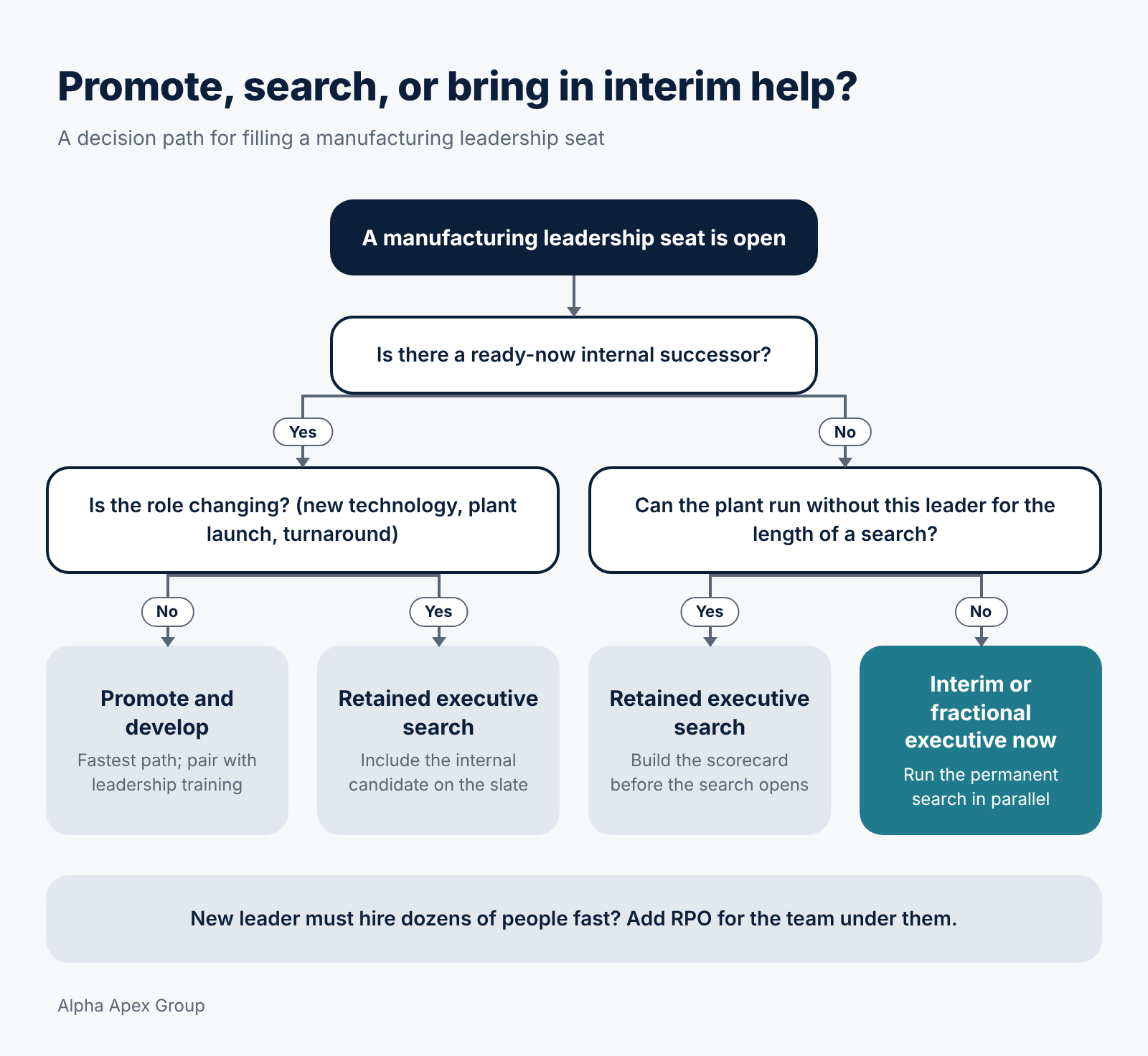
Sudden vacancies call for an interim or fractional executive. When a plant manager resigns before a launch, or a COO leaves mid-turnaround, a permanent search still takes time, and the plant can't run leaderless for a quarter. An interim leader can run the operation for a few months while the permanent search runs, which often costs less than the vacancy itself.
Once a new leader is in place, the bottleneck often shifts to the team they need to build. A plant manager hired for a launch may need 40 operators, five supervisors, and two maintenance technicians within a single quarter, while also qualifying equipment and writing standard work.
Recruiting at that volume can swallow a new leader's first 90 days. RPO services for manufacturing can run the volume while the leader owns final selection.
Cost of Leaving a Manufacturing Leadership Role Vacant
A vacant plant leadership role usually costs more than the salary saved, because overtime, team attrition, and lost throughput compound every week. Estimate it with your own numbers before you decide how fast to move.
Add the components for the expected vacancy period. If the total is higher than the cost of an interim leader or a retained search over the same period, moving faster is the cheaper choice.
What Are the Solutions to the Manufacturing Labor Shortage?
Apprenticeships, AI and automation, and retention programs all ease workforce shortages, and each works best when a named leader owns it. Give each one an owner, a budget, and a metric.
1. Build Apprenticeship and Technician Training Pipelines
Only 0.3% of the U.S. working-age population is in an apprenticeship, and Switzerland's rate is about 11 times higher. Manufacturers that build apprenticeship programs with community colleges, workforce development agencies, and local STEM education programs create a pipeline they control.
Manufacturing Day provides another way to introduce students and families to plant careers. Led by The Manufacturing Institute, MFG Day begins on the first Friday of October and encourages manufacturers to open their facilities to students, educators, parents, and community members
Who should own it: Plant or operations leadership, with HR and workforce-development teams managing partnerships, recruiting, and training logistics.
2. Use AI and Automation Where Labor Is Hardest to Replace
Automation can take over repetitive tasks while allowing scarce technical workers to spend more time on maintenance, troubleshooting, quality, and other higher-skill work. Machine tending, palletizing, material handling, and inspection are common areas to evaluate first.
AI can address part of the skills problem too. A September 2026 study from The Manufacturing Institute and Deloitte found that AI could supplement on-the-job training and help workers from adjacent occupations develop the knowledge needed for manufacturing technician roles.
3. Protect Retention Before Adding More Recruiting Spend
Manufacturing's quit rate was 1.4% in July 2026, below the 1.9% all-industry rate, so most U.S. manufacturers keep people better than other sectors do.
Protect that advantage with predictable schedules, visible promotion paths from operator to lead to supervisor, and pay reviews tied to skills gained. Use exit and stay interviews to find which of these matters most on each shift, since the answer often differs between first and third shift.
Our guide to building an employee value proposition covers how to package these benefits for candidates and current staff.
Build Your Manufacturing Leadership Bench with Alpha Apex Group
The manufacturing labor shortage won't ease on its own. Retirements continue, technician demand is rising, and raw material costs and trade policy keep pressure on margins. The manufacturers that handle it best will be the ones whose supervisors, plant managers, and operations leaders can recruit, train, and keep people.
Alpha Apex Group recruits manufacturing leaders, from plant managers and maintenance leaders to COOs, and provides interim executives and workforce consulting when a gap can't wait. We assess every candidate against the plant you're building, with competency interviews, technical evaluations, and leadership assessments.
Book a call with our team to talk through your next leadership hire. The first conversation covers your open roles, the scorecard, and a realistic timeline for your market.
FAQs
Should we hire a plant manager from outside manufacturing?
Yes, if they've run a comparable operation, as described in step 4 of the hiring process. The real gap is product and process knowledge, which they'll need to learn on the job. Pair them with a strong operations or engineering lead who knows your product for the first six months.
Does a retained search make sense for a frontline supervisor role?
Usually only at scale. Retained search fits plant manager roles and above, or a supervisor bench for a new site where 10 or more leaders are hired against one scorecard. For a single supervisor role, structured internal selection plus targeted external sourcing costs less.
How do you keep a new plant manager from losing tenured operators in the first year?
Have the new leader spend the first 30 days on the floor across every shift before changing processes, and involve tenured leads in the changes that follow. Track retention by shift each month, and step in early if experienced operators start leaving.
What changes about manufacturing leadership hiring for PE-backed companies?
PE-backed manufacturers usually need leaders who can deliver a value-creation plan within a three-to-five-year hold, so scorecards weight EBITDA impact, speed, and add-on integration more heavily. Equity also changes the offer conversation.
How Does Alpha Apex Group Assess Manufacturing Leadership Candidates?
Alpha Apex Group uses competency interviews, technical evaluations, and leadership assessments. Candidates are evaluated against the manufacturer’s operational challenges, technology landscape, strategic priorities, and culture rather than being screened only for job titles or years of experience.
Does Alpha Apex Group Support Manufacturing Leaders After Placement?
Yes. Alpha Apex Group provides ongoing support and consultation after placement to help new leaders integrate into the organization and connect with its strategic goals. This can be particularly useful when a new executive is stepping into a plant transformation, succession, or technology-led change.
.jpg)

.jpg)