Top 10 Change Management Consulting Firms in 2026
.webp)
Organizational change usually fails somewhere between the executive decision and the day-to-day reality of the people expected to carry it out. McKinsey found that fewer than one-third of transformations both improve performance and sustain those gains.
So, what separates a successful transformation from an expensive initiative that loses its momentum?
Execution. Aligned leadership, credible communication, clear ownership, and enough support for employees to change how they work.
The best change management consulting firms bring these elements together, adapting their approach to the organization rather than simply applying a familiar framework.
We looked past brand recognition to ask: Which consultancy is equipped to make change stick in your organization?
Here’s our list:
10 Change Management Consulting Firms Shaping Organizational Change
A change management firm can look impressive and still be the wrong partner for the work. Some are made for global transformation programs, while others are strongest in technology adoption, culture change, or developing internal change capability.
Why does that distinction matter?
Prosci found that projects with “excellent” change management were seven times more likely to meet their objectives than those with poor change management.
The 10 firms below have the frameworks, specialist expertise, or client evidence to merit your consideration:
1. Korn Ferry
- Change Focus: Culture transformation, behavioral change, leadership alignment, communications, digital transformation, M&A, and restructuring.
- Best Fit: Large global organizations managing complex, workforce-wide transformation.
Korn Ferry uses its proprietary Art of Movement Making™ to build change through employee networks and internal influence. Its organizational network analysis identifies employees who can help adoption spread, while the Culture 360 Toolkit tracks progress. Through its partnership with Kotter, leaders can also earn change management certification.
Korn Ferry applied its change expertise at scale with Maersk, helping deploy a new performance and talent approach to 110,000 employees with support from 10,000 people leaders. Employee surveys rated the resulting conversations 4.5 out of 5.
2. Boston Consulting Group (BCG)
- Change Focus: Enterprise transformation, culture change, behavioral change, leadership alignment, and transformation governance.
- Best Fit: Large enterprises managing complex, organization-wide transformation.
BCG combines behavioral science with proprietary tools that measure whether employees are ready for change. Its toolkit includes the Momentum Meter for weekly sentiment tracking, OrgVantage for organizational diagnostics, and KEY Impact Management for transformation governance.
BCG also publishes unusually concrete change-program results. In one global pharmaceutical transformation, a 12-week change program helped lay the foundation for $500 million in cost reductions and a $20 billion increase in market value.
3. Alpha Apex Group
- Change Focus: Organizational design, operating model redesign, restructuring, role clarity, culture, and workforce transformation.
- Best Fit: Companies navigating rapid growth, restructuring, M&A, or organizational transformation.
At Alpha Apex Group, we combine change management with organizational design and executive talent support. We help leadership teams redesign structures, decision rights, workflows, and roles, then support the people side of implementation so the new model works in practice. Our organizational design page also lists clients including AWS, Meta, Siemens, Semrush, Zendesk, and GDIT.
Our differentiator is the ability to connect organizational change with the talent needed to execute it. Across our broader talent practice, we have supported 2,000+ placements worldwide with an average 43-day time-to-fill.
4. Bain & Company
- Change Focus: Enterprise transformation, change capability, program execution, behavioral adoption, and transformation governance.
- Best Fit: Large enterprises managing complex, high-stakes transformations.
Bain is known for its proprietary Results Delivery® approach, supported by tools such as the Change Power Index® for benchmarking change capability and ARC℠ for tracking transformation execution. Its model emphasizes identifying execution risks early and building an organization’s ability to sustain change.
Bain reports 4,400+ change management and implementation projects. It also says organizations using Results Delivery are 2x more likely to achieve their goals and 3x more likely to sustain results.
5. Prosci
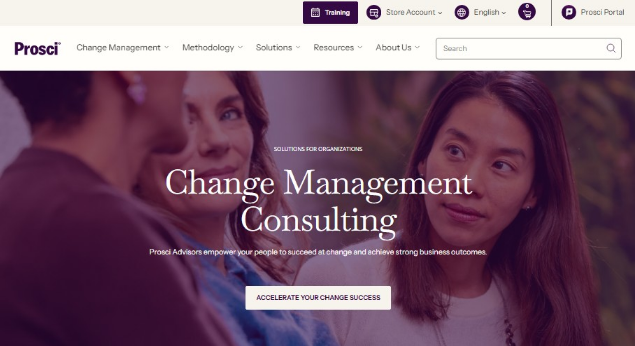
- Change Focus: ADKAR-based change management, enterprise change capability, technology adoption, leadership coaching, and practitioner training.
- Best Fit: Organizations that want a standardized change methodology while building internal capability to manage future transformations.
Prosci is unusual among consulting firms because change management is its entire business. Its advisors embed with client teams and apply the Prosci Methodology and ADKAR® Model while coaching internal practitioners, sponsors, and managers.
For McCarthy Holdings, Prosci Advisory Services helped an AI rollout reach 90% adoption in 30 days, versus a 70% target for the first three months. Usage remained at 85% monthly, and the project reached its adoption target two months ahead of schedule.
6. Blankenship Change Consulting
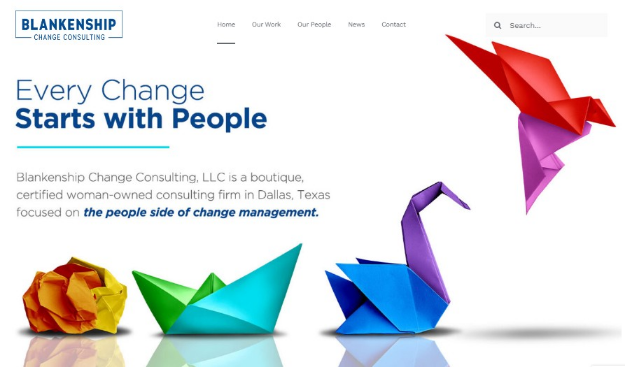
- Change Focus: Organizational transformation, technology and process change, communications, learning, and culture integration.
- Best Fit: Enterprises that want senior change expertise with a more flexible boutique consulting model.
Blankenship uses a network of around 100 independent consultants, many with backgrounds at top-tier consulting and design firms. Rather than forcing clients into one methodology, its consultants work across approaches such as Prosci and adapt to the client’s existing change framework.
In one post-acquisition transformation, Blankenship helped integrate ~5,000 employees across four legacy employee groups while rolling out a new brand, organizational structure, and culture on schedule.
7. North Highland
- Change Focus: People-centric transformation, culture change, behavioral adoption, technology change, and operating model transformation.
- Best Fit: Large organizations that want change management integrated with broader transformation delivery.
North Highland takes a people-centric approach that brings together design thinking, behavioral science, and agile delivery. Its consultants use co-creation and employee experience techniques to determine how change is introduced. This makes the firm relevant for complex transformations where adoption and culture are as important as the technical rollout.
In one global beverage transformation, North Highland’s work reached 100+ executives and 60,000+ employees as the company redesigned its structure, processes, and ways of working. North Highland was also recognized as a notable provider in Forrester’s Q4 2025 Organizational Change Management Services Landscape.
8. Huron
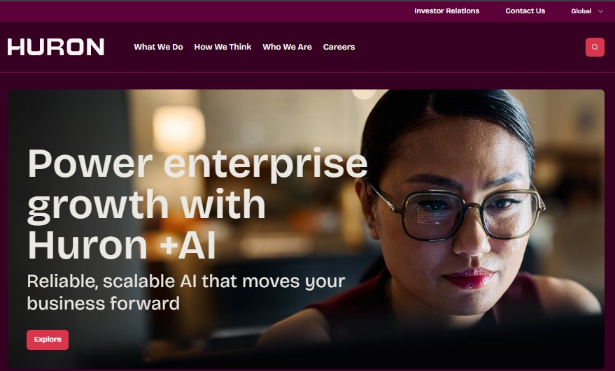
- Change Focus: Enterprise transformation, technology adoption, AI readiness, leadership alignment, workforce change, and post-go-live sustainment.
- Best Fit: Healthcare, higher education, financial services, and large organizations implementing platforms such as Workday, Oracle, Salesforce, or Microsoft.
Huron is particularly strong when change management is inside a larger technology or operating-model transformation. Its approach spans readiness diagnostics, leadership activation, role-based adoption, and sustainment, with sector depth in healthcare and higher education rather than a purely methodology-led model.
Huron reports 20+ years of experience guiding organizational and digital transformations. In one University of Washington program, Huron supported organizational change alongside a Workday rollout that began in 2016 and launched in June 2017, helping what Huron describes as the largest public-sector university using Workday.
9. Centric Consulting
- Change Focus: Enterprise transformation, technology adoption, organizational design, culture change, M&A, and change capability building.
- Best Fit: Organizations that want change management integrated with process, technology, and operating-model transformation.
Centric Consulting uses an iterative, people-centered model built around leadership alignment, change networks, continuous learning, and ongoing readiness and adoption measurement. It can also help clients build internal change capability, which reduces reliance on outside consultants over time.
For World Wide Technology, Centric supported a major business transformation alongside a 175-person project team and 150-person change network. A 20-person Centric team managed the broader program, spanning change management, process redesign, Oracle modernization, and organizational restructuring.
10. SEI
- Change Focus: Enterprise transformation, technology adoption, culture change, stakeholder alignment, communications, and change recovery.
- Best Fit: Large organizations managing technology rollouts, multi-location change programs, or transformations struggling with adoption.
SEI uses bottom-up training and top-down leadership reinforcement, with change champions and feedback loops used to build adoption across different levels of an organization. The firm also supports programs already underway where resistance, communication gaps, or low adoption are slowing progress.
In a utility-company culture transformation, SEI conducted 12 workshops totaling 2,080 engagement hours with 80+ employees and generated 100+ employee ideas around workload, communication, and accountability. The work led to a new organizational roadmap and structural changes designed to address capacity and collaboration issues.
What Can Go Wrong When You Pick the Wrong Change Management Consultant
By the time weak change advice becomes visible, it may already be built into the program. That delay is what makes the wrong consulting partner so expensive.
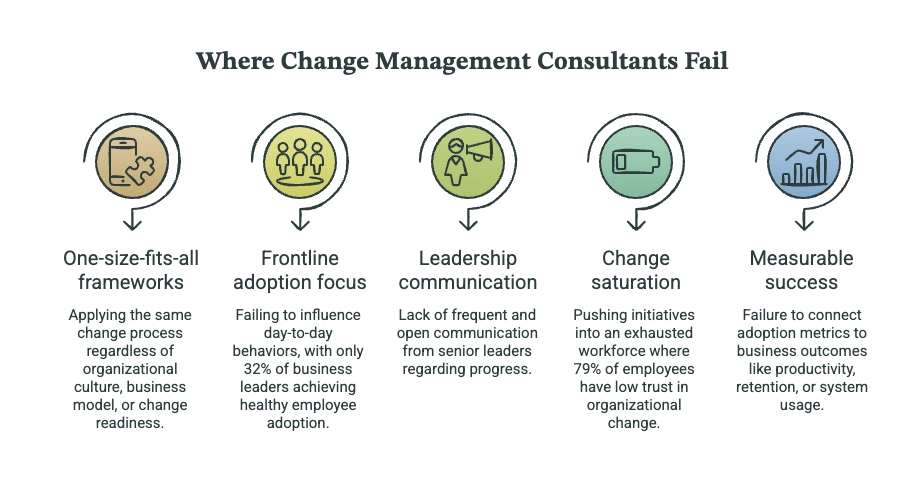
These are the risks worth checking before the engagement begins:
- One-size-fits-all frameworks
Prosci, Kotter, and other methodologies are useful, but applying the same change process regardless of organizational culture, business model, or change readiness can create more resistance than momentum.
- Too little focus on frontline adoption
Gartner found that only 32% of business leaders said their most recent change initiative achieved healthy employee adoption. Change management consulting needs to influence day-to-day behaviors, not just executive messaging.
- Poor leadership communication
Transformations are far more likely to succeed when senior leaders communicate frequently and openly about progress. Without visible sponsorship, change agents and employees are left filling in the gaps themselves.
- Ignoring change saturation
Gartner also reports that 79% of employees have low trust in organizational change. Pushing another initiative into an already exhausted workforce without assessing readiness can make even a well-designed transformation stall.
- No measurable definition of success
A consultant should connect adoption metrics to business outcomes such as productivity, retention, system usage, performance improvement, or transformation milestones.
Some failures begin even earlier with the organizational structure itself. Our guide to organizational design consulting explains how unclear decision rights, reporting lines, and responsibilities can undermine a transformation before the change programme really gets going.
The same problem becomes especially visible during post-merger integration, when culture can break down after a merger if leaders underestimate differences in norms, incentives, and ways of working.
As former McKinsey Senior Partner Bill Schaninger put it:
"There's a known set of things. It's not mystical. That you can get that number, a likelihood of success up closer to 80 percent, but it's not easy."
That is the real test of a change management consultant: whether they can diagnose where adoption is likely to fail and intervene before momentum disappears.
Watch the following video for a breakdown of what change management consulting involves:
Why You (and Your Consultant) Should Care About Change Fatigue
A big change management problem in 2026 is that employees are being asked to absorb too many changes at once.
PwC found that 62% of employees say the pace of change at work increased over the previous year, while 44% do not understand why those changes are happening. Gartner adds another warning sign: only 45% of employees actually achieved the change goals their organizations set for them.
At the same time, 7 in 10 business leaders say being fast and nimble is a top competitive priority. That creates a difficult tension. Leadership wants faster digital transformation, AI adoption, and business transformation, while employees may already be hitting change saturation.
This is where organizational change management has to go beyond communications and training. Strong change leaders assess readiness, sequence competing digital initiatives, explain the business strategy behind the change, and pay attention to the employee experience. Our guide to employee experience consulting explores why that connection matters.
The firms worth hiring are the ones disciplined enough to understand how much change an organization can realistically absorb before asking people to move again.
Build Change That Sticks With Alpha Apex Group
The top change management consulting firms help leaders translate strategy into new structures, behaviors, decision rights, and ways of working that employees can actually adopt.
At Alpha Apex Group, we offer change management consulting together with organizational design, workforce transformation, leadership alignment, and executive talent support.
That makes us really well-suited to complex organizational transformation, restructuring, digital change, and post-merger integration, where the operating model and the people executing it often need to change at the same time.
So if you want to redesign an organizational structure, accelerate AI adoption, or build a broader workforce transformation, we help turn the change strategy into practical execution.
Planning a major transformation? Talk to Alpha Apex Group about building a change management approach that delivers measurable adoption and lasting performance improvement.
FAQ
What's the difference between change management and project management?
Project management focuses on delivering scope, budget, and timelines. Change management focuses on whether people understand, adopt, and sustain the new behaviors, systems, or processes the project introduces.
How do firms measure change management ROI?
Strong firms track adoption, productivity, system usage, retention, training effectiveness, milestone completion, and business KPIs tied directly to the change initiative.
Which change management certifications matter?
Prosci ADKAR and CCMP are widely recognized, but certification alone is not enough. Look for change practitioners who can adapt methodology to your organizational culture, change readiness, and business strategy.
How long does a change management engagement take?
Most enterprise engagements run for several months and often span planning through post-launch sustainment. Large digital transformation, restructuring, or post-merger integration programs can require support for a year or longer.
What change management methodologies does Alpha Apex Group use?
Alpha Apex Group uses proven change management principles alongside organizational design, leadership alignment, operating-model work, and workforce transformation rather than forcing every client into one rigid framework.
Does Alpha Apex Group support M&A change management?
Yes. We support post-merger integration through organizational structure design, leadership alignment, role clarity, culture integration, and workforce planning so the combined organization can operate effectively.
What types of organizations does Alpha Apex Group support?
We work with growing and established organizations navigating restructuring, M&A, digital change, organizational transformation, and other complex change initiatives where strategy, structure, and talent need to move together.
.jpg)
.jpg)
.jpg)