Plant Manager Salary in 2026: Pay Data, Job Description & Hiring Guide
The median plant manager salary in the US is $126,060, per BLS data from May 2025.
Hiring for the role keeps getting harder: manufacturers need about 3.8 million new workers by 2033, and up to 1.9 million of those jobs could go unfilled.
This guide covers plant manager pay data, a job description template, interview questions, and how to work with recruiters.
And if the seat is open now, our manufacturing executive search team can help you find and assess plant managers who fit the scope of the role.
In our search work, plant manager pay depends far more on the scope of the role than the national average: headcount, sector, union status, and whether the plant needs a turnaround.
We hire for that mandate, since a turnaround leader and a steady operator can carry identical résumés. And speed is part of the offer. Strong plant leaders interview with several employers at once, so slow decisions lose them.
What Is the Average Plant Manager Salary in 2026?
The median plant manager salary is $126,060 a year, or $60.61 an hour, and the mean is $134,170.
BLS counts plant managers under the occupation "Industrial Production Managers" (SOC 11-3051), which employed 246,250 people in May 2025. That BLS figure is the most reliable national average because it comes from employer payroll surveys covering plants of every size.
The spread around the median is wide. The bottom 10% of plant managers earn under $78,000, and the top 10% earn more than $205,520.
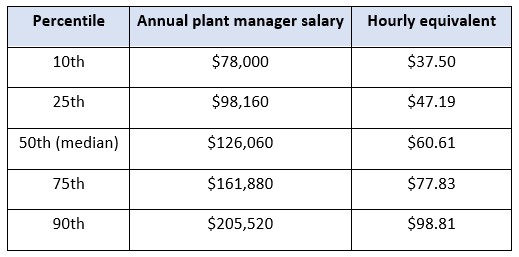

Two numbers are worth anchoring an offer to. The 25th to 75th percentile band, $98,160 to $161,880, is what the middle half of plant managers earn. The 90th percentile, $205,520, shows what top earners make.
Why Plant Manager Salary Data Differs by Source
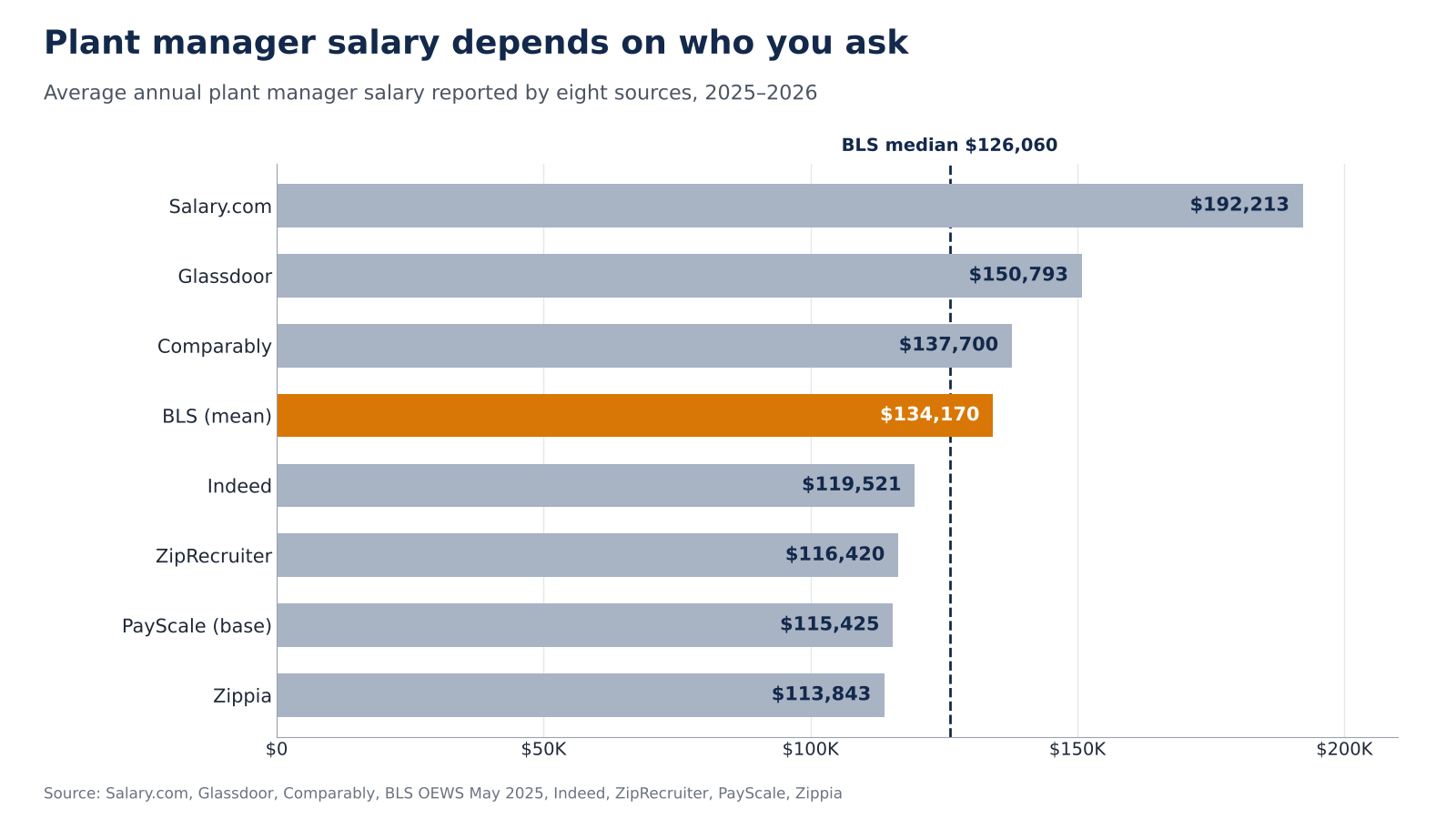
Salary sites disagree on plant manager pay by almost $80,000 because each one samples a different slice of the market.
Salary.com's benchmark sits at $192,213, while Zippia's modeled figure sits at $113,843. Each likely reflects a different mix of plants.
Three likely reasons for the gap:
- Posting-based sources may run low. Indeed and ZipRecruiter count advertised salaries, which may underrepresent senior roles filled through referrals and search firms.
- Some sources count base only. PayScale's $115,425 is base pay. Its additional pay data shows bonuses of $2,000 to $30,000 and profit sharing of $1,000 to $24,000 on top.
- HR-reported surveys may skew large. Salary.com's benchmark draws on employer-reported compensation data, which may lean toward larger employers.
Use the BLS median to understand the market. Use the plant-size tiers in the industry, plant size, and experience section below to price a specific role.
Plant Manager Salary by State and Metro Area
Delaware is the top-paying state for plant managers, with a median of $153,000. The five highest-paying states are all in the Northeast or Mountain West, while the lowest-paying states sit in the Plains, the Midwest, and Idaho, where living costs are lower.
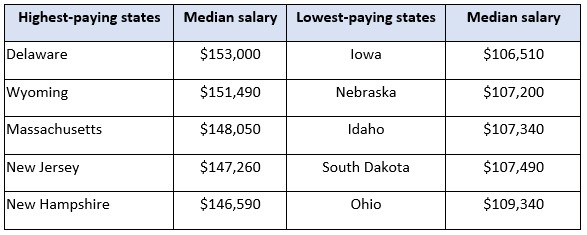
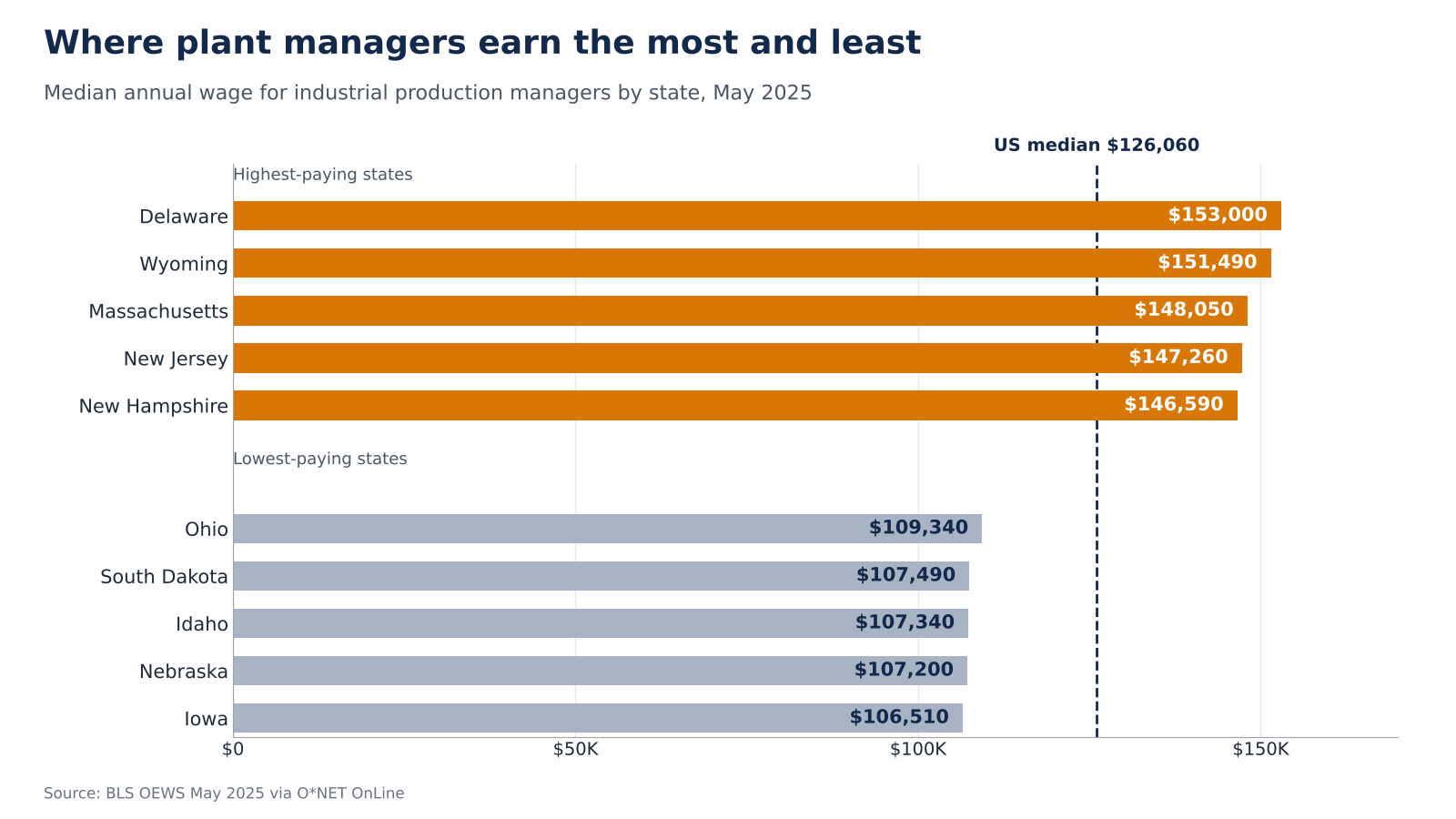
The lowest-paying states still matter a lot for hiring. Indiana alone employs 9,400 plant managers at a median of $121,500, and Ohio sits in the bottom five, so many plant manager searches happen in markets paying below the national median.
A candidate relocating from New Jersey to Ohio will usually take a lower base and expect the difference back in bonus or relocation support.
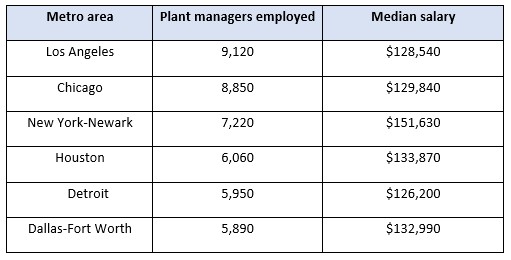
Metro pay tells a similar story. The highest-paying metros are Manchester-Nashua, New Hampshire ($174,360) and San Jose, California ($171,140). The metros with the most plant managers pay closer to the middle:
Regional demand is also shifting as tariffs and reshoring move production. We covered how that affects hiring in our guide to manufacturing recruiting during a trade war.
Plant Manager Salary by Industry, Plant Size, and Experience
Plant size and industry also shape plant manager pay. By the plant-size tiers below, a plant manager running 600+ people can earn close to twice the base of one running fewer than 100.
Plant Manager Salary by Industry
Chemical manufacturing pays plant managers the most among the large manufacturing industries, at a $135,530 median, and fabricated metal pays the least at $109,920. These BLS figures are the most reliable manufacturing plant manager salary data by industry:
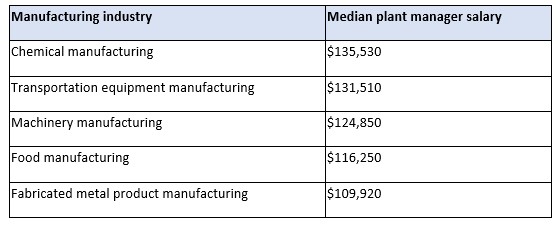
Transportation equipment, which includes auto and aerospace plants, employs more plant managers than any other industry. Our automotive executive search team works in that pool every week.
Other reported figures cover plant types and employers outside the BLS list:
Company-level figures come from small samples, so treat them as reference points. The power plant row shows why one source is never enough: Salary.com and PayScale differ by $60,000 for the same title.
Recruiters who place plant leaders also report sector premiums that BLS doesn't break out.
A 2026 recruiter salary guide estimates semiconductor and EV plants pay 15% to 25% more than general industrial plants, pharmaceutical and medical device plants 10% to 20% more, and aerospace and defense plants 10% to 15% more. Treat these as market estimates built from public salary sources.
If you're hiring in a specialized sector, a specialist pool matters more than a bigger budget.
Plant Manager Salary by Plant Size
Plant headcount is one of the strongest signals in plant manager salary estimates. Larger plants mean more shifts, more direct reports, a bigger capital budget, and usually full P&L ownership.
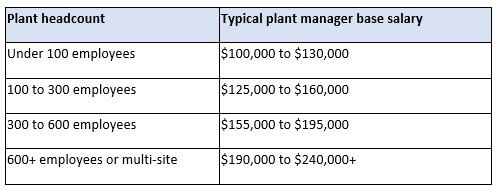
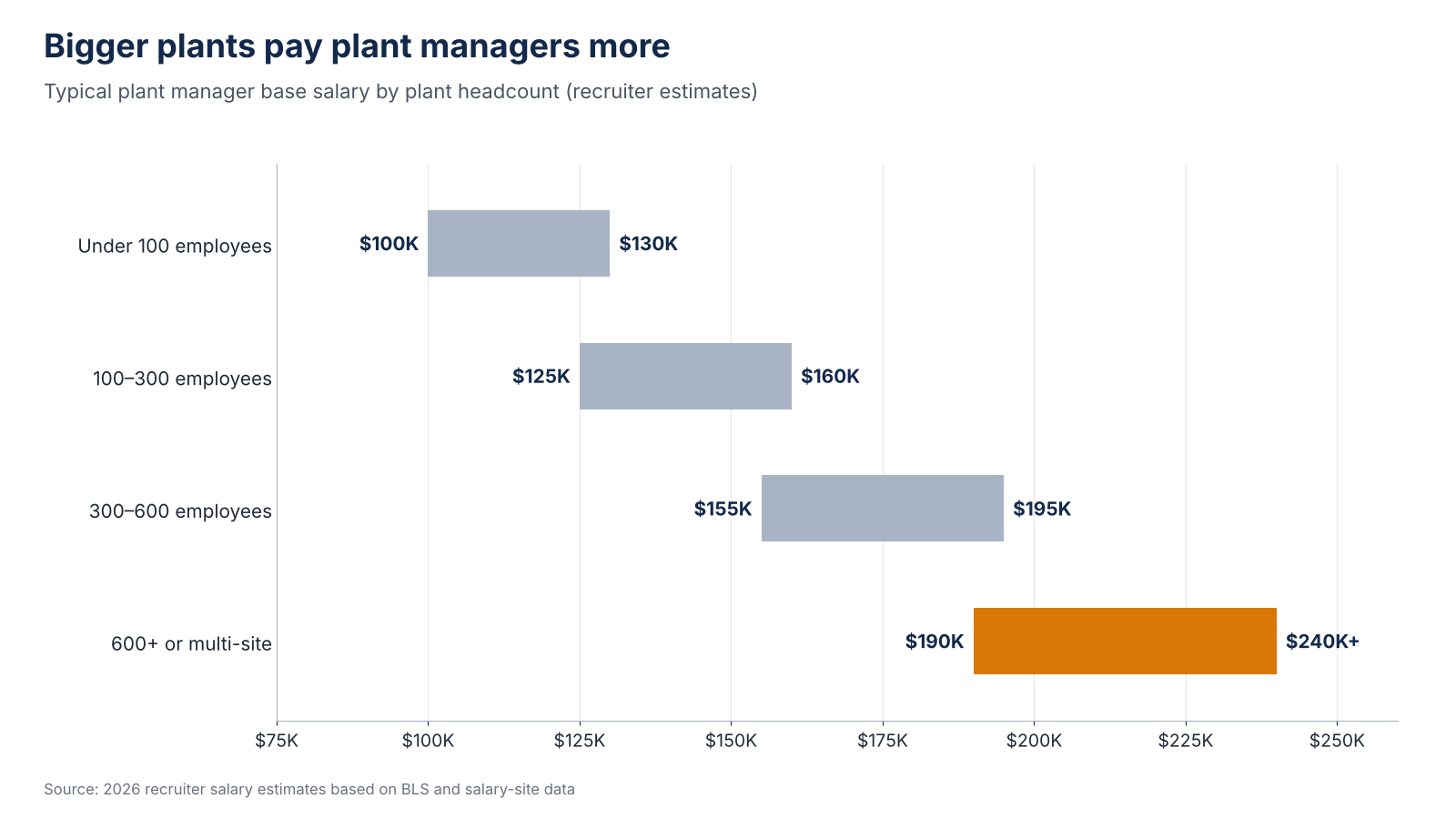
These tiers line up with the BLS distribution: the under-100 tier sits around the 25th to 50th percentile, and the 600+ tier straddles the 90th percentile ($205,520).
Move a band up for regulated or capital-heavy plants, union environments, or a turnaround mandate, and down for a simple, single-shift operation.
Plant Manager Salary by Experience
In PayScale's data, plant manager pay climbs through the first decade, then levels off. Its total pay figures by experience level:
- Less than 1 year: $78,127
- 1 to 4 years: $94,914
- Mid career (5 to 9 years): about 5% below the average
- Experienced (10 to 19 years) and late career (20+ years): about 7% and 6% above the average
Source: PayScale, July 2026, 1,573 profiles.
The flattening suggests that after the first decade, pay grows mainly by moving to a larger or more complex plant. When you price a role, weight the size and complexity of the candidate's last plant more heavily than their total years.
Assistant Plant Manager Salary
The average assistant plant manager salary is $86,923 in base pay, according to PayScale, with a range of $58,000 to $127,000. Zippia puts it at about $85,755. Salary.com's posting-based figure is much higher at $139,166, likely because it draws on a different mix of job postings.
How to Structure a Plant Manager Compensation Package
A plant manager compensation package has five parts: base salary, an annual bonus, profit sharing, long-term incentives at larger employers, and relocation support.
Comparably reports average total pay of $137,700, including a $27,540 bonus that equals 25% of base salary, so base makes up about 80% of cash pay and the rest is tied to plant results.
Here is how those pieces fit together for a 350-person plant in the Midwest. This is an illustrative offer built from the ranges above:
Tie the bonus to three or four plant metrics the candidate can actually move, such as safety incident rate, OEE, on-time delivery, and cost per unit. The KPI table in the next section lists benchmarks for each.
Pro tip: Weight the safety metric on leading indicators, such as hazards identified and fixed, near-misses reported, and corrective actions closed. Rate-based injury targets are allowed only when they don't discourage injury reporting, per OSHA's 2018 guidance, so pair any recordable-rate goal with clear reporting safeguards.
What Does a Plant Manager Do?
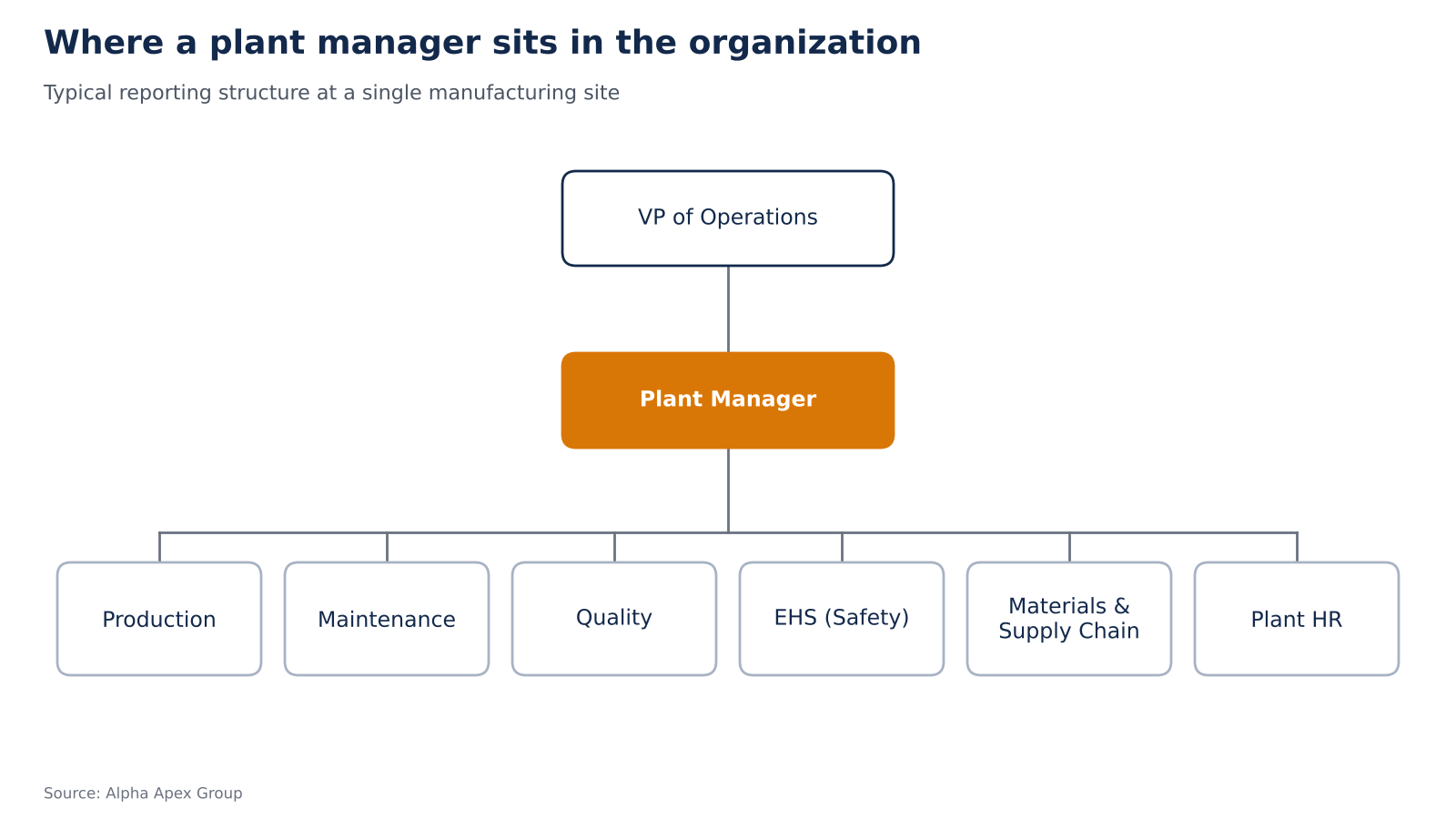
A plant manager runs everything inside one manufacturing site: safety, quality, delivery, cost, and people. Most plant managers report to a VP of Operations or a general manager and own the plant's budget, and many carry full plant-level P&L responsibility.
Is a plant manager a high position? Yes. It's the top job on the site org chart, usually one level below the VP of Operations. Production, maintenance, quality, EHS, materials, and plant HR typically report into it.
Plant managers are judged on a short list of plant KPIs, usually grouped as safety, quality, delivery, and cost (SQDC):
A typical plant manager's day follows the production rhythm:
- Early shift handoff: review overnight output, safety events, and open issues.
- Tiered meetings: short stand-ups that escalate problems from the line to department heads to the plant manager.
- Gemba walk: time on the floor to see problems firsthand.
- Production review: compare output, scrap, and downtime against plan, usually from the plant's manufacturing execution system (MES).
- Afternoon: capital projects, budget reviews, hiring, and calls with corporate or customers.
Plant Manager Job Description Template
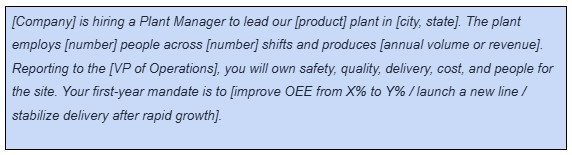
You can copy this plant manager job description and edit the bracketed fields. The most important line to customize is the mandate in the job summary, because it tells candidates whether you need a builder, a fixer, or a steady operator.
Plant Manager Job Summary
Plant Manager Responsibilities
- Lead a safety culture and drive the plant's recordable incident rate toward zero
- Own the plant operating budget and, where applicable, the plant P&L
- Plan production to meet customer demand, inventory targets, and on-time delivery goals
- Lead continuous improvement using Lean, Six Sigma, or TPM methods
- Maintain quality systems and certifications such as ISO 9001 or IATF 16949, and meet any applicable FDA requirements
- Hire, develop, and hold accountable the plant leadership team
- Manage labor relations, including union contracts where applicable
- Plan and execute capital projects and equipment upgrades
- Track plant KPIs through ERP and MES systems and report results to leadership
- Ensure compliance with OSHA, EPA, and local regulations
- Partner with engineering, supply chain, and sales on new product launches
Plant Manager Qualifications and Certifications
Required:
- Bachelor's degree in engineering, operations management, or a related field
- [5+] years of manufacturing leadership, including [2+] years leading a department or plant (BLS lists 5+ years of related experience as typical)
- Experience managing a budget and a multi-shift workforce
- Working knowledge of Lean manufacturing
Preferred:
- MBA or master's in engineering management
- Lean Six Sigma Green or Black Belt (ASQ or equivalent)
- APICS CPIM from ASCM
- OSHA 30-Hour General Industry card
- Experience in [your industry] or with [your key process]
We recommend separating the skills you must hire from those a strong leader can learn in the first six months:
Plant Manager Pay Range and Benefits Statement
The pay range for this role is $[minimum] to $[maximum] base salary, plus a target annual bonus of [X]% of base and [profit sharing/equity]. Benefits include medical, dental, and vision coverage, a 401(k) with company match, and relocation assistance.
Set the numbers from the plant-size tier that matches your site. Many states now require a posted pay range, so check the current rules in our pay transparency laws guide before publishing.
Plant Manager vs. Operations Manager vs. General Manager
A plant manager runs one site, an operations manager runs a function or several sites, and a general manager runs a whole business unit including sales and finance.
At a manufacturer, an operations manager over several plants usually sits above the plant manager; at a single-site company, the plant manager is often the senior operations role.
The titles overlap at smaller companies, which is why pay data for them gets mixed up.
The BLS median for general and operations managers sits below plant managers because that category includes general managers at small businesses of every kind. At manufacturers, an operations leader over several plants may command higher pay than a single-site plant manager, depending on scope.
How to Hire a Plant Manager in 5 Steps
Hiring a plant manager well takes five steps, and the timeline depends mostly on how quickly you decide. SHRM's 2026 benchmarking puts the median time to fill nonexecutive roles at 39 days, and senior roles commonly take longer.
- Define the mandate, success metrics, and pay band. Write down whether the plant needs a turnaround, steady-state leadership, a greenfield launch, or multi-site coordination. Pick three success metrics for the first 12 months from the KPI table above, and set the pay band from the plant-size tier.
- Source locally and nationally. Decide early whether you'll pay relocation. In our experience, a local-only search in a small manufacturing market produces a very short list, so settle the relocation question before sourcing starts.
- Run a structured interview loop. Every finalist goes through the same stages, scored against the same competencies.
- Make the offer within days. Have compensation pre-approved before the final round so the offer can go out within 48 hours. Slow offers are a common way companies lose their first-choice candidate.
- Onboard with a 30-60-90 day plan. Days 1 to 30 are for listening and floor time, days 31 to 60 for a diagnosis, and days 61 to 90 for the first improvement plan. You can use our employee onboarding checklist for the administrative side.
The interview loop in step 3 works best in this order:
In our experience, the plant tour is the stage most companies skip and the one that reveals the most. Walk the candidate past a real constraint, such as a bottleneck machine or a high-scrap cell, and ask what they'd want to know. Strong plant managers ask about data, people, and maintenance history before they offer any fix.
Plant Manager Interview Questions to Ask Candidates
The best plant manager interview questions ask for specific results with numbers attached. Below are 20 questions in five groups, each with what a strong answer includes.
These are spoken questions. The hands-on floor problem and the 90-day plan belong in the interview stages above.
Safety and Quality Interview Questions
1. What was the recordable incident rate at your last plant when you arrived, and when you left? A strong answer gives both numbers and the two or three specific changes that moved them.
2. Tell me about a serious safety incident on your watch. Listen for ownership, a root-cause investigation, and a change that stuck.
3. How have you handled a customer quality escape? Strong candidates describe containment first, then root cause, then the system fix.
4. Which quality-system audits and regulatory inspections have you led? Look for direct audit experience with ISO 9001 or IATF 16949, plus any FDA inspections or compliance requirements that apply to your plant.
Operations and Continuous Improvement Interview Questions
5. What was your OEE on your main line, and how did you improve it? A strong answer separates availability, performance, and quality losses.
6. Walk me through a Lean or Six Sigma project you led personally. Listen for the baseline, the method, the result, and how the gain was sustained.
7. How do you run your daily production meetings? Strong candidates describe tiered meetings with clear escalation rules.
8. Tell me about a time you had to choose between hitting a shipment and fixing a recurring problem. Look for judgment about short-term and long-term cost.
Cost and P&L Interview Questions
9. What was the size of the budget or P&L you owned? Get the dollar figure and what was inside it.
10. Tell me about a year you missed budget. What happened? Strong answers explain the variance clearly and describe the recovery plan.
11. How have you reduced cost per unit without hurting quality or safety? Listen for specific levers such as scrap, labor efficiency, or energy.
12. How do you build a capital request for new equipment? Look for payback math and a realistic risk assessment.
People Leadership and Labor Relations Interview Questions
13. How many direct reports did you have, and who did you hire or replace? Strong candidates have built their own leadership team.
14. Tell me about a supervisor you developed into a manager. This shows whether they grow talent or only manage it.
15. Have you worked under a union contract? How did you handle a grievance? Match the answer to your plant's labor situation.
16. How do you handle turnover on the floor? Look for root causes such as scheduling, supervisors, or pay, with data behind them.
Situational Plant Manager Interview Questions
17. You start Monday and learn the plant's largest customer is threatening to pull business over late deliveries. What do you do in week one? Strong answers start with facts and customer contact before making internal changes.
18. Your best line supervisor is producing results but has two HR complaints. How do you handle it? Listen for a clear standard on behavior.
19. Corporate asks for a 10% headcount cut. How do you approach it? Look for analysis before action and attention to safety and morale.
20. A key machine goes down with no spare part for two weeks. What's your plan? Strong candidates cover customer communication, workarounds, and preventing a repeat.
Plant Manager Interview Scorecard
Score each finalist from 1 to 5 on the same five competencies, with each interviewer scoring independently before discussion.
Red Flags in Plant Manager Interviews
- No numbers. A plant manager who can't recall their own safety rate, OEE, or budget probably didn't track them.
- Only "we," never "I." Team credit is good, but you need to know what the candidate personally did.
- Blaming the workforce. Leaders who describe their last plant's people as the problem tend to repeat the pattern.
- Every plant was a turnaround. Short stints with dramatic claims can mean the candidate leaves before results are tested.
- No questions on the plant tour. Strong plant managers are curious about your equipment, data, and people.
- Labor relations mismatch. A leader with only non-union experience will need support in a union plant, and the reverse is also true.
When Should You Use Plant Manager Recruiters?
Plant manager recruiters are worth the fee in three situations: the empty seat is costing output, the search has to stay confidential, or the right candidates live outside your region. Each of those situations makes an in-house search slower and riskier.
A vacant plant manager seat costs more than the salary saved. Siemens' 2024 study found unplanned downtime costs automotive plants $2.3 million an hour, and even consumer goods plants lose $36,000 an hour. In our searches, plants without a leader take longer to recover from these events.
A bad hire is also expensive. Gallup estimates that replacing an employee costs one-half to two times their annual salary, which for a median plant manager is $63,000 to $252,000.
Plant manager recruiters work under four main models:
You can use this checklist to evaluate plant manager recruiters before signing:
- Manufacturing specialization: Ask how many plant manager searches they completed in the last two years.
- Sector match: Check whether they've placed leaders in your industry and plant size.
- Time to fill: Ask for their average and what happens if a search stalls.
- Assessment method: Ask how they test candidates beyond interviews, such as structured scorecards or work samples.
- Guarantee: Check the replacement guarantee period and its terms.
- References: Speak with two clients and one placed plant manager.
If a plant manager leaves suddenly, an interim leader can hold the site steady. Our guide to interim and fractional executive search firms covers what interim leaders cost and when they make sense.
Hire Your Next Plant Manager with Alpha Apex Group
Alpha Apex Group recruits plant managers and manufacturing leaders who match your plant's size, sector, and mandate. We've completed more than 2,000 placements, put first candidates in front of hiring managers within 72 hours, and average 43 days to fill full-time roles.
Every search starts with the mandate and a pay band set from real market data. Candidates go through competency interviews, technical evaluations, and leadership assessments before you meet them, and we support the new leader through their transition.
Talk to our team about your plant manager search. The first call covers your plant's mandate, a realistic pay range for your market, and a timeline for a shortlist.
FAQs
How do you become a plant manager?
Most plant managers start as engineers or production supervisors and reach the role after at least five years of field experience. The usual path runs through production or operations manager first. A bachelor's degree in engineering or operations is standard. First-line production supervisors earn a median of $74,450, so the move to plant manager adds about $51,600 at the median.
Is plant manager a job in demand?
Yes. BLS projects 3% employment growth for industrial production managers from 2025 to 2035, with about 17,000 openings a year from growth and retirements. Demand is strongest in reshoring sectors such as semiconductors, batteries, and pharmaceuticals.
Is a plant manager a stressful job?
It can be. BLS notes that most plant managers work full time, some work more than 40 hours a week, and they may be on call for emergencies at any time, including nights and weekends. In 24/7 plants, they usually visit off-shifts and weekends to stay connected with every crew. Plants with strong second-level leaders put far fewer after-hours demands on the plant manager.
Should you promote an internal candidate or hire an external plant manager?
Promote internally when the plant needs continuity and a strong production or operations manager is ready. Hire externally when the plant needs a turnaround, a new skill set such as a launch or a union transition, or when no internal candidate has managed a budget. Many companies run both: they assess the internal candidate against the same scorecard as external finalists.
What is the difference between a plant manager and a plant superintendent?
A plant superintendent usually oversees day-to-day production and reports to the plant manager. The plant manager, on the other hand, owns the whole site, including budget, quality systems, and leadership hiring. In some industries, such as utilities and construction materials, "superintendent" is the senior site title, so check the scope before comparing pay.
.jpg)
.jpg)
.jpg)

.jpg)