Manufacturing Execution Systems (MES) Explained: 2026 Guide
You need MES to know what is happening on your plant floor. It acts as the operational record of production. It shows you what’s running, what each order has consumed, and whether output is on track.
But if MES is so important, why do so few manufacturers have a fully connected system?
93% of manufacturers use MES in at least one facility, yet only 23% have fully integrated it across ERP, quality, PLM, and operational systems.
Really implementing MES and making it work throughout the entire operation are two very different things.
This guide explains what MES is, how manufacturing execution software works, where it fits with ERP systems and industrial automation, and what to look for when choosing a platform in 2026.
What Is a Manufacturing Execution System?
A manufacturing execution system is software that connects business planning with what is happening on the shop floor. In simple terms, ERP systems tell a manufacturer what should be produced, while MES software tracks and manages how that production is carried out.
This places MES between Enterprise Resource Planning systems and plant-level technologies such as SCADA systems, Programmable Logic Controllers, and other process control systems. It turns production plans into shop-floor instructions and gives the wider business an up-to-date view of how production is progressing.
The role of MES has been formalized through industry frameworks. The Manufacturing Enterprise Solutions Association defined its core functions through the MESA-11 model, while ISA-95 provides a widely used framework for how manufacturing operations connect with enterprise systems.
As manufacturers invest in more connected operations, the market continues to grow. The global manufacturing execution systems market is projected to reach $18.87 billion in 2026 and $29.35 billion by 2031, with North America accounting for 36.74% of market value, according to Mordor Intelligence.
What Are the Benefits of an MES
The biggest advantage of an MES is that you can see production problems while they are happening, as opposed to after the shift ends.
That real-time visibility can translate into measurable gains. Manufacturers using smart manufacturing and MES-enabled operations report:
- 10-20% higher production output
- 7-20% improvement in employee productivity
- 10-15% more unlocked capacity
Beyond throughput, MES systems can help manufacturers:
- Catch bottlenecks faster with real-time data from the plant floor.
- Improve quality control by flagging defects and process deviations earlier.
- Reduce downtime through better equipment monitoring and predictive maintenance.
- Make production scheduling more responsive when demand, labor, or machine availability changes.
- Improve traceability across materials, work orders, operators, and finished goods.
- Give managers real-time insights into overall equipment effectiveness, scrap, cycle times, and production performance.
These gains increasingly affect more than operating costs. 92% of manufacturing executives say smart manufacturing will be a main driver of competitiveness over the next three years. Advanced automation also ranks among the top capabilities executives expect to create competitive advantage.
A strong MES manufacturing setup gives teams the information they need to make faster decisions across production processes, quality assurance, maintenance, and the supply chain.
Important Features of an MES
The best MES platforms connect machines, operators, quality teams, and enterprise systems so every production decision is based on current, complete information.
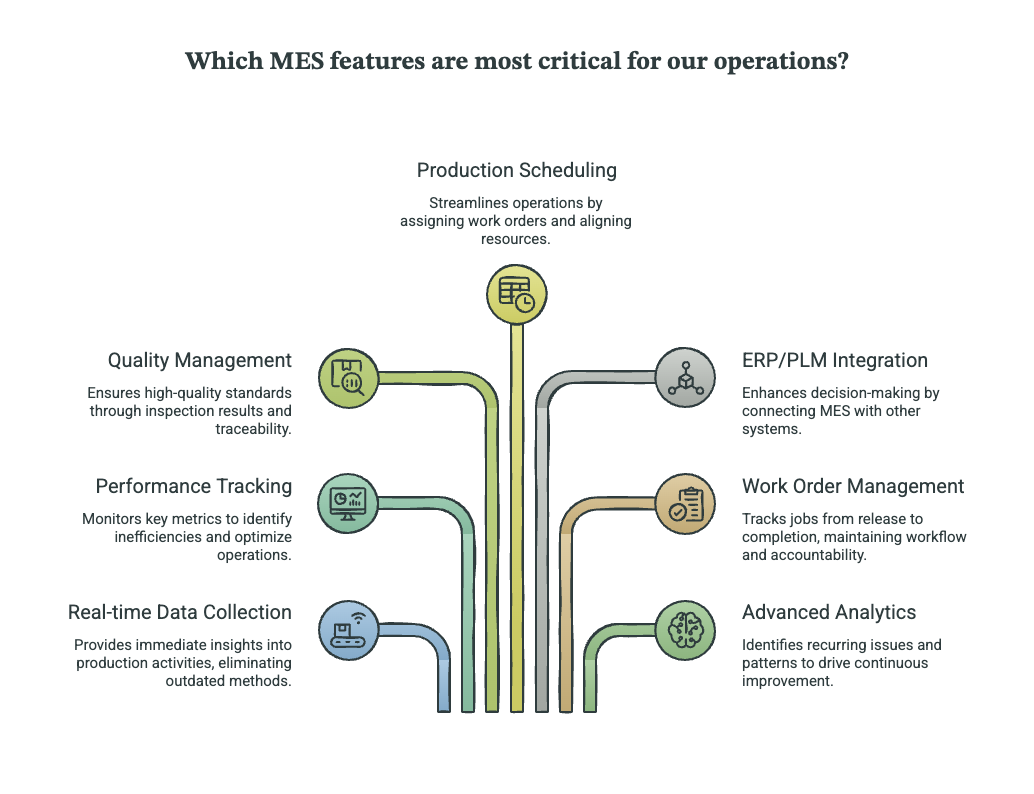
Key features include:
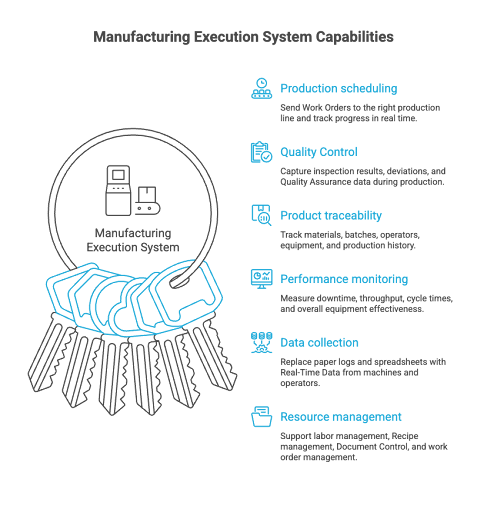
- Real-time data collection
Pull production data directly from equipment, operators, and connected systems instead of relying on paper logs or spreadsheets.
- Performance tracking
Monitor downtime, cycle times, throughput, scrap, and overall equipment effectiveness.
- Quality management
Capture inspection results, flag deviations, support quality assurance, and maintain product traceability.
- Production scheduling
Assign work orders, adjust priorities, and keep production aligned with labor, materials, and machine availability.
- ERP and PLM integration
Connect MES software with enterprise resource planning, product lifecycle management, and supply chain systems so production data is not trapped in silos.
- Work order management
Track each job from release through completion, including status, materials, labor, and exceptions.
- Advanced analytics
Use manufacturing data to identify recurring bottlenecks, quality issues, and maintenance patterns.
How MES Fits With Other Manufacturing Systems
MES manages production execution, while ERP and supply chain platforms handle functions such as business planning, inventory, and logistics. Understanding where one system ends and another begins makes it easier to define the integrations your MES will need. Our guides to ERP options built for manufacturing and supply chain ERP platforms provide a closer look at the systems surrounding MES.
How MES Technology is Changing
Manufacturers are building more advanced technology into their operations. According to the Deloitte research cited earlier, 57% of manufacturers already use cloud computing and data analytics at the facility or network level, while 46% use industrial IoT.
AI adoption is expected to follow. Rockwell found that manufacturers expect 42% of their processes to be supported by artificial intelligence within one year, rising to 54% by 2030.
MES vendors are responding with machine learning, predictive analytics, AI-assisted scheduling, and predictive maintenance capabilities. Manufacturers planning more advanced implementations may also need specialist support. Our guide to AI consulting firms covers companies that help integrate AI into operational systems.
How MES Adoption Breaks Down in Practice
A long feature list means little if operators still work around the system. Half of manufacturers continue to rely on manual frontline input, paper trails, or spreadsheets for shop-floor data, even as MES adoption becomes widespread.
This suggests that many implementations coexist with old processes instead of replacing them. When comparing platforms, manufacturers should consider how easily the software fits into daily work and whether teams can use it consistently without maintaining a second set of records.
Common Challenges with MES
MES adoption is high, but full integration is not.
As we learned, less than a quarter of businesses have fully integrated MES across ERP, PLM, quality, and operational technology systems. That shortcoming is where many implementations lose value.
The most common problems include:
- Disconnected systems
33% of manufacturers cite MES as their biggest data integration challenge (according to the Rockwell source from earlier). When MES software, ERP systems, quality platforms, and plant-floor systems do not share data cleanly, teams end up rebuilding the same manual workarounds the software was meant to replace.
- Poor data quality
Inconsistent master data, duplicate records, and incomplete equipment or product data can undermine reporting, scheduling, and traceability.
- Low frontline adoption
If operators find the system slow or difficult to use, they may fall back on spreadsheets or tribal knowledge.
- Limited root-cause visibility
Data spread across separate systems makes it harder to identify why downtime, scrap, or quality issues are happening.
- Cybersecurity exposure
As MES systems connect operational technology with enterprise networks, the attack surface grows. 46% of manufacturers reported a cyber incident in the past year.
Many of these issues mirror the problems manufacturers face during broader ERP implementations, especially around data migration, integrations, change management, and user adoption.
The same applies when MES needs to exchange data with platforms such as NetSuite. Poorly planned migrations can create duplicate records, broken mappings, and unreliable production data, which is why data migration discipline matters just as much as the software itself.
A manufacturing execution system only works as well as the systems, data, and people connected to it.
Do You Need an MES?
You may need an MES if your existing systems cannot provide a complete view of production or keep day-to-day execution aligned with the production plan.
The clearest signs include:
- Operators still rely on spreadsheets, paper logs, or manual data entry.
- Production teams struggle to see downtime, scrap, or bottlenecks in real time.
- ERP and shop-floor systems operate with limited data sharing.
- Root-cause analysis takes hours or days because information lives in different systems.
- Product traceability is difficult across materials, machines, operators, and work orders.
- Multi-site operations struggle to standardize production processes or performance reporting.
These are signs that the operation may have outgrown its current systems. 49% of manufacturing and supply chain leaders lack confidence that their current manufacturing strategy will deliver the necessary business outcomes over the next three years. Two-thirds are also not pursuing the level of operational redesign their leaders believe is necessary.
An MES can support that redesign, but installing the software in one part of the business is rarely enough. It must connect with the surrounding systems and work consistently across the operation. As Rockwell Automation’s Anthony Murphy puts it:
“MES adoption is no longer the hurdle, but enterprise scale is. Manufacturers may have checked the box by making initial investments in MES technology, but many struggle to gain full value across the enterprise.”
For a closer look at where the technology is heading, watch Siemens Software’s video:
How to Choose a Manufacturing Execution System
To choose the right MES, look for a system that fits how you produce today and can support a more connected operation as the business grows.
Integration Capability
MES software should connect reliably with ERP, product lifecycle management, quality systems, industrial automation, and other plant-floor technology. Check which integrations are native and which will require custom development. Rockwell found that 44% of manufacturers rank integration as their top MES buying requirement.
Security and Compliance
Connecting operational technology with enterprise networks introduces additional security risks. Look for role-based access, audit trails, encryption, and a clear process for security updates. 43% of manufacturers rank security and compliance as a leading MES requirement.
Deployment Model
Mordor Intelligence found that on-premises systems represented 62.46% of the MES market in 2025, while cloud-based MES is growing at a 10.12% CAGR. Compare the options based on your infrastructure, latency requirements, security policies, and ability to maintain the system internally.
Fit for Your Scale
Large enterprises account for most MES spending, but the SME segment is growing faster at 12.46% annually. Smaller manufacturers should check that the pricing and implementation process suit their resources, rather than accepting a reduced version of an enterprise deployment.
Ease of Use
Operators, supervisors, and quality teams will use the system every day. Include them in product demonstrations and test how easily they can complete routine tasks without creating manual workarounds.
Industry Requirements
The MES must support the processes and controls specific to your industry. Regulated manufacturers may need stronger validation, document control, recipe management, and traceability, while other operations may prioritize scheduling or machine connectivity.
Room to Grow
Consider whether the platform can accommodate new facilities, production lines, connected equipment, and more advanced analytics. Growth should not require rebuilding the system or maintaining different MES setups at every location.
Once you have a shortlist, map how data currently moves through the operation and define the integrations the MES must support. Then test each platform against real production scenarios instead of relying only on a feature comparison.
MES and ERP evaluations involve many of the same decisions. Our guide to the top ERP selection criteria covers usability, vendor support, total cost, and other factors that can help structure the selection process.
Choose the MES and its integration approach together. If the technical connections are left until implementation, even a capable platform can add another layer of disconnected software to the operation.
Get More Value From Your Manufacturing Execution System with AAG
Manufacturers get the most value when their manufacturing execution system connects cleanly with ERP, quality, product lifecycle management, and plant-floor technology instead of operating as another isolated platform. The software matters, but the surrounding data, systems, and workflows matter just as much.
Alpha Apex Group helps manufacturers address those issues through:
- MES-to-ERP integration
- System and data architecture
- Custom implementation and module development
- Plant-floor and industrial automation integration
- Ongoing optimization across manufacturing systems
If your MES is underused, disconnected, or difficult to scale, we can help identify what is holding it back and build a clearer path forward.
Book a consultation with Alpha Apex Group to assess your current MES environment, or check out our guide to ERP and IT transformation support if you are still evaluating outside partners.
FAQs: Understanding Manufacturing Execution Systems
How is MES different from SCADA or PLC controls?
PLCs control individual machines and processes, while SCADA systems monitor and visualize plant-floor activity. MES works above those systems, coordinating production, work orders, quality, traceability, and performance across the operation.
Can you implement MES before ERP is finished?
Yes, but the integration plan needs to be defined early. If ERP is still changing, manufacturers should lock down data ownership, interfaces, master data, and production workflows before connecting the two systems.
What security standards should an MES vendor support?
Look for strong access controls, encryption, audit logs, secure APIs, vulnerability management, and alignment with frameworks such as IEC 62443 or NIST. Regulated manufacturers may also need industry-specific validation and compliance controls.
How do MES requirements change in regulated industries?
Pharmaceutical, aerospace, chemical, and other regulated manufacturers usually need stronger traceability, document control, electronic records, quality assurance, validation, and auditability. Our guide to chemical manufacturing ERP software covers related system requirements in process manufacturing.
Does Alpha Apex Group build custom MES integrations?
Yes. Alpha Apex Group can support custom MES integration work rather than limiting projects to standard platform configuration. That can include connections between MES, ERP, quality systems, plant-floor technology, and other enterprise systems.
How does Alpha Apex Group connect MES with SAP or NetSuite?
The process starts by mapping the data and workflows that need to move between systems, such as work orders, inventory, production status, quality data, and finished goods. From there, integrations can be designed around APIs, middleware, custom connectors, and existing system architecture.
What does an MES readiness assessment include?
Alpha Apex Group typically looks at current production processes, system architecture, data quality, integration gaps, reporting needs, plant-floor workflows, and business goals before recommending a platform or integration path.