How AI & High-Density Workloads Are Changing Data Center Staffing Needs
The data center industry is undergoing one of the most significant transformations in its history as artificial intelligence (AI) redefines the scale, complexity, and operational demands of digital infrastructure.
AI workloads aren’t like typical processes, as they require high-density server clusters with GPU-intensive processing.
As a result, operators are modernizing facilities to meet escalating power densities, but this is happening alongside severe challenges in recruiting and retaining qualified talent.
More data centers, more processing, and more coverage mean more hands on deck. Although some of the AI technology is also automating parts of data center management, there is clearly a need for more staff.
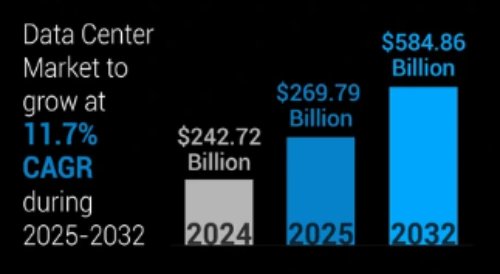
The data center market is poised to reach $584 billion by 2032, with hundreds of data centers to be built across the US and the world.
And here’s where things get complicated. Hiring for AI-specific data centers can be even more challenging, as the technology is fairly new, and even seasoned data center professionals may need training on equipment and workloads that power AI operations.
This guide explores that reality and provides solutions for hiring, so your data center can be better prepared for the AI future.
P.S. Looking for talent that can support AI-driven, high-density workloads without risking uptime? Alpha Apex Grouphelps data center operators connect with vetted professionals who understand AI infrastructure, power density, and uptime-critical environments.
How AI Is Impacting Data Centers
AI is affecting every layer of data centre infrastructure, from power usage to thermal management and staffing models. AI workloads, particularly for generative AI and deep machine learning models, are becoming core services for cloud providers, hyperscale facilities, and on‑premise enterprise data centers.
The underlying hardware for all that demands far greater compute density. As a result, the AI power draw is significant.
One of the most tangible impacts of AI is the dramatic rise in rack power and thermal loads. Traditional servers typically operated in the 5-15 kW range per rack.
However, racks running high‑density GPU clusters may require 40-60+ kW of power, with some experimental AI training zones exceeding that.
These higher power densities exceed the capabilities of many existing HVAC systems and air cooling.
That’s why data center operators are also exploring options such as liquid and immersion cooling, as well as other advanced cooling technologies that are supposed to be more efficient.
Demand for electricity is climbing rapidly as a result.
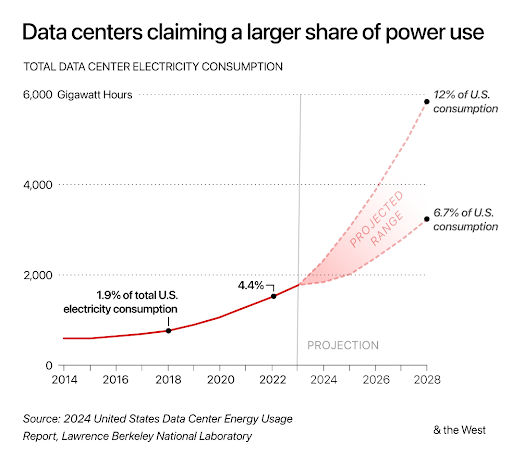
In the U.S., data centers consumed roughly 183 TWh of power in 2024, representing about 4.4% of national electricity use.
This figure could more than double by 2030 as AI‑driven workloads become the norm. This surge puts pressure on both on‑site power capacity and utility grids.
Then there’s the question of the environmental impact of these new data centers. As AI workloads are energy-intensive, they’re projected to impact carbon emissions.
In fact, Cornell University researchers found that AI data centers could emit 24 to 44 million metric tons of carbon dioxide into the atmosphere by 2030.
For that reason, companies are exploring renewable resources to keep their carbon footprint in check. Still, the expansion and its environmental cost are raising eyebrows.
| Quick Word on AI Workloads in Data Centers |
| AI workloads in data centers typically fall into two categories: training and inference. Training involves running massive datasets through GPU clusters or custom AI-specific processing units to develop models. In contrast, inference is the process of using trained models to generate outputs, which comparatively demands lower compute per task but requires rapid response and low latency. |
Traditional Data Center Roles That Are Being Redefined
In response to the rising demands of AI workloads, many traditional data center roles are being reconceived to handle more than just routine tasks. That means the conventional roles that have long been part of the data centers’ day-to-day may need some upskilling.
Here are those roles and how they’re transforming:
1. Data Center Technicians
The classic role of data center technicians is turning into a more proactive systems role. Rather than simply reacting to outages or performing scheduled check‑ups, modern technicians are expected to understand AI chips, power usage profiles, and advanced sensors.
This information feeds into predictive analytics and AIOps platforms that help anticipate failures and optimize performance.
Read Next: The Complete Guide to Data Center Technician Staffing
2. Facilities Engineers
Facilities engineers now require deeper expertise in newer technologies like liquid cooling, immersion cooling, and cold‑plate cooling systems that handle the heat loads of dense racks running GPU clusters or custom AI accelerators. As legacy air cooling reaches its limit, engineers must model thermal behavior, balance coolant flow rates, and maintain fluid systems alongside conventional chillers.
This competence intersects with sustainabilitygoals and metrics such as Power Usage Effectiveness (PUE) and Water Usage Effectiveness (WUE) that organizations publish as part of ESG reporting.
3. Network Engineers
Networking specialists are now closely integrated with compute and workload management teams due to the intricate demands of AI-centric workloads. Tools like telemetry and real‑time performance analytics are essential for diagnosing congestion and optimizing paths across both physical and virtual fabrics.
4. Operations Managers
Operations managers are in a similar transitional phase. They’ll need to balance the traditional mandate of maintaining 24/7 operations and reliability with the need to adapt rapidly to new AI‑specific demands. They may also need to adapt to changing regulations (power usage, data handling, and privacy).
New and Upcoming Roles in AI-Driven Data Centers
AI-specific data centers, with their technical requirements and complexities, are creating new job roles. These roles are essentially new titles for some of the existing roles as they take on more responsibility, while others are completely new. For a broader overview, see our guide to the top data center roles.
AI infrastructure operations engineers: These professionals sit at the intersection of compute, networking, and thermal systems. They ensure workloads, such as AI-driven cloud services and on‑premises AI clusters, run reliably and efficiently. They leverage tools for telemetry, automation, and DCIM to predict and resolve issues before failure.
Liquid cooling and thermal specialists: These engineers design, deploy, and maintain liquid cooling technologies that can handle racks drawing many times more power than legacy systems.
Power and capacity planning analyst: These experts focus on electrical forecasting, grid integration, and energy sourcing to balance soaring AI demand with sustainability targets. As companies like Meta invest tens of gigawatts of power capacity into AI infrastructure, strategic planning roles that marry electrical design with business continuity have become indispensable.
Reliability and automation engineers: These professionals may be charged with strengthening operational resilience by implementing predictive maintenance systems, automation frameworks, and redundancy strategies that keep 24/7 operations running.
Robbin Caraway, the global HR director at LiquidStack, told Network World:
“We’re seeing an increased demand for mechanical engineers who can design and build coolant delivery systems, thermal engineers who focus on optimizing heat transfer at the chip level, electrical engineers integrating sensors, controls, and monitoring systems, and reliability engineers working to ensure long-term system uptime and resilience.”
AI Skills and Competencies Now in High Demand at Data Centers
All the changing roles in data centers and the adoption of new ones are, of course, accompanied by specific skills. Those skills are still somewhat rare, as the industry is experiencing a renaissance, and it may be some time until these skills become common.
1. Liquid Cooling and Hydraulic Management
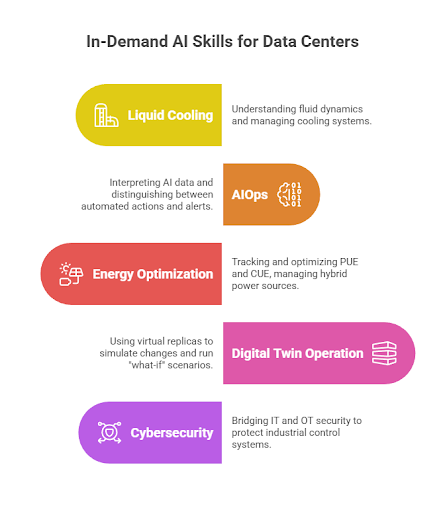
Data center staff, particularly thermal and cooling specialists, need to understand fluid dynamics, manage closed-loop systems, and "Direct-to-Chip" or immersion cooling setups.
This includes monitoring dielectric fluids, managing Cooling Distribution Units (CDUs), and performing leak detection and mitigation.
2. AIOps and Predictive Interpretation
In our experience working with modern facilities, AIOps has shifted from a “nice to have” to a core operational skill.
Staff are now expected to be skilled in AIOps to interpret the massive streams of data generated by AI-driven monitoring. They need to distinguish between automated "self-healing" actions and alerts that require human intervention to prevent downtime.
3. Energy Optimization
We’ve noticed that Data centers are under intense regulatory pressure to reach Net Zero. Technicians now need to track and optimize PUE and CUE (Carbon Usage Effectiveness) in real-time.
This involves managing hybrid power sources (like on-site solar, battery storage, or even small modular reactors) and participating in "grid-interactive" programs where the data center shifts loads based on grid demand.
4. Digital Twin Operation
Modern facilities use Digital Twins (virtual 3D replicas) to simulate changes before they are implemented physically. System architects and engineers must be proficient in using these platforms to run "what-if" scenarios for airflow, power distribution, and rack placement.
5. Advanced Physical and Cybersecurity
As data centers become more automated, we’ve observed that Operational Technology (OT), such as smart breakers and cooling controllers, becomes a target for hackers.
Staff must bridge the gap between IT and OT security, ensuring that the industrial control systems (ICS) and sensors are patched and monitored against sophisticated cyber-physical threats.
Staffing Challenges Continue to Be a Hurdle for AI Expansion
Even as the data center industry races to support the explosive growth of AI workloads, persistent staffing challenges threaten to slow deployments. Operators report that the demand for skilled professionals far outstrips the available workforce.
And this has been the reality for a while now, as staff age or shifts career. For instance, in 2023, a Uptime Institute survey found that 58% of companies were struggling to find qualified candidates for data center jobs.
And now, with AI set to add thousands more data centers just in the US, this difficulty may only rise. We break down the root causes in our guide to the data center talent shortage.
Besides the shortage of actual data center staff, there’s also a strong need for construction-related staff. This includes electricians for the construction phase of data centers. That could slow down expansion plans, especially for cloud/internet giants.
Here are some numbers that confirm this reality:
There’s a shortage of approximately 439,000 construction and trade workers for data center construction.
By 2030, the US will need an additional 130,000 trained engineers, many of whom are needed by the data center industry.
Retention is another critical hurdle. Despite competitive compensation packages, many current data center professionals plan to change employers within the next year. Industry surveys show this retention paradox persists even amid salary growth.
However, companies are becoming more creative and strategic in their hiring. Network World points out that many are tapping fresh high school graduates and veterans, with the latter having some technical affinities similar to those of data centers.
How to Prepare Data Centers for AI: Rethinking Staffing Models
The truth is that the traditional way (and expectations) of hiring data center staff isn’t going to work in the AI era. The shortage of available talent and the transformation of technologies inside data centers make it that much more difficult to find well-qualified candidates across different roles.
Operators will need to think of alternatives and be more strategic. In our opinion, here are the best options:
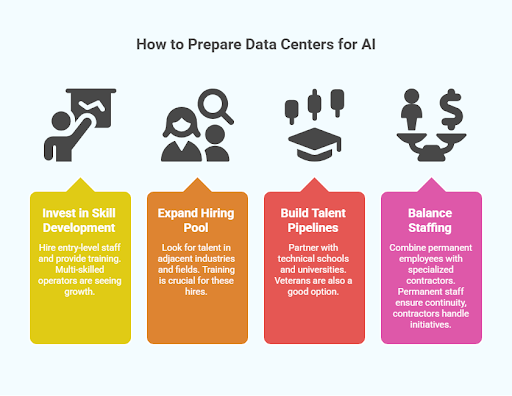
1. Invest in Skill Development
When qualified talent is sparse, the only logical solution is to hire entry-level staff and provide them with the necessary training. And that’s actually a great opportunity, considering AI data centers require staff to have multidisciplinary skillsets.
The State of the Data Center Report 2025 from AFCOM found that multi-skilled data center operators are seeing the most growth.
What all of this means is that data center operators will need to train new hires and encourage them to get certified in different data center-related skills, typically those relevant to modern AI operations.
While this requires upfront investment, we’ve found that offering clear development paths also plays a meaningful role in improving retention.
2. Expand Hiring to Data Center Adjacent Industries and Fields
If you explicitly require data center experience from potential candidates, you may be hard-pressed to find the right person. Instead, looking for talent in fields and industries adjacent to data center space can help widen the pool.
That’s what some operators are already doing. They’re not necessarily looking for individuals who have worked in data centers, but for those familiar with systems used in typical data center settings, such as HVAC or networking gear.
Again, training will be incredibly important here. Those individuals with some experience might still need training on systems deployed in data centers.
Read Next: Avoiding Downtime: The Hiring Mistakes That Put Data Centers at Risk
3. Build Talent Pipelines with Technical Schools and Universities
Fortunately for the AI data center expansion, the education sector has recognized the need for new talent and is churning out graduates with courses and certifications in relevant skills. AFCOM’s Wendy Schuchart says:
“Technical colleges are driving the charge in bringing new talent to an industry undergoing exponential growth with an almost infinite appetite for skilled workers.”
Microsoft and Amazon are already working with technical schools and community colleges, especially in places where they have facilities, to train upcoming talent. Amidst a shortage of skilled workers, that’s the best bet for operators who desperately need workers.
And as we mentioned earlier, veterans are also another option, as they already have the right mindset to meet the demanding requirements and soft skills of the on-site data center jobs (long hours, weekends, alertness, and quick decision-making).
4. Balance Permanent Staff with Specialized Contractors
In conversations with data center operators, a common theme we hear is the challenge of scaling AI infrastructure without stretching internal teams too thin.
That’s why many facilities are moving toward a blended data center staffing approach that combines permanent employees with specialized contractors.
Permanent staff are invaluable for maintaining continuity in infrastructure that directly supports enterprise workloads and cloud providers’ commitments.
Contract specialists, on the other hand, are best suited for time-bound initiatives such as deploying immersion cooling or scaling GPU clusters ahead of major AI training initiatives.
This is where building partnerships with staffing firms that specialize in data center and AI talent can come in handy.
How Data Center Recruiters Help Meet AI-Era Staffing Needs
Recruiters, usually those with experience and expertise in hiring staff for data centers such as Alpha Apex Group, can be indispensable during the massive AI boom.
While it’s true that there’s an overall shortage, recruiters are uniquely positioned to address that very issue. How exactly?
They have access to passive candidates who may not be actively looking for jobs. This means they can headhunt the right candidate for a specific role that you might not find if you just post a listing on a job board.
Let’s explore the reasons why working with a recruiter can streamline your hiring strategy, whether you’re looking for seasoned professionals or fresh graduates to train internally:
Technical vetting: Specialized recruiters understand the nuances of AI-specific hardware and can accurately screen for the specialized certifications required.
Reduced time-to-fill: In the AI race, speed is critical. Recruiters use pre-vetted pipelines to fill roles in weeks rather than months, preventing costly construction or operational delays.
Market intelligence: They provide real-time data on competitive salary benchmarks and benefit trends, ensuring operators don't lose talent to rival hyperscalers.
Scaling support: During massive "site builds," recruiters can manage high-volume hiring across multiple phases, from initial design and construction to long-term facility management.
Build Your AI-Ready Data Center Team With Alpha Apex Group
As recruiting specialists for data centers, we’re in touch with the reality of the labor market. We understand how the roles in data centers and their requirements are changing. But most importantly, we know how to fill those roles.
Our extensive network of candidates, combined with links with industry insiders and educational institutes help us find talent at the level you need. We also work with clients closely to strategize the best approach to fill specific roles, sometimes at scale.
And we provide both contractual and full-time recruitment services to data center operators and companies with their own private facilities.
The future of AI, like the Internet itself, is powered by data centers—and the people who keep them running. Alpha Apex Group specializes in identifying and placing top professionals who ensure these critical environments operate at peak performance.
Let’s talk. Contact Alpha Apex Group today and build the talent foundation that powers your data center’s success.
FAQs
Will AI reduce the need for staff in data centers or increase it?
Contrary to narratives about automation eliminating jobs broadly, AI is increasing the need for skilled workers in data centers, even as some routine tasks become automated.
While AI and automation tools can optimize operations (e.g., using AI for predictive maintenance and resource allocation), complex infrastructure still requires human expertise in power systems, thermal dynamics, advanced controls and monitoring, and 24/7 operations management.
Why is there a shortage of data center professionals?
Staffing shortages in the data center industry stem from several factors:
AI-driven demand growth, which is outpacing the supply of workers with specialized power, cooling, and networking skills.
Evolving job requirements, as roles now blend electrical, thermal, and software expertise, narrowing the talent pool.
Wider skilled-trade shortages, with electricians and HVAC professionals in high demand across multiple industries.
What training should employers provide for professionals working in AI data centers?
Employers should invest in training that builds cross‑disciplinary competencies, such as:
Power and thermal modeling
Expertise in liquid cooling and advanced heat management systems
Use of data center infrastructure management (DCIM) and real‑time sensors for predictive analysis
Skills in automation frameworks, telemetry tools, and performance monitoring
Network optimization for low latency and secure operations
How can Alpha Apex Group help with data center staffing?
Alpha Apex Group specializes in bridging the gap between complex data center management needs and available talent in the market. We also help clients connect with industry-adjacent and fresh talent that can be trained and deployed quickly. We provide candidates within 72 hours of signing up. Our average time-to-fill is much lower than competitors’ at 43 days (60% faster than the national average).