10 Best Chemical Manufacturing ERP Software Solutions
For chemical manufacturers, your ERP system has to manage formula control, lot traceability, quality control, inventory management, and audit-ready compliance data in one place.
This is why ABI Research expects chemical firms to spend $7.4 billion on digital transformation by 2031. It also makes vendor selection more important, since the right choice depends on your production model, compliance needs, and enterprise resource planning implementation lifecycle.
In this article, we’ll walk through 10 of the best chemical manufacturing ERP software solutions, what each platform is best suited for, and which features make it stand out.
TL;DR: A Quick Look at 5 Leading Chemical Manufacturing ERP Software
- BatchMaster Software: Best for chemical manufacturers that want a chemical manufacturing ERP with built-in formula management, batch tracking, quality control, and compliance support inside SAP Business One or connected to existing accounting platforms.
- IFS: Best for larger, asset-heavy chemical manufacturers that need ERP software, enterprise asset management, supply chain management, production planning, industrial AI, and compliance management in one broader platform.
- NetSuite: Best for chemical manufacturers that want a cloud-based ERP connecting finance, inventory management, procurement, production management, formula control, and multi-entity visibility in a single ERP system.
- Infor: Best for multi-site chemical manufacturing operations that need cloud ERP with strong production scheduling, tank management, quality control, traceability, asset management, and industry-specific analytics.
- Datacor: Best for chemical manufacturers and distributors that want a purpose-built process manufacturing ERP for batch production, formula management, lot traceability, regulatory reporting, SDS management, and chemical distribution workflows.
Which ERP Priorities Match Your Chemical Sub-Vertical?
You can use this table as a quick self-check before evaluating ERP software. It can help you match your production model, compliance needs, and deployment setup to the ERP capabilities that matter most. For a fuller checklist, see our guide to ERP selection criteria.
Chemical Manufacturing ERP Tools Worth Considering
Some chemical manufacturers need stronger formula control. Others need better batch traceability, quality workflows, plant-floor visibility, or distribution support.
Below, we’ve highlighted the ERP tools worth considering and where each one fits best.
1. BatchMaster Software
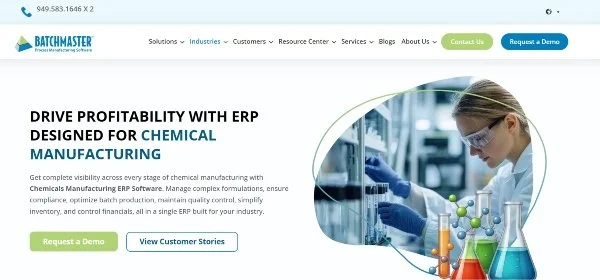
- Best for: Chemical manufacturers that want a process-manufacturing ERP embedded into SAP Business One or connected to existing accounting platforms.
- Customer proof: Cosmetix West reported a 50% productivity increase and a 15% improvement in overall equipment effectiveness, moving from 67-69% to over 80%, after upgrading to BatchMaster Web QuickBooks Edition.
BatchMaster stands out for chemical manufacturers that want industry-specific batch, formula, quality, and compliance capabilities without starting from a generic ERP build. Its software can run as an end-to-end ERP or integrate with platforms such as SAP Business One, Microsoft Dynamics 365 Business Central, Sage, and QuickBooks.
The clearest differentiator is its SAP Business One model. BatchMaster says its process manufacturing application is embedded within SAP Business One, which gives users a single SAP login, a single SAP menu, and a centralized database rather than a loosely connected add-on.
2. IFS
- Best for: Larger chemical manufacturers that want ERP, EAM, service management, and industrial AI in one enterprise platform.
- Customer proof: In an IFS case study, All American Poly moved from 14-day delivery windows to a confirmed delivery date at order placement, reduced finished-goods inventory shrink by 200%, reduced raw-material inventory shrink by 100%, and reported $5M/year in savings after implementing IFS Cloud.
IFS stands out less as a niche chemical ERP vendor and more as an enterprise platform for manufacturers with asset-heavy, complex environments. Its chemical manufacturing software combines ERP with EAM, service management, industrial AI, compliance, traceability, production planning, emissions tracking, and energy consumption tracking.
It’s a good option if you want chemical ERP as part of a broader industrial software stack rather than a standalone formulation system. IFS says IFS Cloud spans ERP, EAM, SCM, and FSM, as well as AI and machine learning capabilities.
3. NetSuite
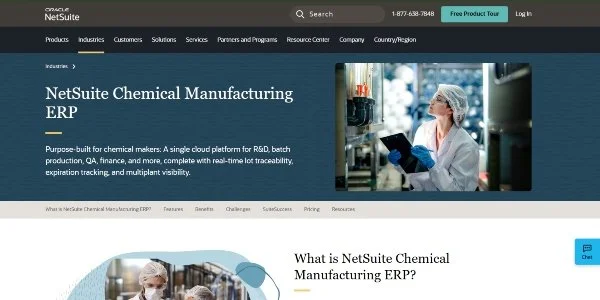
- Best for: Chemical manufacturers who want cloud ERP with strong finance, inventory, procurement, supply chain, and multi-entity management in a single system.
- Customer proof: In a chemical-sector case study, Withum implemented Oracle NetSuite for a large family-owned specialty chemical manufacturer that produces chemicals for coatings, inks, plastics, and more. The project replaced paper-based manufacturing documentation and helped add governance around who could change formulas, orders, and customer data.
NetSuite stands out as a broader cloud ERP platform for chemical manufacturers that need stronger business-wide visibility as well as production management. Its chemical ERP page emphasizes formula control, batch processing, storage conditions, procurement, compliance, production planning, quality, traceability, finance, and multiplant visibility.
It makes sense if your chemical manufacturing operation has outgrown disconnected accounting, inventory, and production systems and needs a single cloud platform across finance and operations. NetSuite says its platform is used by 43,000+ customers, which makes it a stronger fit for buyers that want chemical manufacturing capabilities inside a widely adopted ERP ecosystem rather than a niche-only chemical ERP.
4. Infor
- Best for: Chemical manufacturers that need cloud ERP with deeper support for complex production planning, tank scheduling, asset management, and multi-site operations.
- Customer proof: Infor says Scott Bader used Infor CloudSuite Chemicals under an initial six-year agreement to support 380 users across North America, Canada, Europe, Japan, the Middle East, Australia, and South Africa.
Infor’s chemical ERP is built for segments such as resins and plastics, agricultural chemicals, coatings, adhesives, sealants, pigments, lubricants, and cleaners, with industry-specific capabilities for multi-facility planning, tank scheduling, liquid management, quality control, traceability, formula optimization, and compliance.
It’s a strong choice if your operation is asset-heavy, multi-site, or planning-constrained. Infor’s differentiator is its broader industry cloud approach. CloudSuite Chemicals combines ERP with industry-specific process catalogs, role-based workspaces, analytics, enterprise asset management, and Infor OS platform tools for integration, automation, GenAI, and AI-powered analytics.
5. Datacor
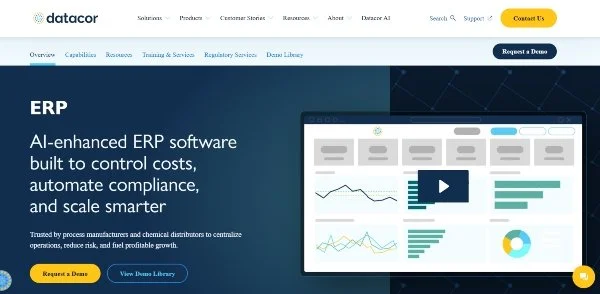
- Best for: Chemical manufacturers and distributors that want an ERP built specifically for batch, formula, tolling, and specialty distribution workflows.
- Customer proof: After implementing Datacor ERP, Pilot Chemical reported that forecasts which once took 2 to 3 months to produce and were only 70% to 80% accurate became available “with just the click of a button” and reached 99% accuracy. Pilot also cut its monthly close by up to 60%, from 30 days to 6 to 12 days.
Datacor’s differentiator is its narrow focus on process manufacturing and chemical distribution, rather than general ERP. Datacor ERP, formerly Chempax, is used by batch and process manufacturers, chemical blenders, tollers, food and beverage producers, and specialty distributors that need lot-level traceability, multi-unit costing, and built-in regulatory controls across one plant or many.
This makes Datacor a stronger fit for buyers who want chemical-specific functionality included as standard rather than customized into a generic ERP. Datacor says every ERP license includes order management, inventory, production planning, purchasing, financials, QC, regulatory reporting, and traceability, with automated GHS label printing, SDS management, lot genealogy, and audit-ready reports for OSHA, EPA, DOT, and FSMA requirements.
6. Aptean
- Best for: Chemical manufacturers that want an industry-specific ERP with both cloud and on-premises deployment options.
- Customer proof: ASK Chemicals reported a 20%-30% reduction in computing costs after moving to an Aptean cloud-based ERP environment. The project also improved scalability, customer service, cybersecurity, latency, and user experience.
Aptean’s chemical ERP is built for process manufacturers that need stronger control over formulas, batches, quality, inventory, compliance, and recall readiness. Its chemical manufacturing software is positioned for businesses managing regulatory requirements and real-time operational data across production and supply chain workflows.
The differentiator is Aptean’s mix of chemical-specific ERP and broader process-manufacturing depth. Aptean offers Process Manufacturing ERP for recipe- and formula-based manufacturers, with its Ross Edition available for companies that need ERP designed for complex formulas, quality standards, and compliance-heavy operations.
7. E21 ERP
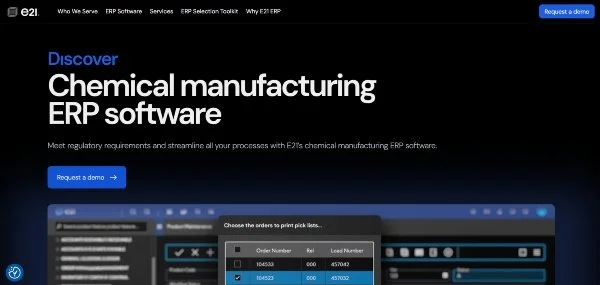
- Best for: Small and mid-market chemical manufacturers and distributors that want one ERP for manufacturing, warehousing, distribution, financials, CRM, and business intelligence.
- Customer proof: In a Global Chemical Resources case study, Enterprise 21 ERP helped the chemical distributor increase revenue by 35%, reduce customer service headcount by 2 full-time employees, lower on-hand inventory value by 31% in seven months, and reduce past-due accounts from 35% to under 18%.
E21 ERP includes order management, procurement, RF and barcode-enabled warehouse management, transportation management, CRM, business intelligence, financials, inventory management, and production management in one integrated system.
For chemical manufacturers specifically, E21 adds batch formulation, lot traceability, regulatory compliance, quality control, real-time reporting, and production management. This makes it more relevant for chemical companies where warehouse execution, logistics, customer service, and financial controls are just as important as formula and batch control.
8. Bonx
- Best for: Small and mid-sized chemical manufacturers that want a faster-to-deploy, AI-native ERP that can adapt to existing factory workflows.
- Customer proof: In a Bonx case study, La Maillecotech reported a 12x improvement in data-entry time, a 10% increase in productivity, and a reduction from nearly 1 hour of manual daily production data entry to just a few minutes.
Bonx stands out for its AI-native and no-code approach rather than a traditional ERP implementation model. The company says Bonx can be deployed in 3to10weeks, uses AI-driven data migration and customization, and lets manufacturers adapt processes and business rules without heavy consultant-led customization.
It’s a good option if you want chemical ERP capabilities but do not want a long, rigid enterprise rollout. Bonx’s chemical manufacturing page focuses on batch control, waste reduction, compliance, real-time production visibility, SDS version control, labeling, customer-specific requirements, and batch traceability.
9. ECI Deacom ERP
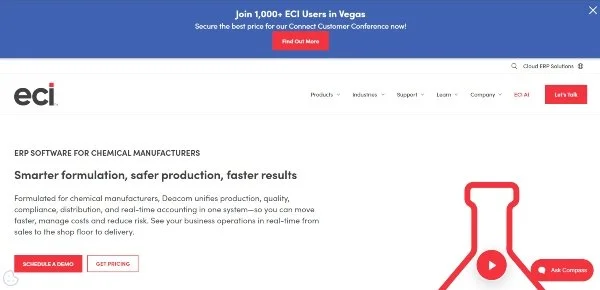
- Best for: Chemical manufacturers that want Deacom’s single-system ERP for batch, formula, quality, compliance, inventory, and traceability workflows.
- Customer proof: In ECI’s Holly Oak Chemical case study, Deacom manages 8,000+ formulations, 80+ vessels across three city blocks, and 1M+ litres of liquid production per month. ECI also says Holly Oak increased output and sales without adding staff.
ECI stands out through Deacom’s single-system model. Instead of stitching together separate tools for production, inventory, accounting, quality, and compliance, Deacom is designed to keep chemical manufacturing workflows in one ERP environment.
It’s a good option if your biggest ERP risk is disconnected data across production, inventory, quality, and finance. ECI says Deacom supports chemical manufacturers with automated SDS, COA, labels, lot tracking, traceability, formula management, compliance workflows, and its Hyper-Tight Process Control™ methodology for real-time production monitoring.
10. Yaveon
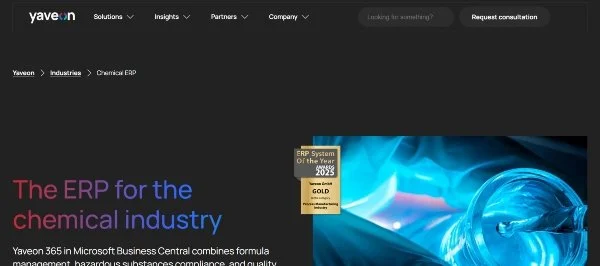
- Best for: Chemical manufacturers that want a Microsoft Dynamics 365 Business Central-based ERP with built-in process manufacturing and regulated-industry functionality.
- Customer proof: Yaveon says its ERP has been implemented in 850+ companies worldwide, and its Schweitzer Chemie reference page says more than 1,000 companies rely on Yaveon.
Yaveon is a Microsoft-first ERP option for process manufacturers. Instead of selling a standalone chemical ERP, Yaveon 365 extends Microsoft Dynamics 365 Business Central with industry-specific capabilities for chemicals, pharmaceuticals, biotech, food, cosmetics, and medical devices.
It’s a solid choice if you want Business Central as the core ERP but need deeper support for regulated batch manufacturing. Yaveon’s chemical ERP page highlights recipe management, hazardous materials management, quality control, lot tracking, REACH and GHS support, and a structured implementation methodology called ProCedures.
Why Chemical Manufacturing ERP Success Depends on People
Chemical manufacturers already know the software requirements. Formula management, lot traceability, batch tracking, quality control, safety data sheets, certificates of analysis, GHS labeling, and regulatory reporting.
The harder question is whether the organization has the right people to run the project.
A chemical manufacturing ERP deals with operations, compliance, finance, HR, warehouse management, and the plant floor. But without clear ownership, even strong ERP software can turn into a slow, expensive implementation.
Most of the risk comes from three people-side issues:
- Project leadership: Many mid-sized chemical manufacturers lack a permanent CIO, COO, ERP program lead, or process manufacturing systems leader to challenge the vendor, control scope, and keep internal teams aligned. Panorama’s 2026 ERP research found that more than a quarter of organizations exceeded their ERP project budgets, with additional technology needs cited as the leading reason.
- Plant-floor adoption: Operators and quality teams need to trust the new ERP system when it changes how they issue raw materials, manage batch balancing, record batch processing, approve certificates of analysis, and trigger recall management workflows.
- HRIS alignment: Production scheduling, safety training, role permissions, labor planning, and compliance support often depend on clean workforce data. If HR systems remain disconnected after go-live, the ERP rollout can improve production data while leaving labor visibility fragmented.
The labor market adds more pressure. Deloitte and The Manufacturing Institute estimate that up to 1.9 million U.S. manufacturing jobs could go unfilled by 2033, and 65% of surveyed manufacturers cite attracting and retaining talent as their top business challenge.
Demand for specialized manufacturing skills is changing too. One Manufacturing Institute report found a 75% increase in demand for simulation and simulation-software skills over five years.
That’s why chemical manufacturing ERP planning needs a clear staffing plan behind it. Before implementation begins, your leadership should get clear on:
- Who owns the ERP requirements
- Who approves formula, quality, and compliance workflows
- Who trains operators and supervisors
- Who owns master data
- Who manages post-launch optimization
How Alpha Apex Group Helps Chemical Manufacturers Get ERP Right
The right chemical manufacturing ERP can improve formula management, lot traceability, inventory management, compliance reporting, and production planning. But the biggest ERP risks usually appear before go-live and include unclear requirements, weak vendor comparisons, poor data planning, and missed process gaps between operations, finance, quality, and HR.
That is where structured ERP consulting becomes valuable. Alpha Apex Group helps chemical manufacturers make stronger ERP decisions through ERP strategy, software selection, implementation planning, process alignment, and post-launch optimization.
Chemical companies also discover that HR systems need to connect cleanly with the new ERP system. AAG’s HRIS consulting services help align workforce data, permissions, labor planning, and HR workflows with the broader ERP infrastructure so the platform supports both production and people operations.
Request an ERP readiness review to identify vendor, data, integration, and adoption risks before your chemical ERP rollout begins.
FAQs
How is chemical ERP different from discrete manufacturing ERP?
Discrete manufacturing ERP is built around parts, assemblies, and bills of material. Chemical manufacturing ERP, on the other hand, is built around formulas, batch production, lot traceability, yield variation, quality control, safety data sheets, certificates of analysis, and regulatory compliance. If you also run discrete or mixed-mode lines, our roundup of manufacturing ERP software covers broader options.
How long does chemical ERP implementation take?
Most mid-sized chemical manufacturing ERP projects take several months to more than a year, depending on scope. Timelines stretch when teams have complex formulas, multi-site inventory, LIMS or EHS integrations, messy master data, custom compliance reporting, or limited internal project leadership.
Can chemical ERP integrate with LIMS and EHS software?
A strong ERP system should integrate with LIMS and EHS tools when those systems are already working well. The key is deciding which platform owns each data set, such as test results, safety data sheets, batch records, regulatory reporting, and quality approvals.
How is formula IP protected during ERP migration?
Formula and batch data should be cleaned, mapped, permissioned, and migrated through controlled test cycles before go-live. IP protection depends on role-based access, audit trails, vendor security controls, data encryption, and clear rules for who can view, edit, approve, or export proprietary formulas.
Does Alpha Apex Group help chemical manufacturers select an ERP system?
Yes, Alpha Apex Group supports ERP consulting as well as staffing. We can help chemical manufacturers define requirements, compare ERP software, organize vendor demos, assess implementation risk, and build a roadmap before the company commits to a platform.
Can AAG provide fractional ERP leadership?
Yes. AAG can support chemical manufacturers with fractional executive leadership, including fractional CIOs, COOs, or ERP program leads who can guide selection, implementation planning, vendor management, adoption, and post-launch stabilization.
How does HRIS consulting support an ERP rollout?
AAG’s HRIS consulting helps you align workforce data with the ERP rollout so labor planning, permissions, training records, scheduling, compliance support, and reporting are not trapped in disconnected systems. This is important when production, safety, HR, and finance teams all depend on the same workforce data.
.webp)
.jpg)
.jpg)