Top 10 ERP Software Systems For Financial Services
Banks, credit unions, insurers, wealth managers, and fintechs cannot evaluate an ERP for financial services like a manufacturer or distributor would.
Regulatory compliance, immutable audit trails, and real-time reporting play a huge role in this industry.
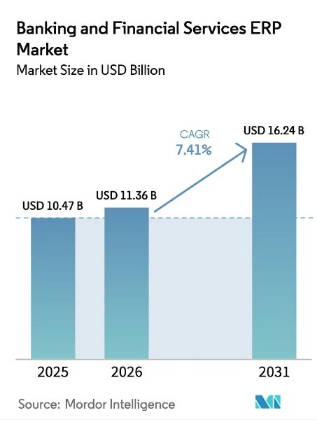
A survey shows that the banking and financial services ERP market is expected to grow from $11.36 billion in 2026 to $16.24 billion by 2031, with risk and compliance management expanding fastest.
Finance leaders are also under pressure to modernize. About 50% of North American CFOs rank finance transformation as a top 2026 priority, and 87% consider AI highly important to their plans.
This guide compares 10 ERP software systems for financial services based on their financial management capabilities, compliance features, reporting tools, integrations, scalability, and suitability for different types of institutions.
A Quick Comparison of Leading Financial Services ERPs
In a hurry? Take a quick look at how the leading financial services ERPs compare before you explore each option in more detail.
| ERP system | Best suited for | Product type | Key strengths | Main consideration |
|---|---|---|---|---|
| Acumatica | Credit unions, fintechs, and growing financial services firms | Cloud ERP | Multi-entity accounting, workflow automation, real-time reporting, and unlimited-user pricing | May require additional configuration for complex banking or insurance workflows |
| IFS Cloud Finance | Large organizations with complex entities and operational processes | Enterprise cloud ERP | Enterprise-wide financial control, forecasting, embedded AI, and operational integration | Broader and more complex than many finance teams may need |
| Oracle Fusion Cloud ERP | Large banks, insurers, and global financial institutions | Enterprise cloud ERP | Risk controls, audit management, connected planning, procurement, and multi-jurisdiction reporting | Implementation can require significant time, budget, and internal resources |
| Priority Software | Mid-sized financial services firms that need flexibility | Cloud and on-premise ERP | Multi-entity accounting, billing, collections, cash-flow forecasting, and reporting | Smaller ecosystem than major enterprise ERP vendors |
| QArea | Banks and fintechs that need a custom ERP system | Custom software development provider | Tailored workflows, third-party integrations, security development, and full-cycle product development | It does not offer a ready-made ERP product |
| Sage Intacct | Family offices, insurers, investment firms, and multi-entity finance teams | Cloud financial management software | Fast consolidation, multi-entity reporting, close automation, and anomaly detection | Less suitable for firms that need extensive operational ERP modules |
| NetSuite | Growing insurers, fintechs, asset managers, and acquisition-led firms | Cloud ERP | Finance, CRM, procurement, entity management, reconciliations, and role-based controls | Customization and subscription costs can increase as the organization grows |
| FinanSys | Financial services firms implementing SunSystems or NetSuite | ERP implementation and automation partner | Finance automation, compliance reporting, multi-currency support, and workflow improvement | It is an implementation partner rather than a standalone ERP vendor |
Financial Services ERPs Your Team Can Use To Simplify Finance Operations
Each ERP on this list serves financial services differently. Some excel at enterprise-wide financial management, while others stand out for multi-entity reporting, automation, customization, or flexible deployment. If you are also hiring leaders for this area, see our guide to the top finance executive search firms.
The summaries below explain each platform's strengths and the types of organizations it is best suited for.
1. Acumatica

- Notable clients: Arkansas Federal Credit Union, Star One Credit Union, Fixnetix
- Client outcome: Star One Credit Union reported a 25% reduction in accounts payable, financial reporting, and accounting process times after moving to Acumatica.
Acumatica is a strong fit for financial services organizations that need cloud-based financial management without locking every employee behind per-user ERP licensing. Its financial management software covers general ledger, accounts payable, accounts receivable, cash management, tax management, intercompany accounting, multi-entity support, real-time reporting, dashboards, and workflow automation.
For credit unions, fintechs, and finance teams with strict reporting and internal control requirements, the appeal is visibility and process control. Arkansas Federal Credit Union said Acumatica helped it double the frequency of invoice payments, improve transparency into corporate credit card charges, strengthen internal controls, and streamline financial operations.
2. IFS Cloud Finance
- Notable clients: Berkeley Group, Babcock International, Stockholm Exergi, Culligan Middle East
- Client outcome: Berkeley Group unified financial and project control across 200+ operating companies, replaced two decades of fragmented legacy systems, and integrated 9 functional areas into a single platform after using IFS Cloud Finance.
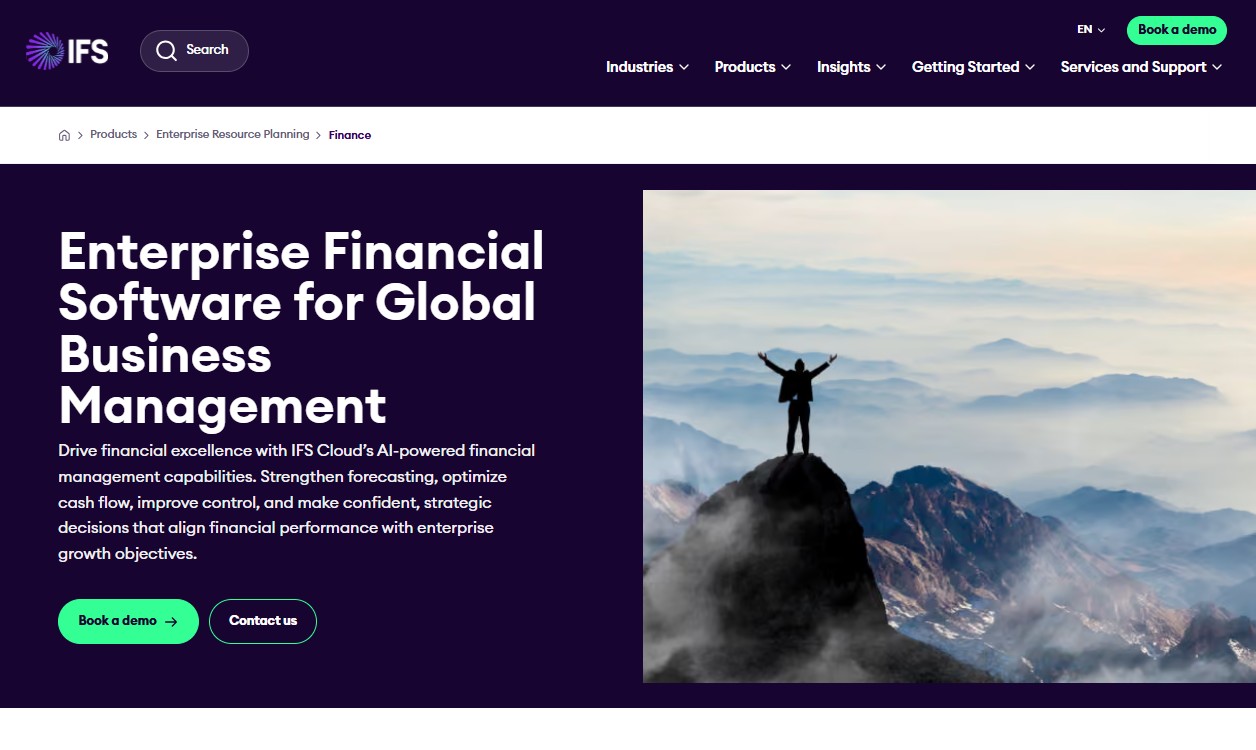
IFS Cloud Finance is built for organizations that need financial management tied closely to operations rather than a standalone accounting system. Its finance ERP page highlights unified financial data, embedded AI, real-time financial insights, forecasting, cash-flow optimization, margin protection, reporting, and enterprise-wide control.
For financial services firms with complex entities, reporting needs, or data spread across systems, the strongest benefit is financial control at enterprise scale. IFS describes Cloud Finance as part of a broader ERP platform that unifies financial data and processes across the enterprise, with support for real-time insights and decision-making.
3. Oracle Fusion Cloud ERP
- Notable clients: Guardian Life, Nuvama, Discover Financial Services, Tamilnad Mercantile Bank
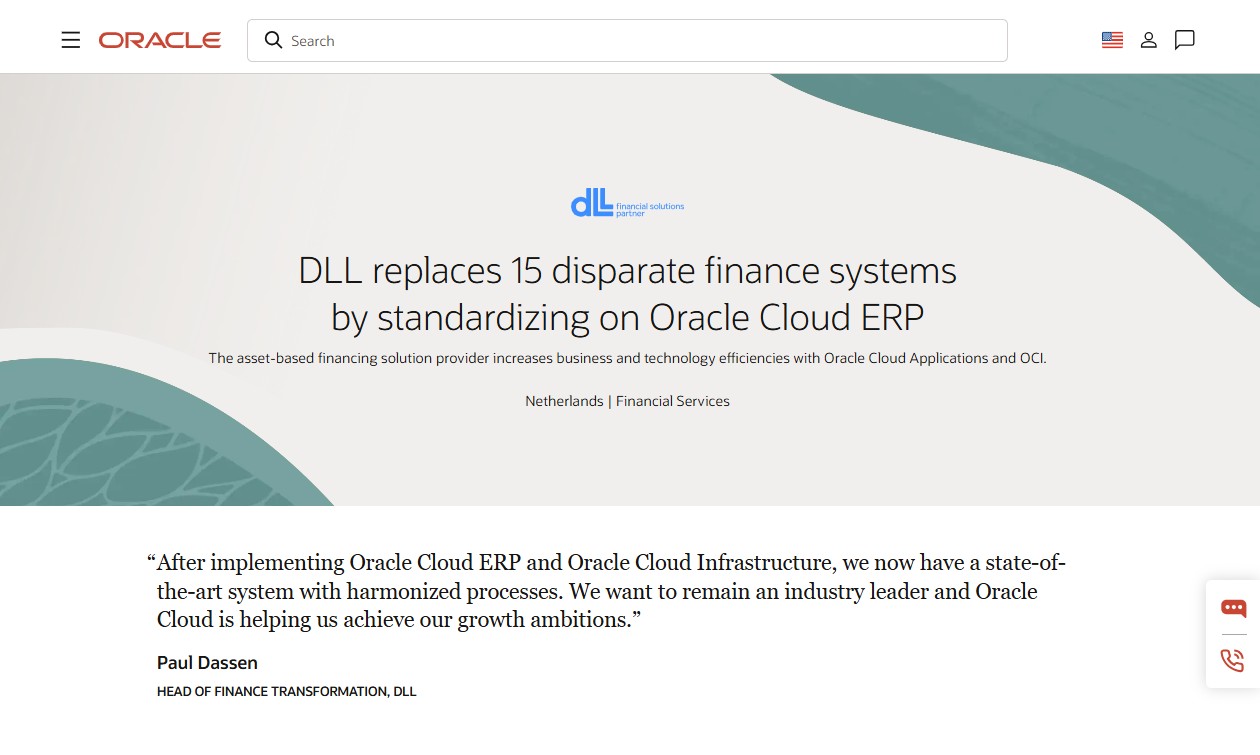
- Client outcome: DLL replaced 15 disparate finance systems by standardizing on Oracle Fusion Cloud ERP as its single financial management platform.
Oracle Fusion Cloud ERP is built for finance teams that need accounting, planning, procurement, project management, risk controls, and reporting in one enterprise cloud suite. Its finance and accounting page highlights automation for close, payables, receivables, asset management, expense management, revenue management, joint venture management, and real-time financial analysis.
The platform is a good choice if you’re managing strict controls, multi-jurisdiction reporting, and high-volume transaction data. Oracle’s finance ERP includes AI-supported automation, embedded analytics, risk management, audit controls, and connected planning capabilities. All these features make it a strong fit for organizations trying to modernize finance without separating ERP from enterprise performance management.
4. Priority ERP
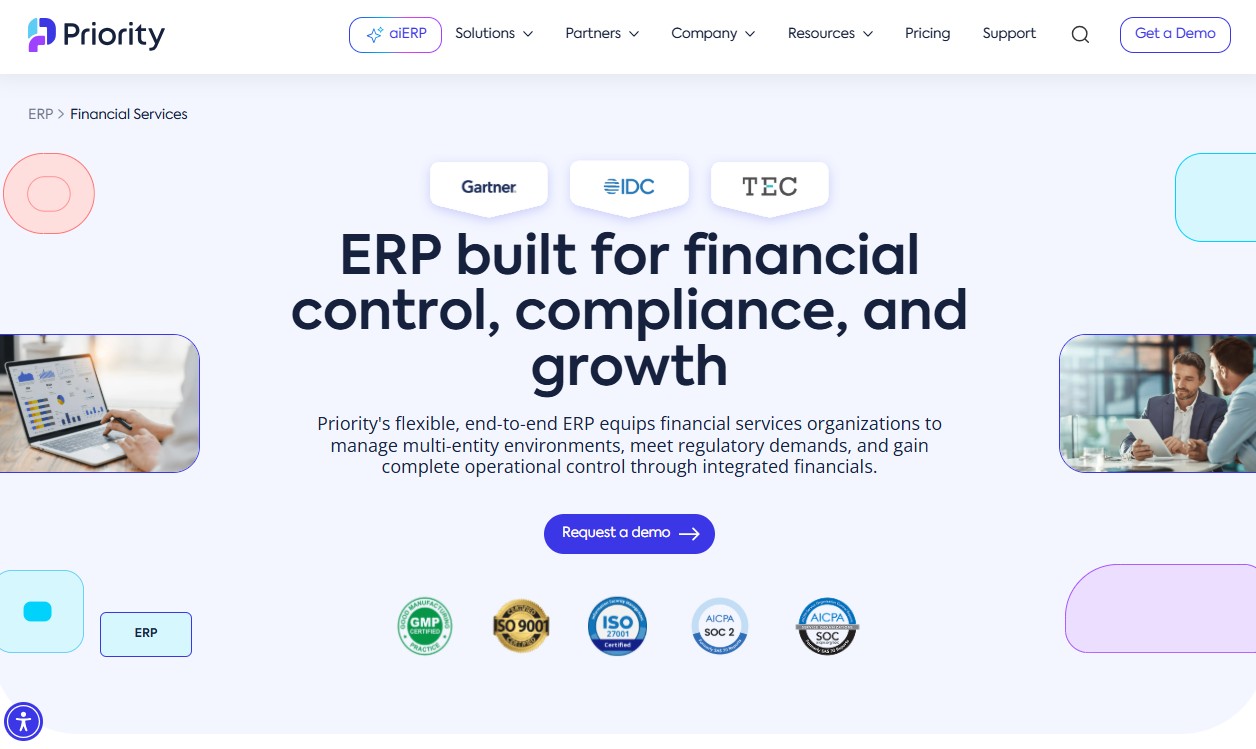
- Notable clients: Altshuler Shaham Credit, Dejavoo, Cyberint, Innplay Labs
- Client outcome: Dejavoo automated 100% of consolidation tasks, delivered instant reporting across six subsidiaries, and kept the same lean finance team using Priority ERP.
Priority’s financial services ERP is designed for organizations managing multi-entity accounting, compliance demands, billing, collections, reporting, and operational control in one system. Its financial services page highlights general ledger, accounts payable, accounts receivable, budgeting, asset management, bank reconciliations, cash-flow forecasting, collections management, and revenue-recognition workflows.
The platform is most relevant for financial services firms that need flexibility without moving to a heavier tier-one ERP. Priority says its broader ERP platform has 30+ years of development and innovation and supports financial services alongside CRM, sales, supply chain, manufacturing, wholesale distribution, retail, project management, warehouse management, HR, BI, BPM, and mobile app generation.
5. QArea
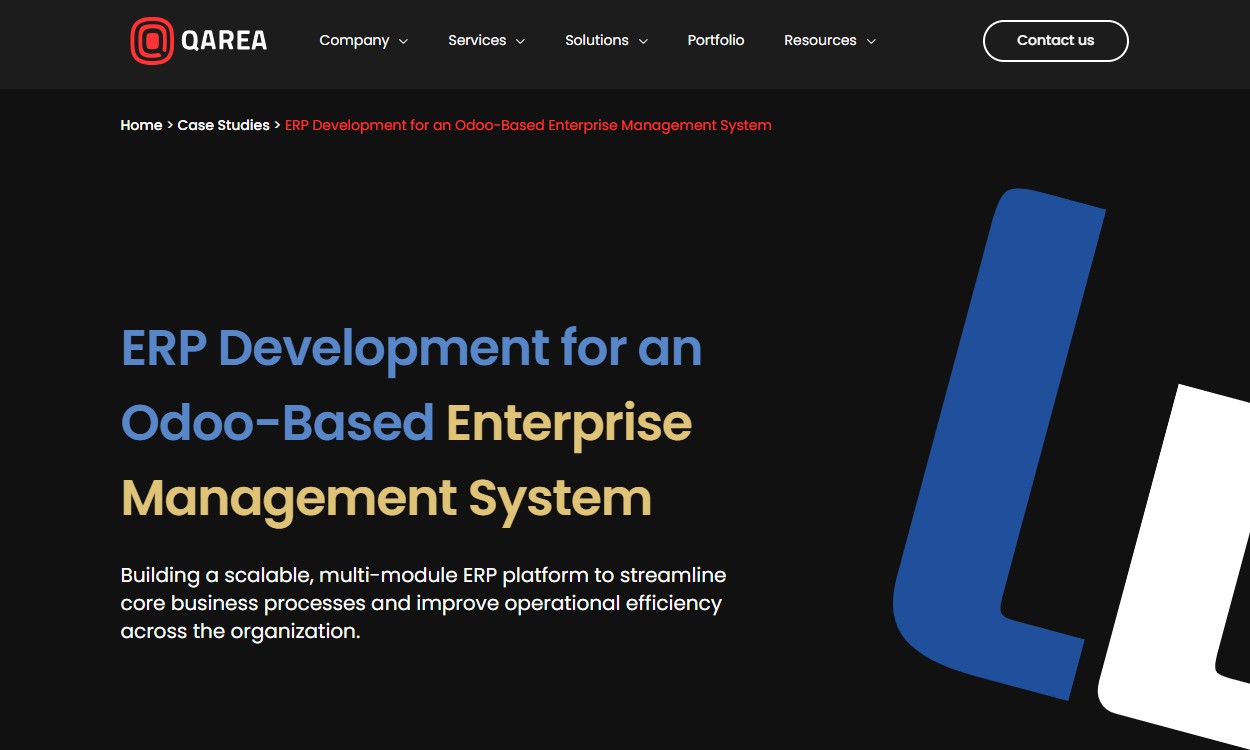
- Notable clients: Micros Northeast Inc, Interfaced Labs, Perx, Skyhook
- Client outcome: QArea replaced fragmented tools with a unified Odoo-based ERP for finance, HR, and operations. The client reported 60% less manual work, 35% faster system response, and 40% fewer operational errors after the six-month implementation.
QArea is different from the ERP vendors in this list because it is not selling a packaged finance ERP. Its banking ERP content is aimed at companies considering a custom system, with QArea outlining stages such as analysis, prototyping, MVP development, full ERP development, QA and testing, deployment, and post-launch support. This makes it more relevant for banks, fintechs, or financial services firms that believe off-the-shelf ERP will not fit their operating model.
QArea reports 24 years in software development, with 78% of returning clients. QArea’s finance software page says it builds banking and finance systems covering third-party integrations, risk management tools, security development, performance improvement, customer support tools, and complex CRM/ERP systems.
6. Sage Intacct
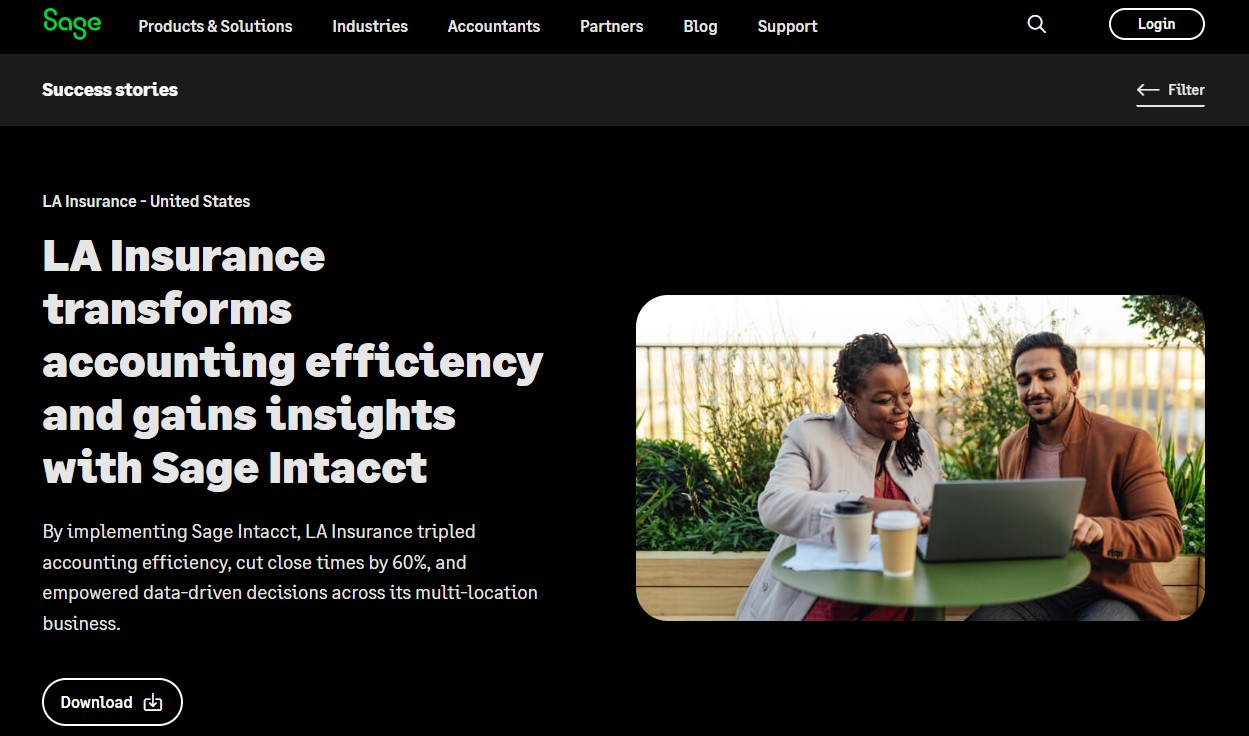
- Notable clients: New York Yankees, LPGA, Banyan Treatment Centers, US Anodize
- Client outcome: In the LA Insurance case study, Sage says the company tripled accounting efficiency, cut monthly close from 40 days to 20 days, and gained store-by-store reporting across 160 locations after implementing Sage Intacct.
Sage Intacct’s financial-services positioning is built around faster close, multi-entity visibility, and AI-assisted finance work. Its financial services page highlights AI-powered search, multi-entity management, AP/AR automation, cash management, revenue recognition, budgeting, forecasting, and financial assurance tools that flag unusual journal entries in real time.
This is most useful for finance teams that need stronger controls and faster reporting across entities, funds, agencies, or operating companies. Sage says its financial services software helps organizations consolidate across multiple operating companies in minutes, cut consolidation time in half, and close up to 90% faster with AI assistance.
7. NetSuite

- Notable clients: Highstreet Insurance Partners, Alumni Ventures, Brex, Granite Partners.
- Client outcome: Highstreet Insurance Partners reported saving around 120 hours of finance work each quarter after implementing NetSuite Planning and Budgeting. The system also simplified reporting across 121 subsidiaries and helped the company manage acquisition-driven growth.
NetSuite’s financial services ERP is built around unified finance and operations. Its page says the platform connects finance, planning, procurement, vendor management, CRM, back-office operations, multi-entity management, governance, and business intelligence in one system.
The differentiator is NetSuite’s fit for financial services firms that need scalable entity management without moving straight to a heavier enterprise ERP. Its page specifically calls out banks, insurers, asset managers, and fintechs, with tools for audit-ready records, automated reconciliations, intercompany eliminations, role-based permissions, segregation of duties, vendor oversight, and investor-ready reporting.
8. FinanSys
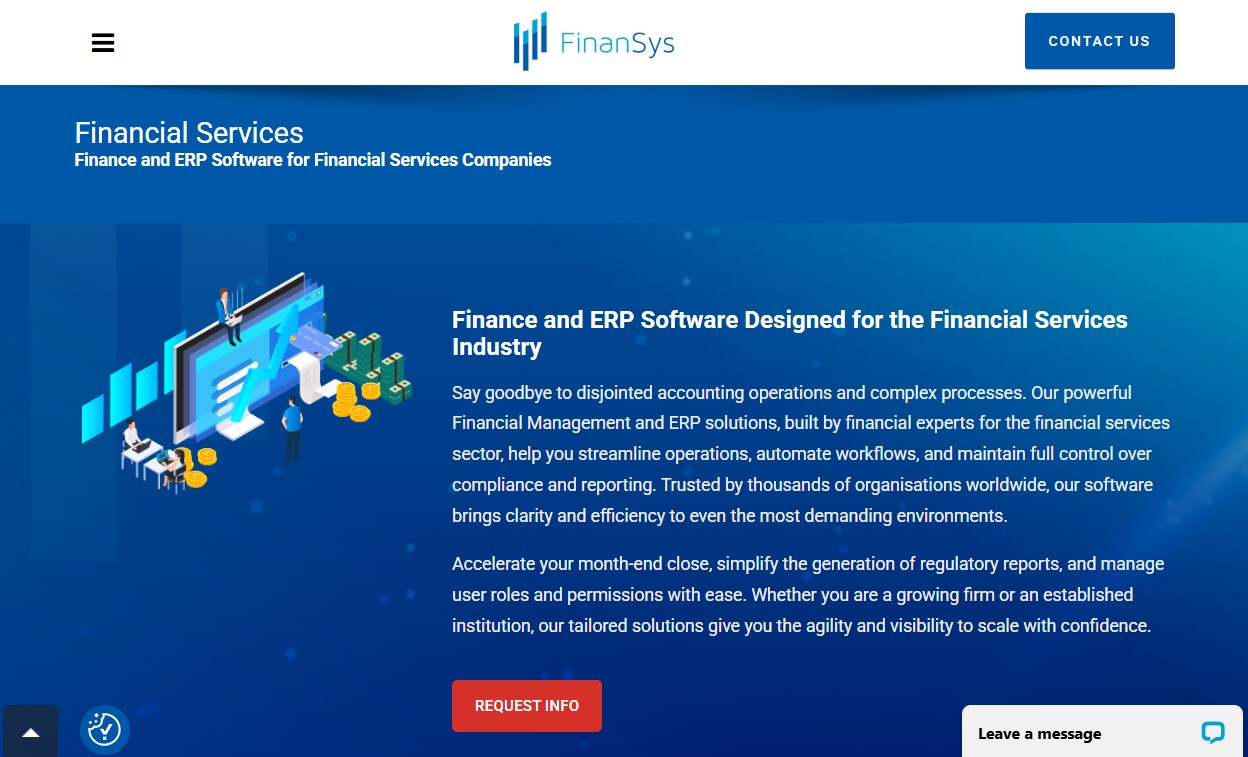
- Notable clients: Salix Finance, CCBI Metdist, The Crane Hotel, Cogent, Life & Peace Institute
- Client outcome: Salix Finance improved multi-level reporting, loan repayment tracking, and client data integration with SunSystems and FinanSys Cloud.
FinanSys is not a standalone ERP vendor; it implements and supports finance systems including Infor SunSystems Cloud and Oracle NetSuite, with its own UniFi automation layer for finance and operations workflows. Its financial services page focuses on accounting automation, compliance reporting, multi-entity finance, multi-currency support, audit controls, procurement, expenses, and real-time reporting.
FinanSys reports 200+ SunSystems implementations in 36 countries, and a 93% customer renewal rate. The main difference is its focus on finance-system implementation and automation over broad enterprise transformation. For financial services teams that already know they want SunSystems or NetSuite, FinanSys is most relevant when the priority is replacing spreadsheet-heavy finance processes, improving reporting control, and adding workflow automation around the ERP.
9. Unit4
- Notable clients: Qvantel, SQLI, National Trust, and Accent Group.
- Client outcome: Logan University achieved a 20% increase in financial management productivity and a 20% reduction in IT management time after moving Unit4 ERP to Azure Cloud.
Unit4 is most relevant for finance teams that need adaptable financial management across entities, reporting structures, currencies, and compliance requirements. Its finance ERP brings accounting, reporting, and compliance into a cloud ERP finance module built on single-ledger architecture.
Its edge is flexibility for service-centric organizations. Unit4 ERP unifies finance, HR, and project teams on one cloud platform, while its financial management tools cover general ledger, AP, AR, fixed assets, bank reconciliation, supplier management, customer management, compliance, and smart invoice processing.
10. Frappe ERPNext
- Notable clients: Zerodha, CIEE, KEPCO, Avanti Overseas.
- Client outcome: CIIE-IIM Ahmedabad migrated from QuickBooks to ERPNext on schedule. They transferred more than 58,000 accounting entries and 11,000 files while preserving data integrity and financial report accuracy.
Frappe ERPNext is the open-source entry in this list. This means more control over customization, source-code access, deployment choices, and long-term vendor dependency than closed ERP platforms. ERPNext works for banking, lending, insurance, investment firms, and fintechs, with emphasis on real-time financial operations, transparency, control, and compliance.
It is a good option for finance organizations that want ERP flexibility without per-user licensing pressure. ERPNext’s accounting software includes a flexible chart of accounts, general ledger, payables, receivables, tax and compliance, cost centers, budgeting, financial statements, asset management, account reconciliation, and audit-trail support. Frappe says 30,000+ companies have adopted ERPNext globally
Factors to Consider When Choosing an ERP for Financial Services
The right ERP should support your regulatory, reporting, security, and operational requirements. Use the criteria below to compare vendors before you commit to product demonstrations or implementation proposals.
| ERP system | Best suited for | Product type | Key strengths | Main consideration |
|---|---|---|---|---|
| Acumatica | Credit unions, fintechs, and growing financial services firms | Cloud ERP | Multi-entity accounting, workflow automation, real-time reporting, and unlimited-user pricing | May require additional configuration for complex banking or insurance workflows |
| IFS Cloud Finance | Large organizations with complex entities and operational processes | Enterprise cloud ERP | Enterprise-wide financial control, forecasting, embedded AI, and operational integration | Broader and more complex than many finance teams may need |
| Oracle Fusion Cloud ERP | Large banks, insurers, and global financial institutions | Enterprise cloud ERP | Risk controls, audit management, connected planning, procurement, and multi-jurisdiction reporting | Implementation can require significant time, budget, and internal resources |
| Priority Software | Mid-sized financial services firms that need flexibility | Cloud and on-premise ERP | Multi-entity accounting, billing, collections, cash-flow forecasting, and reporting | Smaller ecosystem than major enterprise ERP vendors |
| QArea | Banks and fintechs that need a custom ERP system | Custom software development provider | Tailored workflows, third-party integrations, security development, and full-cycle product development | It does not offer a ready-made ERP product |
| Sage Intacct | Family offices, insurers, investment firms, and multi-entity finance teams | Cloud financial management software | Fast consolidation, multi-entity reporting, close automation, and anomaly detection | Less suitable for firms that need extensive operational ERP modules |
| NetSuite | Growing insurers, fintechs, asset managers, and acquisition-led firms | Cloud ERP | Finance, CRM, procurement, entity management, reconciliations, and role-based controls | Customization and subscription costs can increase as the organization grows |
| FinanSys | Financial services firms implementing SunSystems or NetSuite | ERP implementation and automation partner | Finance automation, compliance reporting, multi-currency support, and workflow improvement | It is an implementation partner rather than a standalone ERP vendor |
What Most Financial Services ERP Comparisons Overlook
Most ERP for financial services comparisons focus on familiar features such as compliance tools, risk management, financial reporting, and customer management. These capabilities matter, but they do not tell you how difficult or expensive the system will be to implement.
Your team also needs answers to more practical questions:
- Can the ERP connect reliably with your core banking and operational systems?
- How will historical financial data be mapped, migrated, reconciled, and validated?
- Which reports and integrations will require customization?
- What will the full implementation cost once training, migration, support, and additional technology are included?
Vendor hype is an important risk as AI becomes standard in ERP software. Gartner expects AI-enabled tools to represent 62% of cloud ERP spending by 2027, up from 14% in 2024. Yet many CFOs remain constrained by poor data quality, integration complexity, and skills gaps.
Gartner also advises CFOs to assess vendor claims carefully and look for independently validated AI capabilities, transparent pricing, and proven customer adoption.
Financial services implementations require more integration and testing than standard finance projects. Core banking data, regulatory reporting, audit trails, access controls, and real-time synchronization can all affect cost, scope, and delivery timelines.
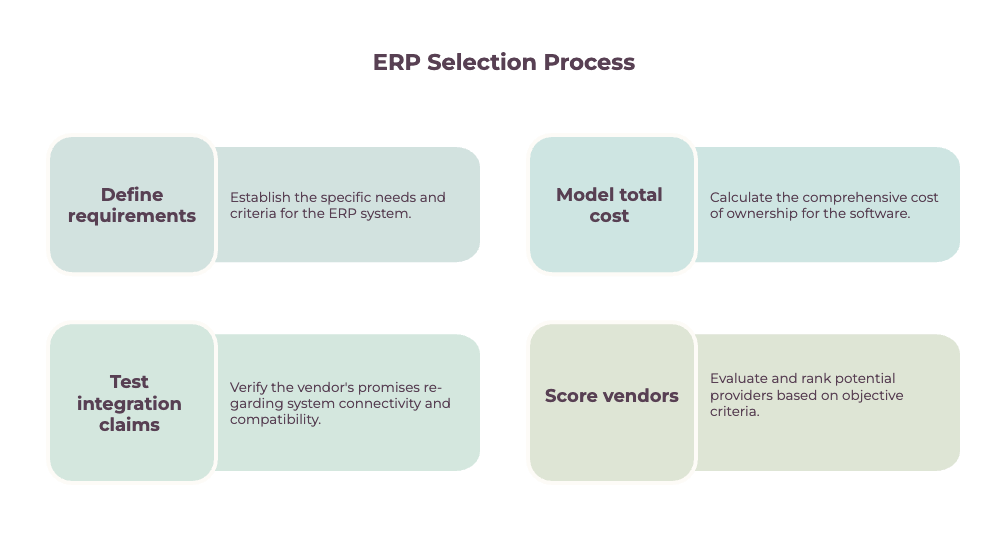
A strong selection process starts before the vendor demos. An independent ERP adviser can define your requirements, calculate total cost of ownership, test integration claims, and compare vendors without commissions or implementation incentives affecting the recommendation.
Read Next: Top 10 ERP Implementation Challenges and Solutions
Build a stronger ERP strategy with Alpha Apex Group
Alpha Apex Group helps financial institutions select and implement ERP systems without software sales, vendor commissions, or platform bias. Through our ERP Strategy & Implementation Consulting services, we compare platforms against your regulatory requirements, integration needs, operating model, and financial goals.
Our team supports banks, credit unions, insurers, wealth managers, and fintechs with business case development, requirements planning, vendor evaluation, total cost analysis, and implementation preparation. You get a clearer view of each option’s cost, risk, technical fit, and long-term value before making a commitment.
Contact us to discuss your ERP strategy and implementation needs.
FAQs
How is financial services ERP different from general ERP?
Purpose-built financial enterprise resource planning platforms usually include stronger audit trails, regulatory reporting, segregation of duties, multi-entity consolidation, and controls for sensitive financial data. A general ERP may support these functions, but mostly needs added configuration, middleware, or third-party compliance tools.
How long does ERP implementation take for a mid-market financial firm?
Most firms should plan for roughly 9 to 18 months. Core banking integration, historical data migration, custom financial reports, regulatory testing, and multiple approval layers can extend the timeline.
Should banks use a core banking ERP module or a separate platform?
A bolt-on Financial Module may reduce integration work, while a separate ERP can offer stronger consolidation, forecasting, and budget tracking. The right choice depends on data synchronization, reconciliation, reporting depth, and long-term scalability.
What ERP vendor demo red flags should financial firms watch for?
Watch for vague answers on record immutability, weak field-level audit trails, manual reporting, limited segregation of duties, and no proven core banking integrations. A demo focused on inventory or manufacturing rather than financial-services workflows is another warning sign.
How does Alpha Apex Group help prevent ERP vendor lock-in?
Our experts at Alpha Apex Group evaluate data portability, API access, contract terms, customization risk, and switching costs before selecting a platform. We also test whether the system can support future growth, customer service, and broader customer-experience goals without excessive dependence on a single vendor.
Is Alpha Apex Group’s ERP guidance vendor-neutral?
Alpha Apex Group provides vendor-neutral ERP guidance. We do not sell software or base recommendations on commissions, so decisions remain tied to operational fit, implementation risk, total cost of ownership, and long-term financial health.

.webp)
.jpg)

.jpg)