Top 9 Healthcare ERP Systems
Healthcare organizations are under more pressure than ever to improve efficiency while delivering high-quality patient care. Rising costs, workforce shortages, growing regulatory requirements, and fragmented systems have made enterprise resource planning a strategic priority rather than just an IT upgrade.
According to Grand View Research, the global ERP in Healthcare market is projected to reach $15.1 billion by 2033, a sign of growing demand for platforms that unify financial management, supply chain, human resources, and Clinical Systems.
But how can you be sure you’ve picked the right software solution?
This guide compares the top healthcare ERP solutions to help healthcare organizations find the best fit.
For a concise overview of how the leading healthcare ERP platforms compare across the core capabilities hospital and health system buyers care about most, this breakdown from SoftwareConnect is a useful starting point:
TL;DR: These Healthcare ERP Systems Fit Your Goals
And if you’re curious about the best software solutions at a glance, here are the top 5:
- SAP S/4HANA for Healthcare (ATSP S4Health): Best for large healthcare organizations that want to unify finance, patient administration, billing, and supply chain on a single SAP platform.
- Multiview ERP: A healthcare-specific ERP that combines strong EHR integration with financial management and budgeting, which makes it an excellent fit for community hospitals and critical access providers.
- Infor CloudSuite Healthcare: Infor connects finance, supply chain, human resources, and workforce management through a unified cloud platform with deep EHR integration.
- Oracle Fusion Cloud ERP for Healthcare: Oracle helps large health systems replace fragmented legacy applications with a scalable cloud ERP that standardizes finance, procurement, and supply chain operations.
- GPI Health Administration: GPI focuses on standardizing financial and operational processes across complex healthcare environments.
Side note: Healthcare organizations that need extra support can also work with an ERP consulting partner to clarify requirements, reduce implementation risk, and keep the project aligned with business goals.
The Healthcare ERP Systems Worth Your Time
We’ve helped many healthcare organizations implement ERP systems; in our experience, here are the ones that constantly stand out.
1. SAP S/4HANA for Healthcare (ATSP S4Health)
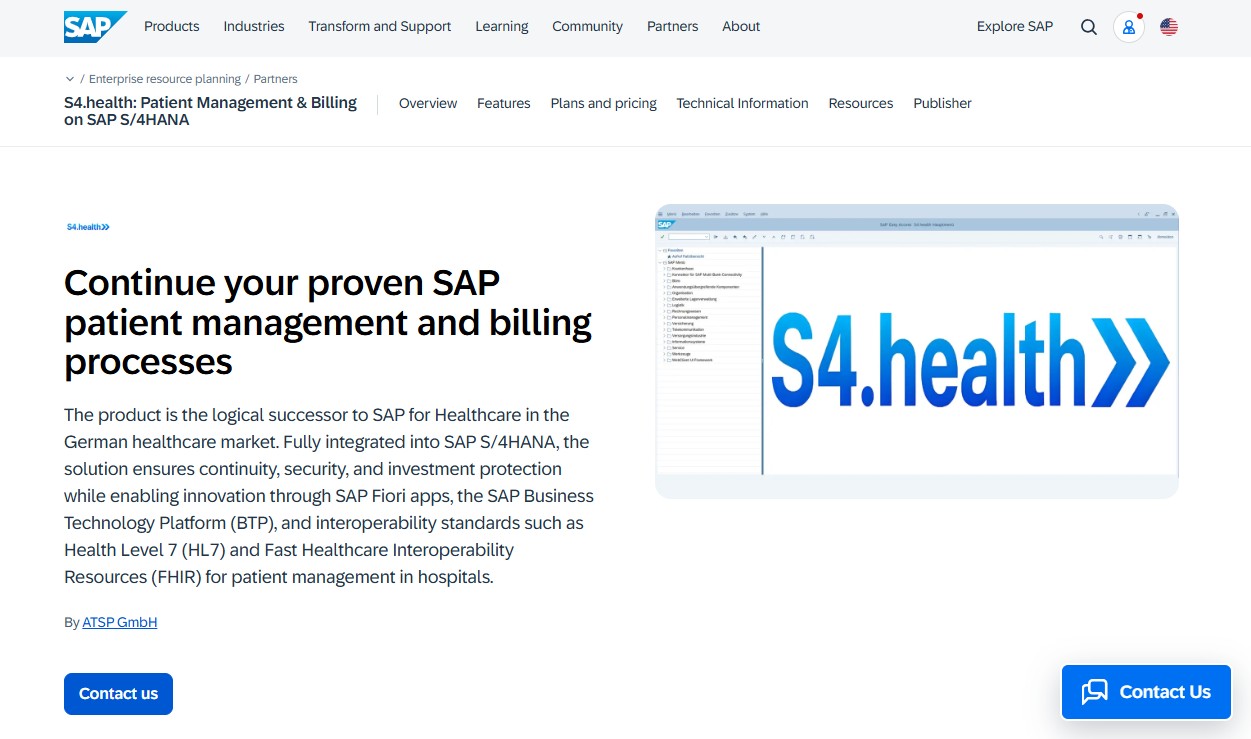
SAP S/4HANA SAP S/4HANA serves as the enterprise financial, procurement, and supply chain backbone for large, multi-site health systems. Rather than replacing the electronic health record, it typically runs alongside a separate best-of-breed EHR (Epic, Oracle Health, MEDITECH), handling the business side: fund accounting, cost center management, budget control, and real-time financial consolidation across multiple hospitals, clinics, and legal entities.
SAP's key differentiator is depth in enterprise financial and supply chain management at scale. Paired with SAP Ariba, it gives health systems end-to-end visibility from purchase order to point of care, tracking medical supplies, pharmaceuticals, and equipment in real time while enforcing contract compliance and reducing off-contract spend. It also supports cost visibility down to the service line or procedure level, which large health system CFOs use for resource allocation and pricing decisions.
Key Services:
- Enterprise Financial Management & Consolidation
- Fund Accounting & Budget Control
- Supply Chain Management & Procurement (via SAP Ariba)
- Cost Accounting by Service Line
- HR & Workforce Management
- Real-Time Financial Reporting
Why work with SAP S/4HANA?
It's a good option if you're a large, multi-entity health system that needs a single enterprise backbone for finance, procurement, and supply chain across hospitals and clinics, and you're running (or plan to run) a separate best-of-breed EHR for clinical and patient administration.
2. Multiview ERP
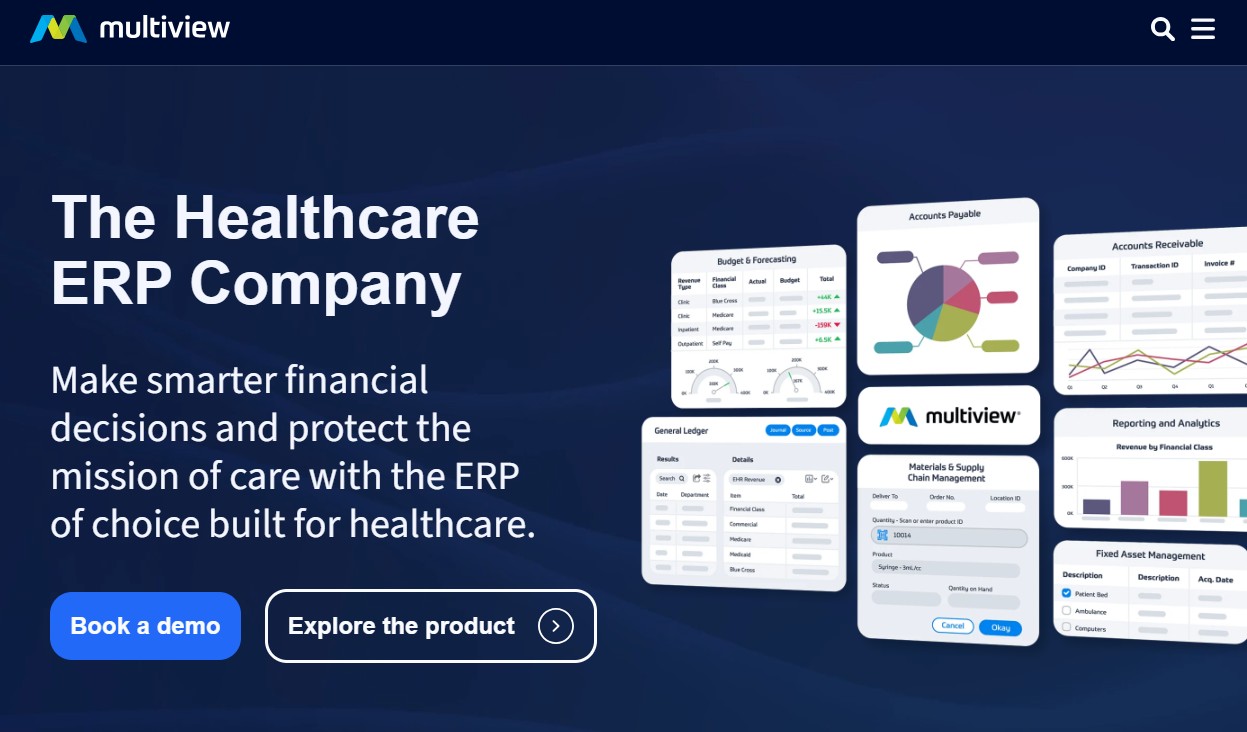
Multiview ERP integrates with leading EHR systems, including MEDITECH, Epic, Oracle Health, PointClickCare, Juno Health, and TruBridge, to centralize financial management, budgeting, supply chain, reporting, and business intelligence. The platform is designed for community hospitals, critical access hospitals, health systems, federally qualified health centers (FQHCs), senior living organizations, and skilled nursing providers.
According to the company, hundreds of rural and critical access hospitals, health centers, and post-acute organizations across North America use the platform. It has also been recognized as the #1-rated ERP for healthcare organizations with fewer than 300 beds by KLAS Research, based on customer feedback.
Myrtue Medical Center, a 25-bed Critical Access Hospital in Iowa, reported a 75% faster budgeting cycle, completed its month-end close 7-10 days earlier, achieved 98% adoption of automated workflows, and improved finance team efficiency by 20% after implementing Multiview ERP. The hospital also integrated the platform with Epic and UKG to provide real-time financial and operational visibility across departments.
Key Services:
- Healthcare ERP
- Financial Management & General Ledger
- Budgeting & Forecasting
- Materials & Supply Chain Management
- Business Intelligence & Reporting
- EHR & Payroll Integrations
Why work with Multiview ERP?
It's a good option if you're a community hospital or healthcare provider that wants an ERP built specifically for healthcare rather than a general-purpose finance platform.
3. Infor CloudSuite Healthcare
Rather than replacing an electronic health record (EHR), Infor CloudSuite Healthcare integrates with EHR systems to unify finance, supply chain, human resources, workforce management, and analytics in a single platform.
CHRISTUS Health, a not-for-profit health system with more than 600 locations, used Infor CloudSuite Healthcare to consolidate 19 general ledger systems, 16 supply chain management systems, and numerous third-party applications into a single cloud platform, improving operational continuity and standardizing enterprise processes across the organization.
Key Services:
- Healthcare ERP
- Financial Management & Planning
- Supply Chain Management
- Human Capital Management & Workforce Scheduling
- AI-Powered Analytics & Automation
- EHR Integration & Clinical Insights
Why work with Infor CloudSuite Healthcare?
Infor has a long history in hospital finance and supply chain (through Lawson), which makes it particularly well-suited for complex, multi-entity organizations that need to consolidate finance, procurement, HR, and workforce management onto a single cloud platform.
What to read next: Browse this detailed ERP implementation guide to learn how to account for hidden rollout work, including data migration, workflow redesign, testing, training, and post-go-live support.
4. Oracle Fusion Cloud ERP for Healthcare
Oracle Fusion Cloud ERP helps hospitals and health systems modernize finance, procurement, supply chain, and enterprise performance management on a single cloud platform. Rather than replacing an electronic health record (EHR), it integrates with Oracle Health and third-party clinical systems to connect financial and operational data while using embedded AI and automation to streamline administrative processes.
Oracle's strength lies in supporting large, complex healthcare organizations. One example is Cleveland Clinic, a nonprofit health system with 52,000 employees, 11 regional hospitals, 150+ outpatient locations, and 7.6 million outpatient visits annually, which implemented Oracle Fusion Cloud ERP and Supply Chain Management to standardize finance and supply chain operations across its global organization.
The cloud platform provides real-time financial visibility and a scalable foundation to support expansion across the U.S., London, Abu Dhabi, and Toronto.
Key Services:
- Enterprise Resource Planning (ERP)
- Financial Management
- Supply Chain Management
- Procurement
- Enterprise Performance Management (EPM)
- AI-Powered Business Analytics
Why work with Oracle Fusion Cloud ERP?
It's a good option if you're replacing multiple legacy enterprise systems across a large health system. Oracle is particularly well suited to multi-entity organizations that need to standardize finance, procurement, and supply chain operations on a single cloud platform.
5. GPI Health Administration
GPI Health Administration is a healthcare-specific enterprise resource planning (ERP) platform designed for hospitals, health systems, public healthcare organizations, and social care providers.
GPI's ERP platform is built around a Single Accounting Model to standardize financial processes across multi-entity healthcare organizations. GPI also publishes customer case studies, including ASL Bari, where its cloud-based laboratory information system connected 11 laboratories, around 100 sampling points, and supports the management of more than 12 million tests annually. This shows the company's ability to deliver enterprise-scale healthcare systems.
Key Services:
- Healthcare ERP
- Financial & Budget Management
- Supply Chain & Inventory Management
- Asset & Facilities Management
- Business Intelligence & Reporting
- Healthcare System Integration
Why work with GPI Health Administration?
It's a good option if you're a public healthcare organization or multi-site hospital network that needs to standardize financial and operational processes across multiple facilities.
6. Workday Healthcare
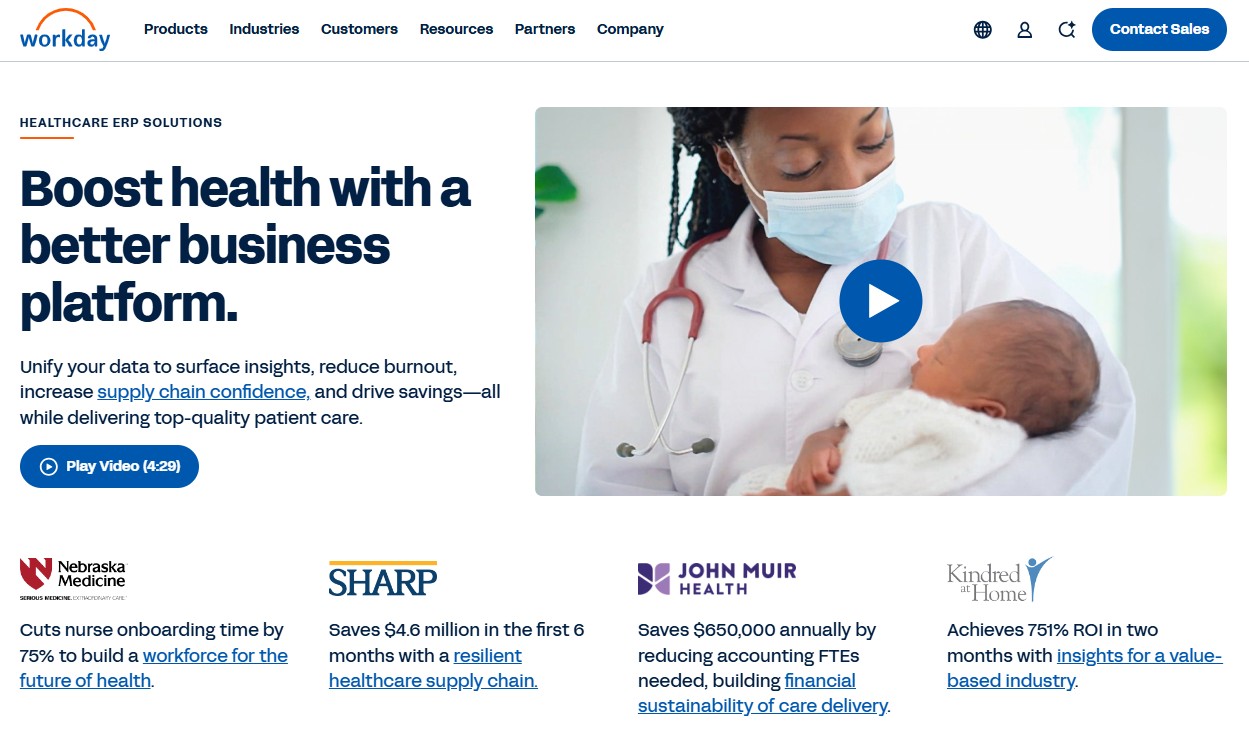
Rather than functioning as a traditional hospital ERP focused on patient administration, Workday helps healthcare organizations manage enterprise operations like workforce planning, financial management, supply chain, and compliance from a single cloud platform.
Workday's biggest differentiator is its strength in workforce and finance transformation for large healthcare organizations. One published customer story highlights Nebraska Medicine, which reduced nurse onboarding time by 75% after implementing Workday.
Key Services:
- Enterprise Resource Planning (ERP)
- Financial Management
- Human Capital Management (HCM)
- Workforce Planning
- Supply Chain Management
- Analytics & Planning
Why work with Workday Healthcare?
Workday stands out for combining enterprise financial management with industry-leading HCM, which makes it particularly well suited to health systems where workforce management is just as critical as finance and supply chain.
7. Sage Intacct for Healthcare
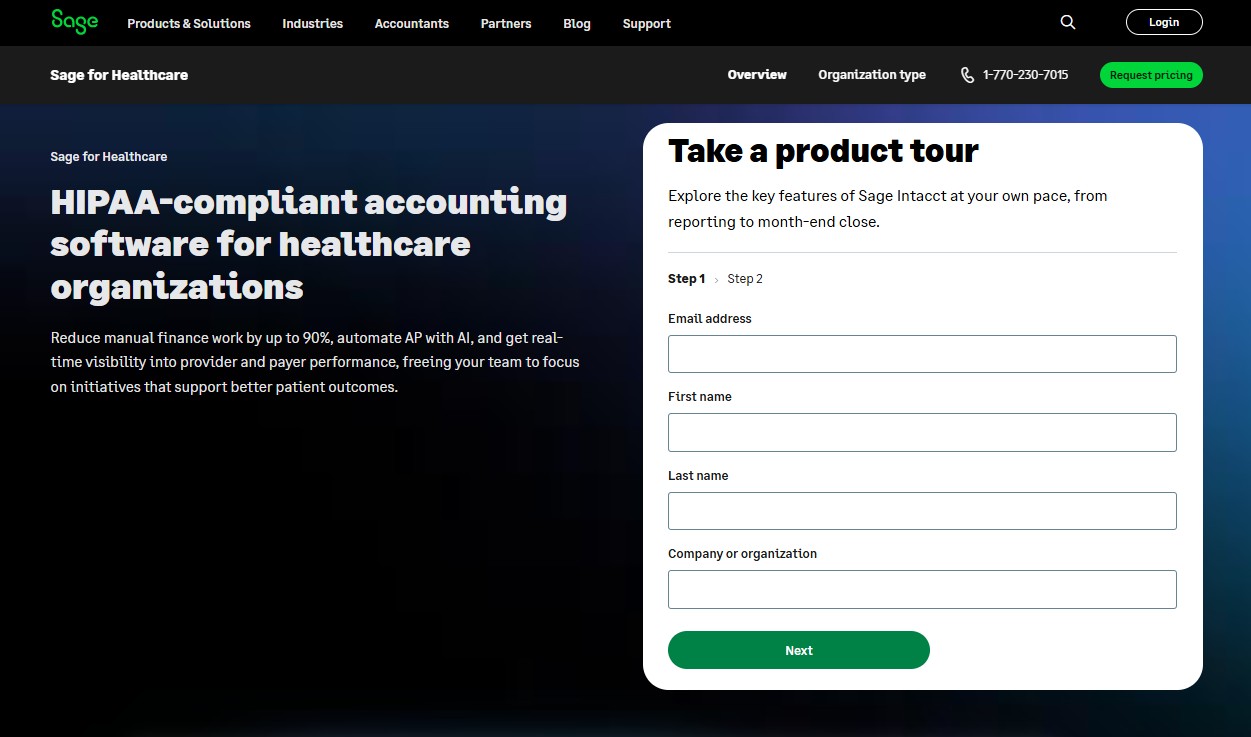
Sage Intacct is a cloud-based financial management and enterprise resource planning (ERP) platform used by physician groups, behavioral health providers, community health centers, senior living organizations, home health agencies, and nonprofit healthcare systems that want to modernize finance without relying on traditional on-premise ERP systems.
Sage Intacct's differentiator is its depth in healthcare financial management for mid-market organizations. The company claims to cut admin by 90%.
Key Services:
- Financial Management
- Budgeting & Planning
- Accounts Payable & Purchasing
- Multi-Entity Accounting
- Financial Reporting & Dashboards
- ERP Integrations
Why work with Sage Intacct?
It's a good option if you're a mid-sized healthcare organization looking to modernize financial management without implementing a full enterprise ERP.
8. Microsoft Dynamics 365
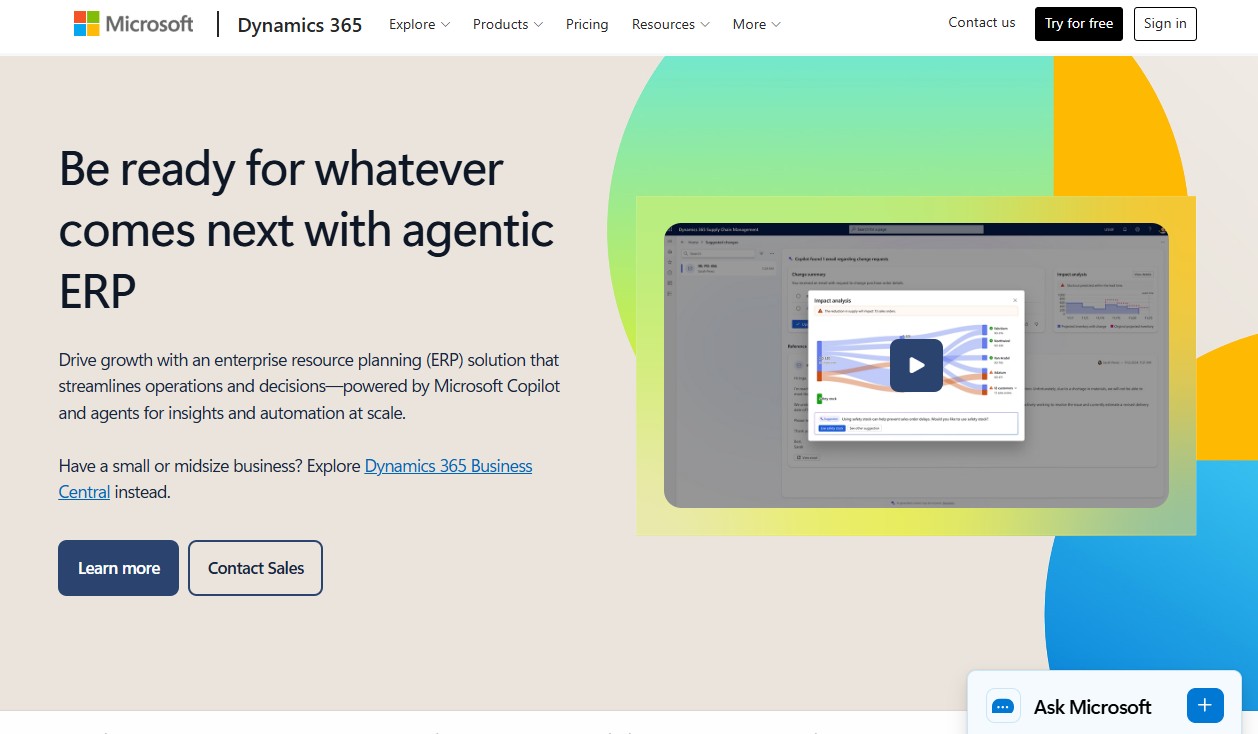
Microsoft Dynamics 365, rather than offering a healthcare-specific ERP, provides a flexible platform that can be extended through industry solutions and partner applications. This makes it a common choice for hospitals, health systems, physician groups, and healthcare service organizations that want to modernize enterprise operations.
Microsoft's key differentiator is the breadth of its business ecosystem. Dynamics 365 integrates natively with Microsoft 365, Teams, Power BI, Power Platform, Azure, and Copilot, enabling healthcare organizations to automate workflows, build low-code applications, and generate AI-powered insights without relying on disconnected systems.
Rather than replacing clinical applications, Dynamics 365 complements existing EHR platforms by providing enterprise finance, procurement, and operational management capabilities.
Key Services:
- Enterprise Resource Planning (ERP)
- Financial Management
- Supply Chain Management
- Procurement
- Project Operations
- Business Intelligence & AI
Why work with Microsoft Dynamics 365?
It's a good option if your organization is already invested in the Microsoft ecosystem. It’s well-suited to healthcare providers that want to extend ERP capabilities with AI, analytics, and workflow automation rather than adopting a standalone enterprise system.
9. NetSuite for Healthcare
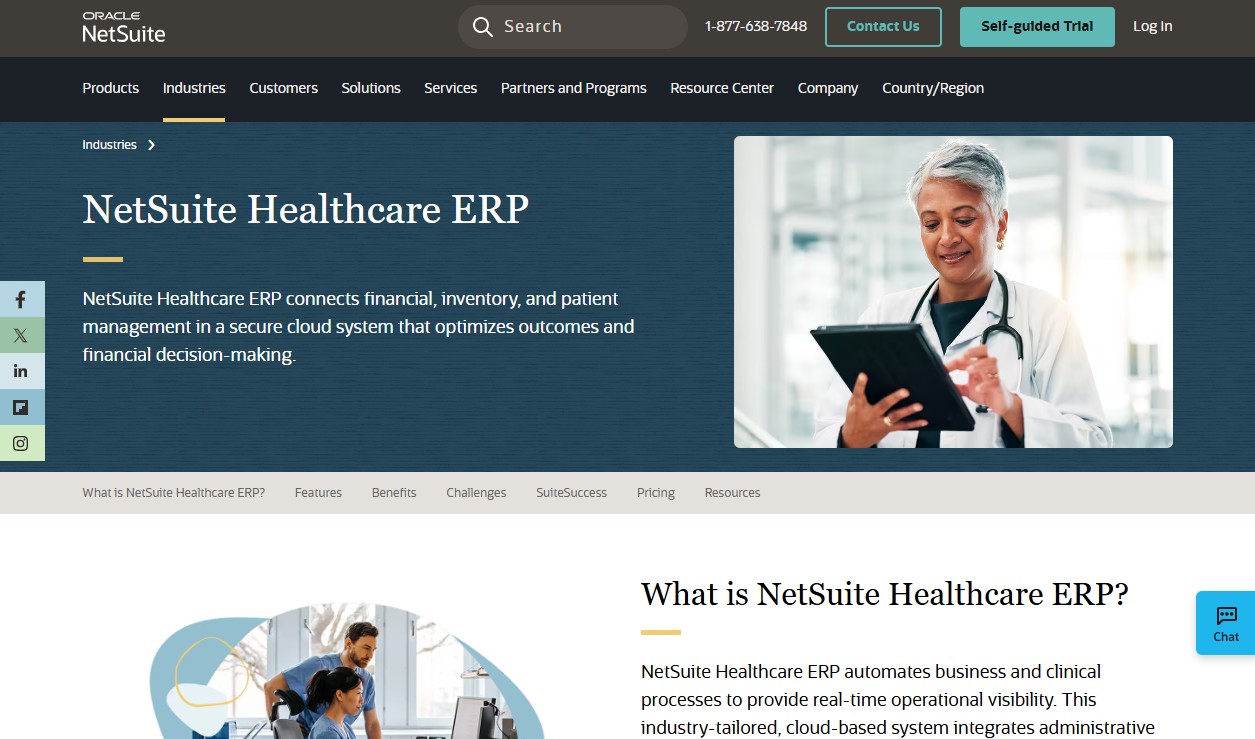
NetSuite is a cloud-based enterprise resource planning (ERP) platform that helps healthcare organizations manage financials, procurement, inventory, order management, planning, and reporting from a single system. The platform is used by physician groups, behavioral health providers, medical device companies, healthcare service organizations, and multi-location care providers looking to replace disconnected accounting and operational systems with a unified cloud ERP.
NetSuite's differentiator is its ability to unify financial and operational data across growing healthcare organizations. The company reports that more than 41,000 organizations worldwide use NetSuite and publishes healthcare customer success stories with measurable results. One example is Anchorum Health Foundation, which replaced spreadsheet-based financial processes with NetSuite to improve investment portfolio reporting, budgeting, grant management, and financial visibility as the organization expanded its philanthropic initiatives.
Key Services:
- Enterprise Resource Planning (ERP)
- Financial Management
- Procurement & Purchasing
- Inventory Management
- Planning & Budgeting
- Business Intelligence & Reporting
Why work with NetSuite?
NetSuite is particularly well suited to multi-entity and multi-location providers that need real-time financial visibility while supporting continued expansion.
How to Evaluate Healthcare ERP Systems: What Vendors Won't Tell You
Comparing features is the easy part. The harder, and more important, task is determining whether an ERP will support your organization five or ten years from now.
Clear ERP selection criteria can help healthcare teams compare platforms by integration depth, compliance requirements, reporting needs, scalability, and total cost of ownership.
According to Panorama Consulting Group's 2026 ERP Report, more than a quarter of ERP implementations exceed budget, with unexpected technology requirements among the leading causes.
As Brian Devault of Panorama Consulting Group, says,
"Organizations often discover fatal misfits late in the project, so they turn to additional technology, scope expansion, and custom builds."
1. Evaluate the Depth of EHR Integration
Many vendors advertise EHR integration, but not all integrations are created equal. Some platforms offer native, bidirectional data exchange, while others rely on third-party integrations or middleware that increase complexity and maintenance costs.
Ask vendors exactly what information moves between systems in real time, whether patient records, clinical documentation, patient billing, and financial data synchronize automatically, and how much manual reconciliation is still required.
Pro tip: For complex healthcare environments, ERP selection consulting can help translate those integration requirements into a structured vendor evaluation process.
It's also worth asking for examples of similar healthcare organizations already using the integration in production.
2. Look Beyond Inventory Management to End-to-End Supply Chain Visibility
Supply chain is one of the largest controllable cost centers in healthcare, yet Gartner found that the average health system centrally manages only 72% of organizational spending.
For organizations with less than $5 billion in net patient revenue, that figure drops even further, leaving a significant portion of spending outside centralized oversight.
The strongest ERP platforms deliver far more than inventory tracking. They provide real-time visibility into procurement, inventory control, materials management, medical equipment utilization, purchasing trends, and supplier performance through real-time dashboards that help leaders make faster operational decisions.
3. Separate HIPAA Compliance Features From HIPAA Compliance Architecture
No ERP is automatically HIPAA compliant simply because a vendor says it is. Compliance depends on how the platform protects patient data through encryption, role-based access controls, audit logs, monitoring, and secure handling of electronic protected health information.
As regulatory requirements continue to change, you need to be sure that security capabilities are built into the platform and don’t depend on external products and custom configurations that increase risk. A well-designed security architecture is easier to maintain than one assembled from multiple point solutions.
4. Calculate the Total Cost of Ownership
Software pricing is only one component of an ERP investment. Implementation, data migration, workflow redesign, change management, user training, ongoing support, and future enhancements often account for a much larger share of the overall project cost.
You need to evaluate the cost of customization, future upgrades, and additional software needed to fill functional gaps. A platform with a higher upfront investment may ultimately deliver a lower total cost of ownership if it reduces custom development and long-term maintenance.
5. Decide Whether You Need a Healthcare-Specific ERP or a Flexible Enterprise Platform
Purpose-built healthcare ERP solutions often include industry-specific capabilities such as patient management, revenue cycle workflows, clinical workflow support, and healthcare reporting out of the box. That can speed up implementation for hospitals and integrated delivery networks.
Broader enterprise platforms like SAP S/4HANA, Microsoft Dynamics 365, and Oracle Fusion Cloud ERP typically require more healthcare-specific configuration, but they often provide more flexibility, stronger enterprise functionality, and bigger partner ecosystems. The right choice depends on your existing technology environment, internal IT capabilities, long-term growth plans, and how much specialization your organization requires.
6. How Does Healthcare ERP Integrate With Your EHR?
An ERP and an EHR do different jobs. The EHR manages clinical data: patient records, orders, clinical documentation. The ERP manages the business side: general ledger, accounts payable, supply chain, HR, and often revenue cycle. The two systems need to talk to each other constantly, which makes integration depth one of the most consequential decisions in a healthcare ERP evaluation.
Not all integrations are built the same way. There are two broad categories:
- Native or certified connectors. Some ERP vendors maintain pre-built, tested integrations with specific EHR platforms. Multiview, for example, publishes integrations with MEDITECH, Epic, Oracle Health, PointClickCare, Juno Health, and TruBridge. Infor CloudSuite Healthcare and Oracle Fusion Cloud ERP are both built to integrate with Oracle Health and third-party clinical systems rather than replace them. These tend to be faster to implement and cheaper to maintain, since the vendor has already done the interface engineering work.
- Middleware or custom-built interfaces. Where a native connector doesn't exist, integration typically runs through HL7 or FHIR-based middleware, or a custom interface built during implementation. This works, but it adds implementation time, ongoing maintenance cost, and another point of failure to monitor.
When evaluating any vendor on this list, ask specifically:
- Which EHR platforms have a native, tested connector, versus which require custom integration work
- What data actually moves in real time (patient billing records, clinical documentation, financial data) versus what requires manual reconciliation
- Whether the vendor can name an existing customer running the same EHR-to-ERP pairing you're considering, in production, at a similar scale
If a vendor can't answer the third question concretely, that's a signal the integration is more theoretical than proven.
7. Revenue Cycle Management and ERP: What's the Connection?
Revenue cycle management (RCM) is the process that turns a patient encounter into paid revenue: charge capture, coding, claims submission, and collections. It's usually handled by the EHR, a dedicated RCM platform, or some combination of the two, not the ERP itself. But the ERP still plays a direct role, because RCM data has to land somewhere in the general ledger.
If your organization already runs a specialized RCM platform separate from your EHR, treat the RCM-to-ERP data flow as its own line item in vendor evaluation. Consider these points:
- Does the ERP have native revenue cycle support, or does it only receive RCM data after the fact? SAP S/4HANA and Oracle Fusion Cloud ERP both list revenue cycle management or revenue cycle support among their core healthcare capabilities, meaning charge and reimbursement data can flow into financial reporting with less manual reconciliation.
- How does denied or delayed reimbursement show up in your financial reporting? A weak RCM-to-ERP connection means denials and payment delays surface in your books weeks after they happen, instead of in near real time.
- Who owns the data mapping between coding/billing categories and your chart of accounts? This is usually the most underestimated part of a healthcare ERP implementation, since RCM systems and ERPs typically use different categorization logic that has to be reconciled manually unless the integration handles it natively.
How Much Does Healthcare ERP Cost?
Healthcare ERP pricing varies more than most industries because the compliance layer, EHR integration work, and multi-entity consolidation needs all add cost on top of the base license.
Most vendors price cloud healthcare ERP through custom, per-user quotes rather than published rate cards, since the final number depends heavily on module selection (finance-only vs. finance plus supply chain plus HR) and organization size. A small clinic or physician group can get a finance-first platform like Sage Intacct running for a fraction of what a multi-hospital health system pays for an enterprise deployment.
Across industries generally, Panorama Consulting's 2024 ERP Report found a median implementation cost of $450,000, though that figure isn't healthcare-specific.
Healthcare projects tend to run higher than that median once EHR integration, HIPAA-compliant access controls, and multi-entity financial consolidation are factored in.
As such, the total cost of ownership for healthcare ERP can run from the low hundreds of thousands for a single-facility or small multi-site organization into the millions for a large health system running a phased, multi-year rollout across dozens of locations.
Two cost drivers are worth budgeting for specifically, since they're the ones healthcare organizations most often underestimate:
- Implementation services. Configuration, data migration, and training typically add 1 to 2 times the software license cost on top of the license itself.
- EHR integration. This is frequently quoted separately from the core ERP license, and the cost depends heavily on which EHR you're connecting to and whether the integration is a certified, native connector or a custom-built interface.
Pro tip: Get a specific quote scoped to your organization size and EHR environment before comparing vendors on price alone. A lower sticker price with a costly, custom-built EHR integration can end up more expensive than a higher sticker price with a native connector already built.
Get Your Healthcare ERP Implementation Right the First Time with Alpha Apex Group
The right healthcare ERP can improve financial management, strengthen supply chain operations, and support long-term growth, while the wrong one can lead to costly delays, budget overruns, and years of technical debt.
Alpha Apex Group helps healthcare organizations navigate every stage of the ERP journey—from platform selection and vendor evaluation to implementation strategy, organizational change management, and post-go-live optimization.
Ready to modernize your healthcare operations with confidence? Connect with Alpha Apex Group today to build an ERP roadmap that reduces risk, accelerates adoption, and delivers lasting value for your organization.
FAQ
What's the difference between a healthcare ERP system and an EHR?
An Electronic Health Record (EHR) manages clinical information such as patient records, clinical documentation, and care delivery, while a healthcare ERP manages business functions like financial management, supply chain, human resources, and Revenue Cycle Management. Most healthcare organizations need both, with reliable EHR integration connecting clinical and operational data.
How long does a healthcare ERP implementation typically take?
Implementation timelines vary based on organization size, customization requirements, and data migration complexity, but most projects take anywhere from several months to well over a year. Strong project governance, stakeholder engagement, and clearly defined requirements can reduce delays.
Which healthcare ERP systems offer the strongest supply chain capabilities?
Platforms like SAP S/4HANA for Healthcare, Oracle Fusion Cloud ERP, and Infor CloudSuite Healthcare provide particularly robust supply chain functionality, including inventory management, procurement, materials management, and real-time visibility across multiple facilities.
If the shortlist is still unclear, comparing ERP selection consultants can help leadership decide whether to manage the selection internally or bring in outside support.
What should healthcare organizations look for when evaluating HIPAA compliance?
Look beyond marketing claims and evaluate how the platform supports data protection through encryption, role-based access controls, audit logging, secure handling of patient data, and ongoing regulatory compliance. It's also important to understand which security capabilities are native and which rely on third-party integrations.
How does Alpha Apex Group support healthcare ERP selection?
Alpha Apex Group provides independent ERP consulting to help healthcare organizations evaluate vendors, develop selection criteria, manage RFPs, and choose solutions that fit into their long-term business objectives rather than vendor sales priorities.
Can Alpha Apex Group help if our ERP implementation is already underway?
Yes. Alpha Apex Group supports organizations at every stage of the ERP lifecycle, including projects experiencing delays, scope changes, budget overruns, or adoption challenges, to help identify issues and get implementations back on track.
What types of healthcare organizations does Alpha Apex Group work with?
Alpha Apex Group works with a wide range of healthcare organizations, including hospitals, integrated health systems, physician groups, long-term care providers, nonprofit healthcare organizations, and other healthcare enterprises undertaking ERP modernization or digital transformation initiatives.
.webp)
.jpg)
.jpg)