Your Org Chart Is Costing You Money: A Guide to Spans & Layers Analysis

Most organizations don’t realize their org chart is draining performance until it’s too late.
In a McKinsey survey of 2,500+ leaders, two-thirds said their organizations are overly complex and inefficient. This level of complexity comes at a real cost. Freshworks found it can consume up to 7% of annual revenue, which is roughly the size of an R&D budget.
At the same time, companies are actively removing management layers, which signals a clear shift toward leaner, faster structures. This is something firms like Alpha Apex Group are actively addressing as they help organizations rethink leadership, structure, and performance.
Your organizational structure directly shapes speed, cost, and talent retention. In this guide, you’ll learn how spans and layers analysis works, how to assess your current structure, and how to optimize it for efficiency, faster decision-making, and stronger performance.
What Is Spans and Layers Analysis?
Spans and layers analysis is a way to evaluate your organizational structure by focusing on two core elements: spans of control and management layers.
Together, these help you understand whether your structure is balanced, efficient, and aligned with your business goals.
In organizational design, spans and layers analysis is a diagnostic assessment that goes beyond a simple org chart. It does more than map reporting lines. It looks at manager-to-employee ratios, workload distribution, and how decisions actually move through the organization.
This helps uncover issues like excess management overhead, unclear communication paths, and unnecessary layers in the hierarchy.
Unlike a basic org chart review, which provides a static snapshot, spans, and layers analysis, it focuses on how the structure actually functions.
It typically looks at metrics such as:
Average direct span and average indirect span
Total reporting layers and reporting paths
Distribution of direct reports across leadership roles
This makes it a key part of organizational structure optimization. It helps you:
Streamline spans and layers and reduce unnecessary complexity
Improve manager effectiveness and clarify reporting lines
Speed up decision-making and strengthen organizational effectiveness
Check out this video for a breakdown of spans and layers analysis:
To understand how this works in practice, let’s break down the span of control first.
What Is Span of Control?
Span of control refers to the number of employees who report directly to a manager. It includes both direct span (immediate direct reports) andindirect span (employees reporting through multiple layers beneath a manager).
At its core, the span of control comes down to balancing manager capacity with work complexity.
A wider span increases efficiency and reduces management overhead, but only if the manager can effectively support their team. A narrower span allows for closer oversight but can introduce unnecessary management layers and slow down decision-making processes.
This trade-off becomes more visible as organizations grow. As Amazon CEO, Andy Jassy, explains:
"Companies tend to slow down as they grow, focusing more on adding layers of management rather than improving customer experience."
Research tells us that there is no single ideal span. For example, McKinsey identifies five managerial archetypes, each with different optimal spans:
Player/coach: 3-5 direct reports (hands-on contribution)
Coach: 6-8 reports (developing team members)
Supervisor: 8-10 reports (oversight and execution)
Facilitator: 10-12+ reports (coordination-focused)
Coordinator: 15+ reports (highly standardized environments)
Industry benchmarks show a similar pattern. Spans typically range from 6 to 8 for knowledge workers and 15 to 25 for operational roles.
Importantly, the span of control directly impacts team performance and organizational effectiveness. When spans are too narrow, organizations add layers, which leads to slower decisions and unnecessary complexity. When spans are too wide, managers struggle to support their teams, which affects coaching and execution.
Many large organizations also develop what firms like StrategyX and PwC describe as an “hourglass” structure. Spans are wide at senior levels, narrow in the middle, and wide again at the frontline. This makes the middle layer more prone to inefficiency and structural bloat.
We’ll look at the hourglass pattern in more detail later on.
What Are Organizational Layers?
Organizational layers refer to the number of hierarchical levels in a company, from the CEO at the top to frontline employees at the bottom. Each layer represents a level of management or reporting responsibility within the organizational structure.
Layers are typically counted by following the reporting lines from top to bottom:
CEO (top layer)
Executive leadership
Senior and middle management
Frontline managers
Individual contributors (bottom layer)
The total number of these reporting layers defines the depth of the organization’s hierarchy. More layers create a taller org chart, while fewer layers result in a flatter structure.
How Spans and Layers Work Together
Spans and layers are two sides of the same equation. Span width (number of direct reports) directly influences layer depth (number of reporting levels). As spans widen, organizations typically require fewer layers; as spans narrow, additional layers are mostly introduced to manage smaller teams.
You’ll usually see patterns like this:
| Structure Type | Key Outcomes |
|---|---|
| Wider spans and fewer layers |
|
| Narrower spans and more layers |
|
The goal is to find the right balance based on how your organization operates.
Effective organizations follow a few key structural principles here:
Align the span of control with work complexity and manager capability
Avoid unnecessary reporting layers that don’t add clear value
Make sure reporting paths are clear and support fast, effective decisions
In practice, high-performing organizations continuously calibrate their span-and-layer mix to support both execution and agility rather than defaulting to a static org chart.
The Hourglass Organization Problem in Spans and Layers
Remember the hourglass organization we mentioned earlier? It’s a common structure where spans are wide at the top, narrow in the middle, and wide again at the bottom.
Research from Strategy& and PwC that we shared above shows this pattern appears frequently in large enterprises and usually signals an imbalance in spans and layers.
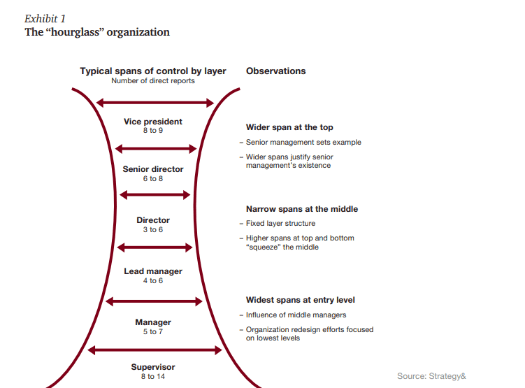
Source: Strategy& / PwC spans and layers research report referenced above
In this model:
Senior leaders have relatively wide spans (e.g., 8-9 direct reports)
Middle managers have narrow spans (often 3-6 direct reports)
Frontline supervisors again manage broader teams (8-14 employees)
At first glance, this may seem logical, but the middle layer is where problems emerge.
Why the middle becomes a bottleneck
Narrow spans in mid-level leadership roles create excess management layers, which slow decision-making processes and fragment communication channels.
Instead of making execution easier, middle managers can become approval checkpoints, which actually adds extra complexity rather than reducing it.
What causes narrow middle spans
Several structural and cultural factors drive this pattern:
Unclear accountability, leading to role duplication
Functional siloing requires more coordination roles
Micromanagement, which reduces trust, and widens oversight needs
Implied promotion paths that add layers instead of expanding responsibility
The business impact
The hourglass pattern is one of the clearest indicators of organizational inefficiency. It leads to:
Increased management overhead without proportional value
Slower execution due to excessive reporting layers
Reduced manager effectiveness in the middle of the organization
Poorer organizational effectiveness overall
In many cases, organizations attempting organizational structure optimization find that addressing the middle layer by widening spans and reducing unnecessary roles often delivers the greatest impact.
Why Spans and Layers Analysis Matters for Organizational Structure Optimization
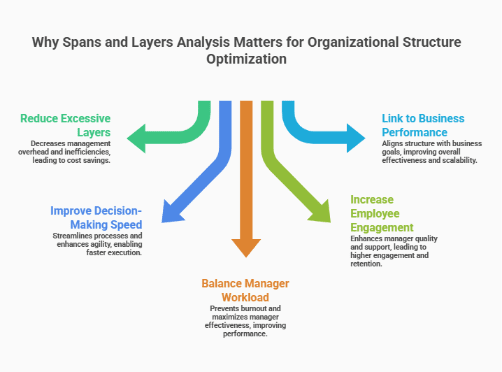
Spans and layers analysis is one of the most valuable things you can do for organizational structure optimization because it directly affects cost, speed, and talent outcomes. It connects your organizational design to real business performance.
1. Cost of excess management layers
Every additional layer adds management overhead without necessarily adding value. Excess reporting layers increase headcount, duplicate responsibilities, and create inefficiencies that compound over time, particularly in large organizations.
2. Decision-making speed and agility
More layers mean more approvals, slower decision-making processes, and fragmented communication channels. By contrast, optimizing the span-and-layer mix leads to faster execution and more accountability across teams.
3. Manager effectiveness and workload balance
Poorly calibrated spans can break manager performance in either direction:
Too narrow, and you end up with unnecessary layers and underused leadership capacity
Too wide can lead to excessive managerial workload and burnout
In fact, a Gartner survey found that 75% of CHROs believe their managers are overwhelmed, which is a clear sign of how misaligned spans can impact manager effectiveness.
4. Employee engagement and retention
Manager quality is one of the strongest drivers of employee engagement, and structure plays a major role in that. Gallup’s 2025 report found global engagement dropped from 23% to 21%, driven largely by declining manager engagement. This resulted in $438 billion in lost productivity.
When spans and layers are misaligned, managers have less time to coach, support, and develop their teams. This results in lower engagement and a weaker company culture.
5. Link to business performance
Structural inefficiencies are now visible at the macro level. Middle managers accounted for 29% of all layoffs in 2024, a sharp increase from prior years, as organizations actively remove layers to improve efficiency.
In practice, organizations that invest in spans and layers analysis improve organizational effectiveness, strengthen leadership performance, and create structures that scale with growth.
What Is the “Right” Number of Spans and Layers?
There is no single number that works for every organization.
What works for you depends on how your teams operate and the kind of work they handle. A small company might run with 2 to 3 layers, while a large enterprise may have more than 9.
It’s tempting to rely on generic targets. You’ll mostly hear ranges like 5 to 10 direct reports per manager. In practice, these numbers can create more problems than they solve. In complex roles, they can overload managers. In simpler teams, they can add layers that don’t need to exist.
Benchmarks still help, but only as a reference point. Spans have increased over time, and many organizations are reducing layers to simplify how they operate.
You’ll also notice that different parts of your organization need different structures. Some teams require tighter spans when the work is complex or oversight is critical. Others can operate with broader spans when tasks are repeatable and teams are experienced.
The focus should stay on building a structure that fits how your organization actually works. To get that right, it helps to look more closely at the factors that shape spans and layers.
Key Factors That Influence Spans and Layers Design
The right span-and-layer structure depends on a few practical variables. These factors shape how much oversight your teams need and how your structure should evolve.
Work complexity: If your team handles complex or ambiguous work, you’ll usually need narrower spans and closer support. More routine work can support wider spans.
Process standardization: When workflows are consistent and repeatable, you can manage larger teams more effectively. There’s less need for constant intervention.
Team capability: Experienced, self-sufficient teams don’t need as much hands-on management. This makes broader spans easier to maintain.
Geographic distribution: If your teams are spread across locations or time zones, coordination becomes more challenging. In these cases, tighter spans or additional support may be needed.
Technology and systems: Strong tools, automation, and visibility make it easier to manage larger teams without losing control.
Taken together, these factors should guide how you design spans and layers across different functions, rather than relying on a single company-wide rule.
When to Use Spans and Layers Analysis
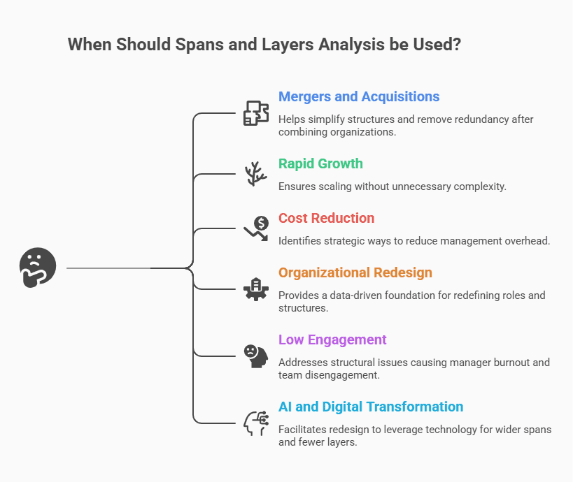
Spans and layers analysis is most valuable during periods of change, when an organization’s structure is under pressure or no longer aligned with how work actually gets done.
Let’s check out some examples.
Mergers and acquisitions
When you combine two organizations, you often end up with overlapping roles, duplicate reporting lines, and extra layers. This analysis helps you simplify the structure and remove redundancy.
Rapid growth or scaling
As your companies grow, the structures also evolve without a clear plan. Over time, this leads to extra layers and unclear accountability. A structured review helps you make sure the organization scales without any needless extra complexity.
Cost reduction initiatives
When reducing costs, lots of organizations focus on headcount without addressing structural inefficiencies. Spans and layers analysis identifies where you can reduce this management overhead in a more strategic way.
Organizational redesign
During broader organizational design efforts, span and layer analysis gives you a data-driven foundation for redefining roles, reporting paths, and leadership structures.
Low engagemet or manager burnout
If your managers are overwhelmed or teams are disengaged, the root cause is mostly structural. Imbalanced spans can lead to a ton of workload for managers, and this limits coaching and weakens the company culture.
AI and digital transformation
As technology reshapes how work gets done, organizations have to rethink their structure. Automation and AI can support wider spans and fewer layers, but only if the organization is intentionally redesigned to take advantage of them.
In each of these scenarios, spans and layers analysis gives you a clear and objective way to diagnose issues and restructure accordingly.
How to Conduct a Spans and Layers Analysis: Step by Step Guide
A spans and layers analysis should be a structured, data-driven process instead of a one-time org chart review. Your goal is to spot inefficiencies, understand what’s causing them, and redesign the structure in a way that supports better performance.
When done well, this process can lead to meaningful improvements across cost, speed, and accountability.
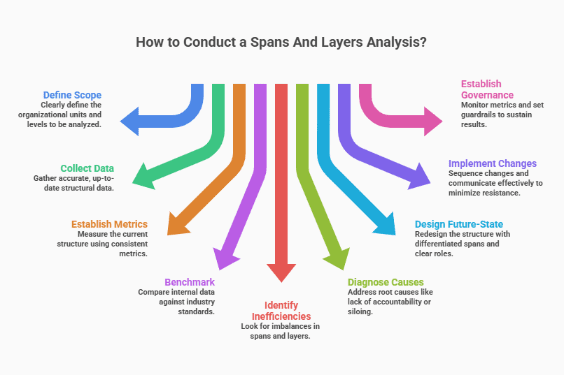
Step 1: Define Scope and Objectives
Start by clearly defining what part of the organization you are analyzing. Which business units, functions, or geographies are in scope? And which levels (for example, executive to frontline) will be included?
You also need to be clear on what you want to solve. In your case, the priority might be cost reduction, faster decision-making, or preparing the organization for growth.
Step 2: Collect Organizational Data
Next, gather accurate and up-to-date structural data. This typically includes, at a minimum, HRIS exports, reporting lines, org chart data, headcount, and role or grade definitions. The quality of this data matters. If your inputs are incomplete or outdated, your conclusions will be off too.
Step 3: Establish Baseline Metrics
Once you have the data, measure the current structure using a consistent set of metrics. For example:
Average direct span (by level and function)
Maximum reporting depth (layer count from CEO to frontline)
Percentage of managers with only one direct report
Percentage of managers managing other managers
These metrics form the foundation of your diagnostic assessment.
Step 4: Benchmark Against Standards
Compare your internal data against both internal and external benchmarks. Internally, you can look at differences across teams, functions, or regions. Externally, you can compare spans, layers, and manager ratios against industry norms.
This helps you see where your structure stands out. Benchmarks should guide your thinking, but they should not make the decision for you.
Step 5: Identify Structural Inefficiencies
Look for clear signals of imbalance in your structure. Ask yourself, where are spans too narrow or too wide? Where are layers deepest or most concentrated? Where do excessive reporting paths slow execution?
This step sheds light on where your organizational structure optimization efforts should focus.
Step 6: Diagnose Root Causes
Structural issues are usually symptoms of deeper problems. In many cases, they come down to a few common patterns:
Lack of accountability
Functional siloing
Micromanagement
Implied promotion paths that add layers instead of responsibility
If you don’t address these, the same issues will show up again even after redesigning the structure.
Step 7: Design the Future-State Structure
Now, define what your organization should look like going forward. Start by setting differentiated span targets by function and level. Then, redesign roles and clarify decision rights. And finally, align the structure with actual work and business priorities.
Insider tip: Avoid applying a single company-wide target here. Remember that context and specificity are important.
Step 8: Sequence and Implement Changes
We have noticed that this is where most transformations break down.
Start by simplifying layers at the top, where excess structure often builds up. At the same time, think through how these changes affect career paths. Your top performers need to see clear opportunities for growth.
Communication matters just as much as structure. Make sure your teams understand what’s changing, why it matters, and how it affects their roles. We recommend holding meetings to address key points, sharing updates via email, and ensuring you’re available to address questions and concerns.
Research from McKinsey shows that 72% of transformations fail due to a lack of support or resistance. That’s why change management plays a critical role here.
Step 9: Establish Governance
Finally, to sustain results, you need to actively manage your spans and layers over time. This means you need to define guardrails for adding new roles or layers and make these clear to all relevant decision makers.
Always monitor key metrics like average direct span and reporting depth through an HR dashboard. And make sure leaders are accountable for any changes and have all the information and resources they need to make key decisions.
Data from KPMG shows that organizations using strategic workforce planning can achieve around 10% labor cost savings through better structure and resource allocation.
In practice, the difference between a successful spans and layers analysis and a failed one ultimately comes down to the discipline to implement and sustain the change.
Key Metrics to Track in Spans and Layers Analysis
To make spans and layers analysis actionable, organizations need a clear set of metrics that connect structure to performance. Without this, even the best organizational design efforts can easily become subjective.
Here are the main metrics you need to consider.
| Metric Category | Metric | What It Measures | Why It Matters |
|---|---|---|---|
| Structural Metrics | Average direct span | Number of direct reports per manager | Shows how work and oversight are distributed |
| Maximum reporting depth | Total layers from CEO to frontline | Shows how tall or flat the organization is | |
| % of single-direct-report managers | Managers with only one direct report | Flags inefficiency and potential layer bloat | |
| Cost & Efficiency Metrics | Manager-to-employee ratio | % of workforce in management roles | Assesses management intensity and overhead |
| Management cost ratio | Management payroll as % of total payroll | Quantifies the cost of management overhead | |
| Span variance | Consistency of spans across similar roles | Identifies imbalance and lack of standardization | |
| Decision latency proxies | Number of approval steps for key decisions | Measures impact on speed of execution | |
| Performance & People Metrics | Engagement by span bracket | Engagement scores by manager span size | Links structure to employee experience |
| Attrition by span | Turnover rates across different spans | Identifies structures linked to higher attrition |
Common Spans and Layers Analysis Mistakes (and How to Avoid Them)
Spans and layers analysis is powerful, but only when applied correctly. Many organizations fall into predictable traps that limit impact or even make structural problems worse. Here they are, and how to avoid them.
Cutting layers without fixing root causes
Reducing headcount alone doesn’t solve structural issues if accountability, decision rights, or workflows remain unclear. To avoid this, you need to address underlying drivers like siloing, micromanagement, and unclear ownership.
Delayering from the bottom up
Many organizations remove frontline supervisors first, even though bloat typically sits in middle and senior layers. Avoid this issue by starting from the top and work downward to remove unnecessary coordination layers
Ignoring career path implications
Flattening the structure without redefining progression can create a promotion bottleneck and lead to the loss of high performers. Data shows that managers are more likely than non-managers to be burnt out, disengaged, and job hunting, so you need to work hard to keep them happy and on board.
You can avoid this by redesigning career paths alongside structure, including lateral growth and expanded roles.
Treating it as a one-time exercise
Organizations usually run a spans and layers project once, only to see hierarchy creep return within 12-24 months. Instead, you must build ongoing governance and track key metrics through an HR dashboard.
Failing to align with the operating model
Changing structure without updating decision rights, processes, or incentives leads to misalignment. This is typically called the “org DNA” problem. You need to make sure structure, processes, and incentives evolve together.
Swinging too far toward flat
Overcorrecting by maximizing span width can overwhelm managers, reducing coaching quality and increasing burnout. The solution here is to balance efficiency with manager effectiveness and sustainable workloads.
Poor data quality
Decisions based on outdated or incomplete HRIS data lead to flawed conclusions and misaligned redesigns. What you should do instead is validate data accuracy before starting any diagnostic assessment.
Some organizations are already moving in this direction. For example, Amazon set a target to increase the ratio of individual contributors to managers by 15%, which reflects a shift toward flatter structures without going too far.
Spans and layers analysis is a critical capability. When done well, it improves efficiency and performance. When done poorly, it adds complexity and increases the risk of talent loss.
Spans, Layers, and AI: The Next Frontier
AI is changing how organizations manage structure by reducing the need for manual coordination. Tasks like reporting, tracking, and workflow management are increasingly automated, which gives managers better visibility and frees up time. This makes it easier to handle larger teams, so wider spans are becoming more practical without increasing workload.
At the same time, AI is reducing the need for multiple management layers. Many layers existed to manage information flow, and as that becomes automated, organizations are starting to simplify their structure. This shift is already visible. McKinsey & Company projects workforce reductions of up to 30% driven by AI.
That said, flattening the structure without redesigning roles can create new problems. The focus going forward is not just fewer layers, but clearer accountability, better-supported managers, and structures that adapt to how work actually gets done.
Get your Spans and Layers Right with Alpha Apex Group
Most organizations discover their structural inefficiencies too late, long after they’ve already lost key talent, slowed down a critical initiative, or watched a competitor out-execute them.
Alpha Apex Group combines the strategic rigor of top-tier consulting with a practical, hands-on approach to spans and layers analysis. We work alongside your leadership team to redesign your organizational structure in a way that is executable, sustainable, and aligned with your business goals.
Whether you’re navigating a transformation, integrating an acquisition, or looking to improve organizational effectiveness, we help you:
Identify hidden inefficiencies in your org chart
Optimize spans and layers for speed, cost, and performance
Implement changes that stick
If you’re ready to move beyond theory and build a structure that actually works, contact us to start the conversation.
FAQs
What is a good span of control?
There’s no single ideal number. Most organizations range from 5 to 15 direct reports, depending on work complexity and team maturity.
How many management layers should a company have?
It depends on size and complexity. Small companies usually operate with 2 to 4 layers, mid-sized organizations with around 4 to 6, and large enterprises often have 6 to 9 or more. The key is making sure each layer adds value and supports how your organization runs.
How do you calculate span of control?
To calculate the span of control, divide the number of direct reports by the number of managers at a given level or across the organization.
What causes management layer bloat?
Common causes of management layer bloat include unclear accountability, siloed teams, micromanagement, and promotion structures that add roles instead of responsibility.
How do you interpret spans and layers?
To interpret spans and layers, look for imbalance. Too many layers or too few direct reports typically signal inefficiency, while overly wide spans can indicate manager overload.
What are the 4 types of organizational structure?
The most common types of organizational structure are functional, divisional, matrix, and flat structures. Each of these has different implications for spans and layers.
How does Alpha Apex Group approach a spans and layers analysis?
We combine data-driven diagnostics with hands-on implementation. This means structural changes are both practical and sustainable.
Appendix: Links and Further Reading
- McKinsey & Company — The State of Organizations 2026
- McKinsey & Company — How to Identify the Right Spans of Control for Your Organization
- McKinsey & Company — State of Organizations 2023: 10 Shifts Transforming Organizations
- Strategy& (PwC) — Management Spans and Layers
- Freshworks — Global Cost of Complexity Report
- Korn Ferry — The Great Flattening
- Gallup — State of the Global Workplace 2025
- Gallup — Workplace Trends Leaders Should Watch 2024
- Gartner — CHROs on Manager Overwhelm
- Gartner — HR Survey: Manager Support & Employee Engagement
- Gusto — Managerial Flattening 2025
- NBER — Flattening of Corporate Management (Rajan & Wulf)
- KPMG — Strategic Workforce Planning with AI Agents
- Boston Consulting Group (BCG) — AI at Work: Momentum Builds but Gaps Remain
- World Economic Forum — AI's Dual Workforce Challenge: Balancing Overcapacity and Talent Shortages
- Hyring — Span of Control Framework
- Live Data Technologies (via HR Morning) — Middle Manager Layoffs: The Great Flattening
- McGraw-Hill Higher Education — Flattening Management Trend
- Databricks (citing Fortune) — Amazon CEO Andy Jassy's Delayering Mandate
- Fast Company / Verizon — AI Will Reshape Your Workforce

.jpg)