Top ERP Selection Criteria in 2026: What Really Matters
.webp)
ERP software selection can be really hard.
Leading platforms often check all the same boxes, and 85% of organizations report only marginal functional differences between top systems. And yet, more than a quarter of ERP
So, you can select the wrong software, yes, but you can also use completely wrong selection criteria.
Because of that, this guide breaks down how to choose an ERP system in 2026, which ERP evaluation criteria carry the most weight, and how to build a selection process that holds up through implementation.
ERP Buying Has Changed in 2026
ERP selection used to be a little easier to narrow down. Buyers compared feature lists, checked which vendors served their industry, and moved a handful of recognizable names into the demonstration phase. One or two people usually drove the decision, and a good feature match was often enough.
That approach is a lot less useful these days.
Today, the average B2B technology purchase involves 12 to 14 stakeholders and takes 16.3 months, according to Gartner data cited by Deloitte. An ERP decision has to satisfy finance, operations, IT, leadership, and end users at the same time - and no single feature list, however long, tells you whether all five of those groups will actually get what they need from the system.
That's what pushes the real question from "which ERP has this feature?" to a different set of questions entirely:
- Does it fit the company’s actual business processes?
- What will it cost to implement, integrate, support, and upgrade?
- Can it scale with the business strategy?
- How well does it connect with existing software applications?
- Will employees realistically use it?
Choosing an ERP system based mainly on brand recognition or a feature checklist misses the factors most likely to create problems later. A modern ERP selection process needs clearer requirements, agreed-upon evaluation mechanics, and criteria that expose meaningful differences between vendors.
That is what the next section’s ERP selection criteria checklist is designed to do.
ERP Software Selection Criteria: What is Important?
A useful ERP selection criteria checklist should expose where each option fits the business, where it creates tradeoffs, and where costs or challenges may arise later.
For a shorter reference, see our Top 6 ERP Selection Criteria for Choosing the Best System. For a deeper ERP software selection, these are the criteria worth scoring.
1. Business Process and Functional Fit
Start with how the business operates.
Requirements gathering should map core workflows across finance, operations, sales, procurement, inventory management, and customer management before vendors enter the picture. That creates a functional requirements baseline that can be used during RFP responses and scripted demos.
Build the ERP system requirements checklist first, then make vendors show how their software handles those exact workflows.
The best ERP system is the one that supports critical processes with the least unnecessary customization.
2. Industry- and Process-Specific Functionality
Generic capability is not enough when the business has specialized requirements.
A manufacturer may need production planning applications, lot traceability, or detailed inventory management tools. Construction businesses may need project accounting. A multi-entity company may care more about consolidation, intercompany transactions, and financial reporting.
That is why industry expertise should carry real weight in the ERP evaluation criteria.
Manufacturing buyers can start with our comparison of ERP solutions for manufacturing, while process manufacturers may need the narrower capabilities covered in our chemical manufacturing ERP guide. Construction companies face a different set of requirements entirely, which we cover in our construction ERP comparison.
3. Scalability and Future Fit
ERP system selection should account for the business you expect to become as well as the business you run today.
Ask what happens if transaction volume doubles, new entities are added, operations expand internationally, or the supply chain becomes more complex. Can the ERP software support that growth without major reconfiguration or another software selection project?
Scalability also includes functional growth. A company may not need advanced revenue recognition, accounting automation, or multi-entity reporting today, but those capabilities can become important quickly.
The goal is not to buy every possible feature upfront. It is to avoid choosing an ERP system that becomes the constraint once the business strategy succeeds.
4. Integration Capabilities
An ERP system has to exchange data with CRM platforms, e-commerce systems, warehouse tools, payroll applications, production systems, and other software applications.
That makes APIs, EDI support, integration architecture, and data portability core technical requirements.
Deloitte recommends giving technical architecture substantially more weight than older ERP evaluation models, reflecting how integration complexity has increased.
During the ERP selection process, map every critical system that must connect to the ERP and identify who will own each integration. For companies with complex logistics or procurement operations, our guide to supply chain management ERP software provides a useful view of how those requirements differ across platforms.
5. Deployment Model
Cloud-based ERP is now common, but that does not make it the automatic right choice.
Cloud deployment can reduce infrastructure management and simplify upgrades, while on-premises ERP may give organizations greater control over infrastructure, customization, or sensitive environments. Hybrid solutions can bridge the two when operational or regulatory requirements make a full cloud move impractical.
Look beyond preference and assess what each model means for IT workload, security, upgrade cycles, integrations, software licensing, and long-term cost of ownership.
Deployment affects the operating model of the ERP system for years after implementation.
6. Total Cost of Ownership and ROI
A proper total cost of ownership calculation should include software licensing, implementation, data migration, integrations, customization, training, internal labor, user support, upgrades, and ongoing consulting or managed services.
Deloitte's ERP vendor selection framework gives total cost of ownership a 15% weighting, putting it alongside factors such as capability fit and user experience.
When comparing RFP responses, normalize the assumptions behind each quote. A low initial price can become expensive once integrations, additional modules, or implementation partner fees appear.
7. Vendor Viability, Roadmap, and Ecosystem
Choosing an ERP system also means choosing a long-term vendor relationship.
Assess the vendor's financial stability, investment in the product, release roadmap, support model, partner ecosystem, and customer base in your industry. Ask where key functionality is headed and whether future development aligns with your business systems strategy.
Reference calls can be useful here. Speak with customers that resemble your organization in size, complexity, and industry rather than relying solely on vendor-selected success stories.
Also evaluate the implementation partner ecosystem. If you are already considering NetSuite, for example, our list of NetSuite implementation partners can help illustrate how much partner capability can vary even around the same ERP platform.
8. Security, Compliance, and Regulatory Fit
Security and compliance requirements should be established before the vendor long-list is created.
Depending on the business, that may include access controls, audit trails, data residency, segregation of duties, ISO 9001 processes, healthcare requirements, or financial controls around the general ledger, accounts receivable, revenue recognition, and financial reporting.
Do not accept a generic claim that a platform is "compliant." Ask vendors to demonstrate how specific requirements are handled and which controls remain the customer's responsibility.
Healthcare buyers can compare these requirements in our healthcare ERP systems guide, while financial organizations can review our breakdown of ERP software for financial services.
9. User Experience and Change Readiness
An ERP implementation can technically succeed while still failing its users.
Less than 25% of organizations report an intense focus on organizational change management during their ERP process, according to Panorama Consulting Group's 2026 ERP Report. That makes usability and adoption important selection criteria before implementation starts.
During the demonstration phase, put real users in the room. Have vendors walk through everyday tasks using scripted demos rather than polished sales scenarios. Finance, operations, supply chain, and other teams should contribute to demo scoring based on the workflows they actually perform.
If users consistently struggle with the system during evaluation, implementation will not magically fix the problem.
10. AI and Automation Readiness
AI capabilities are becoming harder to ignore in ERP software selection, but buyers should separate useful automation from product marketing.
Gartner projected that more than 80% of enterprises would have used generative AI APIs or deployed generative AI-enabled applications by 2026. ERP vendors are responding with AI features across forecasting, accounting automation, reporting, procurement, planning, and anomaly detection.
Ask what is available now, what remains on the roadmap, what data the tools require, and how outputs are governed.

Should You Work With an ERP Selection Partner or Consultant?
An ERP selection consultant is most valuable when the decision is complex enough that internal teams risk losing structure, objectivity, or time.
A good consultant can help define functional and technical requirements, build the vendor long-list, structure the RFP, script demonstrations, normalize RFP responses, run demo scoring, coordinate reference calls, and keep the vendor selection process tied to business needs rather than sales presentations.
Vendors naturally present their strongest workflows during the demonstration phase. A structured selection partner makes each vendor respond to the same requirements and scripted demos, which makes comparisons much more useful.
Panorama Consulting Group's 2026 ERP Report found that technology assessment guidance was the most commonly sought type of outside ERP support. Demand for project auditing guidance also increased year over year, suggesting that more organizations are bringing in independent expertise before implementation problems become expensive.
As Third Stage Consulting Group CEO Eric Kimberling puts it:
"I always advise clients to develop a detailed implementation plan during the selection phase."
In other words, ERP implementation planning should start before the contract is signed, rather than after software selection is complete.
When Do You Need Outside Support?
An ERP selection partner adds the most value when:
- The business operates across multiple entities, locations, or countries.
- Requirements span finance, supply chain, manufacturing, inventory management, or other complex functions.
- The organization has strict compliance or integration requirements.
- This is the company's first major enterprise resource planning project.
- Internal teams lack time to manage requirements gathering, demos, scoring, and vendor negotiations properly.
- Stakeholders disagree on how to choose the right ERP system.
For a small, single-entity business with straightforward requirements and experienced internal technology leadership, a consultant may add less value. The key question is whether the organization can run a disciplined ERP selection process internally without shortcuts.
The selection partner should also be evaluated separately from the eventual implementation partner. One helps determine which system fits, while the other is responsible for configuring and deploying it. Sometimes the same firm can do both, but buyers should understand where advisory work ends and implementation begins.
For companies already leaning toward NetSuite, our comparison of NetSuite implementation partners shows why partner choice still matters even after the ERP software itself has been selected.
For a quick visual overview of the criteria behind these decisions, this ERP Selection Criteria video from SoftArt also provides a useful primer.
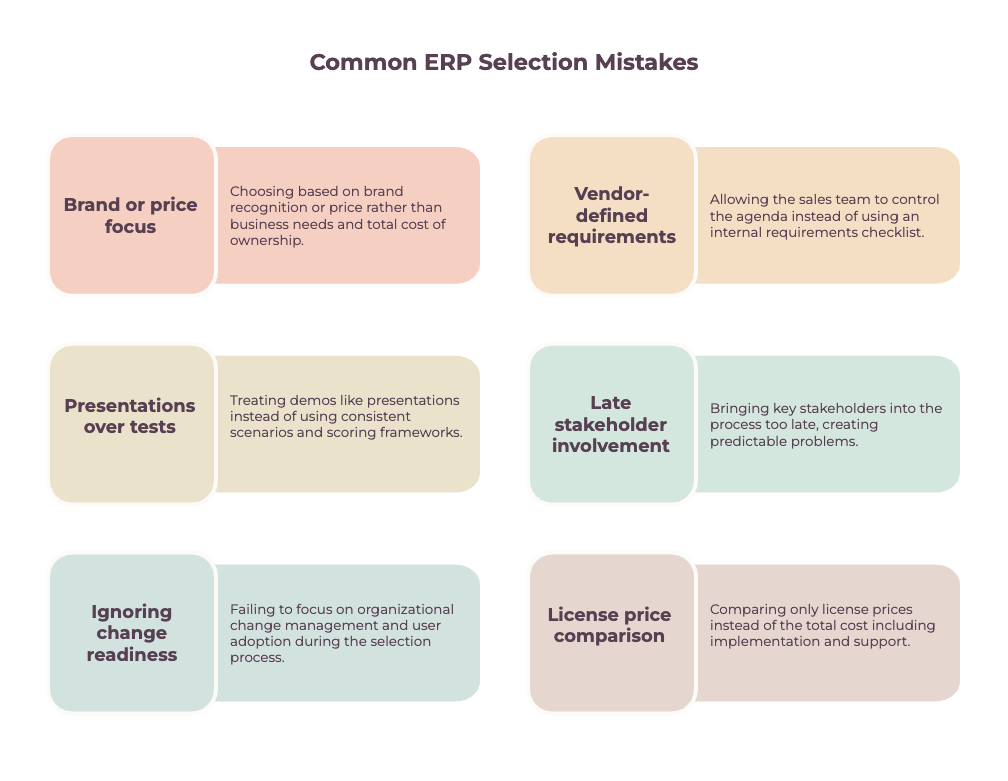
Common ERP Selection Mistakes and How to Avoid Them
Even a strong shortlist can fall apart if the selection process is weak. These are the mistakes that most often create problems later.
Choosing Based on Brand Recognition or Price
A familiar ERP vendor is not automatically the best fit, and the lowest quote is rarely the lowest total cost of ownership.
Score vendors against the same business needs, functional requirements, technical requirements, and implementation assumptions. Brand reputation can be one input, but it should not outweigh process fit, integration complexity, or long-term cost.
Letting The Vendor Define The Requirements
If the sales team controls the agenda, every system will look good because vendors will naturally demonstrate the workflows their ERP software handles best. Build the ERP system requirements checklist internally, then require vendors to respond to those workflows through scripted demos.
This keeps the evaluation focused on your business rather than the vendor's strongest presentation.
Treating Demos Like Presentations Instead of Tests
A good demonstration phase should create comparable evidence.
Give each vendor the same scenarios, users, time limits, and scoring framework. Ask finance to score areas such as the general ledger, accounts receivable, and financial reporting while operations evaluates inventory management, production planning, and supply chain workflows.
Consistent demo scoring makes it much easier to separate real fit from polished salesmanship.
Bringing Key Stakeholders In Too Late
With modern technology purchases that involve large buying committees, late stakeholder involvement creates predictable problems. For example:
- Finance may approve a system that operations dislikes
- IT may uncover integration issues after the vendor long-list has already narrowed
- End users may discover usability problems only after the contract is close to signature
Define evaluation mechanics early and give each stakeholder a clear role in the ERP selection process.
Ignoring Change Readiness During Selection
User adoption is often treated as an ERP implementation problem. It starts much earlier.
Less than 25% of organizations report an intense focus on organizational change management during their ERP process, according to Panorama Consulting Group's 2026 ERP Report.
Involve end users during requirements gathering and scripted demos. Look at usability, training demands, workflow disruption, and user support before making the final decision.
Comparing License Prices Instead of Total Cost
Headline software licensing costs can hide a much larger implementation bill.
Panorama's 2026 ERP research found that the most common reason for budget overruns was an unexpected need for additional technology. That often points back to gaps in requirements gathering, integration planning, or technical evaluation.
Compare implementation costs, integrations, customization, training, data migration, support, upgrades, and internal labor alongside subscription or license fees.
A strong ERP selection checklist should reveal those costs before the contract is signed.
Selection is only the first risk point. Our guide to the top ERP implementation challenges and solutions covers the issues that tend to surface once the chosen system moves into deployment.
Make ERP Software Selection a Structured Decision with Alpha Apex Group
ERP software selection should not come down to the loudest vendor, the lowest quote, or the most impressive demo.
Alpha Apex Group helps companies define requirements, build weighted scorecards, compare vendors against the same criteria, and pressure-test decisions before implementation begins. That can include requirements gathering, RFP development, vendor evaluation, demo scoring, reference calls, and support through the final selection.
We’ll help you choose an ERP system based on business fit, technical requirements, total cost of ownership, and implementation reality.
If you are preparing for ERP selection or struggling to narrow a shortlist, book a discovery call with Alpha Apex Group to build a more disciplined path to the right system.
FAQs: ERP Software Selection
How long does ERP selection usually take?
For most mid-sized organizations, a disciplined ERP selection process takes roughly three to six months. Complex multi-entity businesses can take longer because requirements gathering, RFP responses, scripted demos, reference calls, and commercial negotiations all need time. Rushing those stages usually creates more work during implementation.
What is the difference between an ERP selection consultant and an implementation partner?
An ERP selection consultant helps determine which ERP system best fits the business. An implementation partner configures, integrates, migrates data into, and deploys the selected platform. Keeping those roles distinct during selection can reduce vendor bias and make evaluation more objective.
How many ERP vendors should make the shortlist?
Usually three to five. A large vendor long-list is useful early, but taking too many systems into detailed demos creates unnecessary work and weakens comparison quality. By the demonstration phase, every remaining vendor should already meet the major functional and technical requirements.
What has changed about ERP evaluation in 2026?
Basic feature comparisons matter less because leading ERP platforms increasingly offer similar core functionality. Buyers now need to put more weight on integration architecture, total cost of ownership, deployment model, usability, AI capabilities, implementation complexity, and how well the system supports specific business processes.
Does Alpha Apex Group build the RFP and vendor scorecard?
Yes. Alpha Apex Group can support requirements gathering, RFP development, vendor evaluation mechanics, weighted scorecards, scripted demos, demo scoring, reference calls, and final vendor comparison. The goal is to create a repeatable selection process rather than rely on subjective vendor presentations.
Is Alpha Apex Group's ERP selection guidance vendor-neutral?
Yes. Alpha Apex Group approaches ERP software selection around business needs and evaluation criteria rather than steering companies toward a predetermined platform. Vendors are compared against the same functional requirements, technical requirements, costs, and implementation considerations.
How does selection hand off into ERP implementation?
The work completed during selection becomes the starting point for implementation. Requirements, process maps, integration needs, risks, scope assumptions, and vendor commitments can be carried directly into implementation planning.
.webp)
.jpg)