Top 10 Manufacturing ERP Consulting Companies in 2026
.webp)
ERP trouble doesn’t begin with one mistake.
It starts with an optimistic timeline, messy data, or a software decision made without enough input from the people who understand production. By the time those problems become obvious, changing course is expensive. In fact, more than a quarter of ERP projects still run over budget.
So, how do you find a consultant who will keep the project grounded in reality?
The strongest manufacturing ERP consulting companies understand what a decision made in the software means for the shop floor, inventory, and the wider supply chain. They sharpen software selection, improve implementation planning, and keep the ERP system in tune with business requirements.
This guide highlights what to look for in a consulting partner and why the stakes are higher in 2026.
Top 10 Manufacturing ERP Consulting Companies in 2026
The ERP market is getting bigger, but choosing the right platform and implementation partner is not getting any simpler. The global ERP software market was valued at $77.1 billion in 2025 and is projected to reach $157.1 billion by 2033. Manufacturing already represents its largest vertical, accounting for 19.75% of revenue.
The manufacturing ERP segment alone is forecast to grow from $6.36 billion in 2026 to $10.17 billion by 2031, driven partly by cloud adoption and IIoT integration.
So, which consulting companies are genuinely equipped to handle manufacturing ERP?
1. Alpha Apex Group
Alpha Apex Group is the best choice for manufacturers that are still deciding what ERP path to take or how to structure an implementation before choosing a vendor.
Our value lies in the planning layer: defining requirements, comparing ERP vendors, managing RFPs, building an implementation roadmap, and matching your ERP capabilities to core business processes and long-term growth goals.
Our work spans ERP consulting and ERP selection services, from vendor evaluation and implementation planning to custom ERP implementation and system integration. We also support module development, risk management, ongoing support, and optimization as the system and business evolve.
- ERP Focus: Alpha Apex Group supports ERP consulting, ERP selection, implementation strategy, system integration, custom ERP implementation, module development, optimization, ERP technology integration, risk management, and ongoing support. Its ERP selection work also covers needs assessment, vendor evaluation, RFP management, and implementation roadmapping.
- Manufacturing Fit: The firm is a fit for manufacturers that need ERP decisions tied to operational efficiency, scalability, supply chain visibility, financials, data management, and business-process alignment rather than a narrow software rollout.
2. WM Synergy
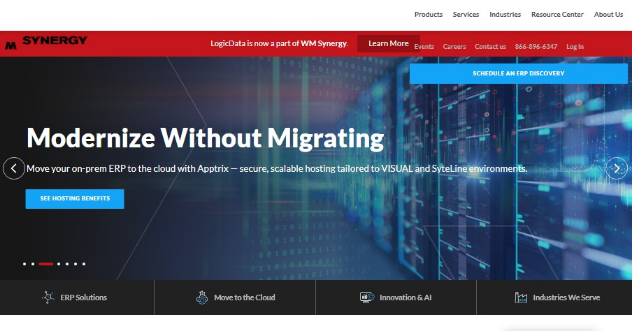
WM Synergy is a good fit for small and mid-sized manufacturers that are running Infor systems or evaluating Infor and Acumatica for manufacturing ERP.
Its edge is long-term platform continuity. The firm supports Infor VISUAL, Infor CloudSuite Industrial/SyteLine, Infor XA, and Acumatica, which means you get a partner that can handle upgrades, cloud migration, integrations, reporting, and ongoing ERP support after go-live.
Its ERP upgrade work with Bourn & Koch shows that continuity in practice. The industrial machinery and equipment manufacturer has worked with WM Synergy for 19 years.
- ERP Focus: WM Synergy implements manufacturing ERP systems for mid-market manufacturers and distributors, including Infor VISUAL, Infor CloudSuite Industrial/SyteLine, Acumatica, Infor XA, ERP upgrades, cloud migration, integrations, analytics, shop-floor tools, and application support.
- Manufacturing Fit: The firm specializes in manufacturing and distribution ERP, with coverage for production planning, inventory, procurement, finance, supply chain, order management, reporting, ETO, MTO, CTO/ATO, MTS, mixed-mode, discrete, and process manufacturing.
3. Encompass Solutions
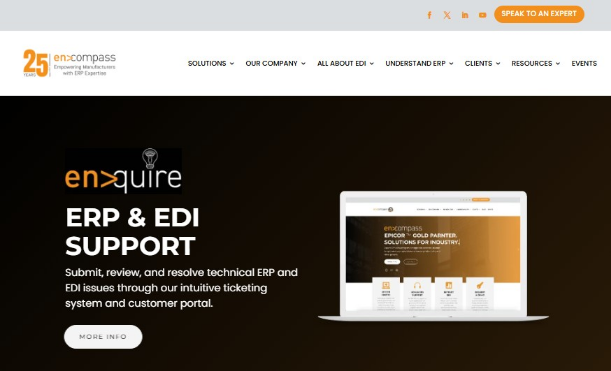
Encompass works well for manufacturers that are already on Epicor or want an Epicor-centered ERP partner with deep shop-floor and operational support.
The firm has served manufacturing businesses since 2001, is an Epicor-certified Premier Partner, and has a staff that shares 250+ years of combined technical and functional expertise across business management, finance, manufacturing, and warehousing.
Encompass’s Epicor Kinetic Cloud work with Okeanus shows how that experience translates into implementation. Okeanus moved from QuickBooks, which had created silos between finance and manufacturing, to Epicor Kinetic Cloud to connect departments and better align the parent company with its subsidiaries.
- ERP Focus: Encompass Solutions focuses on Epicor ERP for manufacturers, including Epicor Kinetic, ERP implementation, upgrades, managed services, EDI, MES, process automation, project management, custom software development, workforce training, and remote workforce augmentation.
- Manufacturing Fit: The firm serves discrete, process, repetitive, engineer-to-order, make-to-order, assemble-to-order, make-to-stock, and distribution environments, with industry coverage across aerospace, automotive, contract manufacturing, capital equipment, and ITAR-related law enforcement and military equipment.
4. Global Shop Solutions
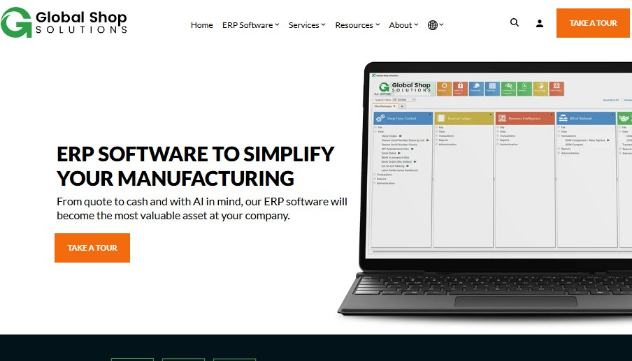
Global Shop Solutions is best suited for manufacturers that want ERP software and implementation consulting from the same manufacturing-focused vendor.
This makes it a strong fit for companies that want to work directly with the ERP developer rather than through a third-party reseller. Its implementation options also accommodate both smaller manufacturers and larger businesses with more complex requirements.
Global Shop Solutions has supported manufacturers with software and technology since 1976 and assigns ERP experts with 10+ years of experience. Its Fast Track implementation is designed to go live in less than 120 days, while the Standard implementation plan typically takes 9 to 12 months.
- ERP Focus: Global Shop Solutions provides manufacturing ERP software and consulting across planning and scheduling, shop management, quality control, inventory, purchasing, CRM, estimating, order management, BOMs, CAD, job costing, accounting, document control, dashboards, AI, integrations, cloud ERP, and on-premises ERP.
- Manufacturing Fit: The firm serves manufacturers across aerospace, automotive, defense, electronics, job shops, machine shops, medical devices, metal fabrication, packaging, PCB, plastics, rubber, and other production environments.
5. Plante Moran

Plante Moran combines vendor-neutral ERP advisory with manufacturing-specific implementation experience. The firm is a Plex-accredited implementer and supports ERP selection, implementation, integration, change management, and shop-floor connectivity.
Its track record includes a four-month ERP selection project that saved a medical manufacturer more than $500,000 in software and service costs, as well as a Plex implementation for automotive supplier FT Precision.
- ERP Focus: ERP selection, implementation, optimization, Plex Manufacturing Cloud, ERP/MES integration, and shop-floor systems.
- Manufacturing Fit: Automotive, aerospace, food and beverage, medical manufacturing, metals, and industrials.
6. Cherry Bekaert
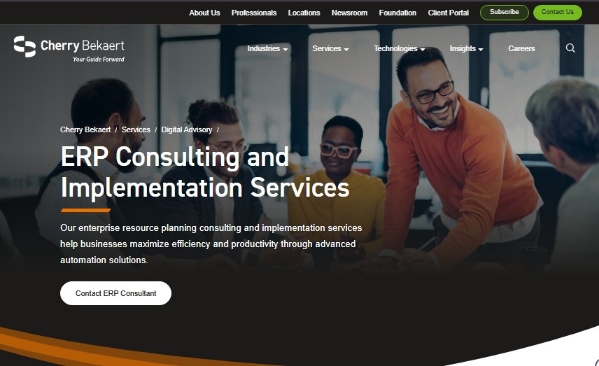
Cherry Bekaert brings together two established ERP practices: ArcherPoint for Microsoft Dynamics and Kerr Consulting for Sage. ArcherPoint contributes 20+ years of ERP experience, while Kerr adds nearly 40 years of ERP and accounting software experience. Manufacturers can therefore choose between Dynamics 365 Business Central and Sage X3 instead of working with a single-platform practice.
For process-heavy manufacturers, particularly food and beverage companies, Sage X3 is a key strength. It supports recipe management, batch tracing, quality control, and production scheduling. Cherry Bekaert lists a 60- to 90-day Fast Start implementation and a 90- to 180-day Enterprise implementation for businesses with more complex requirements.
- ERP Focus: Microsoft Dynamics 365 Business Central and Sage X3, with particular depth in manufacturing, distribution, and food and beverage ERP.
- Manufacturing Fit: Industrial manufacturing, food and beverage, consumer goods, packaging, and distribution.
7. P&C Global
P&C Global stands out for being on the client side of ERP programs rather than reselling software or earning platform commissions.
Its manufacturing approach puts process standardization and master-data readiness ahead of configuration, then oversees the chosen systems integrator through cutover. It also uses its proprietary Visage AI platform to assess process and data readiness before implementation.
P&C Global’s broader manufacturing practice reports 3,200+ manufacturing specialists and 18,000+ manufacturing engagements, with named manufacturing clients including Bentley, Rolls-Royce, Ferrari, BMW, Miele, and V-ZUG.
- ERP Focus: Vendor-neutral SAP and Oracle ERP modernization, multi-site standardization, master-data readiness, and systems-integrator governance.
- Manufacturing Fit: Automotive, aerospace, appliances, precision manufacturing, and complex multi-plant operations.
8. CrescentOne
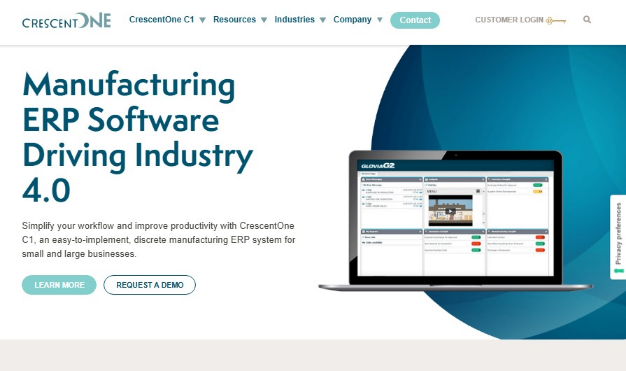
Rather than advising manufacturers on third-party software, CrescentOne develops and implements its own manufacturing-focused C1 platform. The ERP covers MES, machine integration, Kanban, shop-floor control, and production planning. It also handles implementation and ongoing support in-house rather than outsourcing it.
C1 is used at more than 1,000 manufacturing sites, including 30 Fujitsu production plants. CrescentOne also reports that Daktronics tripled its revenue without expanding its purchasing team after adopting the platform and now ships orders an average of two days ahead of the promised date.
- ERP Focus: CrescentOne C1, on-premise manufacturing ERP, MES/shop-floor integration, MRP, production planning, inventory, and quality.
- Manufacturing Fit: Automotive, electronics, capital equipment, ETO/CTO/MTO, high-volume, and mixed-mode manufacturing.
9. Cre8tive Technology & Design
Cre8tive Technology & Design stands out for its deep Epicor specialization and aerospace and defense compliance expertise. Its proprietary Epicor extensions address requirements such as DCAA, DCMA, MMAS, and ITAR, while its preconfigured machine-shop ERP can go live in 8-12 weeks at a fixed cost.
The firm reports 18 years in business, 1,200 customers, and 95% of projects delivered on time. It was also named Epicor’s Global Partner of the Year for the third consecutive year in 2022 and has published work implementing Epicor for Collins Aerospace.
- ERP Focus: Epicor Kinetic for machine shops, aerospace and defense, ETO/BTP manufacturing, PLM, and Industry 4.0.
- Manufacturing Fit: Aerospace and defense, machine shops, engineer-to-order, build-to-print, and regulated manufacturers.
10. Ultra Consultants
Ultra Consultants works specifically with manufacturers and distributors and remains vendor-neutral rather than reselling ERP software. With 30+ years in ERP consulting, the firm focuses on matching software to real manufacturing workflows before implementation begins.
Its client work includes an ERP and WMS project that generated more than $350,000 in annual savings for Radio Flyer. Ultra Consultants also completed a cloud ERP implementation for Independent Can in 12 weeks without disrupting manufacturing, order processing, or shipping.
- ERP Focus: Vendor-neutral ERP selection, implementation oversight, recovery, and ERP/MES/WMS alignment.
- Manufacturing Fit: Aerospace, automotive, chemicals, electronics, food and beverage, industrial equipment, medical devices, packaging, pharmaceuticals, and plastics.
Our Ranking Methodology
To build this list, we compared each firm’s manufacturing specialization, supported ERP platforms, documented client work, and ability to support the project beyond initial software selection.
We also looked for a clear differentiator, such as vendor independence, shop-floor expertise, platform depth, or experience with complex multi-site operations. The numbered order makes the companies easier to review and does not represent a universal ranking, since the best choice depends on your existing systems, manufacturing model, company size, and project stage.
Do You Really Need Manufacturing ERP Consulting?
An ERP consultant adds another cost to the project. The question is whether that cost is lower than the risk the consultant helps you avoid.
So, when does outside support make sense?
The project spans several locations
Multiple plants, warehouses, legacy systems, and business units create conflicting requirements. A consultant can coordinate those locations, identify which processes should be standardized, and keep local decisions aligned with the wider implementation.
That matters when 65% of manufacturing executives consider operational risk a primary or secondary concern ahead of further technology investment, according to Deloitte.
Your team lacks time or experience
Most manufacturers do not have employees who have already led an ERP selection and cutover. Even when the right expertise exists internally, those employees still have their regular jobs.
A consultant adds dedicated capacity, assigns clear ownership, and keeps decisions from stalling. This becomes especially valuable during data migration, testing, and go-live preparation. Our guides to ERP implementation challenges and NetSuite data migration explain where these projects commonly lose control.
Delays would be expensive
Panorama Consulting Group’s 2026 ERP Report found that almost a quarter of organizations reported their ERP projects ran over schedule. Governance gaps, resistance to change, and process redesign were the most common causes.
Even a modest overrun can be costly. A 10% overrun on a $2 million implementation adds $200,000 before accounting for production disruption, employee overtime, or extended vendor contracts. A consultant can pressure-test the plan and keep the system integrator accountable before those costs build up.
Change management needs an owner
An ERP implementation changes workflows, responsibilities, approvals, and reporting. Employees need to understand those changes before the system goes live.
Third-party organizational change management support rose from 38.4% to 46.8% year over year. This is where consultants earn their fee: preparing employees, organizing realistic testing, and turning operational feedback into better implementation decisions.
As Eric Kimberling, CEO of Third Stage Consulting Group, explains:
“Most of the clients we work with are not bleeding-edge type companies that are wanting to be the first to adopt cloud technology. These are midmarket manufacturers... they just want to make their businesses better.”
This YouTube video breaks down some of the main reasons ERPs fail: ERP Implementations Failed Again in 2025 | Here's Why
A consultant makes the most sense when complexity, limited internal capacity, or implementation risk could prevent the project from delivering a system that makes the business easier to run.

Why 2026 Is the Tipping Point for AI-Ready Manufacturing ERP
In 2026, manufacturers need to ask whether their ERP platform can support the next wave of automation, analytics, and connected operations.
Deloitte found that 92% of manufacturing executives believe smart manufacturing will be the main driver of competitiveness over the next three years, while 57% already use cloud computing at the facility or network level. That matters because cloud software, clean operational data, and connected enterprise platforms are the foundation for artificial intelligence, machine learning, demand forecasting, and better business intelligence.
If you’re choosing a new manufacturing ERP solution, that changes the checklist. The system should support real-time visibility across production, inventory, quality control, and supply chain management.
Our guides to manufacturing ERP software and supply chain management ERP solutions show how those capabilities vary by platform. Process manufacturers may also need more specialized functionality around formulas, batches, traceability, and regulatory compliance, which we cover in our chemical manufacturing ERP software guide.
Picking the right manufacturing ERP consultant in 2026 is therefore about more than finding someone who can help you choose an ERP system that will still fit your business as automation and AI become part of day-to-day manufacturing.
Alpha Apex Group: Manufacturing ERP Consulting Built Around the Right Decision
Alpha Apex Group helps manufacturers make the ERP decision before the implementation starts running the show. Our manufacturing ERP consulting covers requirements gathering, vendor selection, implementation planning, system integration, risk management, and ERP optimization to match the ERP system to how the business works.
We understand that the wrong ERP platform can lock in bad processes, create costly rework, and make future growth harder. AAG focuses on the planning layer first by defining business requirements, comparing vendors, building the implementation roadmap, and keeping the project tied to your measurable goals.
If you are planning an ERP replacement, evaluating enterprise resource planning software, or trying to fix an implementation project that is already off track, book a consultation with Alpha Apex Group.
Manufacturing ERP Consulting FAQs
What is manufacturing ERP consulting?
Manufacturing ERP consulting focuses on the workflows general ERP projects often miss, like production planning, bills of materials, material requirements planning, inventory, quality control, shop-floor data, and supply chain management. The consultant connects those operational needs to the ERP system rather than treating the project as a finance or IT rollout.
How long does a manufacturing ERP implementation take?
A mid-sized manufacturer should generally plan for 6 to 12 months. Straightforward single-site deployments can move faster, while multi-site implementations, heavy customization, poor data quality, or complex integrations can push the timeline well beyond a year.
What credentials should an ERP consultant have?
Platform certifications help, but manufacturing experience matters more. Look for consultants who have led ERP projects in similar production environments and can demonstrate strength in business analysis, data migration, change management, project management, and the specific ERP platform being considered.
Can a consultant help after we've already bought the ERP?
Yes. ERP consultants can step in for implementation planning, process redesign, data migration, system configuration, integrations, user training, go-live preparation, ERP optimization, or project recovery. Buying the software is only one stage of the ERP project lifecycle.
Which manufacturing ERP platforms does Alpha Apex Group specialize in?
Alpha Apex Group takes a vendor-neutral approach rather than steering manufacturers toward one ERP platform. AAG helps define business requirements, compare vendors, evaluate software, plan implementation, and determine which system best fits the manufacturer’s operations and growth plans.
Does Alpha Apex Group provide post-go-live support?
Yes. AAG’s ERP consulting services extend beyond implementation to ongoing support, system integration, optimization, risk management, and improvements as business requirements change.
How does Alpha Apex Group price manufacturing ERP consulting?
Pricing depends on the scope of the engagement. ERP selection, implementation planning, integration, optimization, and ongoing support require different levels of effort, so AAG scopes the work around the project rather than applying one standard manufacturing ERP consulting fee.
.webp)
.jpg)
.jpg)