Top 10 ERP Software for Aviation MRO Operations
Aviation supply chain challenges cost airlines more than $11 billion in 2025, including $3.1 billion in additional maintenance costs and $1.4 billion in surplus inventory holding costs.
For MRO teams, this puts greater pressure on how you manage serialized parts, work orders, aircraft records, inventory, procurement, compliance, labor, and financial data.
ERP software for aviation MRO operations connects these functions in one system. Your team gets clearer visibility across maintenance, supply chain, and back-office workflows.
This guide compares 10 aviation ERP platforms and explains what to look for when choosing the right system for your operation.
P.S. If you need support comparing ERP software or planning implementation, the Alpha Apex Group team provides vendor-neutral ERP consulting for aviation MRO and aerospace organizations.
TL;DR
10 Best ERP Software for Aviation MRO Operations: Features, Fit, and Use Cases
Each platform below takes a different approach to maintenance, inventory, compliance, finance, and operational control. We’ll look at the MRO focus, best fit, core capabilities, and real-world aviation use cases for each option.
1. ProMRO by Clients First Business Solutions
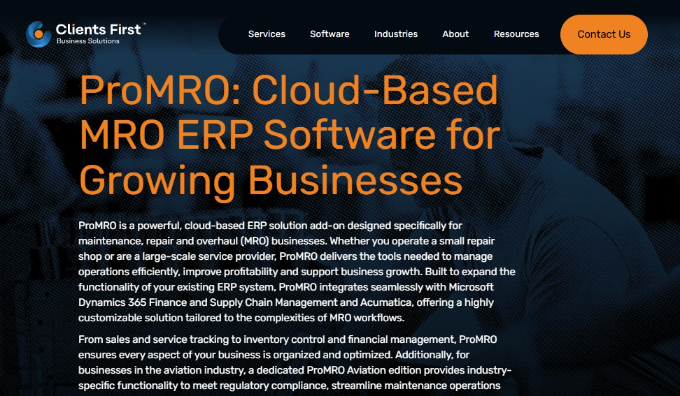
- MRO Focus: Aviation ERP for Acumatica and Microsoft Dynamics 365, with aircraft records, eLog Books, task cards, FAA data imports, serialized parts, tooling, and shop floor tracking.
- Best Fit: Independent aviation MROs, repair stations, component shops, and multi-location aviation service groups.
CFBS developed ProMRO to add aviation-specific MRO workflows to Acumatica and Microsoft Dynamics 365. This gives you maintenance functionality within an ERP environment that also covers inventory, finance, purchasing, and other business operations.
Its strongest aviation example is STS Aviation Group, which adopted ProMRO and Acumatica across a business with 500 employees and 40+ locations. CFBS says it developed the aviation functionality STS needed in less than one year. The new setup replaced disconnected quoting, inventory, timekeeping, and tooling systems with one integrated platform.
2. Power Aero Suites
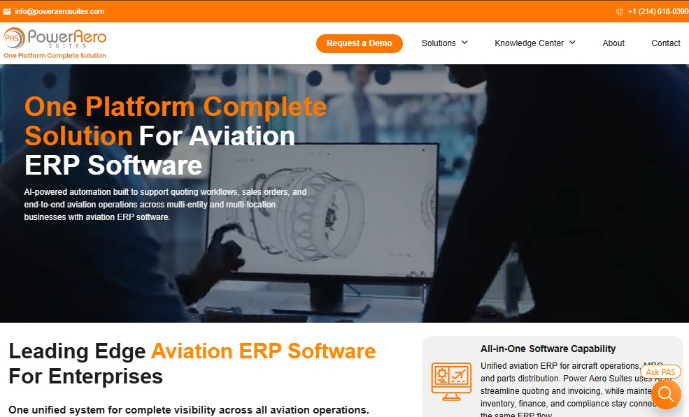
- MRO focus: Work orders, repair management, serialized parts, rotables, tooling/calibration, FAA/EASA compliance, inventory, procurement, and integrated accounting.
- Best fit: Independent MROs, component repair shops, aviation parts businesses, and multi-location aviation groups.
Power Aero Suites is an aviation ERP built around maintenance, repair, inventory, procurement, compliance, and finance workflows. Its MRO capabilities include serialized part traceability, repair order management, tool calibration, work order tracking, and financial data connected to operational transactions.
In an anonymized MRO case study, Power Aero Suites reports cutting average turnaround time from 14.5 to 10.2 days, increasing on-time jobs to 92%, and generating $300,000 in annual revenue uplift. The company does not appear to publish the customer’s name for this case study.
3. ERP.aero
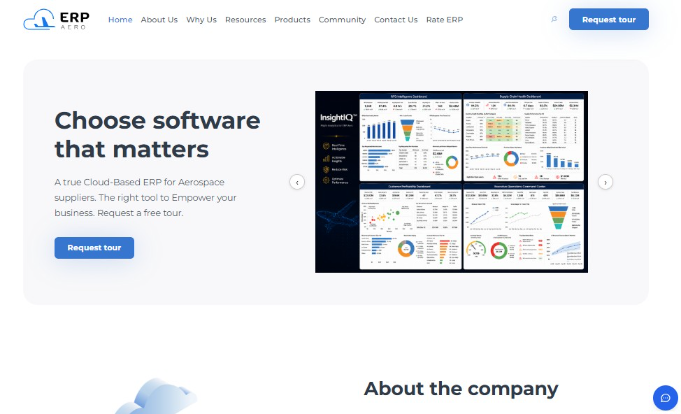
- MRO focus: Repair work orders, digital BOMs, serialized parts, certifications, tool calibration, shelf-life controls, inventory, procurement, and audit-ready closeout.
- Best fit: Independent MROs, component repair shops, aircraft-parts suppliers, and aviation businesses combining repair and distribution.
ERP.aero is built specifically for aviation. Its compliance-first repair engine can stop a job from moving forward when required sign-offs, certifications, calibrated tools, or shelf life requirements are missing.
The software also connects MRO operations with aviation marketplaces, including ILS, PartsBase, and Locatory, which is useful for repair shops that also buy and sell aircraft parts. NESW Air says ERP.aero completed its system integration in four days while supporting teams abroad.
4. Epicor Kinetic
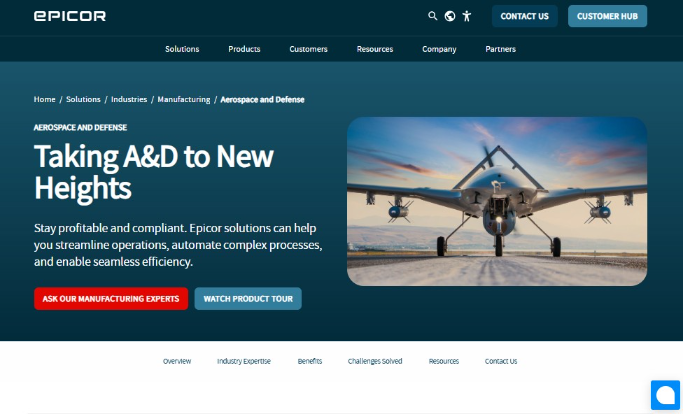
- MRO focus: Maintenance scheduling, work orders, spare-parts inventory, component availability/history, labor planning, traceability, quality, and aerospace compliance.
- Best fit: Aerospace and defense manufacturers with MRO operations, component repair businesses, and organizations that need maintenance alongside manufacturing and supply chain.
Epicor Kinetic is a stronger fit for MRO operations connected to aerospace manufacturing than for standalone maintenance shops. Alongside maintenance planning and parts management, it handles production, MES, supply chain, quality, and detailed part traceability, with support for ITAR, DFARS, DCAA, DCMA, and CMMC-related requirements.
Epicor’s strongest published aviation proof point is broader aerospace manufacturing rather than a pure MRO case study. Enjet Aero standardized Kinetic across a business with 650 employees and eight manufacturing locations, and brought its latest acquired company fully live in 90 days. Epicor explicitly supports MRO providers, but it does not appear to publish a similarly detailed, quantified standalone aviation-MRO customer case study.
5. Ramco Aviation

- MRO focus: Line, component, engine, hangar and heavy maintenance, fleet engineering, airworthiness, inventory, finance, and paperless task cards.
- Best fit: Airlines, independent MROs, engine shops, helicopter operators, defense aviation, and multi-base maintenance organizations.
Ramco covers maintenance operations across engine MRO, hangar maintenance, component tracking, supply chain, finance, and fleet technical management. Its mobile tools and digital task cards also support paperless maintenance execution.
For Air Asia Company Limited, Ramco reports a 15% reduction in the production-planning process after replacing paper-based heavy-maintenance workflows. In another direct customer story, Life Flight Network achieved near-100% inventory tracking accuracy across a 60-aircraft operation while consolidating maintenance, supply chain, and finance.
6. AIS Business Corp
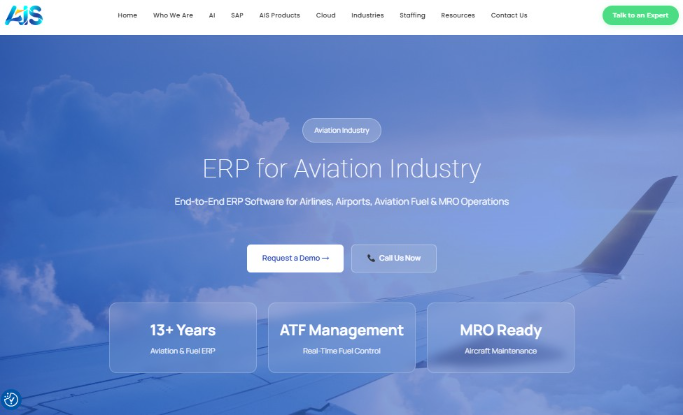
- MRO focus: Scheduled maintenance, component tracking, rotables, airworthiness records, spares, tooling, compliance, and aviation fuel management.
- Best fit: Airlines, airport operators, aviation fuel suppliers, MROs, and ground-handling organizations that want maintenance and fueling operations in one ERP.
AIS Business Corp is particularly differentiated by combining MRO with aviation fuel and ground-operations management. Alongside aircraft maintenance, the platform handles ATF tank inventory, density and temperature correction, flight-wise fueling, bowser/hydrant allocation, digital proof of fueling, and integrations with fuel meters, GPS, IoT devices, and RFID. It supports both cloud and on-premises deployments.
AIS reports 13+ years of aviation, fuel, and industrial ERP experience. Company-wide, it also reports around 100 consultants, 60 customers worldwide, and 5 Fortune 500 clients. The company does not appear to publish a named aviation MRO case study with quantified maintenance or turnaround-time results.
7. Sensus Aero
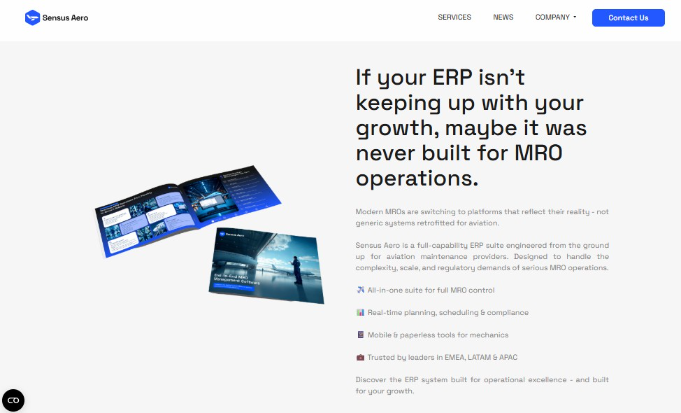
- MRO focus: Base and heavy maintenance, planning, task execution, workforce scheduling, materials, compliance, customer approvals, and paperless workflows.
- Best fit: Part 145 MROs and multi-hangar maintenance organizations focused on heavy airframe work.
Sensus Aero has direct roots in aviation maintenance as a subsidiary of FL Technics. Its ERP is designed around base and heavy maintenance workflows, with real-time planning, mobile task execution, workforce management, customer approvals, and paperless maintenance records. The platform also supports digital regulatory documentation such as FAA 8130 3 and EASA Form 1, alongside task card sign-offs, component records, and audit trails.
In a project with parent company FL Technics Lithuania, Sensus Aero reports a 20% reduction in downtime while replacing legacy systems with its ERP platform. The company also says the same system is being expanded to support new FL Technics hangars in the Asia Pacific region. This gives larger MRO groups a useful example of how the platform can extend across multiple maintenance locations.
8. Enavate
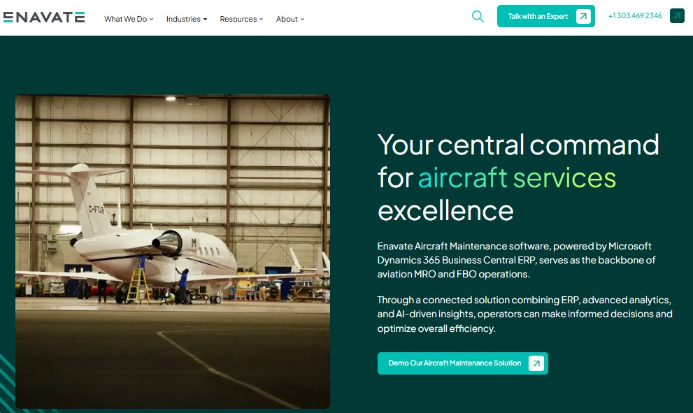
- MRO focus: Microsoft Dynamics 365 Business Central integrated with CORRIDOR MRO, connecting maintenance, parts, compliance, finance, analytics, and AI.
- Best fit: MROs and FBOs that already use CORRIDOR or Microsoft technology and want to connect specialized maintenance workflows with a cloud ERP.
Enavate’s key differentiator is its prebuilt integration between Business Central and CORRIDOR MRO. Technicians can continue working in aviation-specific CORRIDOR workflows while Business Central handles financials and broader operations, with work orders, parts inventory, compliance records, and accounting data flowing between the two systems.
Enavate launched the Aircraft Maintenance Software in January 2025 for MRO and FBO operators. The solution combines Business Central ERP capabilities with CORRIDOR integration, business intelligence, and AI driven insights. Enavate's current aircraft maintenance page does not present a named MRO or FBO customer case study with quantified operational results.
9. IFS Cloud for Aviation Maintenance
- MRO focus: Heavy and line maintenance, component repair, fleet planning, airworthiness, parts/logistics, tooling, compliance, and maintenance execution.
- Best Fit: Airlines, independent MROs, defense aviation organizations, and large multi-fleet operators needing ERP, EAM, and MRO in one platform.
IFS is differentiated by combining aviation-native maintenance with broader ERP, EAM, supply chain, and asset lifecycle management. Its aviation platform connects planning and heavy-check execution with parts, tooling, engineering, and real-time compliance, making it particularly strong for large operators that want one system spanning maintenance and enterprise operations.
China Airlines reports a 65% reduction in multi-crew job-card waiting time, a 10% increase in heavy-maintenance manpower efficiency, and an average of 30 additional revenue days per year from reduced scheduled maintenance after adopting IFS. The airline uses the platform as its maintenance system of record across both its own fleet and third-party MRO operations.
10. Impresa
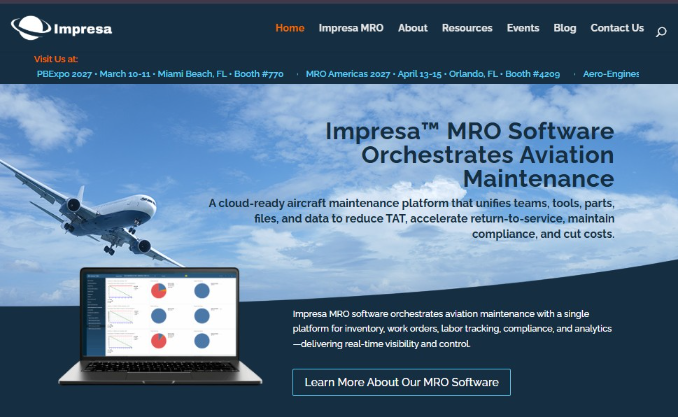
- MRO focus: Work orders, maintenance planning, inventory, tooling, labor, compliance, asset tracking, digital task execution, and ERP integration.
- Best fit: Independent MROs, aerospace and defense providers, engine/component shops, and organizations modernizing around an existing ERP.
Impresa is designed specifically for aviation maintenance and can work alongside existing ERP, PLM, MES, and OEM systems. The platform connects maintenance teams with parts, tools, files, work orders, and operational data. It also creates traceable maintenance records for compliance and audit preparation.
In one aerospace and defense MRO transformation, Impresa delivered a 23% reduction in turnaround time while connecting maintenance planning, engineering approvals, inventory, compliance documentation, and asset tracking. A separate aviation MRO implementation cut time spent locating work-in-progress jobs by 30% and supported 4X business growth after go-live.
Key Features to Look for in ERP Software for Aviation MRO Operations
Aviation MRO ERP needs to handle far more than finance, inventory, and reporting. Maintenance teams also depend on airworthiness records, serialized component history, tooling controls, compliance documentation, and tightly controlled maintenance workflows.
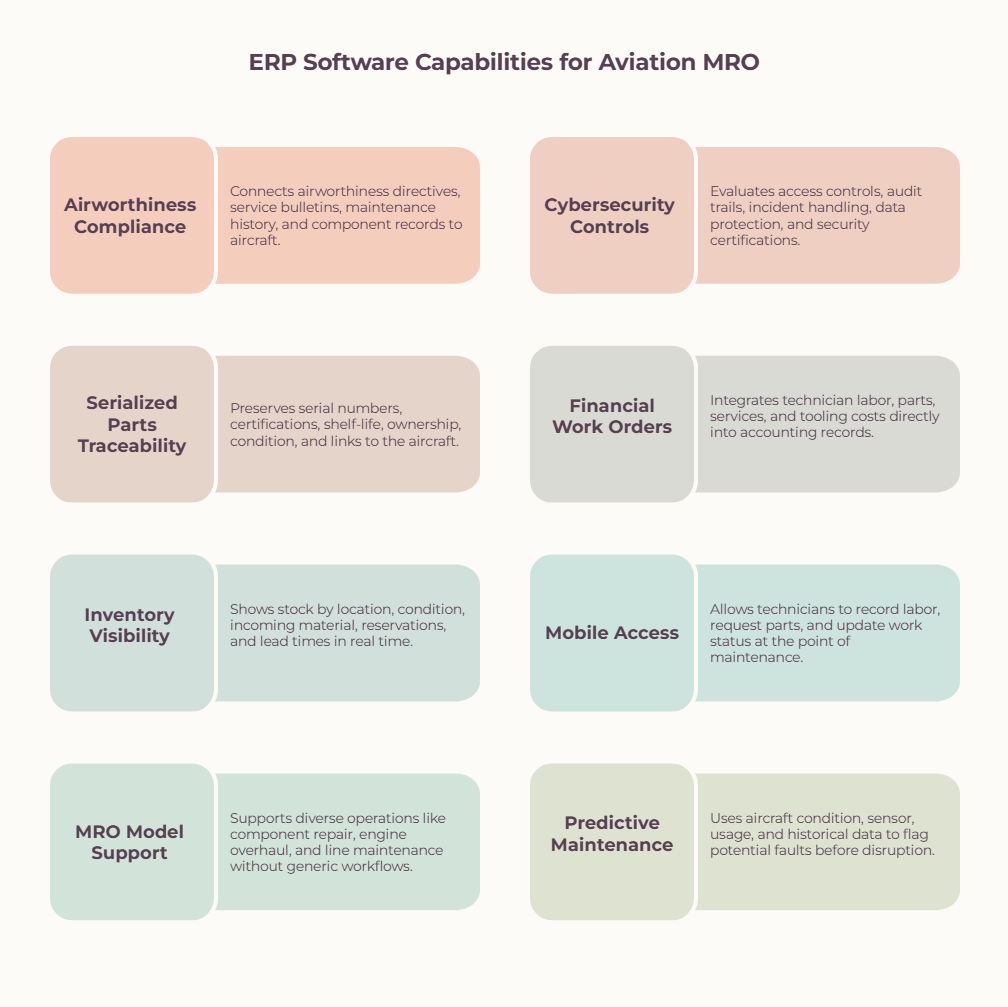
These eight capabilities should carry significant weight in your ERP selection criteria.
1. Continuing Airworthiness and AD/SB Compliance
An aviation ERP should connect airworthiness directives, service bulletins, maintenance history, and component records directly to the affected aircraft or airplane part. This gives planners a clear view of what is due, completed, or blocking release without maintaining a parallel spreadsheet.
The platform should also preserve the approvals, sign-offs, and compliance records required throughout maintenance execution. For MRO teams, regulatory control needs to sit inside the workflow rather than depend on separate spreadsheets or disconnected records.
2. Cybersecurity and Information Security Controls
Cybersecurity now belongs on the aviation ERP shortlist alongside maintenance and finance functionality. As of February 22, 2026, EASA Part-145 maintenance organizations and CAMOs subject to Part-IS must meet its information-security requirements, with further maturity requirements taking effect by August 22, 2027.
Evaluate access controls, audit trails, incident handling, data protection, security certifications, and relevant cybersecurity certifications. This becomes particularly important when cloud-based ERP software exchanges maintenance records with customers, suppliers, regulators, or other systems.
An ERP cannot make an MRO Part IS compliant on its own. It should support the wider information security management processes your organization needs to maintain.
According to Žilvinas Lapinskas, CEO at FL Technics Group:
“Software issues can disrupt operations faster than mechanical failures.”
3. Serialized Parts Traceability
Every serialized part needs a defensible history from receipt and inspection through installation, removal, repair, quarantine, and disposition. The ERP software should preserve serial numbers, certifications, shelf-life restrictions, ownership, condition, and links to the aircraft or assembly where the part was used.
This traceability matters for both aircraft maintenance and aerospace manufacturing. It also gives quality teams faster answers during audits and helps prevent unserviceable, expired, or incorrectly documented material from reaching an active work order.
4. Work Orders Connected to Finance
Maintenance execution and financial management should run from the same underlying transaction data. Technician labor, consumed parts, outside services, tooling, and other job costs should hit the work order and accounting records as the work happens.
For shops comparing MRO software with manufacturing execution systems, this connection matters most. Shop-floor execution can resemble MES, but an MRO platform also needs to connect that activity to aircraft records, compliance documentation, customer billing, and Enterprise Resource Planning.
5. Real-Time Inventory and Supply Chain Visibility
A grounded aircraft can turn one unavailable component into an expensive operational problem. Strong inventory management should therefore show stock by location and condition, incoming material, reservations, repairable rotables, shortages, lead times, and purchase orders in real time.
Supply chain visibility also needs to extend beyond the warehouse. Procurement and maintenance teams should also be able to connect upcoming work packages with available parts and supplier activity. This makes it easier to spot shortages, delayed orders, or repairable component constraints before they hold up scheduled maintenance.
6. Mobile Access for Hangar and Shop Floor Teams
Technicians shouldn't have to leave the aircraft, engine, or component shop to update a terminal. Mobile access should let them open task cards, record labor, request parts, attach evidence, capture sign-offs, and update work status at the point of maintenance.
Strong mobile workflows do more than digitize paper processes. Technician updates should feed directly into inventory, planning, compliance, and finance. Supervisors then get a clearer view of work in progress, while teams spend less time entering the same information into multiple systems.
7. Support for Different MRO Models
Component repair, engine overhaul, line maintenance, heavy checks, CAMO, and fleet management don't run the same way. A platform should support those differences without forcing every operation into one generic workflow.
This is also where buyers need to distinguish MRO-native products from broader platforms such as SAP S/4HANA, Oracle NetSuite, Microsoft Dynamics 365, IFS Cloud, Infor ERP, or other ERP solutions used in manufacturing.
A broader aerospace and defense ERP can be the right choice, but buyers should verify how much configuration or integration is required to support aviation-specific maintenance.
8. Predictive Maintenance and AI-Assisted Scheduling
Predictive tools can use aircraft condition, sensor, usage, and historical maintenance data to flag potential faults before they disrupt operations. For MRO teams, this can support earlier fault detection, better work planning, and more accurate parts planning while maintenance remains governed by approved programs and regulatory requirements.
A recent example comes from LATAM. In 2025, LATAM selected Lufthansa Technik’s AVIATAR Predictive Health Analytics for more than 300 aircraft. The platform uses live aircraft and airline data to help technical teams anticipate potential maintenance events.
For ERP selection, the key question is integration. Check whether the system can exchange data with predictive maintenance platforms, IoT systems, condition monitoring tools, and digital twins. This allows maintenance teams to bring aircraft health data into planning and operational workflows without replacing the core MRO system.
How the Technician Shortage Changes Aviation MRO ERP Selection
Boeing projects that commercial aviation will need 728,000 new maintenance technicians worldwide between 2026 and 2045. Around two-thirds of overall new aviation personnel demand will replace people leaving the workforce rather than support fleet growth.
This workforce pressure should influence how MRO operators evaluate ERP software:
- Faster onboarding: Guided workflows and digital task cards can help new technicians learn established processes without depending entirely on experienced employees for day-to-day instruction.
- Less reliance on undocumented knowledge: Maintenance records, parts data, compliance steps, and approvals stay within defined workflows instead of spreadsheets, paper travelers, or individual memory.
- Simpler shop floor execution: Mobile access lets technicians review tasks, record work, request parts, and complete required sign-offs from the point of maintenance.
- Better workforce continuity: Standardized processes help MROs retain operational knowledge as experienced technicians retire or move into other roles.
An aviation ERP that takes months to learn can add pressure to an already constrained maintenance workforce. During software selection, usability, training requirements, workflow clarity, and mobile access deserve the same scrutiny as technical functionality.
Choose the Right Aviation MRO ERP Software with Alpha Apex Group
The right aviation ERP software has to fit your maintenance workflows, regulatory compliance requirements, supply chain, existing technology, and technicians who will use it.
Alpha Apex Group provides vendor-neutral ERP strategy and implementation consulting to help aviation MRO and aerospace organizations make that decision with more structure. We can help with:
- Requirements definition: Map aircraft maintenance, serialized parts, compliance, inventory, finance, and integration needs before vendor selection.
- Vendor shortlisting and RFP management: Compare platforms against operational requirements instead of relying on sales demos.
- ERP evaluation: Score shortlisted systems against clear ERP selection criteria.
- Implementation planning: Prepare for data migration, systems integration, rollout, and post-implementation optimization.
A vendor-neutral approach is useful when your shortlist includes aviation-specific ERP platforms alongside broader systems such as SAP S/4HANA, Microsoft Dynamics 365, or IFS Cloud.
If you are evaluating ERP software for aviation MRO operations, book a discovery call with Alpha Apex Group to build a stronger shortlist and plan the next steps with confidence.
FAQs
What separates aviation MRO ERP from a general ERP?
Aviation MRO software connects work orders with aircraft records, serialized parts, AD/SB requirements, tooling, and regulatory compliance. General ERP systems often require added modules or customization for these maintenance workflows.
How long does an aviation MRO ERP migration take?
It depends on data volume, quality, and integrations. Aircraft records, serialized parts, open work orders, and compliance data require careful validation, making MRO migrations more complex than simply transferring financial and inventory data.
Can one aviation ERP support multiple MRO shop types?
Yes, if the platform supports the workflows involved. Engine, component, line maintenance, heavy checks, and CAMO can have very different planning, inventory control, compliance, and billing requirements.
Does Alpha Apex Group evaluate aviation regulatory requirements?
Yes. Alpha Apex Group can evaluate vendors against applicable requirements such as FAA Part 145, EASA rules, ITAR, CMMC, AS9100, information security, and compliance management on top of general software fit.
Can Alpha Apex Group help after we've selected an ERP?
Yes. Alpha Apex Group can support implementation planning, data migration, systems integration, and optimization after selection, including complex platforms such as SAP S/4HANA and Microsoft Dynamics 365.
Does Alpha Apex Group also address aviation workforce requirements?
Yes. Alpha Apex Group can connect ERP decisions with workforce planning, onboarding, maintenance workflows, and recruiting needs across aviation, aerospace manufacturing, and supply chain functions.

.webp)
.jpg)
.jpg)