Top 10 ERP Software for Food Manufacturing: Batch, Lot and Shelf-Life Control
.webp)
Food manufacturers need to know exactly which ingredient lot went into each finished batch, how much shelf life remains, and where affected products were shipped. This visibility becomes critical when a quality or safety issue appears.
The CDC estimates that 48 million people in the U.S. get sick from foodborne illness each year, which shows how high the stakes can be across the food supply chain.
This makes batch control, lot traceability, expiration management, and recall readiness central to the ERP decision.
The right ERP software for food manufacturing should connect production, inventory, quality, traceability, and compliance in one system. It should give your team clear visibility from raw material receipt through finished goods and distribution.
This guide compares 10 ERP platforms based on batch management, lot control, shelf-life tracking, traceability, production capabilities, and overall fit for food manufacturers.
TL;DR
10 Leading Food Manufacturing ERP Software
Each platform below is assessed on the areas that matter most in food production, including batch control, lot traceability, shelf-life management, recalls, quality, inventory, and production planning.
You’ll also see where each ERP fits best, making it easier to compare options based on operational complexity, product requirements, and business size.
1. Wherefour
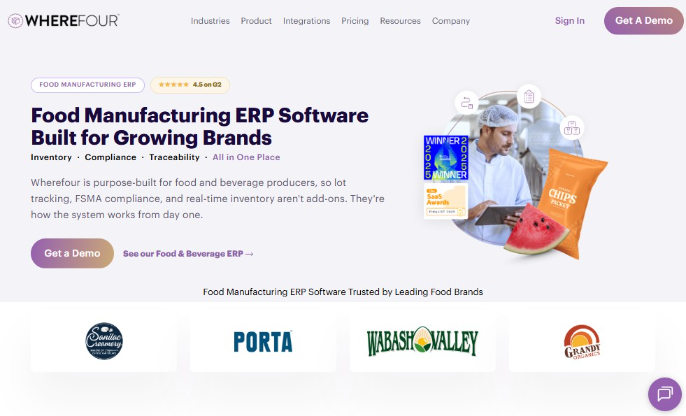
- Food manufacturing focus: Batch production, recipe scaling, lot traceability, shelf-life/expiration control, allergens, catch weight, recalls, and FSMA 204 compliance.
- Best use case: Growing food and beverage manufacturers that need strong traceability and compliance without a heavyweight enterprise ERP.
Wherefour is purpose-built for food manufacturing, with traceability embedded across receiving, production, inventory, and shipping. It supports FIFO/FEFO inventory, automatic expiration alerts, allergen tracking, customizable lot codes, and forward/backward recalls, making it particularly useful for short-shelf-life or highly regulated products.
Wherefour says its system can generate a full recall report in under two minutes. GIANTS Snacks also used the platform as it moved away from manual pen-and-paper inventory tracking and expanded into a facility with more than twice its previous footprint. The company said reliable inventory data helped support that expansion.
2. IFS Cloud
- Food manufacturing focus: Recipe and formula management, batch production, lot genealogy, shelf-life and expiration dates, yields, by-products, quality, planning, and traceability.
- Best use case: Larger food and beverage manufacturers that need process manufacturing plus broader ERP, asset management, and supply-chain capabilities.
IFS Cloud stands out for the breadth of operations it can manage within one platform. It suits manufacturers running complex plants, multiple facilities, or wider supply chains that need production connected with finance, maintenance, planning, procurement, and distribution.
At dairy manufacturer Rodda’s, IFS Cloud supports 8,000+ monthly orders and production of 163,000 liters of milk every 24 hours. Live production data gives planning and logistics teams clearer visibility into shop orders and dispatch while maintaining full product traceability.
3. inecta Food ERP
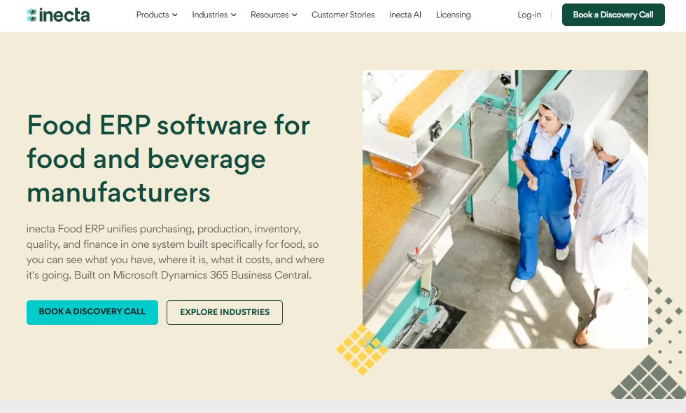
- Food manufacturing focus: Batch production, recipes/BOMs, lot traceability, FEFO, shelf-life, allergens, quality control, recalls, and FSMA 204.
- Best use case: Food processors that want Microsoft Dynamics 365 Business Central with food-specific traceability and compliance built in.
inecta combines Microsoft Dynamics 365 Business Central with functionality developed specifically for food manufacturers. This gives teams access to the wider Microsoft ecosystem while keeping production, inventory, quality, finance, and food specific workflows within the same system.
inecta reports 25+ years of food and beverage ERP experience and 99% customer retention. Its published customers include Riverence, Amir Quality Meats, Catsmo, Crosby Hops, and Sugar Mountain Livestock, with use cases spanning perishable inventory, catch-weight processing, batch management, and end-to-end lot traceability.
4. Plex Smart Manufacturing Platform
- Food manufacturing focus: Batch execution, lot traceability, recipes, yield management, allergen controls, HACCP, quality, recalls, production planning, and plant-floor MES.
- Best use case: Food and beverage manufacturers that want ERP and MES tightly connected for real-time traceability from raw ingredients through production and finished goods.
Plex’s differentiator is its plant-floor depth. Its ERP and batch-oriented MES capture ingredient consumption, production, quality checks, waste, and lot genealogy as work happens. It also supports forward and backward lot tracing, supplier quality, allergen tracking, HACCP checks, and rapid mock recalls.
Downeast Cider implemented Plex in six months without shutting down production. After go-live, it reduced inventory carrying costs by 10% and cost of goods sold by 17% while gaining lot-level traceability across its production process.
5. JustFood ERP
- Food manufacturing focus: Batch production, recipe management, bi-directional lot traceability, FEFO, shelf-life controls, allergens, quality, recalls, and catch-weight inventory.
- Best use case: Food manufacturers that want a Microsoft-based ERP built specifically around food safety, traceability, and production rather than a general-purpose manufacturing system.
JustFood combines Microsoft Dynamics with hundreds of capabilities developed for food manufacturers and distributors. Its main advantage is that these industry requirements come prebuilt into the ERP, reducing the amount of customization needed to adapt a general manufacturing system to food operations.
Creative Food Ingredients provides a useful example of that capability in practice. The company reduced a basic traceability exercise from up to four hours to about 30 minutes, while the information required for the report can be pulled from the system within seconds. The company can trace finished lots back to their source or follow raw materials forward through production. Another customer, Almondina, completed mock-recall requirements in 30 minutes instead of days.
6. 1Ci
- Food manufacturing focus: Batch traceability, expiration dates, recipe and ingredient management, production planning, quality control, inventory, and cost accounting.
- Best use case: Food and beverage manufacturers that need a highly configurable ERP for production, distribution, and perishable inventory.
1Ci’s advantage is flexibility around food-production workflows. Its 1C:Drive and 1C:ERP platforms support batch tracking, FEFO inventory, expiration dates, recipes, raw materials, packaging, and real-time production control, which makes them particularly relevant for manufacturers dealing with perishable products and variable production processes.
At MCS Coca-Cola Mongolia, 1C:ERP was implemented in 6 months and helped reduce losses from expired or defective products by 15% by tracking production dates, serial numbers, and expiry periods. The same implementation covered 102 users and a beverage operation producing about 140 products across 9 brands.
7. QAD Adaptive ERP
- Food Manufacturing Focus: Batch and lot traceability, shelf-life control, quality management, serialization, production planning, supply chain, and shop-floor execution.
- Best Use Case: Larger food manufacturers with complex supply chains, short shelf lives, and multi-site operations that need ERP, quality, planning, and production systems closely connected.
QAD is particularly strong when traceability and supply-chain planning need to work together. Its food platform supports serialization, track-and-trace, shelf-life management, quality controls, and production scheduling across fresh, frozen, shelf-stable, confectionery, and beverage operations.
At fresh-food manufacturer Sodebo, QAD Demand Planning helped improve forecast reliability by 6 points over six years while product breakage declined. The same operation produces 96,000 tons of food annually and performs 1,000 quality analyses each day.
8. SYSPRO
- Food manufacturing focus: Recipe management, lot and batch traceability, FEFO, shelf-life and expiry control, recalls, quality, production planning, and shop-floor integration.
- Best use case: Mid-sized food and beverage manufacturers that need strong traceability and shelf-life controls alongside broader manufacturing ERP.
SYSPRO brings food production into a wider manufacturing and distribution system. It can connect plant operations with inventory, warehousing, procurement, finance, and production planning, which makes it relevant for manufacturers that need tighter coordination across the business.
At fruit processor Langeberg Foods, SYSPRO delivered a 6-month implementation and cut a warehouse receiving and transfer cycle from up to 2 days to under 3 hours. The same deployment introduced full electronic batch traceability from the production line to the warehouse.
9. ERPNext
- Food manufacturing focus: Batch inventory, manufacturing/expiry dates, BOMs, quality inspections, production planning, inventory, and shop-floor management.
- Best use case: Food manufacturers that want a highly customizable, open-source ERP without being locked into a proprietary platform.
ERPNext’s biggest differentiator is its 100% open-source model. Food manufacturers can customize workflows and data structures while still getting native batch tracking, manufacturing and expiration dates, BOM-based production, and configurable quality inspections. The system can also block receipt or delivery until required quality checks are completed.
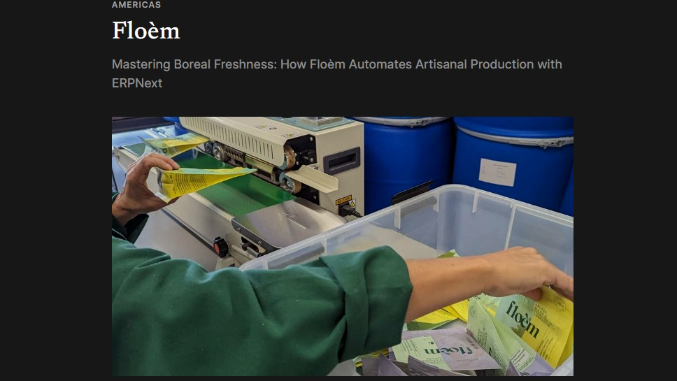
At food and beverage producer Floèm, ERPNext’s batch and recipe controls helped increase inventory accuracy to 99% while reducing administrative management and data-entry time by 40%. Another food customer, Teabox, configured a quality-inspection template with 50+ weighted checks to manage complex tea production and differing ingredient shelf lives.
10. VAI S2K Food ERP via SMC Data Systems
- Food Manufacturing Focus: Lot genealogy, recipe/formula management, expiration dates, FEFO/FIFO, allergen tracking, catch weight, quality, recalls, and production planning.
- Best Use Case: Mid-market food manufacturers that want food-specific manufacturing and warehouse functionality on a single ERP database.
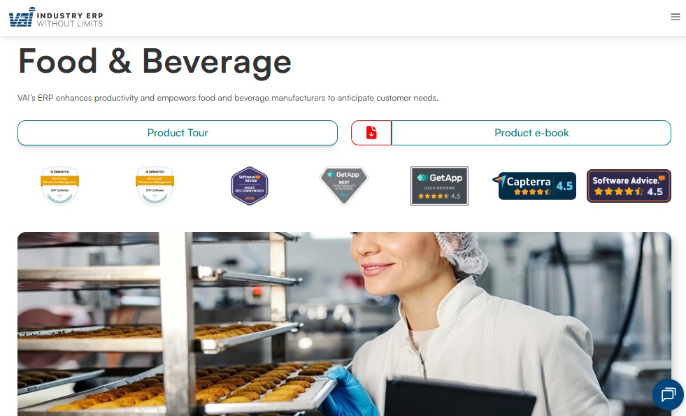
VAI S2K Enterprise for Food is developed by VAI, while SMC Data Systems is a certified implementation partner that has worked with S2K since 1999. The platform is designed for food businesses that need production connected closely with warehouse and distribution operations.
SMC reports that food manufacturers implementing S2K can improve production efficiency by 15 to 25%, while automated batch records can reduce administrative time by 50 to 70%. These are vendor-reported implementation benchmarks rather than results from a named customer case study.
What Challenges Does ERP Software for Food Manufacturing Solve?
Food manufacturers deal with operational requirements that standard ERP systems may not cover in enough depth. Raw materials move through batches, products carry different expiration dates, quality status can change during production, and affected lots may need to be identified quickly.
The need for accurate traceability becomes clear during a recall. A 2026 GS1 US survey found that 94% of U.S. adults are concerned about the frequency of food recall. This puts greater pressure on manufacturers to maintain accurate records and respond quickly when affected products need to be traced.
1. Lot Genealogy Makes Recalls More Precise
A strong ERP for food manufacturing should connect supplier lots, production batches, finished goods, and shipments in one traceable chain. Teams can work backward from a finished product to its source or follow an ingredient forward through every affected batch and shipment.
This goes beyond the plant floor focus of manufacturing execution systems. ERP software connects production records with inventory, quality, purchasing, warehousing, and distribution.
2. Shelf Life Controls Protect Margin
FEFO rules, expiration dates, and quality status help food manufacturers prioritize stock before usable shelf life runs out. They can also prevent expired or held inventory from moving into production or customer orders.
These controls connect with broader supply chain ERP requirements, including ingredient sourcing, cold storage, warehouse allocation, and distribution planning.
3. Traceability Helps Protect Customer Trust
Recall performance can influence purchasing behavior long after the initial incident. In the same 2026 GS1 US survey we shared above, 66% of U.S. adults said they were hesitant to purchase the same product or brand again after a recall, up from 59% in 2025.
Accurate traceability records help manufacturers identify the affected lot, determine where it was used or shipped, and isolate the relevant inventory. A targeted response can give customers, retailers, and distributors clearer information about which products are affected.
As Frank Yiannas, former FDA Deputy Commissioner for Food Policy and Response, says:
“Better food traceability can't wait. Our ability to provide safe, affordable, and sustainable food for this generation and the next depends on it.”
How to Test Traceability Before Choosing Food Manufacturing ERP Software
Most food manufacturing ERP platforms claim to support lot tracking. The more useful question is whether the system can produce a complete trace back when a quality or safety issue occurs.
FDA's 2026 Traceability Readiness Tabletop Exercises showed why that distinction matters. Only 40% of participants' records captured the properly assigned Traceability Lot Code across every Critical Tracking Event they performed, while just 27% captured the complete TLC source across every event. FDA noted that missing or inconsistent data made products harder to trace back through the supply chain.
The exercises also found that technology alone did not determine success. Stronger results came when supply chain partners agreed on what information to collect, maintain, and share. ERP selection therefore needs to account for both system capability and the way data moves between suppliers, production, warehousing, and customers.
During a customized demo, ask the vendor to trace one lot from receipt through production and shipment. Your team should be able to answer three questions:
- Which supplier lot caused the issue?
- Which finished batches used that lot?
- Which customers received those batches?
Ask the vendor to show the process inside the system rather than relying on a feature checklist. Check how much manual reconciliation is required, where traceability data originates, and whether the required records can be exported quickly.
For manufacturers moving away from older systems or disconnected processes, implementation matters as much as software selection. Our guide to the top ERP implementation challenges explains where ERP projects can lose data consistency, process alignment, and user adoption.
Build the Right Food Manufacturing ERP Roadmap With Alpha Apex Group
Choosing the software is only one part of an ERP project. Food manufacturers also need to define requirements, evaluate vendors, prepare existing data and processes, and plan how the new system will connect production, inventory, quality, and distribution.
Alpha Apex Group provides vendor-neutral ERP strategy and implementation consulting to help companies move from software evaluation to a practical implementation roadmap. The process can include requirements planning, vendor assessment, system integration, customization, and implementation support.
If your current ERP cannot give you reliable visibility into batches, inventory, shelf life, or production data, contact Alpha Apex Group to discuss the next steps.
FAQs
What’s the difference between basic lot tracking and full batch-to-finished-goods traceability?
Basic lot tracking records where a lot exists. Full traceability connects supplier lots, production batches, finished goods, inventory moves, and customer shipments so teams can trace an issue in both directions.
Can ERP software integrate with HACCP, SQF, or BRC quality systems?
Yes. A strong ERP for food manufacturing should connect quality checks, holds, corrective actions, batch records, and traceability data without forcing teams to re-enter the same information across systems.
How does shelf-life tracking actually reduce food waste?
The ERP can use expiration dates, FEFO rules, quality status, and remaining shelf life to prioritize what gets consumed or shipped first. That helps prevent saleable inventory from aging into a write-off.
Can Alpha Apex Group help compare food manufacturing ERP vendors before implementation?
Yes. We can help define your requirements, compare vendors against real production and traceability needs, review integration risks, and build an implementation roadmap before you commit to a platform.
Can Alpha Apex Group help replace a general-purpose ERP that lacks food-specific controls?
Yes. We help food and beverage manufacturers identify gaps in lot genealogy, bills of materials, master batch records, electronic batch records, allergen controls, shelf-life tracking, and supply chain visibility, then evaluate better-fit systems.
.jpg)

.jpg)