Top 10 ERP for Government Contractors: DCAA and CMMC-Ready Setups
When you choose an ERP for government contractors, your system needs to support DCAA audit requirements, protect controlled data, and handle the contract structures federal work depends on.
In FY2025, the Defense Contract Audit Agency examined more than $788 billion in contract costs and completed 9,527 engagements, which shows how much scrutiny federal work faces.
This guide will help you compare 10 ERP options for government contractors, understand why DCAA and CMMC requirements matter, and know what to look for when choosing the right setup.
And if you need help selecting, integrating, or customizing an ERP around your existing systems, Alpha Apex Group can support you with ERP implementation, system integration, custom module development, and ongoing optimization.
ERP for Government Contractors: A Quick Comparison Table
10 Leading ERP Software for DCAA and CMMC-Focused Government Contractors
The right ERP depends on your contract mix, accounting requirements, company size, security obligations, and the complexity of your federal work.
Below, we take a closer look at 10 ERP systems for government contractors, including their compliance strengths, ideal contractor profile, and key capabilities.
1. xpdOffice
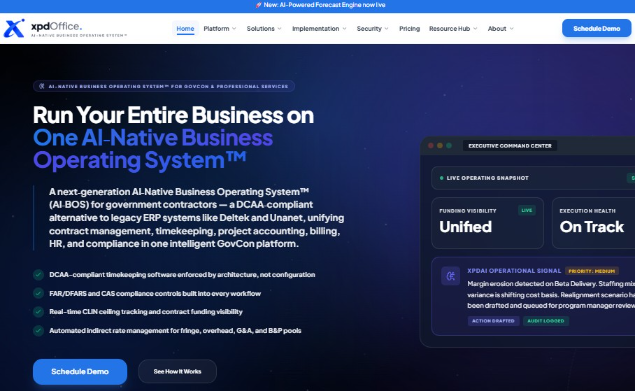
- Compliance strengths: DCAA-compliant timekeeping, SF 1408 audit readiness, FAR/DFARS controls, indirect rates, CLIN tracking, incurred-cost exports, and CMMC 2.0 alignment.
- Contractor profile: Small and mid-sized government contractors, particularly services firms that want an alternative to larger GovCon ERP platforms.
xpdOffice’s main differentiator is that the platform was originally built inside federal contractor SSSi rather than adapted from a commercial ERP. DCAA controls are embedded into daily timekeeping, cost allocation, indirect-rate management, contract billing, and audit trails. The platform also says its security controls align with NIST SP 800-171 and CMMC Level 2 practices.
The platform is specifically positioned for contractors with fewer than 200 employees and says deployments can occur within the same week. xpdOffice also reports 25 years of GovCon operating history and 500+ government contractor and professional-services customers. It does not currently publish named GovCon case studies with independently attributable DCAA or CMMC outcomes.
2. Infor CloudSuite Aerospace & Defense
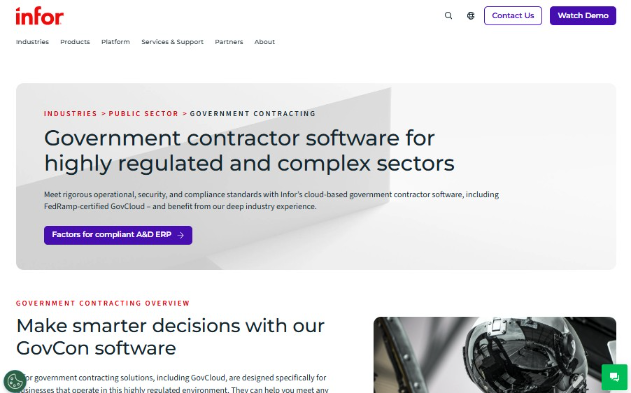
- Compliance strengths: DCAA/DCMA audit reporting, FAR, CAS, DFARS, ITAR, compliant timekeeping, indirect-rate visibility, and CMMC support through a FedRAMP Moderate-authorized GovCloud deployment.
- Contractor profile: Aerospace and defense manufacturers, engineering firms, electronics contractors, and larger GovCon organizations with complex project and manufacturing requirements.
Infor brings project accounting, total-time accounting, multi-site costing, and government contract reporting into the same system as its manufacturing capabilities. This makes it relevant for contractors managing complex production environments alongside federal project and cost-accounting requirements.
A useful example is Flyer Defense, which completed the first two phases of its Infor ERP implementation in two months. The company has fielded, tested, and certified more than 1,000 vehicles for customers including the U.S. Army and allied defense organizations.
3. Adeaca PlanAutomate
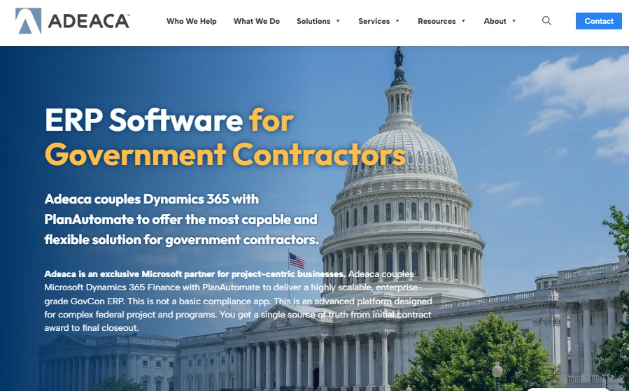
- Compliance strengths: DCAA-compliant time and expense, Cost-Plus/T&M/FFP billing, EVM, indirect cost control, audit trails, and integrated WBS/CBS financial tracking.
- Contractor profile: Mid-to-large government contractors in defense, military aircraft, shipbuilding, space, federal engineering, and other complex project-based environments.
Adeaca’s PlanAutomate product extends Microsoft Dynamics 365 Finance into a project-centric ERP. It connects schedules, EVM, contract billing, funding controls, procurement, production, and financial reporting through the same project structure, which gives contractors a direct link between project execution and financial performance.
Adeaca publicly supports DCAA requirements and complex federal billing models, but its current GovCon pages do not specify CMMC, NIST SP 800-171, or FedRAMP support. Contractors handling CUI should therefore confirm how their Dynamics 365 deployment, hosting environment, and surrounding security controls fit their CMMC requirements before implementation.
4. PROCAS
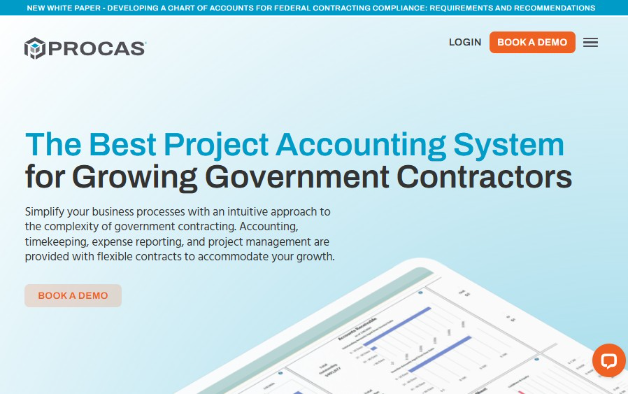
- Compliance strengths: SF 1408/DCAA accounting, indirect rates and cost pools, compliant timekeeping, incurred-cost reporting, FAR-aligned cost segregation, SOC 2, and CMMC Level 2.
- Contractor profile: Small and growing service-based government contractors that want simpler GovCon accounting than a large enterprise ERP.
PROCAS is built around government contract accounting, with tools for project costing, labor distribution, expense reporting, indirect-rate allocation, government invoicing, and incurred-cost submissions. Its accounting system is designed around SF 1408 and FAR requirements, and PROCAS has worked exclusively with government contractors since 1997.
Cybersecurity gives PROCAS another point of distinction. The company says it achieved CMMC Level 2 certification in 2025 following an assessment by an authorized C3PAO, and it also undergoes independent SOC 2 audits. This provides a more concrete security credential than vendors that only describe their environment as CMMC-ready.
5. ProShop ERP

- Compliance strengths: CMMC 2.0, NIST 800-171, DFARS 7012, ITAR, audit trails, role-based access, CUI file management, and AWS GovCloud hosting.
- Contractor profile: Small and mid-sized aerospace, defense, space, and precision machine shops handling CUI and supplying defense primes.
ProShop’s differentiator is that ERP, MES, QMS, and cybersecurity controls live in the same manufacturing platform. Its CMMC-focused environment has been independently assessed for FedRAMP Moderate equivalency, and ProShop says customers can inherit roughly 41 of the 110 NIST 800-171 controls through its infrastructure and application setup. It is much more manufacturing- and CMMC-focused than accounting-led GovCon ERPs.
One customer example comes from Rennscot MFG, a space and defense manufacturer that achieved a 110/110 self-attested CMMC score while using ProShop to centralize sensitive data, quality records, and manufacturing traceability. ProShop does not appear to publish native DCAA-compliant accounting functionality, but it earns a place here because its CMMC, CUI, and defense-manufacturing capabilities are substantially deeper than most general ERPs.
6. ECI Software Solutions/JobBOSS²
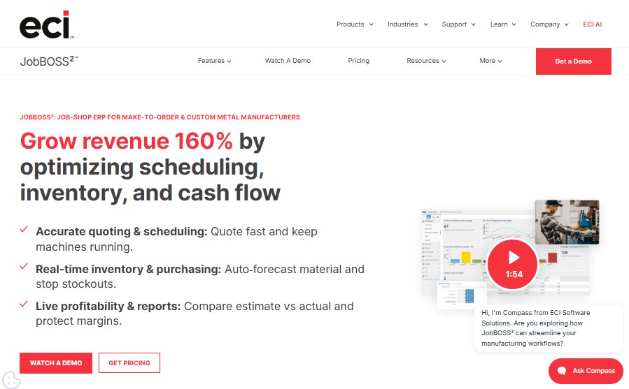
- Compliance strengths: ITAR and CMMC-focused Government Compliance Cloud, secure CUI handling, audit trails, MFA, and aerospace/defense manufacturing controls.
- Contractor profile: Small and mid-sized defense machine shops, job shops, and discrete manufacturers supplying aerospace and DoD customers.
JobBOSS² combines job shop ERP with ECI’s Government Compliance Cloud for manufacturers working with government and defense customers. Alongside its security and compliance capabilities, the platform covers quoting, scheduling, job costing, inventory, accounting, production tracking, and quality management. Its focus is firmly on manufacturing operations rather than the detailed contract accounting found in GovCon-specific financial platforms.
A useful example is Midway Swiss Turn, which moved to ECI’s Government Compliance Cloud after aerospace and defense customers required ITAR compliance. ECI reports that the manufacturer achieved 160% revenue growth and a 31% win rate on new parts and jobs while growing from five to 11 employees.
7. SYMPAQ
- Compliance strengths: SF 1408 support, DCAA-focused cost accounting, indirect-rate calculations, incurred-cost reporting, unallowable-cost segregation, compliant timekeeping, and detailed audit trails.
- Contractor profile: Small and mid-sized labor-intensive federal contractors that need GovCon accounting and timekeeping without a manufacturing-heavy ERP.
SYMPAQ is more narrowly focused on government contract cost accounting than other platforms. SYMPAQ SQL was designed specifically around DCAA requirements, while its eTX system enforces DCAA timekeeping rules. The software covers indirect rates, labor distribution, unallowable costs, project/task costing, and standard ICE schedules; SYMPAQ says DCAA has raised no significant audit issues where its system was properly implemented.
SYMPAQ has served government contractors since 1991 and is geared toward labor-intensive organizations working under cost-reimbursable, cost-plus, and time-and-materials contracts. Its focused approach makes it relevant for contractors that need detailed GovCon accounting and audit trails without the manufacturing functionality found in broader ERP platforms.
8. JAMIS Prime ERP
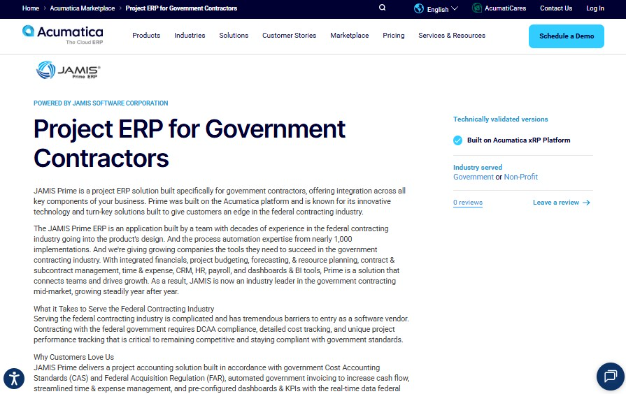
- Compliance strengths: DCAA, FAR, CAS, indirect-rate management, compliant timekeeping, contract/subcontract administration, NIST 800-171, CMMC support, and FedRAMP Moderate cloud security.
- Contractor profile: Growing mid-market and enterprise federal contractors that want GovCon accounting, project management, HR/payroll, and contract administration in one cloud ERP.
JAMIS Prime is built on the Acumatica xRP platform but adds functionality developed specifically for government contracting. Its capabilities cover project accounting, government invoicing, indirect-rate management, contract and subcontract administration, time and expense, budgeting, forecasting, HR, and payroll, with accounting processes designed around DCAA, FAR, and CAS requirements.
The Acumatica Marketplace says JAMIS brings process-automation experience from nearly 1,000 implementations. JAMIS also describes itself as the only privately held ERP vendor focused exclusively on the federal sector, so it’s a particularly direct alternative to adapting a broader commercial ERP for GovCon requirements.
9. Unanet ERP GovCon

- Compliance strengths: DCAA accounting, compliant timekeeping, incurred-cost reporting, indirect rates, audit trails, CUI protection, and FedRAMP Moderate-equivalent cloud infrastructure for CMMC readiness.
- Contractor profile: Government contractors of all sizes, particularly project-driven services, engineering, aerospace, defense, and technology firms.
Unanet’s advantage is its combination of purpose-built GovCon financials with a secure cloud environment for CUI. DCAA compliance spans timekeeping through incurred-cost reporting, while its FedRAMP Moderate-equivalent cloud supports CMMC readiness. Unlike manufacturing-heavy defense ERPs, Unanet offers deep project accounting, resource planning, contract management, subcontractor management, and automated billing.
Unanet says more than 2,000 government contractors use the system, backed by over 30 years of GovCon-focused experience. A useful example is CFD Research, which uses Unanet across nearly 375 users and credits the platform with helping leadership make faster, more confident financial decisions as the company scales.
10. Deltek Costpoint
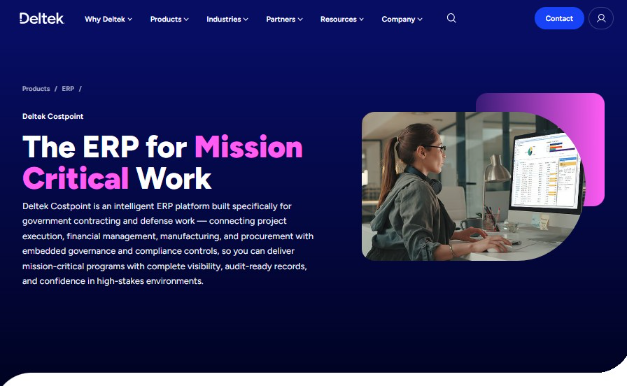
- Compliance strengths: DCAA audit support, FAR-aligned controls, indirect-rate management, contract billing, compliant timekeeping, DFARS 7012, and CMMC support through its FedRAMP Moderate Equivalent GCCM environment.
- Contractor profile: Mid-market and enterprise government contractors managing complex cost-plus, fixed-price, and multi-entity federal programs.
Deltek Costpoint is purpose-built for government contracting, with project accounting, indirect-rate management, contract billing, revenue recognition, manufacturing, procurement, and audit-ready reporting in one platform. Deltek says 84% of the top 25 government contractors use Costpoint to manage complex contracts.
A useful example is UIC Government Services, which uses Costpoint to manage more than 300 contracts, 165 subcontracts, and payroll for over 2,815 employees. UICGS also reports that its ERP support costs and staffing are about 40% lower than they were 10 years earlier.
Why Does DCAA and CMMC Expertise Matter for ERP for Government Contractors?
DCAA and CMMC address different compliance requirements, and your ERP setup may need to support both.
The Defense Contract Audit Agency (DCAA) focuses on whether your accounting system can accurately track, allocate, and document contract costs.
In FY2025, according to the source we looked at earlier, DCAA reported $5.3 billion in savings, while contractors voluntarily removed more than $3.8 billion in unallowable costs before audits began. Your ERP therefore needs reliable cost accounting, timekeeping, indirect-rate management, and audit trails when those requirements apply.
CMMC, meanwhile, focuses on protecting Federal Contract Information (FCI) and Controlled Unclassified Information (CUI). DoD suspended the planned CMMC Phase II rollout in July 2026, but Phase I requirements remain in place, along with applicable NIST SP 800-171 and DFARS cybersecurity obligations.
When evaluating an ERP, look for support for:
- DCAA-ready contract accounting, cost tracking, indirect rates, audit trails, compliant timekeeping, and Cost Accounting Standards where applicable.
- CMMC-ready security controls like role-based access, controlled data flows, system logging, and secure cloud environments such as FedRAMP Moderate or GovCloud when required.
- Contract structures including work breakdown structures, contract line-item numbers, project-based accounting, Progress Billings, and Estimate to Complete (ETC) reporting.
- Clear connections between the general ledger, contract management, supply chain, and financial management so teams can maintain consistent records across the business.
Weak accounting controls can create questioned costs, payment delays, or business-system findings, while inaccurate cybersecurity attestations can create False Claims Act exposure. That is why compliance should be designed into the ERP implementation rather than added after go-live.
Many costly ERP implementation challenges begin when compliance requirements are identified too late. If you are planning a larger transformation, map these controls across the full Enterprise Resource Planning implementation process, from requirements and software selection through migration, testing, and deployment.
For government contractors, your ERP should make it easier to produce the financial records, security controls, and audit evidence required under your contracts.
Read Next: The Ultimate Guide to Enterprise Resource Planning Implementation: 7 Key Phases
How to Evaluate ERP Partners for DCAA and CMMC Requirements
Government contracting adds accounting, cybersecurity, reporting, and contract-management requirements that can expose weaknesses in a generic implementation quickly.
We suggest starting with these four criteria:
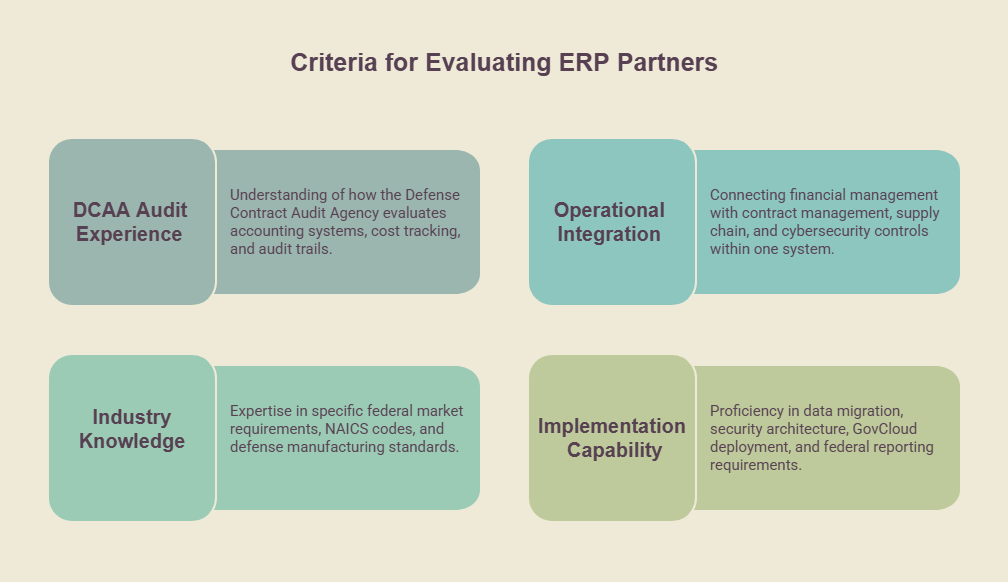
1. Proven DCAA Audit Experience
Look for a partner that understands how the Defense Contract Audit Agency evaluates an accounting system, including cost tracking, indirect rates, timekeeping, revenue recognition methods, audit trails, and the general ledger.
This experience matters when configuring project-based accounting, Cost Accounting Standards, progress billings, contract line-item numbers, and WBS (work breakdown structures).
2. Compliance and Operational Integration
A strong ERP for government contractors should connect financial management with contract management, supply chain, material handling, and manufacturing capabilities where needed.
Avoid setups where DCAA requirements, Cybersecurity Maturity Model Certification controls, and core business processes live in separate systems with manual handoffs. That creates more compliance issues, more reconciliation work, and more points of failure.
3. Federal Market and Industry Knowledge
A contractor working under NAICS 541330 may have very different requirements from a defense manufacturer managing contract inventory, quality management systems, DFARS clauses, or Department of Energy programs.
You should evaluate those industry-specific requirements before selecting software. Our guide to ERP selection criteria offers a broader framework for comparing functionality, implementation risk, scalability, and long-term fit.
4. End-to-End Implementation Capability
Data migration, integrations, security architecture, GovCloud deployment, role-based access, testing, and user adoption all matter after the software decision is made.
A capable implementation partner should also understand reporting requirements such as Estimate to Complete (ETC), government contracting KPIs, contract accounting, and the documentation needed to support federal regulations.
The best ERP government contractors software setup is the one configured around the contracts, compliance requirements, and business processes your team uses.
Choose the Right GovCon ERP with Alpha Apex Group
The right ERP for government contractors should fit your accounting requirements, security obligations, contract structures, and day-to-day operations.
Alpha Apex Group can help you evaluate ERP options, map business and compliance requirements, plan implementation, integrate systems, and configure an ERP around the way your organization works.
If you need support selecting or implementing the right GovCon ERP, get in touch with Alpha Apex Group.
FAQs
What’s the difference between a DCAA-compliant accounting system and a CMMC-ready IT environment?
DCAA focuses on contract accounting, cost tracking, timekeeping, indirect rates, and audit trails. CMMC, on the other hand, focuses on protecting FCI and CUI through cybersecurity controls such as access restrictions, logging, encryption, and secure system architecture. Many Department of Defense contractors need both.
Do government contractors need CMMC certification before bidding on DoD work?
It depends on the solicitation and the applicable CMMC requirement. Phase II certification requirements were suspended in July 2026, while Phase I self-assessment requirements remain in effect. Contractors may still need to meet applicable NIST SP 800-171, DFARS, and assessment requirements.
Can a commercial ERP support DCAA requirements?
Yes, if it can be configured to support compliant timekeeping, cost segregation, project accounting, indirect-rate calculations, contract billing, and complete audit trails. You should evaluate the underlying processes and system configuration rather than assume that a commercial ERP is automatically suitable for government contracting.
How can Alpha Apex Group help with GovCon ERP selection?
Alpha Apex Group takes a vendor-neutral approach to ERP selection. We can help you define business requirements, compare ERP options, assess implementation risks, plan integrations, and determine which system best fits your accounting, operational, and compliance needs.
.webp)
.jpg)
.jpg)