How to Hire a Private Equity CFO: Process, Profile, and Pay
A private equity deal can change what a company needs from its finance leader almost overnight. The sponsor expects faster closes, lender-ready reporting, reliable cash forecasting, and a CFO who can communicate the equity story through exit.
Those expectations are difficult to meet. According to Accordion’s 2025 PE Sponsor-CFO Alignment Survey, 74% of PE sponsors say their CFOs are not meeting expectations.
This makes the CFO decision one of the most important leadership calls early in the hold period. The right profile depends on the investment thesis, starting condition of the finance function, growth plan, reporting demands, and intended exit.
This guide explains when to make the hire, which CFO model fits the situation, how to match candidates to the investment thesis, the seven-step search process, the questions to ask in interviews, and 2025 compensation survey benchmarks for hiring in 2026.
Need a shortlist quickly? Our CFO executive search team can get the first candidates in front of hiring managers within 72 hours.
TL;DR
- When to hire: At close if the incumbent is a controller-level leader, when the investment thesis changes, or 12 to 24 months before a planned exit.
- Which model: Full-time for any platform with a live value creation plan and lender covenants; interim to bridge a search or stand up a carve-out; fractional for sub-scale businesses.
- Which profile: The one your investment thesis needs (buy-and-build, carve-out, turnaround, or pre-exit), weighted above title and pedigree.
- How long: Roughly 10 to 12 weeks to an accepted offer in a focused retained search (see the sample plan in Step 7), plus the candidate's notice period.
- What it costs: A US median base of $370K, a 50% target bonus, and about 1% equity, per a 2025 compensation survey of 353 senior finance leaders at PE-backed companies (Survey 1 in this guide, detailed in the pay section).
At Alpha Apex Group, we treat a private equity CFO hire as an investment decision. The investment thesis sets the brief, and a title on a résumé tells you far less than what the candidate actually owned. The scorecard gets written from the value creation plan before a single candidate is called, because a CFO who doesn't know how they'll be judged can't be hired against anything.
And an interim CFO works best as a planned bridge with a defined handoff. Treated as a stopgap, an interim can stretch a vacancy into a lost year of the hold.
What Does a Private Equity CFO Do Differently From a Corporate CFO?
A private equity CFO runs finance on a fixed hold period that ends in a sale, with EBITDA, cash, and debt capacity as the scoreboard. A corporate CFO usually optimizes for steady earnings over an open-ended horizon.
The PE version also answers to more people (the CEO, the sponsor's deal team, an operating partner, lenders, and a board) and carries a heavier load outside finance.
Scope is often a surprise for candidates moving in from corporates. A 2025 report on PE-backed CFO pay and hiring, based on a survey of CFOs at private equity portfolio companies (Survey 2 in this guide), found the CFO owns IT in 61% of PE-backed companies and Legal in 61%, with HR in the remit 40% of the time.
The capital structure also moves during the hold: EY notes that a PE CFO will most likely need to refinance the business at least once during the investment cycle. The table below shows typical tendencies, not fixed rules.
A working private equity CFO job description comes down to three lines:
- Own the cash forecast, covenant compliance, and lender relationship.
- Build the reporting, systems, and team the sponsor needs to run the value creation plan.
- Prepare the business and the numbers for a sale from the first year of the hold.
When to Replace or Upgrade the CFO After a Private Equity Deal
A PE-backed company should replace or upgrade its CFO when the finance leader can't deliver the reporting, cash discipline, or transaction work the next stage of the hold requires.
Four triggers account for most changes.
1. The Deal Closes, and the Incumbent Finance Leader Is a Controller
Founder-owned and family businesses often run with a strong controller or VP Finance who produces accurate historical numbers. A sponsor needs someone who forecasts, manages lenders, and owns the finance side of the value creation plan. This gap usually surfaces during people and HR due diligence, before the deal closes.
External hires are the norm: only 12% of CFOs in Survey 1 had joined their company in a different role and later been promoted into the CFO seat. The incumbent can still stay in a controller role, which helps continuity.
2. The Investment Thesis Changes Mid-Hold
A carve-out, divestiture, or restructuring calls for different skills from the ones the company was bought with. BDO's 2024 PE Portco CFO Outlook found 21% of CFOs expected a carve-out or divestiture and 33% a restructuring that year. Survey 1's commentary adds that sponsors are increasingly willing to change CFOs mid-hold to reset execution.
3. An Exit Is 12 to 24 Months Away
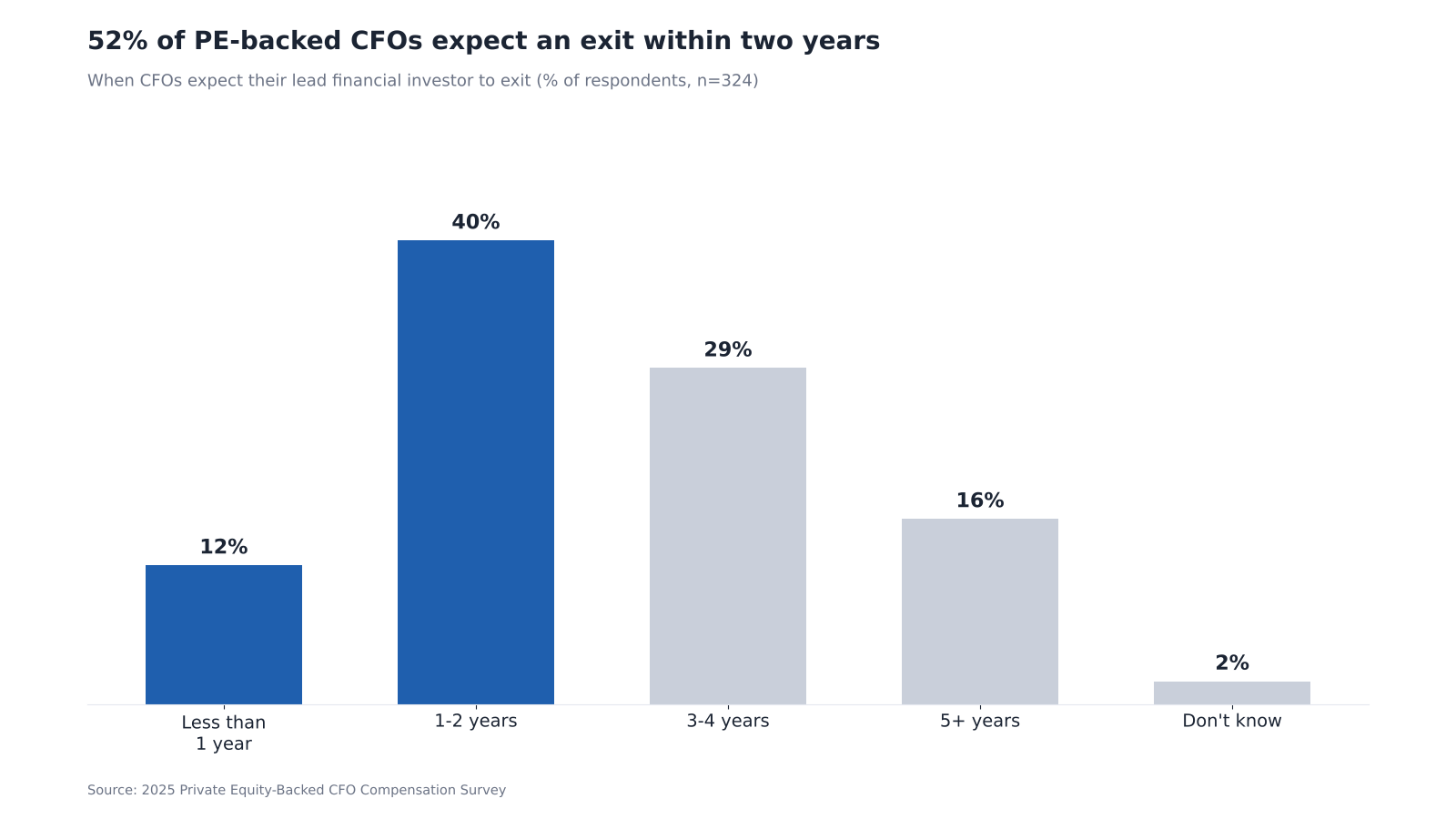
The exit strategy needs a CFO who has time to build a track record before buyers arrive. Just over half (52%) of PE-backed CFOs in Survey 1 expect their lead investor to exit within two years.
EY advises that six to nine months before a target exit, the CFO should already have a deal team mobilized with diligence-ready data.
4. The Sponsor Loses Confidence in Reporting
Late closes, missed forecasts, and weak lender packs erode sponsor trust quickly. Accordion's survey names three recurring gaps: fundamentals such as elongated close cycles, equity performance, and exit readiness. The signals and thresholds below are illustrative; investigate the cause before replacing anyone.
Interim, Fractional, or Full-Time Private Equity CFO: Which Model Fits?
A full-time CFO fits any platform company with a live value creation plan and lender covenants. An interim CFO fits a search gap, a carve-out stand-up, or a turnaround. And a fractional (or outsourced) CFO fits sub-scale add-ons and pre-platform portfolio companies that need senior judgment a few days a month.
Interim and fractional work is now common in finance, so it's worth comparing fractional and interim executive search firms before you engage one.
The Institute of Interim Management's 2026 survey of UK interim managers found the average interim assignment ran 10 months, and almost a quarter of respondents' most recent assignments were fractional.
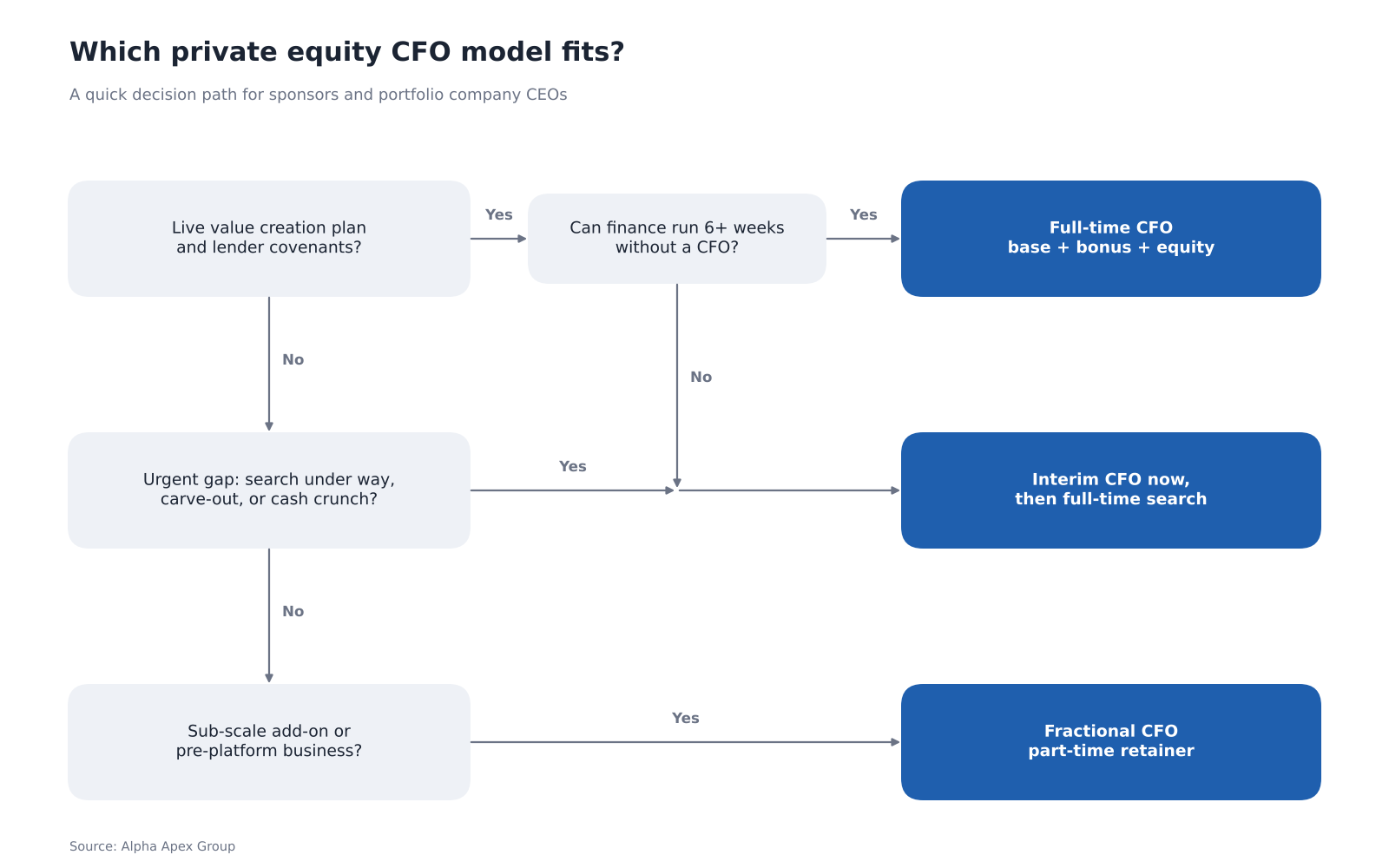
Plan the interim-to-permanent handoff before the interim starts:
- Decide upfront whether the interim is a candidate for the permanent role, and tell them.
- Run the permanent search in parallel from week one.
- Build in a two-to-four-week overlap so the 13-week cash flow, covenant calendar, and lender relationships transfer to one named owner.
- Set the interim's success measures in writing, the same way you would for a permanent hire.
If you need a bridge, our interim and fractional executive search team places CFOs who can start while you run the permanent search.
How to Match the Private Equity CFO Profile to the Investment Thesis
Match the CFO to what the investment thesis needs the finance function to do over the next three years. BDO puts it plainly: your investment thesis should dictate your choice of CFO.
Most finance leaders are strongest in one of three areas (controllership, operational finance and FP&A, or capital markets and treasury), and each thesis leans on a different one.
1. Buy-and-Build Platform CFO
A buy-and-build CFO runs bolt-on diligence, integrates acquired finance teams, and keeps consolidated reporting clean as entity count grows. The best candidates bring a repeatable integration playbook from earlier deals. Pair the hire with M&A integration support when the deal pace outruns the team.
2. Carve-Out CFO
A carve-out CFO must establish an independent finance function while managing separation from the parent company. Prior experience setting up banking, payroll, reporting systems, and transitioning away from service agreements is essential. Candidates should also understand how to deliver an ERP implementation within tight separation deadlines.
3. Turnaround CFO
A turnaround CFO must stabilize liquidity before pursuing growth. Look for experience managing 13-week cash forecasts, negotiating with lenders, reducing costs, and improving working capital. Candidates should demonstrate how they preserved cash during a previous period of financial pressure.
4. Pre-Exit CFO
A pre-exit CFO prepares the business for sale: quality of earnings work, a clean data room, and an equity story backed by numbers. Capital markets and IPO experience usually matters only if a public listing is a realistic exit route. Treat the table below as sample requirements to adapt to your company.
Prior PE experience is common among surveyed CFOs, but it isn't the only route in. Survey 2 found that 51% of PE-backed CFOs came directly from another PE-backed company, yet Survey 1 shows the market already drawing from a wider pool: one-third of respondents had more than 15 years as a CFO, while only 9% had spent that long in PE-backed companies.
A divisional CFO from a large corporate who has run a business unit's P&L, refinanced debt, and integrated acquisitions can outperform a "PE CFO" who sat in one hold with a strong sponsor doing the heavy lifting. Test the work itself, and treat the label as a starting point.
How to Hire a CFO for a PE-Backed Company in 7 Steps
To hire a CFO for a PE-backed company, follow seven steps: agree on decision rights, build a scorecard around the investment thesis, set compensation and equity, choose a search model, source qualified candidates, assess finalists through practical cases, and verify references before making an offer.
Let’s explore each step in detail below:
Step 1: Agree Who Owns the CFO Search
Agree in writing who sets the brief, who interviews, and who makes the final call before any outreach starts. The sponsor usually has strong influence over the CFO hire, while the CEO typically makes the final decision because the CFO will work for them day to day.
Unclear decision rights can cost you a strong candidate, since finalists notice when the CEO and the deal partner want different people. The example decision-rights matrix below is a starting point; agree the real split with your board and sponsor.
Step 2: Turn the Value Creation Plan Into a CFO Scorecard
Write four to six measurable outcomes the new CFO will be judged on, tied directly to the value creation plan. Good outcomes are specific: close the books in 10 business days, refinance the term loan by month 18, integrate two bolt-ons onto one ERP.
The scorecard's first column covers the first 100 days, which EY describes as the window for getting into a reliable reporting rhythm. The targets below are examples; set your own from the value creation plan.
The scorecard also becomes the onboarding plan once the hire starts. For the broader leadership brief and onboarding approach across all PE-backed executive roles, see our guide to executive search for PE-backed companies.
Step 3: Set the Compensation and Equity Range Before Outreach
Agree the base, bonus, and equity range before the first candidate call. Survey 1's authors conclude that base salary and equity upside remain the primary levers for attracting and retaining CFO talent, and a search that leaves the management incentive plan vague until the final round risks losing finalists to sponsors who led with it. The benchmarks are in the pay section below.
Step 4: Choose a Search Model and Timeline
Pick one of three models: a retained specialist search, the sponsor's own network, or an internal promotion. Retained search costs more but brings a mapped market and a structured process; sponsor networks are faster but narrower; internal promotion works when a strong VP Finance is ready and the thesis is stable.
Timelines depend on the model: a sponsor-network search can move in weeks if the right person is already known, while a mapped retained search takes longer but surfaces candidates nobody on the deal team knew about.
Add the candidate's notice period before they start. If you're comparing partners, this roundup of CFO executive search firms covers the main options.
Step 5: Build a Candidate Slate Beyond the Sponsor's Network
Build a slate of six to ten qualified candidates from at least three pools:
- Sitting CFOs at PE-backed companies of similar size and thesis
- Divisional or business-unit CFOs from large corporates with P&L and M&A exposure
- First-time CFOs who have run FP&A or controllership inside a sponsor-owned business
- Former CFOs from the sponsor's exited portfolio companies
Screen each name against the scorecard: has this person owned a cash forecast, a lender relationship, and a sale process, whatever their title was at the time?
Step 6: Test Candidates With a Live Case on Company Data
Give the two or three finalists a case built on the company's own anonymized data. A strong case has three parts:
- Build a 13-week cash flow from real receivables, payables, and payroll data.
- Walk through the credit agreement and flag the covenants most at risk under a downside scenario.
- Present a one-page board pack summarizing the quarter.
The case shows how a candidate thinks under realistic pressure, and it exposes the financial modeling mistakes that a polished interview can hide.
Step 7: Run Back-Channel References and Close the Offer
Speak to people the candidate didn't nominate: a former sponsor deal partner, a lender or banker, an auditor, and a former direct report. Ask what the candidate personally owned in any exit they mention.
Leading a sale process and participating in one are different jobs, and back-channel references are the most direct way to tell them apart. Then close quickly; strong CFO finalists usually have more than one option.
A sample plan for a focused retained search looks like this:
Private Equity CFO Interview Questions and What Strong Answers Include
The best private equity CFO interview questions ask for specific past situations with numbers attached, then probe what the candidate personally did.
Use the table below for the behavioral rounds; the live case in Step 6 covers technical skill, and the scorecard in Step 2 covers what success looks like.
How Much Does a Private Equity CFO Make?
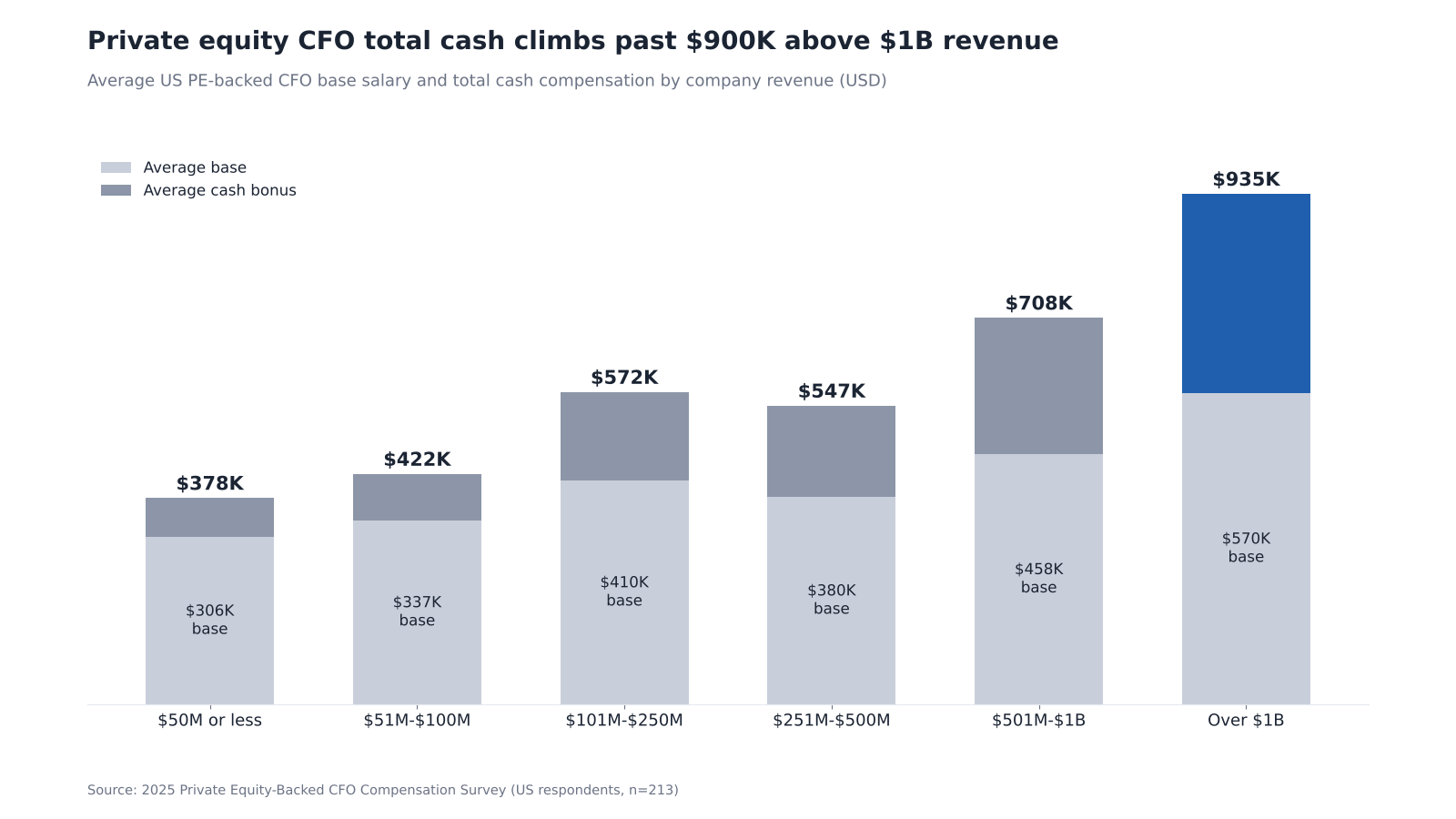
A US private equity CFO earns a median base salary of $370,000 (average $418,000), median total cash of $500,000, and a median initial equity grant of 1.0% of the company. That's according to Survey 1, a 2025 PE-backed CFO compensation survey, whose US figures come from 213 of its 353 respondents, with a median target bonus of 50% of base.
Private Equity CFO Base Salary and Bonus by Company Size
Private equity CFO salary rises with company revenue in both surveys, though Survey 1's averages run higher than Survey 2's in most bands. Note that the two use slightly different revenue bands.
Private Equity CFO Equity and Management Incentive Plans
Equity is where most of a private equity CFO's upside sits. Survey 1's median initial grant is 1.0% of the company (25th to 75th percentile: 0.5% to 1.2%), and respondents' median expected value at exit ranges from $2.0 million to $5.0 million. Survey 2 puts the typical stake at about 1.2% of fully diluted equity.
The vehicle varies by sponsor. Survey 2 found phantom equity in 31% of packages, stock options in 25%, profits interests in 25%, and sweet equity in 10%.
Leaver terms matter as much as the percentage: 58% of US CFOs in Survey 1 get no equity acceleration if they're terminated without cause. Our PE executive search guide linked in Step 2 explains how management incentive plans work across the wider leadership team.
Sign-On Bonuses and the Move Premium
Most PE-backed CFOs don't receive a sign-on bonus, according to Survey 1, so base salary and equity do the work of attracting candidates. Survey 2 found CFOs who change roles capture an average 10% increase in cash compensation (base plus target bonus). Budget for that premium when setting the range in Step 3.
Common Private Equity CFO Hiring Mistakes
The most expensive private equity CFO hiring mistakes happen around the offer: unclear reporting lines, and a plan that expects one person to cover every finance skill.
Undefined CEO and Sponsor Reporting Lines
After the hire, a private equity CFO reports to the CEO and works closely with the sponsor. When nobody defines how that works, the CFO ends up caught between two bosses with different priorities. Agree which information goes to the sponsor directly, which goes through the CEO, and how disagreements get raised.
One CFO Expected to Cover Every Finance Skill
No CFO is equally strong in controllership, FP&A, treasury, tax, and systems. Hire the CFO for the skills the thesis needs most, then hire the controller and FP&A leaders who cover their gaps.
Getting any of these wrong is costly. A failed hire may bring additional search fees and severance costs, depending on the search firm's replacement guarantee and the employment agreement; Survey 1 found more than 80% of PE-backed CFOs are covered by a severance policy. It also costs months of a weaker finance function in a hold that has no time to spare.
Hire Your Next Private Equity CFO With Alpha Apex Group
The right private equity CFO brings the financial leadership needed to execute the investment thesis, meet sponsor expectations, and prepare the business for its next stage.
Alpha Apex Group helps PE sponsors find CFOs whose experience matches their portfolio companies' needs. With more than 2,000 placements completed and an average time-to-fill of 43 days across all full-time roles, our team brings an established search process to critical finance leadership hires.
Ready to find your next CFO? Talk to our team about your investment thesis, hiring timeline, and the experience your next finance leader needs.
FAQs
How Long Does It Take to Hire a Private Equity CFO?
A retained search for a private equity CFO may take 10–12 weeks from defining the role to accepting an offer, depending on candidate availability and assessment requirements. The process includes sourcing, interviews, financial case assessments, and reference checks. The candidate's notice period may extend the actual start date.
Is a CFO Higher Than a VP of Finance?
Yes. A CFO typically leads the entire finance function, reports to the CEO, and oversees financial strategy, capital allocation, and lender relationships. A VP of Finance usually manages financial planning, reporting, or operations. In PE-backed companies, the CFO also plays a central role in executing the investment thesis and preparing for exit.
What Does a Retained CFO Executive Search Cost?
A retained CFO executive search typically costs 30–35% of the hired executive's first-year compensation, depending on the firm's pricing structure. For example, a $500,000 cash compensation package at a one-third fee would cost approximately $167,000. Confirm whether bonuses, signing payments, and other compensation are included in the calculation.
Can a First-Time CFO Succeed in a PE-Backed Company?
Yes. First-time CFOs can succeed when they have relevant finance leadership experience and adequate support. Vardis' 2025 Private Equity CFO Report found that first-time CFOs accounted for 24% of appointments, up from 15% in 2024. Strong controllership support and access to experienced operating partners can help them manage sponsor expectations.
Should a PE Firm Keep the Existing CFO After an Acquisition?
A PE firm should retain the existing CFO if their capabilities match the investment thesis and they can manage cash forecasting, lender reporting, and value creation priorities. Assess performance against measurable objectives during the first 100 days. If significant gaps remain, consider external candidates through a private equity executive search